



Table of Contents
TL;DR
The global swimwear market is on track to reach USD 34.12 billion by 2034 at 5.08% CAGR; period panties are growing at 20.5% CAGR — a period swimwear OEM extension lets your brand capture both curves at once.
Modibodi, Knix, Thinx, Proof, and Ruby Love all began with period underwear and extended into swimwear — using overlapping manufacturing infrastructure rather than rebuilding from scratch.
The core 4-layer absorbent architecture, TPU thermal bonding, selective absorption, and compliance certifications are transferable from underwear to swimwear; only the outer fabric chemistry, fit engineering, and UV/chlorine test suite are genuinely new.
A 5-step extension roadmap — brand asset reuse, dual-category OEM selection, swim-specific sampling, add-on certification, and timeline alignment — typically takes 14–20 weeks from brief to first bulk shipment.
The same modular absorbent system described in Absorbent System Across Activewear migrates cleanly into swimwear, compressing R&D and tooling costs compared to building a swim-specific system from zero.
The three most common pitfalls — applying underwear fabric to chlorine environments, skipping fit redesign, and carrying over an incompatible size system — are avoidable with the right OEM partner.
At 200 MOQ, a mid-tier period swimwear extension is typically break-even within the first summer season at a modest wholesale price point, with full ROI achievable in season two.
Part 1: Why 2026 Is the Optimal Window for a Period Swimwear OEM Extension
If you already sell period underwear, you have already done the hardest work: you educated your customers on reusable absorbent technology, you built a supply chain for multi-layer crotch panel construction, and you established a brand identity in period care. The question is not whether to extend into swimwear. The question is whether to do it now — while the market gap is still open — or later, when the category has consolidated around a smaller number of early movers.
The market data makes a compelling case for 2026. The global swimwear market stood at USD 22.95 billion in 2025 and is projected to reach USD 34.12 billion by 2034 at a 5.08% CAGR. An alternative projection from Grand View Research puts the 2030 value at USD 36.15 billion at 6.8% CAGR — more aggressive, but directionally consistent. Either way, the base market is large and compounding. Women represent 63.56% of global swimwear demand in 2026, making period swimwear a category with direct access to the dominant buyer segment.
Within that base, the period care sub-segment is growing substantially faster. Period panties are tracking a 20.5% CAGR according to Market.us, and the broader period products category is expanding at approximately 8.8% annually. A period swimwear OEM extension positions your brand at the intersection of both growth curves — swimwear market expansion and period care adoption — which is a rarer combination than it appears.
The summer seasonality factor sharpens the argument further. Period swimwear search volume and purchase intent peak sharply between May and August in the Northern Hemisphere. Brands that are in-market with a swimwear SKU before that window open capture the loyalty that converts into year-round period underwear repurchase. Brands that miss the window lose that acquisition opportunity to competitors.
Three structural conditions align in 2026 that did not exist simultaneously before. Consumer awareness is high: following Modibodi's 2022 collaboration with Puma — the first mainstream period activewear launch to include swim and biker-short formats — and sustained editorial coverage in outlets such as Good Housekeeping and NYT Wirecutter, consumers in the US, UK, and Australia now understand the category exists. Retail infrastructure is ready: sporting goods chains, pharmacies, and specialty DTC swimwear retailers have buyer teams actively seeking period swimwear product to fill a thin assortment. And manufacturing infrastructure is more capable than it was two years ago: factories that have built period underwear programs can now be qualified for swim-adjacent production with a defined, documented checklist rather than exploratory guesswork.
The window is open. The question is execution.

Modibodi's 2022 collaboration with Puma on menstrual underwear
Part 2: Brand Case Studies — How the Category Leaders Extended Their Lines
Every major period care brand that trades above USD 20 million in revenue today began with period underwear and extended outward. The extension paths differ in sequence and speed, but the manufacturing logic is consistent: shared absorbent architecture, new outer shell engineering. The comparison below maps how five brands navigated that transition.
Brand Extension Comparison Table
Brand | Founding / First Category | Swimwear Launch | Key Extension Move | Capacity Tier | Notable Retail Channel |
Modibodi | 2013 / Period underwear (AU) | 2019 (swimwear); 2022 Puma activewear collab | Patented multi-layer tech migrated to swim; PUMA co-brand for period biker shorts/leggings | ~2 tampons (20 ml) | Modibodi.com (AU/US/EU); ASOS; Nordstrom |
Knix | 2013 / Period underwear (CA) | 2020 (period swimwear, one-piece + bikini) | 4-layer system extended to swim; teen line added 2021; named Best Overall by Good Housekeeping 2026 | 1–3 tampons (10–30 ml) | Knix.com DTC; US/CA retail |
Thinx | 2014 / Period underwear (US) | 2021 (swimwear) | Light- and heavy-flow swim SKUs; activewear extension followed; positioning around "period care ecosystem" | 2–3 tampons (20–30 ml) | Thinx.com; Target; Nordstrom |
Proof | 2020 / Period + bladder leak underwear (US) | N/A (activewear focus) | Launched Light/Regular/Heavy brief tiers in 2020; expanded to Target and Meijer by 2021 — proving retail scalability from DTC base | 3–8 tsp (light to heavy) | Target; Meijer; Proof.com |
Ruby Love | 2015 / Period underwear — teen focus (US) | 2018 (one-piece period swimwear) | Teen-first positioning carried directly into swim; one-piece format matched teen audience preferences | ~2.5 tampons (25 ml) | RubyLove.com; Amazon |
Several observations from the table are worth holding onto as you build your own extension plan.
First, every brand that launched swimwear did so within three to seven years of founding, and all leveraged their existing absorbent technology rather than developing a parallel system. Modibodi's move into PUMA activewear is the clearest example of how one validated technical platform can unlock multiple adjacent categories — not just swimwear, but leggings, biker shorts, and sport-specific garments — through a single manufacturing relationship.
Second, Ruby Love's early swimwear entry (2018, three years after founding) demonstrates that swimwear is not a "later stage" extension requiring years of underwear market development. If your period underwear is technically validated and your OEM can run swim-specific outer fabrics and fit engineering, the extension can happen in parallel with scaling your underwear line.
Third, the Proof case — which did not include a swimwear SKU at all — shows that retail channel expansion (DTC to Target and Meijer) can be an alternative extension vector. But for brands with an existing summer-active customer base, swimwear is the more direct adjacency.
For a deep dive into what the consumer sees when she evaluates these brands, see our Period Swimwear Explained guide , and for a parent- and teen-specific lens, see the Period Swimwear for Teens guide.

Part 3: Shared vs. Unique Manufacturing Components
This is the section that should reset your cost assumptions about a period swimwear OEM extension. Most brand teams, when they first think about adding swimwear, assume they are starting a new product development cycle from zero. In practice, for a brand that already has a validated period underwear program with a capable OEM, roughly half of the engineering work is already done.
Shared and Unique Components: Period Underwear vs. Period Swimwear
Manufacturing Component | Period Underwear | Period Swimwear | Transferable? |
4-layer absorbent architecture | Core product technology | Same architecture — wicking / absorbent core / TPU barrier / outer shell | Yes — direct transfer |
TPU thermal bonding (18–25 microns) | Barrier layer, thermally bonded, PFAS-free | Same specification; same bonding equipment | Yes — same tooling |
Selective absorption technology | Preferential fluid absorption vs external moisture | Same principle; engineered to resist pool water ingress via TPU | Yes — same core logic |
AQL 2.5 quality standard | Production inspection protocol | Same standard applied to swim production runs | Yes — unchanged |
ISO 10993-1 biocompatibility | Required for EU market; intimate apparel | Same requirement; same documentation applicable | Yes — single compliance package |
OEKO-TEX STANDARD 100 | Material safety certification | Same certification covers swim fabrics and trims | Yes — if OEM holds cert across fabric types |
Outer fabric chemistry | Nylon/spandex standard | Polyester/PBT chlorine-resistant blend required | No — new fabric sourcing required |
DWR (Durable Water Repellent) finish | Not applicable | Required on outer shell; PFAS-free chemistry | No — new process step |
UPF 50+ protection | Not applicable | Required for outdoor pool and beach use | No — new spec and test |
Flat-seam chlorine resistance | Standard flatlock stitching | 4-needle 6-thread flatlock must be validated for chlorine degradation | Partial — same equipment, new validation required |
Fit seal engineering | Comfortable, moderate compression | High-precision seal at waistband and leg openings to prevent water ingress | No — redesign required |
UV and chlorine cycle testing | Not applicable | 52-cycle chlorine soak + UV exposure test suite | No — new test protocols |
The practical implication of this table: if your existing OEM has validated TPU thermal bonding, selective absorption, and AQL 2.5 processes on your underwear program, the inner system of your swimwear is essentially already developed. The genuine new work is confined to the outer shell (fabric sourcing and DWR treatment), fit redesign (seal engineering at waist and leg openings), and an extended test suite.
This is why choosing a dual-category OEM — one that manufactures both period underwear and swimwear on the same production floor — is the single most important sourcing decision in a period swimwear OEM extension. It is not just about convenience. It is about not paying twice for the same engineering validation.
As I noted in Absorbent System Across Activewear, the modular absorbent gusset system is designed exactly for this cross-category transfer. The capacity tiers, gusset shapes, and TPU specifications that are in production for your underwear line do not require re-engineering for swimwear. Only the integration into a swim-specific outer shell changes.

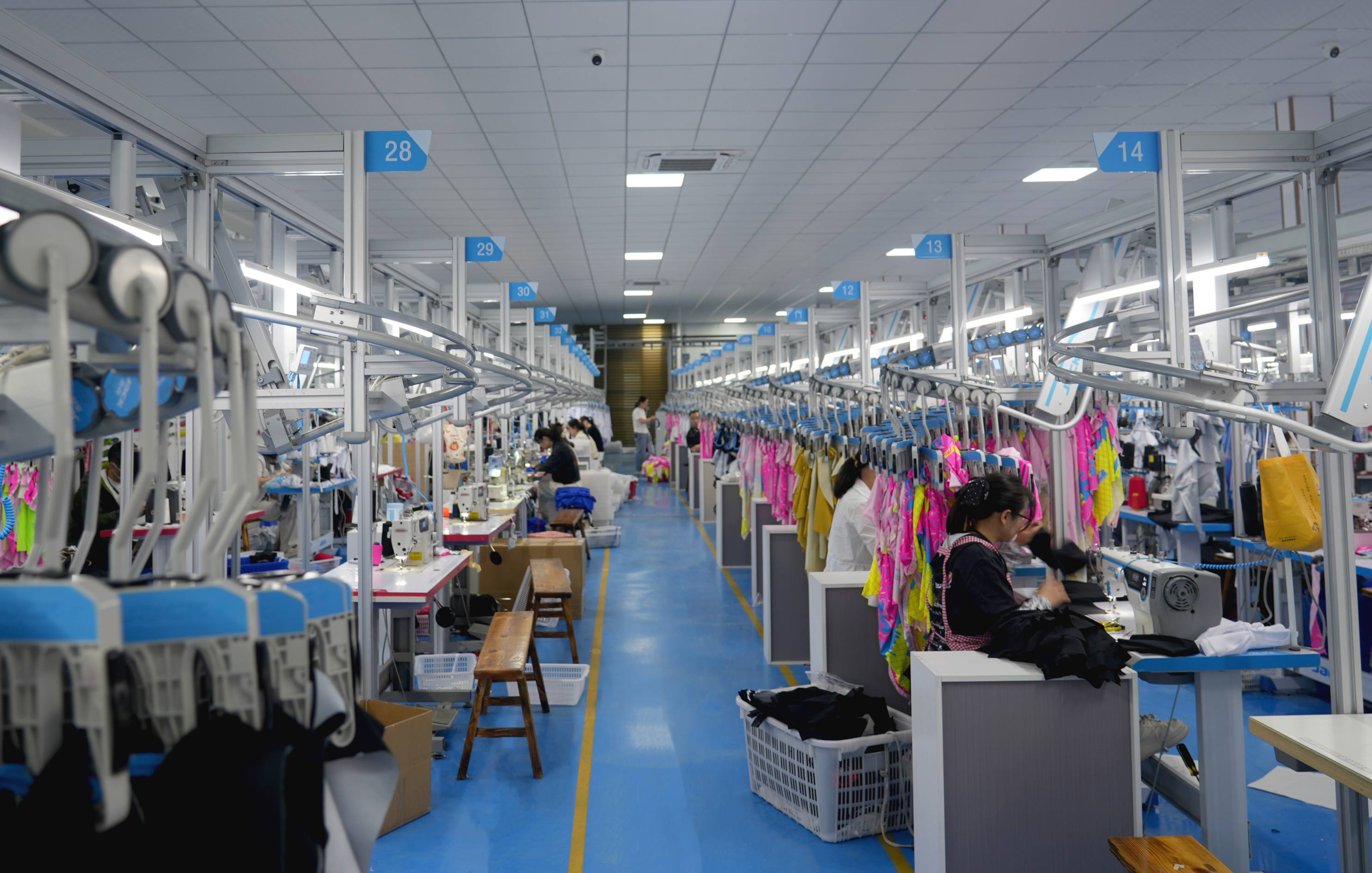
Workers at LJVogues are cutting
Part 4: The 5-Step Extension Roadmap
A period swimwear OEM extension, executed with the right manufacturing partner, follows a predictable five-step sequence. The timeline from brief to first bulk shipment is typically 14–20 weeks, depending on how much of the inner system is already validated from your underwear program.
Step 1: Reuse Your Existing Brand Assets (Weeks 1–4)
Before issuing any RFQ, conduct an internal audit of what you already own. Your customer profile, absorption capacity tiers, brand colorway library, care instruction system, and compliance documentation are all transferable assets. The worst outcome in a line extension is paying a new OEM to rebuild the spec sheet you already have.
Specifically, carry forward: your capacity tier naming and consumer-facing language (so your existing customers immediately understand what "Regular" and "Heavy" mean in the swim context); your OEKO-TEX and PFAS-free documentation (your OEM can apply the same certifications to swim fabrics if they are on the approved material list); and your AQL inspection standard and pre-production approval protocol.
What you should not carry forward without review: your outer fabric specification (nylon/spandex is not appropriate for chlorinated water environments), your fit block (swimwear requires a fundamentally different crotch panel geometry and seal engineering), and your size grading if it was developed against underwear proportions rather than swimwear stretch recovery.
Step 2: Select a Dual-Category OEM (Weeks 2–5, concurrent with Step 1)
The critical qualification question is not "can this factory make period swimwear?" It is "does this factory already make period swimwear on the same production line as period underwear, using the same absorbent system?" A factory that makes underwear and claims it can do swimwear is a different qualification than a factory that demonstrates active swim production with verifiable chlorine soak test reports.
When evaluating dual-category OEMs, request:
Chlorine soak test report (52 cycles at 2.5 ppm, 27°C) on an active swimwear SKU
Documentation confirming the same TPU thermal bonding equipment is used for both categories
Samples of their period swimwear in at least two capacity tiers
Compliance documentation covering both underwear and swimwear fabrics under a single OEKO-TEX certificate
This qualification criteria is covered in detail in How to Source Period Swimwear , which provides the full 7-criteria manufacturer evaluation framework.
Step 3: Sampling — Transfer Capacity Tiers Directly (Weeks 5–10)
This step is where the modular absorbent system argument becomes financially concrete. When briefing your OEM on the swimwear sample, you do not need to revalidate your capacity tiers. If your underwear line runs 15 ml, 30 ml, and 50 ml tiers, your swimwear sampler uses the same tier definitions — adjusted for compressed thickness in the wet state — without rebuilding the absorbent core specification from zero.
What the sample should focus on instead:
Outer shell chlorine resistance and DWR performance (new, specific to swim)
Fit seal at waistband and leg openings (critical — pool water ingress is the consumer's primary concern)
Wet-state silhouette (the absorbent core must not swell visibly after submersion)
Dry-recovery time after removal from water
Request a swim simulation test as part of proto review: submerge the sample in water for 10 minutes, remove, and check for visual swelling, water retention in the core, and seal integrity at leg and waist junctions. This is a practical test your sourcing team can run without laboratory equipment and will catch the most common fit and material failures before they reach the formal test suite.
Step 4: Certifications and Add-On Testing (Weeks 9–14)
Your existing underwear certification package covers OEKO-TEX, PFAS-free, AQL 2.5, and ISO 10993-1 (if you are in EU distribution). For swimwear, three additional test parameters are required:
UPF 50+ certification (AATCC 183 or AS/NZS 4399) — outdoor pool and beach use requires UV protection documentation; this is a consumer expectation in North America, Australia, and the UK.
Chlorine soak cycle testing (52 cycles at pool-standard concentration) — validates outer fabric durability and TPU barrier integrity in the swimwear use environment.
UV exposure colorfastness (ISO 105-B06) — confirms that colorways do not fade under sustained outdoor UV exposure, a relevant concern for beach and outdoor pool use.
For EU market distribution, confirm that your ISO 10993-1 documentation package — as covered in our EU Compliance and ISO 10993-1 article — extends to your swimwear SKUs. GPSR (effective December 2024) applies to all intimate apparel sold in the EU, including period swimwear. An OEM that already holds this documentation for your underwear can typically extend it to swimwear within the same compliance program without requiring a full new assessment.
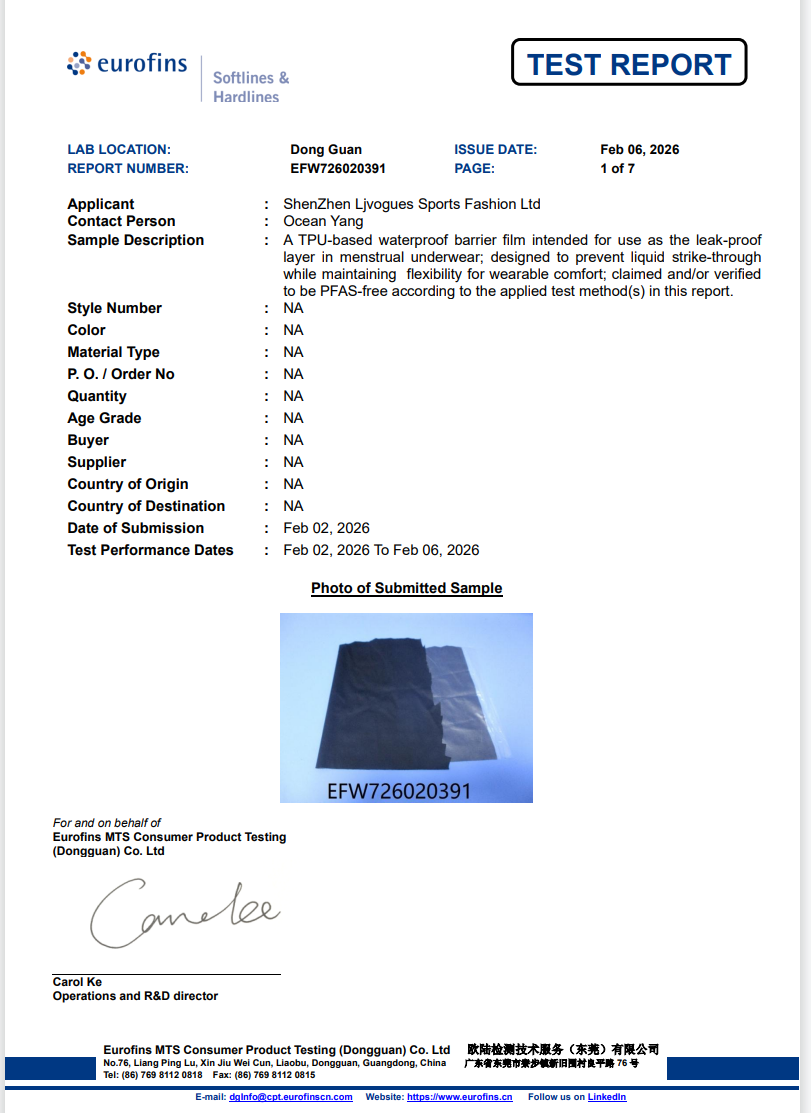
ljvogues' PFAS-FREE report
Step 5: Timeline Alignment — Sync Swimwear to Underwear Restocking (Weeks 14–20)
The final step is logistical, but brands consistently underestimate its importance. Period swimwear demand is seasonal; period underwear demand is year-round. Aligning your swimwear initial production run with your underwear restocking cycle means your OEM can plan both programs together, avoiding capacity competition and taking advantage of shared component inventory.
A practical approach: launch your first swimwear run at 50–100 units per colorway as a validated market test, timed to arrive no later than March for Northern Hemisphere summer. Use that sell-through data to inform your replenishment order — which your OEM can slot into the same production window as your underwear restocking. This approach keeps your inventory exposure modest while building the data you need to scale confidently into the following season.
Part 5: The LJVOGUES Modular Absorbent System — Extending the Article 16 Narrative
In From Period Underwear to Activewear — Engineering a Modular Absorbent System Across 5 Product Categories, the central argument is that a well-designed absorbent gusset system is not category-specific. The same four-layer architecture — moisture-wicking inner layer, absorbent core, TPU barrier, outer shell — can move across period biker shorts, leakproof leggings, girls' safety shorts, schoolwear shorts, and running splits without requiring a new engineering foundation for each. Article 16 demonstrated that across five activewear categories.
Period swimwear is the sixth category that same architecture addresses — and in some ways the most instructive, because the outer shell specification changes more dramatically than in any activewear extension. Moving from an 80% nylon/20% spandex biker short outer to a polyester/PBT chlorine-resistant swim shell requires different fabric sourcing and a DWR process step that activewear does not. But the inner system — the part that does the actual period-protection work — remains structurally identical.
"When a Modibodi-style client extends into swim, the first conversation I have is about what they are not changing," Ocean Yang explains. "The TPU spec, the absorbent core tiers, the wicking layer construction — those are the same file. What we update is the outer shell fabric and the fit block. That distinction saves four to six weeks of sample development because we are not rebuilding the foundation."
This manufacturing logic has direct financial implications. The TPU bonding tooling is the same; there is no new capital investment. The absorbent core materials — microfibre padding, bamboo fleece, or proprietary composites — are already in inventory. The AQL inspection protocol and the compliance documentation structure are already in place. The only new procurement is chlorine-resistant outer fabric and DWR chemistry, both of which a qualified dual-category OEM will hold as standard stock.
"In our Shenzhen facility, we run the same TPU bonder for underwear and swimwear on the same production line," Ocean Yang notes. "The temperature profile shifts slightly for polyester/PBT outer fabric versus nylon/spandex, but the bonding equipment, the operator training, and the inspection protocol are shared. A brand extending from underwear to swim does not pay for a second tooling setup — they pay only for the fabric and process differences."
The modular framework also preserves brand narrative consistency. When your period underwear and period swimwear use the same four-layer system, the same capacity tier language, and the same certification stack, your marketing team can describe the technology once and apply it to both product lines. There is no need to explain why your swimwear has a different absorption standard than your underwear, or why the compliance documentation diverges. The architecture is coherent across categories, which is the consumer-facing expression of the same supply chain efficiency that the modular system delivers on the production side.
For brands that have already read Article 16 and built activewear extensions on the modular system, the progression to swimwear is the logical next step: the same core migrates, the outer shell specification changes, and the result is a summer-season SKU that requires no new OEM relationship and minimal new tooling cost.
"I have seen brands spend 18 months trying to develop period swimwear from a standing start with a factory that only does underwear," Ocean Yang adds. "The technical problems they encounter — chlorine degradation of the outer layer, water ingress through inadequate seals, absorbent core swelling in water — are all solvable, but not by a factory that has never run polyester/PBT outer fabric through its production line. That is the real value of a dual-category manufacturer: you do not pay for their learning curve."
Part 6: Common Pitfalls in Period Swimwear OEM Extensions
The period swimwear OEM extension process has three failure modes that appear in predictable circumstances. Understanding them before you begin protects both your development investment and your brand's reputation with early customers.
Pitfall 1: Applying Underwear Fabric to a Chlorine Environment
This is the most technically consequential mistake in the category, and it happens more often than the industry openly acknowledges. Nylon/spandex, the standard outer fabric for period underwear, degrades visibly in chlorinated pool water after 50–100 sessions at 1–3 ppm chlorine concentration — the standard range for maintained swimming pools. Colour fades. Elasticity weakens. Seam edges begin to separate. A period swimwear garment built on nylon/spandex outer fabric will fail the 52-cycle chlorine soak test and will fail visibly in consumer use before the end of its first summer.
Polyester/PBT (polybutylene terephthalate) outer fabric is the correct specification. PBT is chemically inert to chlorine at pool concentrations; polyester/PBT blends in a properly constructed garment will outlast nylon/spandex equivalents by five to ten times in pool conditions, according to Swimwear Galore's chlorine resistance analysis.
The practical rule: never issue a period swimwear brief to an OEM that cannot provide polyester/PBT outer fabric sourcing documentation. The absence of this capability means the factory does not manufacture genuine swimwear; it manufactures underwear-adjacent garments that happen to be shaped like swimwear.
Pitfall 2: Skipping Fit Redesign
The second pitfall is assuming that the crotch panel geometry from your period underwear can be transferred into a swimwear pattern without modification. It cannot. Period swimwear must seal at two points that period underwear does not: the waistband and the leg openings. If those seals are not engineered correctly, pool water enters the absorbent core from outside — which saturates the core with chlorinated water, compromises absorption capacity, and creates the bulky, waterlogged sensation that negative consumer reviews consistently describe.
Swimwear fit blocks require higher compression at the waistband and leg bands than underwear, and the leg opening angle and curve must be calculated to create a hydraulic seal against the body under water. This is distinct engineering from underwear fit development. It requires a pattern maker with swimwear experience and at least one — and more likely two — fit revision cycles on the proto sample.
The swim simulation test described in Step 3 of the roadmap above is the practical quality gate for this issue. If the proto sample shows water ingress at the leg openings after submersion, the fit block needs revision before the chlorine test suite begins.
Pitfall 3: Not Rewriting the Size System
Period underwear size systems are typically based on hip circumference and waist circumference, calibrated against underwear stretch recovery and coverage preferences. Swimwear size systems add bust measurement for one-pieces, account for higher-compression fabrication, and in many markets are expressed against different numerical or lettered standards than underwear.
A brand that carries its underwear size grading directly into swimwear without recalibration will produce garments that fit the same numerical size inconsistently between the two product lines — which confuses returning customers and generates elevated returns. The swimwear fit block should be graded independently against swimwear stretch standards, validated on fit models for each size bracket, and documented in a size guide that is visually distinct from the underwear size chart to prevent customer confusion.
If your OEM offers in-house grading against your brand's swimwear size specification, use it. The cost of grading errors corrected after bulk production is multiples of the cost of getting it right during sampling.

Part 7: ROI and Break-Even Modeling at 100, 200, and 300 MOQ
The question most brand founders ask before committing to a period swimwear OEM extension is straightforward: what does the first season need to look like for this to make financial sense? The table below models three MOQ entry points — 100, 200, and 300 units per colorway — against realistic unit economics for a mid-market period swimwear product.
First-Season ROI Model: Period Swimwear Extension
Metric | 100 Units / Colorway | 200 Units / Colorway | 300 Units / Colorway |
Manufacturing cost (FOB) | ~USD 22–26/unit | ~USD 18–22/unit | ~USD 15–19/unit |
Sampling & tooling (amortized) | ~USD 4–6/unit | ~USD 2–3/unit | ~USD 1.50–2/unit |
Certification add-on (UPF, chlorine test) | ~USD 3–5/unit | ~USD 1.50–2.50/unit | ~USD 1–1.50/unit |
Logistics (sea freight + duty, per unit) | ~USD 3–5/unit | ~USD 2.50–4/unit | ~USD 2–3/unit |
Total landed cost | ~USD 32–42/unit | ~USD 24–32/unit | ~USD 20–26/unit |
Recommended wholesale price | USD 38–50/unit | USD 38–50/unit | USD 38–50/unit |
Recommended retail price | USD 65–95/unit | USD 65–95/unit | USD 65–95/unit |
Gross margin at wholesale (mid estimate) | 12–22% | 30–40% | 40–50% |
Revenue at 80% sell-through (wholesale) | ~USD 3,040–4,000 | ~USD 6,080–8,000 | ~USD 9,120–12,000 |
Estimated break-even point | ~85–90 units sold | ~75–80 units sold | ~60–70 units sold |
Estimated seasons to full ROI | 1.5–2 seasons | 1–1.5 seasons | 1 season |
Several notes on interpreting this table. Manufacturing cost per unit reflects OEM production at a qualified dual-category manufacturer for a bikini-bottom style period swimwear; one-piece formats carry a 15–25% cost premium due to greater fabric consumption and construction complexity. Sampling and tooling amortization assumes standard proto and pre-production sample cycles without extensive fit revision; brands with complex proprietary construction may incur higher per-unit amortization at 100 MOQ. Certification add-on costs are higher at 100 MOQ because fixed testing fees are spread across fewer units.
The 200-unit tier is the inflection point in this model. Below 200 units, per-unit landed costs compress margins to the point where the first season is primarily a market validation exercise, with meaningful profitability requiring a second-season reorder. At 200 units, an 80% sell-through rate at wholesale pricing covers landed cost and generates a first-season gross profit that funds a full second-season production run at comparable or higher volume. At 300 units, the economics are strong enough to support retail buyer conversations, since the margin structure can accommodate typical wholesale buyer terms.
"For clients entering period swimwear for the first time, I recommend starting at 200 units across two colorways — one neutral, one seasonal," Ocean Yang says. "It gives you enough volume to test the retail channel alongside DTC, manage size run inventory without overexposure, and qualify for the pricing tier that makes the category financially sustainable from the start. The brands that start at 100 units typically need three seasons to reach the unit economics that 200 units delivers in season one."
For a detailed cost structure breakdown covering fabric, absorbent core, trims, labor, and packaging at each MOQ tier, see Period Swimwear MOQ, Cost Breakdown & Lead Times.
Frequently Asked Questions (FAQ)
Q1: Do I need a new OEM partner to add period swimwear to my existing period underwear line?
Not necessarily — but you need to verify that your existing OEM can genuinely manufacture period swimwear, not just claim they can. The specific qualifications to confirm are: active polyester/PBT outer fabric sourcing, documented chlorine soak test results on an existing swimwear SKU, and a production line that has run swimwear construction (not just underwear with a swim-like outer fabric). A factory that passes this three-point check can extend your underwear program into swimwear without introducing a new OEM relationship. A factory that cannot provide these documents requires you to find a dual-category manufacturer.
Q2: How much of my period underwear tech pack can I reuse for the swimwear brief?
The inner system specification — absorbent core construction, TPU barrier spec, wicking layer material, capacity tier definitions, and AQL inspection criteria — is transferable without modification. The outer shell specification, fit block, and size grading are not. Expect to rebuild the outer construction section of your tech pack for swimwear, while retaining the gusset and barrier system sections from your underwear documentation. Brands working with LJVOGUES can request standard swimwear tech pack templates pre-populated with the modular absorbent system specification, which significantly reduces the brief-writing time.
Q3: What is the most important consumer concern in period swimwear, and how do I address it in my product?
The most common consumer objection is that pool water will enter the absorbent layer and make the garment ineffective — or that the garment will become heavy and visible under water. Both concerns are addressed by the same engineering decision: a correctly specified outer shell with DWR treatment plus precision seal engineering at the waistband and leg openings. Selective absorption technology — where the TPU barrier and water-resistant outer layer prevent external liquid from entering the absorbent core — is the technical answer. Your product page and care guide should explain this mechanism directly, because consumers who understand the water-resistance principle are significantly less likely to return garments that perform exactly as designed.
Q4: How does period swimwear sizing differ from period underwear sizing, and how should I communicate the difference to customers?
Period swimwear uses a higher-compression fit block than underwear, and the measurement inputs differ: swimwear grading accounts for bust (for one-pieces), hip circumference under higher stretch tension, and leg opening compression. Numerically, a customer who wears a medium in your period underwear may find that a medium in your period swimwear fits differently — either tighter due to swimwear compression standards, or with a different torso-to-hip ratio. The safest communication strategy is a separate, clearly labeled swimwear size chart with measurement instructions specific to swimwear fit, alongside a note that swimwear sizing is calibrated independently from underwear sizing.
Q5: What certifications are required before launching period swimwear in the US, EU, and Australia?
For all markets: OEKO-TEX STANDARD 100 (material safety), PFAS-free declaration from a third-party laboratory, and AQL 2.5 quality inspection records. For EU market entry: GPSR-compliant technical documentation and an ISO 10993-1 biocompatibility assessment or risk management plan — as detailed in our EU Compliance and ISO 10993-1 article. For US market: FDA compliance documentation and state-level PFAS compliance for any states with active textile PFAS restrictions. For Australia: AS/NZS 4399 UPF certification is expected by consumers and increasingly by retail buyers. UPF 50+ is the market standard across all three regions for outdoor swimwear.
Q6: Can I launch period swimwear in a limited colorway range to reduce initial inventory exposure?
Yes, and this is the recommended approach for a first-season launch. Two colorways — a neutral (black or navy) and a seasonal pattern or color — is sufficient to validate the market without creating fragmented inventory. Black is the highest-volume colorway in the period swimwear category and functions as a reliable baseline for both consumer acceptance testing and size run planning. Add colorways in the second season based on actual sell-through data, not projected preferences.
Q7: How does the Modibodi x Puma collaboration inform what is possible for a period brand extending into swimwear?
The Modibodi x Puma 2022 collaboration demonstrated two things for the wider market. First, that period protection technology is sufficiently mainstream to be co-branded with a global athletic brand — the stigma that limited early period care marketing no longer constrains go-to-market strategy. Second, that a single absorbent technology platform can support multiple product formats — swim shorts, biker shorts, and leggings were all part of the collaboration — without requiring a technology rebuild. For independent period brands, the takeaway is that the ceiling on category extension is higher than it might appear, provided the underlying manufacturing system is designed for cross-category deployment from the start.
Q8: What is the realistic timeline from brief to first retail-ready inventory for a period swimwear extension?
For a brand with an existing validated period underwear program working with a dual-category OEM, the timeline is: weeks 1–4 for OEM qualification and brief alignment; weeks 5–10 for proto sampling and fit revision; weeks 9–14 for certification testing (UV, chlorine, ISO 10993-1 extension); weeks 14–20 for pre-production sample approval and bulk production. Shipping adds 3–6 weeks depending on origin and destination. A total timeline of 20–26 weeks from brief to landed inventory is realistic. For a summer Northern Hemisphere launch, brief submission should begin no later than late October of the preceding year.
Sources
Fortune Business Insights — Global Swimwear Market Size, Share & Industry Analysis (USD 22.95B in 2025, USD 34.12B by 2034, 5.08% CAGR): https://www.fortunebusinessinsights.com/swimwear-market-103877
Grand View Research — Swimwear Market Size, Share & Trends Analysis (USD 23.1B in 2023, USD 36.15B by 2030, 6.8% CAGR): https://www.grandviewresearch.com/industry-analysis/swimwear-market
Market.us — Period Panties Market Report (20.5% CAGR): https://market.us/report/period-panties-market/
Modibodi — Period Swimwear and Activewear (including 2022 Puma collaboration): https://us.modibodi.com
Knix — Period Swimwear Line (4-layer system, 1–3 tampon capacity): https://knix.com
Good Housekeeping — Best Period Swimwear 2026 (Knix Best Overall): https://www.goodhousekeeping.com/clothing/swimwear-reviews/g40078088/best-period-swimwear/
Retail Dive — Proof Launches New Underwear Line at Target and Meijer (2021): https://www.retaildive.com/news/proof-launches-new-underwear-line-at-target/597785/
NYT Wirecutter — Best Period Underwear 2026: https://www.nytimes.com/wirecutter/reviews/best-period-underwear/
Swimwear Galore — Chlorine-Resistant Swimwear: Why It's Worth the Investment (5–10x lifespan comparison): https://swimweargalore.com/en-us/blogs/the-swim-report/chlorine-resistant-swimwear-why-its-worth-the-investment
Cora — Menstrual Care Brand Expansion and Identity (Print Magazine): https://www.printmag.com/branding-identity-design/menstrual-care-brand-cora-wants-to-add-a-little-luxury-to-your-period/
L. (Love Beginnings) — Period Care Brand Product Line: https://www.thisisl.com
Ruby Love — Period Swimwear (teen-first positioning, one-piece format): https://www.rubylove.com
Swim England — Period Wear Guidance Changed (2023): https://www.swimming.org/sport/period-wear-guidance-changed/
OEKO-TEX STANDARD 100 — Official Certification Information: https://www.oeko-tex.com/en/our-standards/oeko-tex-standard-100
ISO 10993-1:2018 — Biological Evaluation of Medical Devices (biocompatibility framework): https://www.iso.org/standard/68936.html
EU General Product Safety Regulation (GPSR): https://eur-lex.europa.eu/legal-content/EN/TXT/?uri=CELEX%3A32023R0988
LJVOGUES — Period Swimwear OEM and Private Label Manufacturing: https://www.ljvogues.com/
About the Author
Ocean Yang | Founder, Shenzhen Ljvogues Sports Fashion Limited
With 20+ years in intimate apparel manufacturing and 500+ global brand partnerships, Ocean leads LJVOGUES' 8,000 m² Shenzhen facility producing certified period swimwear, period underwear, and leakproof activewear for international brands. The team holds BSCI, SEDEX, FDA, OEKO-TEX STANDARD 100, OCS, GRS, ISO 9001/14001 certifications and is 100% PFAS-free.
This article is part of the LJVOGUES B2B Sourcing Guide library. Related reading: Period Swimwear Explained | How to Source Period Swimwear | Absorbent System Across Activewear | EU Compliance / ISO 10993-1
Connect: https://www.ljvogues.com/ | Email Ocean's team for OEM/ODM inquiries.