



Table of Contents
TL;DR
India is the fastest-growing period panties market globally, with a CAGR of 22.6% (Grand View Research). Indian brand founders can source domestically — primarily from garment clusters in Delhi NCR, Gujarat, Maharashtra, Tamil Nadu, and Karnataka — or import from China. Domestic sourcing offers lower MOQs and no import duty. Chinese manufacturing offers superior absorbent core technology, full OEKO-TEX and PFAS-free certification, and better economics at 5,000+ units. Most successful Indian brands use both.
The Indian Period Underwear Opportunity
India is not merely participating in the global period underwear category — it is leading its growth rate. According to Grand View Research, India is the fastest-growing national market for period panties, with a CAGR of 22.6% — higher than any other country tracked. The global market itself was valued at USD 157.03 million in 2025 and is projected to reach USD 700.18 million by 2033 at a 21.1% CAGR.
Several structural factors explain why India outpaces the global average:
Digital commerce acceleration. Platforms like Nykaa, Amazon India, and Flipkart have dramatically lowered the barrier to entry for intimate hygiene and period care brands. A DTC founder with a well-photographed product can reach a national audience without a brick-and-mortar footprint. Category search volume for period-related products on these platforms has grown year-on-year as menstrual health literacy expands.
Tier-1 and tier-2 urban demand. Urban Indian consumers, particularly women aged 18–35, are actively shifting away from disposable pads and tampons. This shift is most pronounced in tier-1 cities (Mumbai, Delhi, Bengaluru, Hyderabad) but increasingly visible in tier-2 cities (Jaipur, Lucknow, Coimbatore, Surat) as smartphone penetration deepens.
Government menstrual hygiene initiatives. National and state-level programmes promoting menstrual hygiene awareness have increased category familiarity, particularly among younger consumers and first-time buyers.
For a brand founder in India right now, the timing is precise: early enough to build a loyal subscriber base and brand identity, but the market is growing fast enough that delay has a measurable cost.

Indian Brands Leading the Market
The domestic period underwear segment has attracted a range of Indian-founded brands. The following are active participants in the category — listed without ranking:
Adira — focuses on comfort-oriented period briefs and everyday leak-proof wear, broad size range
SochGreen — eco-positioned, emphasises organic and natural fibre options
Pee Safe — diversified feminine hygiene brand with period underwear alongside other products, strong e-commerce presence
Niine — menstrual hygiene brand backed by FMCG investment, plays on affordability and accessibility
Saral — sustainability-led brand focused on reusable options and reducing single-use waste
Carmesi — skin-first brand targeting sensitive skin claims, natural ingredients
Floh — design-forward brand targeting the urban millennial buyer
NUA — subscription-based model, period care ecosystem beyond underwear
These brands collectively serve:
Heavy flow / overnight: High-absorbency briefs and boyshorts
Teen / first-time users: Lighter absorbency, smaller sizing, discreet packaging
Plus-size: Extended size grading up to 3XL and beyond
Eco-conscious: Organic cotton, reusable, GOTS-aligned materials
Understanding what these incumbents offer is useful for a new entrant. The market already has established names, which means differentiation — whether through fabric technology, target body type, cultural relevance, or price point — is necessary.

Domestic Indian Manufacturing — The Reality
Major Manufacturing Hubs in India
India has a substantial garment manufacturing base, but its capability for period underwear specifically — a technically demanding product requiring absorbent core lamination — varies considerably by region.
Delhi NCR (Gurugram, Noida, Faridabad)
The Delhi garment cluster is India's most distributed production base for women's intimate apparel. Hundreds of small-to-medium cut-and-sew units operate across the NCR corridor, many of which have entered the period underwear space opportunistically as demand has grown. Typical MOQ from Delhi NCR factories runs 200–500 pieces per style. Lead times are generally 30–45 days for initial production runs, making them well-suited for DTC startups that want to test designs without committing to large batches.
The limitation here is technology depth. Most Delhi NCR units use basic 2–3 layer cotton and microfibre constructions for absorbency. Very few have invested in dedicated absorbent core lamination equipment. For a brand building its initial collection around organic cotton light-flow styles, Delhi NCR can work well. For brands that need to claim heavy flow or overnight protection, the technology gap becomes a product quality issue.
Gujarat (Ahmedabad, Surat)
Gujarat is India's textile heartland. Ahmedabad and Surat together account for a significant share of the country's fabric production, including organic cotton sourcing through the Kutch and Saurashtra cotton belts. Gujarat manufacturers have strong cotton supply chains and are well-positioned to produce the outer shell fabrics for period underwear at competitive prices. Their MOQ thresholds tend to be slightly higher — 500–1,000 pieces per style — and lead times run 35–50 days.
Technical capability for absorbent core construction is improving in Gujarat, particularly among factories that supply the export market. However, the cluster has historically been stronger in fabric production than in full-garment construction of technically complex intimate apparel.
Maharashtra (Mumbai, Pune)
Maharashtra's garment manufacturing base is more export-oriented than the Delhi or Gujarat clusters. Factories around Mumbai and Pune have experience dealing with international buyers, which typically means more structured QC protocols, better documentation practices, and familiarity with compliance requirements. For an Indian brand that plans to eventually export — or that wants domestic manufacturing with export-grade consistency — Maharashtra is worth evaluating.
MOQs in Maharashtra tend to run 500–1,500 pieces depending on the factory scale. Lead times for export-oriented manufacturers are typically 40–55 days.
Tamil Nadu (Tirupur)
Tirupur is India's knitwear capital and accounts for approximately 90% of the country's cotton knitwear exports (Fibre2Fashion). The cluster includes units covering the full value chain from spinning and knitting through wet processing, printing, and garment manufacturing. Tirupur factories have strong organic cotton expertise and are familiar with international compliance frameworks, making them a credible option for brands needing certified organic cotton outer fabrics. Period underwear manufacturing capability exists in Tirupur but is concentrated in a smaller number of specialists.
Karnataka (Bengaluru)
Bengaluru has a smaller but technology-forward garment manufacturing base. Several factory units here serve tech-enabled DTC brands and have adapted to shorter run production models. MOQs can be lower — some accept 100–300 piece runs — which suits early-stage founders who need to iterate quickly. Capability for advanced functional fabrics (including absorbent layers) is limited but growing.
Strengths of Indian Manufacturers
Lower MOQ flexibility. Some Indian manufacturers — particularly in Delhi NCR and Bengaluru — accept initial runs of 100–300 pieces. This is significantly lower than most Chinese factories, where 300 pieces is the floor and 500–1,000 pieces is more typical for technical products. For a founder spending ₹1.5–3 lakh on a first trial run, this flexibility is meaningful.
No import duty or customs. Sourcing domestically eliminates the 20% Basic Customs Duty plus 12% IGST that applies when importing panties from China. This can represent 30–35% of the landed cost for imported goods. For price-sensitive markets, domestic production removes that structural cost.
Cultural fit for Indian body types and clothing styles. Indian manufacturers are more familiar with producing cuts that accommodate the silhouettes typical of Indian consumers — higher rise briefs that work under sarees and salwar kameez, wider hip coverage, and modest waistbands. Requesting these specifications from a Chinese factory is possible, but it requires clear technical communication and sample iteration.
Organic Indian cotton supply. India is one of the world's largest producers of organic cotton, and Gujarat and Tamil Nadu factories have direct access to certified organic cotton supply. For a brand building its identity around Indian-grown organic cotton — a marketable differentiator on platforms like Nykaa — domestic sourcing enables an authentic "Made in India from Indian cotton" story.
Lower per-piece labour cost. At small volumes (under 1,000 pieces per style), Indian manufacturing can be cost-competitive because labour costs are lower and there is no freight or import duty overhead.
Simpler compliance for domestic-only sales. An Indian brand selling exclusively within India does not need to worry about export documentation, country-of-origin compliance, or import licencing. Domestic manufacturing keeps the supply chain simple.
Limitations of Indian Manufacturers
Limited absorbent core technology. This is the most significant technical limitation. The core of any high-performance period underwear — what makes it genuinely capable of holding 25–50ml of fluid without leaking or feeling wet — is the absorbent core laminate: typically a layered combination of moisture-wicking fabric, an absorbent cellulose or polyester core, a leak-proof TPU barrier, and a soft inner layer. Most Indian manufacturers do not have dedicated equipment or R&D investment for this lamination process. The result is products with basic 2–3 layer constructions that are adequate for light flow but not reliably capable for moderate or heavy flow claims.
Limited third-party certification for absorbent cores. OEKO-TEX® STANDARD 100 certification — which tests for harmful substances in every component including the absorbent core — is common among Chinese export-oriented factories but rare among Indian period underwear manufacturers. GOTS (Global Organic Textile Standard) certification for complete garments, including functional layers, is similarly uncommon. This creates a product credibility gap for brands trying to compete on safety and sustainability claims.
PFAS-free DWR coatings not widely available. Period swimwear requires a DWR (durable water repellent) coating on the outer shell fabric to prevent water ingress while allowing sweat and menstrual fluid to pass inward. In China, PFAS-free DWR alternatives are now standard among established period underwear manufacturers. Among Indian manufacturers, this capability is not yet widely available.
Capacity constraints at scale. Indian garment factories capable of period underwear production typically have production capacities in the range of 5,000–20,000 pieces per month per style. For a brand that grows to needing 50,000+ units per season, Indian manufacturers struggle to meet that volume without compromising lead times or quality consistency.
Inconsistent QC standards. Unlike Chinese factories that serve international export markets with structured AQL (Acceptable Quality Level) inspection protocols — typically AQL 2.5 for intimate apparel — Indian domestic manufacturers often operate on customer-side QC frameworks only. Buyers need to invest more in incoming inspection or on-site QC presence.
Importing Period Underwear from China to India — Why Indian Brands Do It
Despite the import duty overhead, a growing number of Indian period underwear brands — particularly those targeting the mid-premium and premium segments — choose to source from Chinese manufacturers. The reasons are primarily technical and economic.
Access to 4-layer leak-proof technology. Chinese manufacturers specialising in period underwear have invested heavily in proprietary absorbent core systems. At LJVOGUES, our 4-layer system combines a moisture-wicking inner layer, a high-absorbency cellulose core, a leak-proof TPU membrane, and a breathable outer shell — a construction that consistently delivers 30–50ml absorbency. This level of performance is not reliably replicable through Indian domestic supply chains in 2026.
Full PFAS-free, OEKO-TEX, and GOTS supply. LJVOGUES carries OEKO-TEX® STANDARD 100, BSCI, SEDEX, ISO 9001/14001, and GRS certifications, and all products are 100% PFAS-free verified. For an Indian brand that wants to make credible safety claims — particularly important when marketing to health-conscious urban consumers or exporting globally — this certification stack is hard to replicate domestically.
Specialised period swimwear capability. Period swimwear is a nascent but growing sub-category in India, particularly for consumers who travel or use pools. No Indian manufacturer currently offers a commercially viable period swimwear product with DWR coating and functional absorbency. Chinese manufacturers with this capability — including LJVOGUES, which offers 30–35ml absorbency swimwear with PFAS-free DWR — are the only current option.
Higher absorbency ceiling. Chinese export-grade period underwear typically achieves 40–50ml certified absorbency. Indian domestic production typically achieves 20–30ml at best. For brands targeting heavy flow users or overnight wear, this performance gap directly affects customer satisfaction and return rates.
Better unit economics at volume. At production volumes of 5,000 units per style, Chinese factory pricing — even after adding shipping and import duties — can be cost-competitive with Indian domestic manufacturing, because Chinese factories achieve better fabric utilisation, higher throughput, and lower per-unit overhead at scale. At 10,000+ units, the economics generally favour Chinese sourcing.
Established export documentation. Chinese manufacturers regularly produce for global markets and have well-developed processes for commercial invoices, packing lists, certificates of origin, OEKO-TEX certificates, and test reports — all documentation that Indian customs and international buyers require. This reduces friction in the import process.
India's Import Duty Structure for Period Underwear
Understanding the landed cost of imported period underwear is essential before committing to a Chinese sourcing strategy. The current duty structure (verify current rates at CBIC India) is as follows:
HS Codes applicable:
6108.21 — Briefs and panties, of cotton (knitted or crocheted)
6108.22 — Briefs and panties, of synthetic fibres (knitted or crocheted)
Most period underwear uses a blend of nylon, spandex, and polyester in the outer and inner layers with a cotton or synthetic absorbent core. Classification depends on the primary fibre by weight; your customs broker should confirm classification before import.
Current duty components (Cybex India Customs):
Duty Component | Rate |
Basic Customs Duty (BCD) | 20% of CIF value |
Social Welfare Surcharge (SWS) | 10% of BCD (i.e., 2% of CIF) |
IGST | 12% on intimate apparel (applied on CIF + BCD + SWS) |
Effective total duty load | ~34–36% of CIF value |
Landed cost example:
If your factory price (FOB Shenzhen) is USD 4.50 per piece, and ocean freight + insurance adds USD 0.50 per piece (CIF value = USD 5.00):
BCD: USD 1.00 (20%)
SWS: USD 0.10 (10% of BCD)
IGST base: USD 6.10 (CIF + BCD + SWS)
IGST at 12%: USD 0.73
Landed cost per piece: approximately USD 6.83 (≈ ₹571)
This import duty load is real and must be factored into your pricing model. Indian brands that import from China and sell at mid-premium price points (₹700–₹1,500 retail) typically achieve acceptable margins because the product quality supports the price point.
BIS certification note: Standard women's underwear — including period underwear — is currently exempt from mandatory BIS Scheme-I certification (Alibaba BIS Guide). Only protective textiles and geotextiles require mandatory BIS. However, the Bureau of Indian Standards has been progressively expanding voluntary quality norms for apparel; monitor this before large-scale imports.
Anti-dumping considerations: As of 2026, there are no active anti-dumping duties on women's underwear imported from China into India. However, India's DGTR (Directorate General of Trade Remedies) has historically been active in the textiles sector. Any brand importing at significant volumes should monitor trade notices through DGTR.
Domestic vs Import Decision Framework
Decision Factor | Domestic India | Import from China | Winner |
Minimum order quantity (initial run) | 100–500 pcs | 300–1,000 pcs | India |
Speed to first sample | 2–3 weeks | 10–15 days | Roughly equal |
Speed to first production run | 30–45 days | 35–45 days | Roughly equal |
Absorbent core technology (25ml+) | Limited | Strong (up to 50ml) | China |
OEKO-TEX / GOTS certification | Rare | Standard at specialist factories | China |
PFAS-free DWR for swimwear | Not available | Available | China |
Unit cost at 500 pcs | Competitive (no duty) | Higher (duty adds ~35%) | India |
Unit cost at 5,000 pcs | Moderate | Competitive (even after duty) | China |
Unit cost at 10,000+ pcs | Limited capacity | Strong economics | China |
"Made in India" branding | Yes | No | India |
Cultural silhouette fit (salwar/saree) | High | Medium (requires spec) | India |
Import duty / customs admin | None | ~34–36% landed overhead | India |
Compliance documentation for export | Variable | Established | China |
Scaling beyond 50,000 units | Capacity constraints | Manageable | China |
Hybrid Sourcing Strategy — Best of Both
The pattern we observe most consistently among growing Indian period underwear brands is a hybrid sourcing model that uses Indian and Chinese manufacturing for different product tiers:
Phase 1 — Domestic proof of concept
A brand launches with a core collection of 2–3 organic cotton styles manufactured domestically in Delhi NCR or Tirupur. MOQs are low (200–300 pcs), no import duty applies, and "Made in India from Indian cotton" is a genuine marketing story. This phase validates demand, customer fit, and price point with minimal capital at risk.
Phase 2 — Chinese sourcing for technology and scale
Once the brand has proven demand and needs to compete on performance claims — heavy flow, overnight wear, period swimwear, OEKO-TEX certification — it sources those product lines from a Chinese OEM/ODM partner. The import duty is a real cost, but it is absorbed into a price point supported by demonstrably superior product performance.
Phase 3 — Parallel supply chains
Mature Indian brands with both domestic and international sales often maintain two supply chains: Indian manufacturing for domestic basic lines (lower cost, fast replenishment, no import friction) and Chinese manufacturing for premium technical lines and international export (certifications, performance, compliance documentation).
This is not theoretical — it is the path we have observed with several Indian clients. As Ocean Yang, Founder of LJVOGUES, explains: "We see a clear pattern with Indian brand founders. They typically start with a domestic manufacturer for their proof-of-concept — which is the sensible thing to do at 200 pieces with limited capital. When they are ready to scale or want to launch a heavy-flow or swimwear product that genuinely performs, that is when they come to us. At that point, they are not choosing between India and China — they are running both supply chains for different parts of their range."
City-Specific Sourcing Guide for India
Delhi NCR Period Panty Manufacturers
The Delhi NCR garment cluster — spanning Gurugram, Noida, and Faridabad — contains hundreds of cut-and-sew units that produce women's intimate apparel. For period underwear specifically, the concentration is highest in Noida's apparel export zones and in small manufacturing units in Gurugram's industrial areas.
Parameter | Typical Range |
MOQ | 200–500 pcs per style |
Sample lead time | 10–20 days |
Production lead time | 30–45 days |
Absorbency capability | Light to moderate flow (20–30ml basic construction) |
Best suited for | DTC startups, fast design iteration, organic cotton basics |
How to find manufacturers: IndiaMART Delhi garment suppliers, TradeIndia, JustDial local listings. Attend the BharatTex trade show (New Delhi, bi-annual) to meet manufacturers face-to-face.
What to ask: Request a factory visit before committing. Confirm whether the manufacturer has in-house absorbent layer lamination equipment or sources pre-laminated fabric from a supplier. The answer will tell you a great deal about their technical depth.
Gujarat Period Panty Manufacturers
Gujarat's primary textile hubs — Ahmedabad and Surat — offer strong cotton supply chain integration. Manufacturers here have better access to certified organic cotton (Kutch and Saurashtra origin) and are capable of producing outer shell fabrics in-house, which can reduce per-piece fabric costs.
Parameter | Typical Range |
MOQ | 500–1,000 pcs per style |
Sample lead time | 15–25 days |
Production lead time | 40–55 days |
Absorbency capability | Light to moderate flow; improving technical capability |
Best suited for | Cotton-focused brands, organic origin sourcing, mid-volume runs |
Gujarat manufacturers are stronger on fabric sourcing and weaker on fully technical functional constructions. If you are building a brand around organic Indian cotton credentials and do not need to claim 40ml+ absorbency, Gujarat can be a sound domestic supply base.
Maharashtra Period Panty Manufacturers
Mumbai and Pune host a segment of garment manufacturers that serve both domestic and export markets. These factories are more likely to have structured QC systems, have dealt with international buyers, and maintain compliance documentation.
Parameter | Typical Range |
MOQ | 500–1,500 pcs per style |
Sample lead time | 15–20 days |
Production lead time | 40–55 days |
Absorbency capability | Light to moderate flow |
Best suited for | Brands planning export from India, "Made in India" positioning, QC-conscious buyers |
The Maharashtra cluster is useful for brands that want domestic manufacturing but with more formalised processes. The cost per piece is typically slightly higher than Delhi NCR given higher labour and real estate costs, but the QC infrastructure is more reliable.
How to Find and Verify Indian Manufacturers
Online directories:
IndiaMART — India's largest B2B marketplace; search "period panty manufacturer" filtered by city. Request quotations directly and compare responses.
TradeIndia — secondary B2B directory with manufacturer listings; useful for cross-referencing
JustDial — useful for local discovery of smaller manufacturers not listed on national platforms
Trade shows:
BharatTex (New Delhi, bi-annual) — India's largest textile trade event, attended by manufacturers, fabric suppliers, and garment makers. Allows in-person factory assessment.
India ITME (Mumbai/Gandhinagar, bi-annual) — textile machinery and manufacturing exhibition; useful for understanding factory technology levels
Verification steps:
Before committing to any domestic manufacturer, apply the same due diligence framework you would use for a Chinese factory. Cross-reference with [internal link: Article 12 — 10 Red Flags When Sourcing Period Underwear] for a complete checklist. Key verification steps specific to Indian factories include: visiting the factory to confirm absorbent layer capability, requesting a production sample (not just a proto sample) before placing a production order, and confirming GST registration and MSME/factory registration status.
How to Find and Engage Chinese Manufacturers from India
For Indian brands exploring Chinese sourcing, the process is similar to that followed by buyers in other markets, with a few India-specific considerations.
Online sourcing platforms:
Alibaba.com — the largest B2B marketplace for Chinese manufacturers. Filter by "period underwear" or "period panties," look for Gold Suppliers with Trade Assurance, and request audit reports. Alibaba's Trade Assurance provides order payment protection.
Made-in-China.com — an alternative B2B platform with strong manufacturer listings in the functional apparel category. Useful for cross-referencing suppliers found on Alibaba.
Canton Fair:
The Canton Fair — held twice yearly in Guangzhou (April and October) — is the world's largest trade fair and includes a dedicated intimate apparel section. Indian buyers attend in significant numbers. Meeting manufacturers in person at Canton Fair allows assessment of product samples, capability, and factory culture before committing to a sourcing relationship. LJVOGUES exhibits at Canton Fair.

Direct outreach:
For Indian brands that have identified a specific technical requirement — period swimwear, heavy-flow certified products, extended size range — direct outreach to specialist manufacturers is often more efficient than sifting through marketplace listings. LJVOGUES specifically welcomes inquiries from Indian brand founders. Our team provides multi-language support and documentation tailored for India customs and import requirements.
For a full framework on working with Chinese suppliers — including how to read factory audits, manage sample rounds, and structure purchase orders — see [internal link: Article 11 — Importing Period Underwear from China: Shipping, Customs & Compliance].
LJVOGUES and Indian Brands — What We Offer
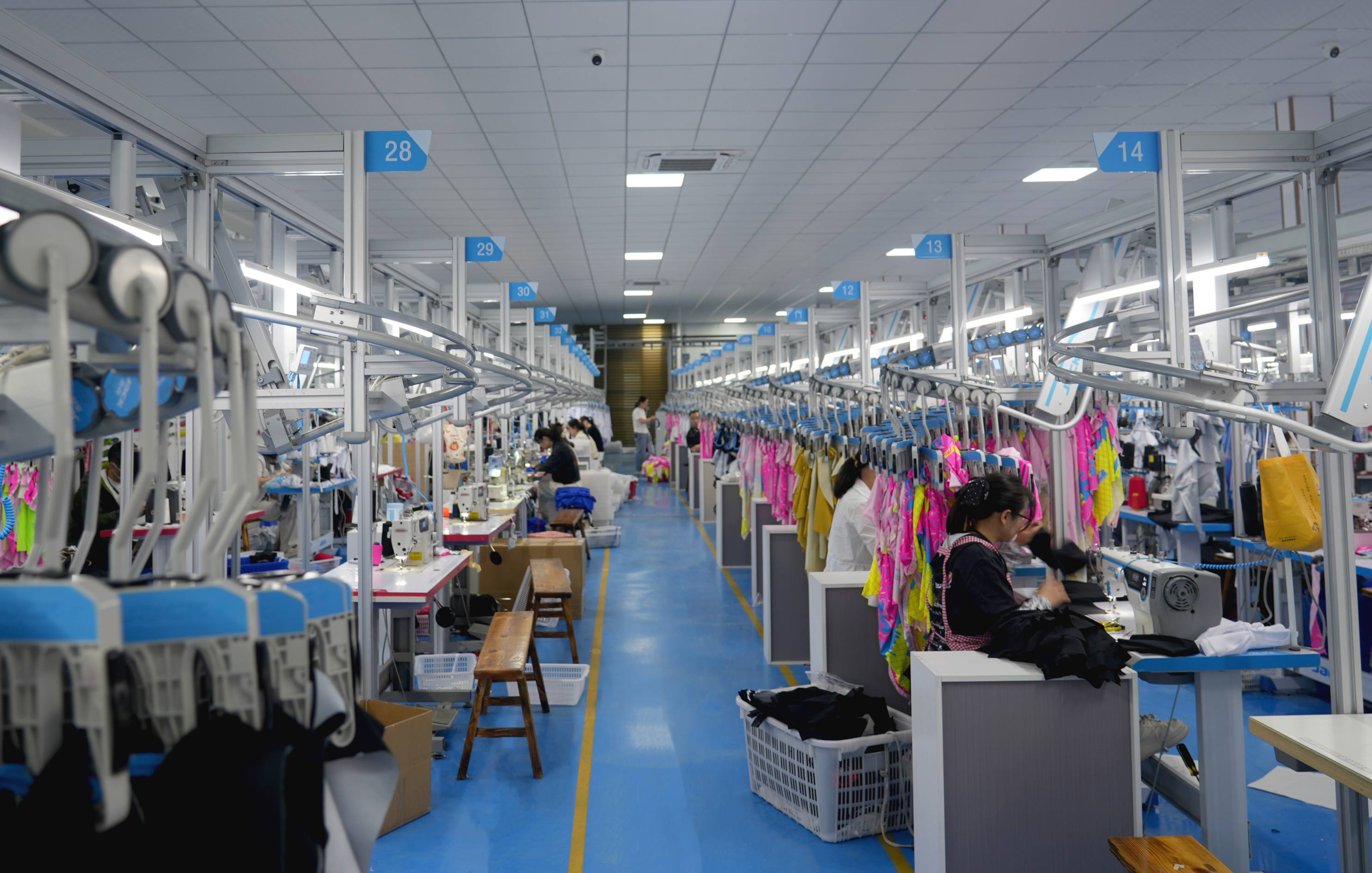
At LJVOGUES, we have a growing base of Indian brand clients and have developed specific capabilities to serve them effectively. Our Shenzhen facility — 8,000 m², 20+ years in functional intimate apparel — ships directly to major Indian ports including Nhava Sheva (Mumbai), Chennai, and Mundra.
What Indian brand founders can expect from us:
Service | Detail |
Sample shipment | DHL India express, 3–5 working days from Shenzhen to major Indian cities |
Sample MOQ | 3–5 pieces per style for evaluation |
Production MOQ | From 300 pieces per style (small-run programme) |
Certifications | OEKO-TEX® STANDARD 100, BSCI, SEDEX, ISO 9001/14001, GRS, 100% PFAS-free |
Technology | 4-layer leak-proof construction, 15–50ml absorbency range, XS–6XL grading |
Period swimwear | 30–35ml absorbency, PFAS-free DWR, OEKO-TEX certified |
India customs documentation | HS code classification support, OEKO-TEX certificates, commercial invoice formats for Indian customs clearance |
Silhouette customisation | Extended rise, wider hip coverage, salwar/saree-compatible cuts available on request |
Communication | English; Indian time zone communication accommodated |
We understand that landed cost — factory price plus Indian import duties — is a central concern. Our wholesale pricing is structured to remain commercially viable after the ~34–36% India landed cost overhead for brands selling at mid-premium and premium retail price points. For brands just starting out with 300-piece trial runs, we offer transparent pricing so you can model margins before committing.
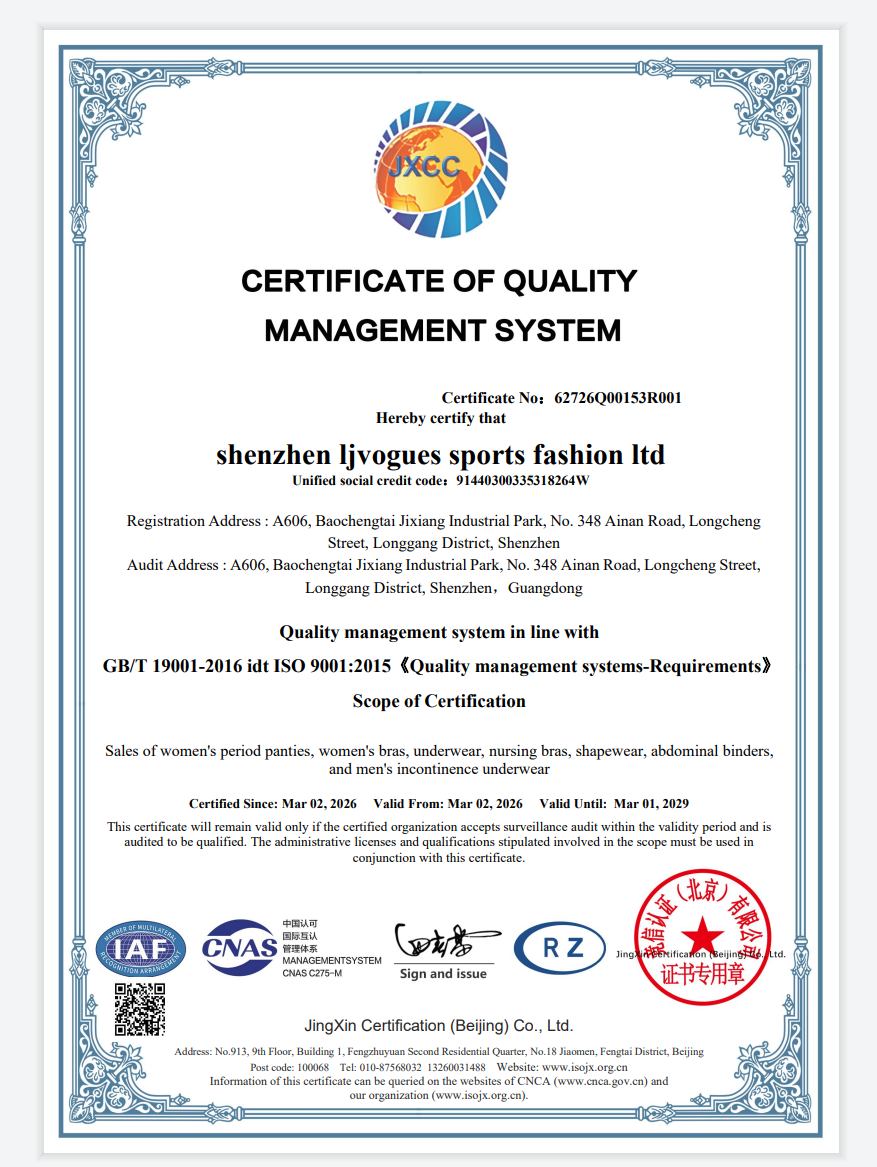
Ljvogues-IOS 9001 certificate
Frequently Asked Questions
Q1: Can I manufacture period underwear in India for under 100 pieces?
A few small workshop-scale units in Bengaluru and Delhi NCR will accept orders below 100 pieces, but expect very limited fabric choices, no absorbent core lamination capability, and inconsistent quality. At sub-100 pieces, you are essentially getting handmade samples, not production-grade goods. For genuine proof-of-concept, a minimum of 200 pieces per style is more realistic and will give you product quality that represents what you intend to sell.
Q2: What is the import duty for period underwear imported from China into India?
Under HS codes 6108.21 (cotton) and 6108.22 (synthetic), the current structure is: Basic Customs Duty of 20% of CIF value, Social Welfare Surcharge of 10% of BCD (2% of CIF), and IGST at 12% applied on the duty-inclusive value. The effective total landed cost overhead is approximately 34–36% above the CIF value. Verify current rates at CBIC India before import, as Union Budget announcements can revise rates annually.
Q3: Is it cheaper to manufacture period underwear in India or import from China?
At small volumes (under 1,000 pieces), domestic Indian sourcing is typically cheaper when you include the import duty overhead for Chinese goods. At 5,000 pieces and above, Chinese factory pricing — combined with superior fabric and core technology — can result in comparable or better per-piece economics, and the product quality premium often supports a higher retail price point. The economics depend heavily on the product specification: a basic organic cotton brief competes differently from a certified 40ml heavy-flow product.
Q4: Which city in India is best for sourcing period underwear?
It depends on your priorities. Delhi NCR is best for low-MOQ iteration (200–300 pcs) and fast domestic shipping. Gujarat (Ahmedabad/Surat) is best if organic cotton sourcing and fabric quality are central to your brand story. Maharashtra (Mumbai/Pune) is best if you want domestic manufacturing with export-grade QC documentation. Tamil Nadu (Tirupur) is best if you want deep cotton knitwear expertise. There is no single correct answer — evaluate based on your volume, product specification, and timeline.
Q5: Can I get GOTS-certified period underwear made in India?
Certified organic cotton fabric from GOTS-approved mills is available in India, particularly from Gujarat and Tamil Nadu. However, GOTS certification for a complete period underwear garment — including all functional layers — requires every component in the supply chain (fabric, thread, elastic, absorbent core, packaging) to be certified. Achieving full GOTS garment certification through Indian domestic manufacturers is possible but requires careful supplier selection and third-party audit. Most Indian period underwear manufacturers have not completed this certification process. Chinese manufacturers with established export compliance — including LJVOGUES — have this more readily available.
Q6: Do Indian factories make period swimwear?
Not commercially, as of 2026. Period swimwear requires a specialised DWR outer shell coating (PFAS-free versions are now standard in responsible manufacturing), a functional absorbent inner construction, and the ability to maintain absorbency while resistant to water ingress — a technically complex product. Indian manufacturers do not yet have this capability at commercial scale. If you want to include period swimwear in your range, Chinese manufacturing is currently the only viable source.
Q7: How long does it take to import period underwear from China to India by sea?
Ocean freight from Shenzhen or Guangzhou to Nhava Sheva (Mumbai) typically takes 14–18 days transit time. Factory production lead time for a confirmed order at LJVOGUES runs 35–45 days for a 1,000–5,000 piece run. Total time from order placement to goods arriving at your Indian warehouse — including production, transit, and customs clearance — should be planned at 55–70 days. Air freight (DHL/FedEx) for sample orders arrives in 3–5 working days.
Q8: What is the MOQ for Indian period underwear manufacturers?
MOQ varies significantly. Small workshop units in Delhi and Bengaluru may accept 100–200 pieces. Most mid-size domestic manufacturers have a floor of 300–500 pieces per style. Larger export-oriented factories in Maharashtra and Tirupur typically set their MOQ at 500–1,000 pieces. Confirm whether the stated MOQ is per style, per colour, or per total order — the answer affects your actual minimum commitment considerably.
Q9: Can Chinese period underwear be labelled "Made in India" for retail?
No. Country-of-origin labelling under Indian consumer protection regulations requires goods to accurately reflect the country of manufacture. Products manufactured in China and imported into India must be labelled "Made in China." Some brands source from China and rebrand under their own label without misrepresenting origin — this is standard private-label practice. Any attempt to misrepresent Chinese-manufactured goods as "Made in India" would violate Indian labelling laws and create significant brand liability.
Q10: Are there anti-dumping duties on Chinese period underwear imported into India?
As of 2026, there are no active anti-dumping duties specifically on women's period underwear from China. India does have a history of imposing anti-dumping measures on Chinese textile and garment products in various categories. Monitor the DGTR (Directorate General of Trade Remedies) for any new investigations or provisional measures affecting HS chapters 61 or 62.
Q11: What certifications should I ask for when sourcing period underwear from China?
For products sold in India, the minimum credible certification set for a premium period underwear brand is: OEKO-TEX® STANDARD 100 (tests for harmful substances in every component), 100% PFAS-free verified test report, and a factory social compliance audit (BSCI, SEDEX, or equivalent). For brands that want to claim organic materials, add GOTS certification. For brands exporting from India to the US or EU, FDA registration (US) and REACH compliance (EU) become relevant. LJVOGUES carries all of these certifications; always request the original certificate with registration number and verify it on the issuing body's website before use in your marketing.
Q12: Can LJVOGUES ship directly to my warehouse in India?
Yes. LJVOGUES ships directly to Indian ports (Nhava Sheva, Chennai, Mundra) for commercial orders, and via DHL India express for samples and small orders. We provide all required export documentation: commercial invoice, packing list, certificate of origin, OEKO-TEX certificate, and test reports. Our team supports Indian buyers through the documentation requirements for customs clearance at Indian ports. Import duty and customs handling on the Indian side are the buyer's responsibility — we recommend working with a licensed customs house agent (CHA) in India for first-time imports.
Start Your India Sourcing Conversation
The Indian period underwear market is at an early and high-growth stage. Whether you are building your first collection, adding a performance tier to an existing range, or looking to source period swimwear for your customers, the manufacturing decisions you make now will define your brand's quality ceiling and cost structure for years.
If you are an Indian brand founder or buyer evaluating your sourcing options — domestic manufacturing, Chinese import, or a hybrid of both — we are available to discuss your specific situation without obligation.
Contact LJVOGUES to request samples shipped to your Indian address (3–5 working days via DHL), a factory capability overview relevant to your product specification, or a price comparison exercise between your current or prospective domestic supplier and LJVOGUES production costs.
We have worked with 500+ global brands. We understand the India market, the import process,and the product requirements for Indian consumers. We look forward to hearing from you.