



Table of Contents
Why This Article Exists
Articles 1 and 2 of this series made the case for postpartum as its own engineering category, and walked through C-section construction specifically. Both articles were product-focused — what to build and why.
This article is the operational companion. If you're a brand owner who has read Articles 1 and 2 and is now thinking "okay, but how do I actually source this," this is the answer. The 12-question manufacturer audit, the MOQ economics, the lead-time map, the documentation chain, and the operational workflow from concept to first production run — all in one place.
The brand owners I talk to in this category fall into two groups. The first group has done the brand and product work — defined the positioning, designed the visual identity, scoped the product concept — but doesn't yet have a manufacturer. The second group has a manufacturer relationship that they're starting to question. Both groups need the same operational toolkit. Both groups need to know what to ask, what to expect to pay, and what documentation to insist on before signing a PO.
This article is that toolkit.

The Sourcing Path, in Six Stages
Most successful postpartum brand launches go through six stages between concept and first production:
Stage | What Happens | Calendar Time | Spend |
1. Manufacturer Vetting | Audit candidate manufacturers; pick a partner | 4–6 weeks | $0–500 |
2. Tech Pack Development | Translate concept into manufacturable specifications | 2–4 weeks | $0–2,000 |
3. Prototype / Sample Round | First physical samples; iterate on fit and feel | 4–8 weeks | $300–1,500 |
4. Pre-Production Sample (PPS) | Sealed sample matching first-PO specifications | 2–4 weeks | $200–800 |
5. Documentation & Compliance Setup | Certificates, TCs, lab testing, claim mapping | 2–4 weeks (parallel) | $1,500–3,500 |
6. First Production Run | First PO production + shipping | 6–10 weeks | $15K–80K (varies by MOQ) |
Total calendar time from contract to delivered first PO: typically 16–24 weeks.
Most brand owners I talk to estimate this at 8–12 weeks because they've heard "4 week production" and assumed that was the full process. The 4-week production number is real, but it sits at the end of a 12–20 week development sequence.
The brands that succeed in postpartum plan for this realistically. The ones that try to compress it typically hit one of three failure modes: rushing the prototype round (get a product that doesn't fit), skipping documentation setup (ship a product without TCs), or compressing the manufacturer vetting (sign with the wrong factory).

Stage 1: Manufacturer Vetting — The 12-Question Postpartum Audit
This is the single most consequential decision in your sourcing path. Get it right, and the next five stages are smooth. Get it wrong, and you're either accepting compromised product or restarting the search 6 months in.
The 12 questions, drawn from the engineering frameworks in Articles 1 and 2:
Engineering & Construction (Articles 1 & 2)
Question 1: Do you produce period underwear, postpartum underwear, or both — and how is your postpartum production different from your period production?
The right answer describes specific differences: different absorbent core technology (with SAP for incontinence-rated SKUs), different waistband construction (above-navel for C-section variants), different chemistry standard (Class I), different pattern grading (postpartum-specific). A factory that says "we just use a higher waist on the period pattern" is producing period underwear with a different cut.
Question 2: For C-section variants specifically, where does the structural waistband sit relative to the incision line, and is the front body panel single-piece or seamed?
The right answer is "above navel, 12–15cm above incision, single-piece front panel." Anything else is the period-panty-with-higher-waist construction.
Question 3: Is the compression structure knit-based (power mesh / graded knit) or elastic-based?
For postpartum and especially C-section variants, knit-based mechanical containment is the right answer. Elastic compression in the abdominal zone is contraindicated.
Question 4: What's the absorbency capacity of your heavy-stage SKU in ml, and does it use SAP for stress-incontinence performance?
For early postpartum / heavy-stage product, 60–100ml minimum is the target. SAP (super-absorbent polymer) is required for stress-incontinence performance. A factory that says "we use cotton terry only" is producing a lochia-only product, not a postpartum-incontinence product.

Chemistry & Documentation
Question 5: What chemistry standard do you apply to postpartum products — OEKO-TEX Class II or Class I?
Postpartum should be Class I (infant-grade limits) — formaldehyde under 16 ppm finished garment, stricter heavy metal extraction limits, full restricted-substance panel to infant standard. Class II is acceptable for general adult intimate apparel; not appropriate for postpartum's compromised-skin-barrier context.
Question 6: Are antimicrobial treatments used anywhere in your postpartum construction?
The right answer is a hard no. Silver, copper, zinc, triclosan, PHMB, quats — none of these belong in a product designed for postpartum recovery. Vaginal microbiome is already disrupted by delivery; antimicrobial finishes prolong and worsen the disruption.
Question 7: What adhesives are used in the construction, and are they water-based / heat-laminated only?
Solvent-based adhesives (DMF, MEK, toluene-based) off-gas slowly and are particularly problematic when the wearer's skin barrier is compromised. The right answer is heat lamination + water-based PU adhesive only, with SDS available for every adhesive.
Question 8: Will you provide GOTS Transaction Certificates per shipment, in our brand's name, for organic-content claims?
Same paperwork-chain principle as the period underwear context. A factory's GOTS Scope Certificate doesn't certify your specific shipment — only a Transaction Certificate does. Without per-shipment TCs in your brand's name, your "GOTS organic" or "Made with Organic" marketing claims are unsubstantiated.

Ljvogues' REACH certification
Operational & Commercial
Question 9: What's your minimum order quantity per SKU, and what's the unit cost curve from MOQ to 5,000 / 10,000 / 20,000 pieces?
Real numbers, in writing. A factory that gives you a single MOQ number without a cost curve isn't giving you the information you need to plan. A factory that gives you a different MOQ in every conversation isn't running a stable operation.
Question 10: What's your lead time from PO confirmation to FOB-ready, broken down by stage?
The honest answer is typically 6–10 weeks for postpartum production: 1–2 weeks fabric procurement, 2–3 weeks knitting/cutting, 2–3 weeks sewing/assembly, 1–2 weeks finishing/QC/packaging. A factory quoting 3–4 weeks is either skipping stages or quoting from finished-goods inventory (which doesn't apply to your custom production).
Question 11: What's your prototype/sample policy — cost per sample, lead time, and number of revisions before pre-production sample?
The right answer typically includes 2–3 prototype rounds at $50–200 per sample, with lead time of 2–3 weeks per round, and a clear path from prototype to PPS to production. A factory that won't quote prototype cost or that limits revisions aggressively is a factory that doesn't expect to develop products with you long-term.
Question 12: Will you sign a written commitment to all of the above on letterhead, with specific spec sheets for our SKUs, before we sign a production agreement?
The contractual question. A factory that will sign that commitment is a factory whose paperwork supports it. A factory that won't is a factory that wants to leave itself room to substitute.
How to Score the Audit
Use the same Green / Yellow / Red framework as the period series:
Result | Action |
All 12 Green | Strong candidate. Move to Stage 2. |
9–11 Green, 1–3 Yellow | Workable candidate. Document the Yellows and request written commitment to upgrade on specific items before first PO. |
Any Red | Stop. The factory is not a postpartum-engineering supply chain. Find another. |
The most common Red I see in my own free audits of competitor manufacturers is on Question 2 (waistband position / front body construction) — the factory shows what they call a "C-section variant" but it's actually a period panty with the waistband moved up. The second-most-common Red is on Question 5 (chemistry standard) — the factory is at OEKO-TEX Class II, not Class I, on postpartum products.
Both are fixable through factory upgrade — but they're upgrades the factory has to be willing to make, with cost and lead time implications. If the factory pushes back on either, that's diagnostic of where their priorities are.
Stage 2: Tech Pack Development
Once a manufacturer is selected, the next stage is translating your product concept into a manufacturable technical specification — the tech pack.
A complete postpartum tech pack includes:
Component | Detail |
Product specification sheet | SKU naming, target customer, intended use, recovery-stage positioning |
Pattern specification | Size run, grading rules, reference body measurements, postpartum-specific fit notes |
Bill of Materials (BOM) | Every fabric, every component, supplier, certification, weight per garment |
Construction specification | Seam-by-seam construction method, thread spec, stitch density, special construction notes |
Chemistry specification | OEKO-TEX class target, restricted substances list, finish chemistry restrictions |
Print and label specification | Care label format, brand label position, print method, ink chemistry |
Packaging specification | Primary, secondary, shipping packaging; barcoding; markings |
Quality assurance specification | AQL standards, defect classifications, inspection protocol |
For a brand new to postpartum, expect tech pack development to take 2–4 weeks, with significant back-and-forth between brand and factory. A good factory partners with you in this process — they bring engineering expertise, you bring brand and customer expertise. Neither side does the tech pack alone.
A common tech pack mistake in postpartum specifically: brands import their period underwear tech pack and edit the waist height. This produces a tech pack that misses postpartum-specific requirements (chemistry standard, absorbent core capacity, pattern grading, support structure) and ends up with a product that's a period panty in a different cut — exactly what Articles 1 and 2 warned against. The tech pack itself has to be postpartum-engineered from the start.

OQC testing standards
Stage 3: Prototype / Sample Round
The prototype round is where the tech pack becomes physical samples. For postpartum, expect 2–3 rounds typical, sometimes 4 for complex multi-stage SKU lineups.
Round | Focus | Output |
Prototype 1 | Construction concept proof — "does this work as described?" | First physical sample, often with substitute fabric and rough fit |
Prototype 2 | Fit refinement — "does this fit the postpartum body across the recovery window?" | Refined sample with target fabric, multiple sizes |
Prototype 3 | Final fit + chemistry + packaging | Production-target sample, ready for PPS approval |
For postpartum specifically, prototype testing should include fit testing on actual postpartum bodies if at all possible — not just standard fit models. Postpartum body shape is sufficiently different from a fit model that traditional sampling doesn't catch fit problems. Some brands run informal fit panels with their own postpartum customer base; others work with doula or postpartum-specialty consultants who can evaluate fit on representative bodies.
This is also the stage where chemistry samples should be sent for independent lab testing if you're committing to a Class I chemistry standard. Don't wait until production to verify the chemistry — verify it on the prototype, before committing to MOQ.
Stage 4: Pre-Production Sample (PPS)
The PPS is the sealed sample — the specific sample that defines what production will match. It's signed by both brand and factory, photographed, archived, and used as the reference standard for QC during the production run.
For postpartum, the PPS should be tested against the same audit you used in Stage 1:
Construction matches tech pack at every point?
Chemistry tests at Class I limits on this specific sample?
Fit performs across the postpartum recovery window?
Documentation chain (Scope Certificate, OEKO-TEX, GOTS TC framework) is in place?
Marketing claim mapping aligns to documents available?
If the PPS doesn't pass, do not sign off on production. The PPS is the last opportunity to catch issues before they multiply across thousands of units.
Stage 5: Documentation & Compliance Setup
Stage 5 runs in parallel with Stages 3 and 4 — it's not sequential. The documentation chain has to be in place before the first PO ships, which means starting it in parallel with prototype work.
The documentation bundle for postpartum is:
Document | Source | Purpose |
Factory Scope Certificate (GOTS) | Factory | Establishes factory eligibility for organic claims |
Factory OEKO-TEX Standard 100 (Class I, finished garment) | Factory | Substantiates chemistry compliance at infant standard |
Independent finished-garment lab test report | Eurofins / SGS / Hohenstein | Verifies chemistry independently of factory statements |
Bill of Materials with component certifications | Factory | Documents synthetic specifications |
Construction Spec Sheet | Factory | Documents adhesive, seam, label specifications |
Pre-Production Sample sign-off | Brand + Factory | Defines production reference standard |
GOTS Transaction Certificate framework | Factory + certification body | Sets up TC issuance for every shipment |
Marketing Claim Mapping | Brand | Maps each marketing claim to a specific supporting document |
Retailer Compliance Packs (if applicable) | Brand | Pre-formatted for major retailer requirements |
SAP Safety Documentation (if used) | Factory | Documents SAP source, GRS certification, safety profile |
The SAP documentation deserves emphasis. If your stress-incontinence-rated SKUs use SAP (super-absorbent polymer) — which they should, per Article 1 — the SAP source and safety documentation has to be in your compliance folder. SAP itself is generally well-characterized and safe in textile applications, but the chemistry has to be specified, certified, and traceable. Brands citing "incontinence-grade absorbency" without SAP documentation are making a claim they can't substantiate.
Stage 6: First Production Run
By the time you reach Stage 6, the hard work is done. Production runs against the PPS, with documentation already in place. The 6–10 week production window includes:
Week | Activity |
Week 1–2 | Fabric procurement, including upstream certificate verification (TC chain) |
Week 2–3 | Cutting, panel preparation |
Week 3–6 | Sewing, assembly |
Week 6–7 | Pre-wash, cure time, finishing |
Week 7–8 | QC inspection, packaging |
Week 8–9 | Documentation finalization (TC issuance, lab testing if final-shipment), shipment prep |
Week 9–10 | Shipping (FOB to destination port; brand handles inbound logistics) |
Per-shipment verification (the Phase B workflow from the period series — Steps 5, 6, 7) runs at the end of this stage:
TC issued in brand's name, references PO, quantity matches
Documentation bundle assembled in compliance folder
Marketing claims validated against documentation
MOQ and Cost Economics for Postpartum
Brand owners almost always have one specific question I haven't fully answered yet: how much does this actually cost at typical MOQ?
Here's the honest answer for postpartum specifically, building on the Tier 1/2/3 framework from the period series.
MOQ Tiers and Unit Cost
Production Tier | MOQ per SKU | Unit Cost FOB (Tier 3, Class I chemistry) | Total First-Run Spend (1 SKU) |
Launch / Validation | 1,500–2,500 pieces | $11–14 | $20K–35K |
Standard | 3,000–5,000 pieces | $9–12 | $30K–60K |
Scale | 10,000+ pieces | $7.50–10 | $75K–100K+ |
These are real numbers for postpartum at our Tier 3 specification — meaning Class I chemistry, GOTS organic cotton, ROICA V550 spandex, polyether phthalate-free TPU, water-based adhesive, knit-structure mechanical support for C-section variants, single-piece front body construction, full documentation chain.
Why postpartum costs more than period:
More fabric per garment (above-navel waistband, longer body)
More complex pattern (single-piece front, no incision-zone seams)
Higher chemistry standard (Class I vs Class II — more testing, more verified inputs)
Knit-structure mechanical support adds fabric cost and labor
SAP-incorporated cores add component cost and assembly complexity
Pattern grading is postpartum-specific, not adapted from period sizing
More documentation overhead per shipment (SAP safety, expanded chemistry panel)
The total finished-garment cost premium for postpartum at Tier 3 specification is typically 40–60% over period at Tier 3 specification — which translates to retail price points typically 30–50% higher than equivalent-tier period products.
Multi-SKU Launch Economics
For brands launching multiple postpartum SKUs (e.g., heavy-stage + transitional + C-section variant), MOQ and cost can be optimized:
Strategy | MOQ | First-Run Spend | Trade-off |
Single-SKU launch | 1,500 pieces single SKU | $20K | Limited product range; harder to validate market preferences |
2-SKU launch | 1,500 pieces × 2 SKUs = 3,000 total | $35K | Heavy + transitional, or general + C-section variant |
3-SKU full lineup | 1,000 pieces × 3 SKUs = 3,000 total | $40K | Full multi-stage lineup; higher per-unit cost on smaller per-SKU runs |
The 1,000-piece-per-SKU threshold is what we offer for new brand launches as the floor. Below that, the per-unit cost scales up significantly because of fixed costs per production run (pattern setup, fabric minimum orders, machine setup, QC overhead) that don't divide well across very small quantities.
What Drives Higher MOQ at Other Factories
Most postpartum-capable factories quote MOQs of 3,000–5,000 per SKU as their minimum. Two reasons:
Fabric MOQ from upstream mills. Specialty fabrics (GOTS organic cotton interlock, power mesh blends) often have minimum order quantities of 500–1,000 yards, which translates to 3,000–5,000 garments depending on fabric per piece. Factories that don't keep these fabrics in stock require the brand to fund the fabric minimum.
Production line setup amortization. Setting up a production line for a custom SKU has fixed cost. Spreading that cost across 1,500 pieces produces a per-unit cost premium that some factories find unworkable.
We address both at Ljvogues by maintaining inventory of the standard postpartum fabrics in our system (GOTS organic cotton, ROICA V550 spandex, polyether TPU, etc.) — meaning new brand partners don't have to fund the fabric minimum themselves. This is part of why we can offer 1,500-piece MOQ where many factories quote 3,000+.
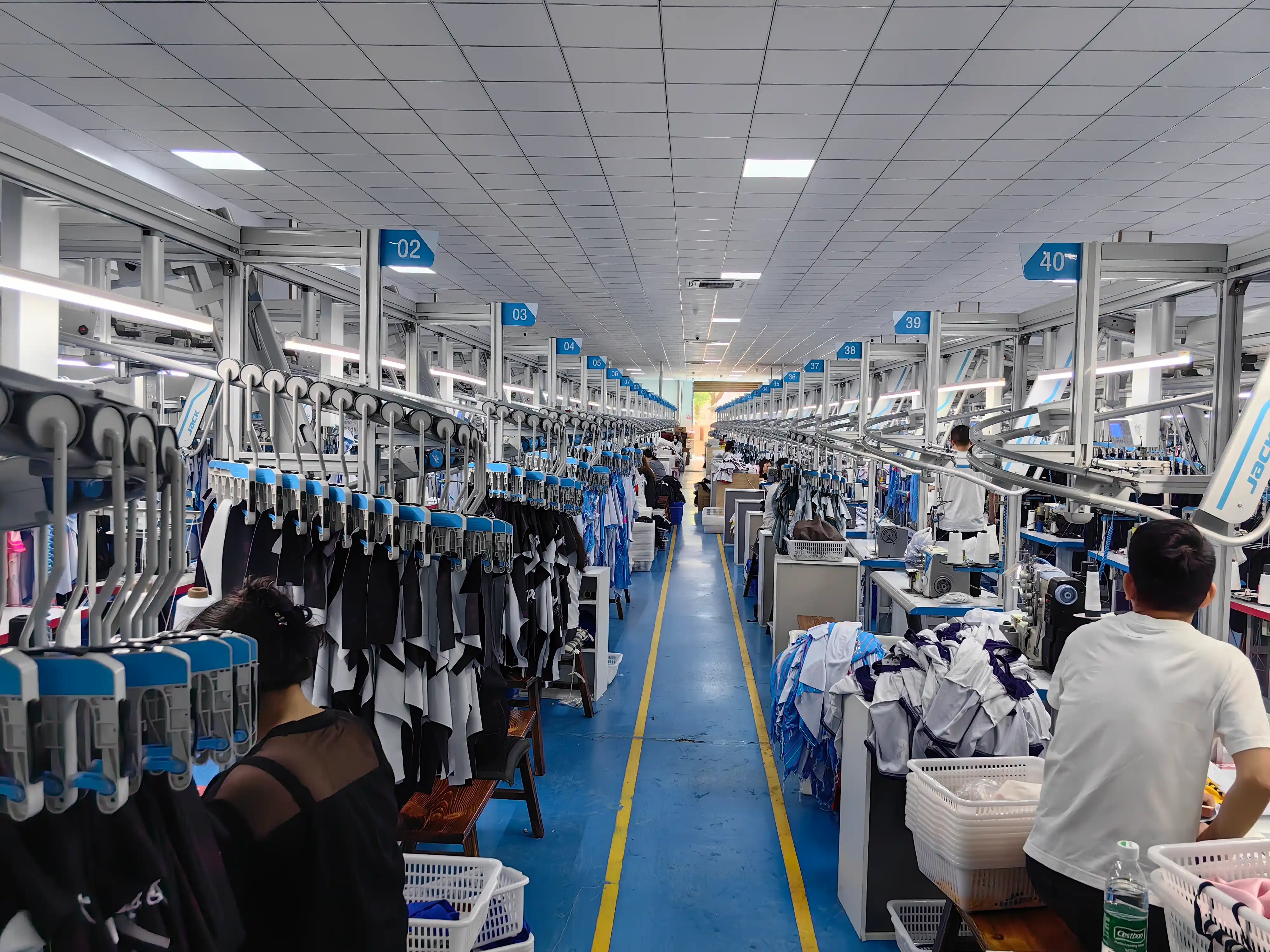
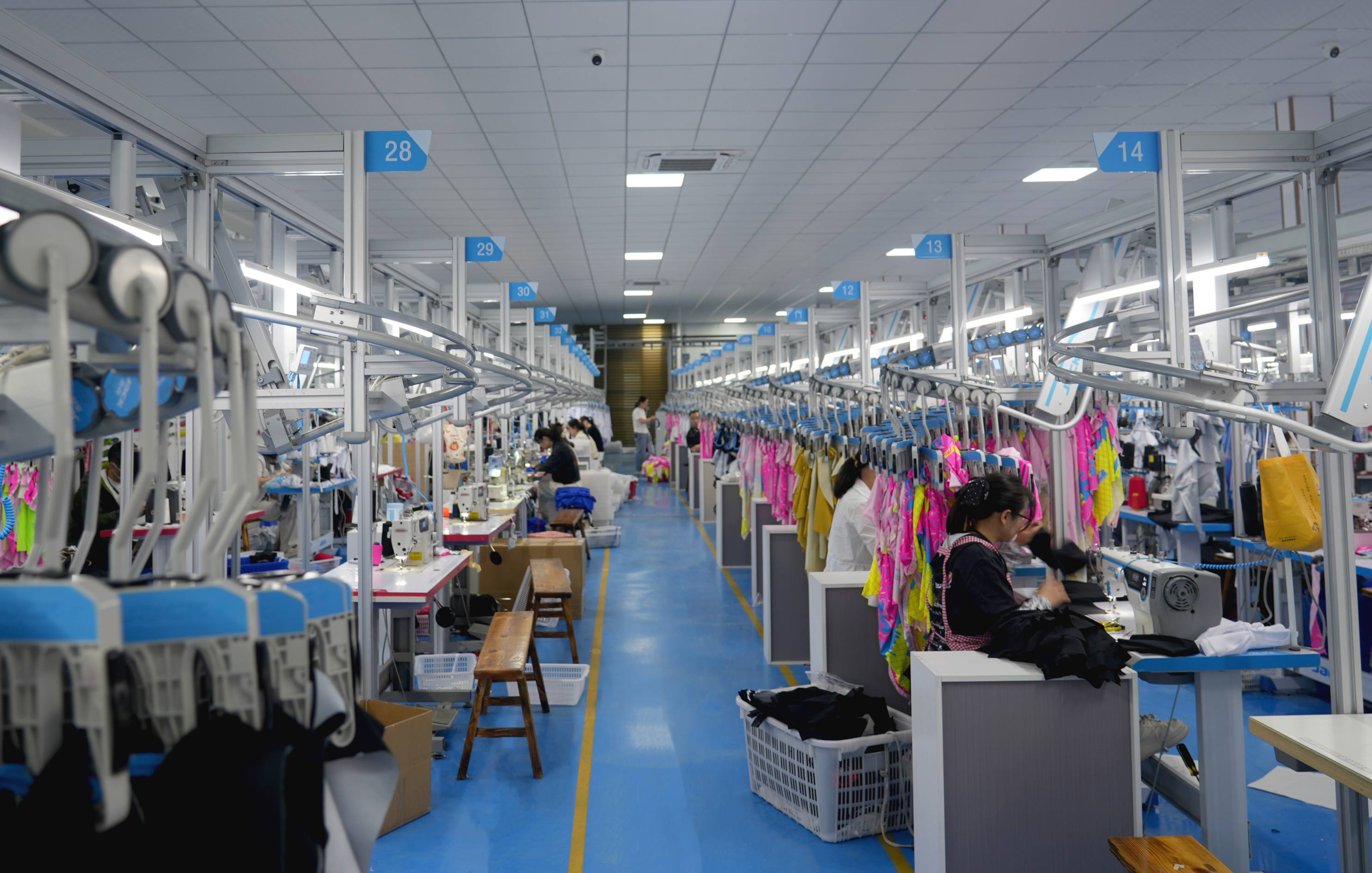
Ljvogues' hanging sewing production line
Lead Time Map
Realistic lead time expectations for a new brand from contract signing to delivered first PO:
Stage | Time | Cumulative |
Stage 1 (already complete by this point) | — | — |
Stage 2: Tech pack development | 3 weeks | Week 3 |
Stage 3: Prototype rounds (2 rounds) | 6 weeks | Week 9 |
Stage 4: Pre-production sample | 3 weeks | Week 12 |
Stage 5: Documentation setup | (parallel with Stage 3 & 4) | — |
Stage 6a: Production | 8 weeks | Week 20 |
Stage 6b: Shipping (FOB to US/EU port) | 2–4 weeks | Week 22–24 |
Total: Contract signing to delivered goods | ~22–24 weeks |
For brands operating on aggressive launch timelines, the compression points are:
Skip Prototype 2 if Prototype 1 is acceptable (saves 3 weeks; risk: production lock against insufficient fit data)
Run documentation setup early so it's not a Stage 6 dependency (saves 0–2 weeks)
Pre-stock fabric if your manufacturer doesn't already (no time saving but locks in cost)
Air freight instead of ocean (saves 2–3 weeks but adds significant per-unit cost)
The fastest realistic timeline I've seen for a successful postpartum launch from contract signing is 16 weeks. Anything compressed below that typically results in either a defective product, a documentation gap, or both.
What "Defensible Postpartum Sourcing" Looks Like End-to-End
Pulling all of the above together, here's what a successful postpartum brand launch looks like operationally:
Stage | What's Happening | Documentation Output |
Stage 1 | Audited 3 candidate manufacturers; selected one against the 12-question audit | Factory selection memo with Green/Yellow/Red scoring |
Stage 2 | Co-developed tech pack with factory's engineering team | Complete tech pack signed by both parties |
Stage 3 | 2 prototype rounds; fit-tested on representative bodies; chemistry tested independently | Prototype evaluation reports; lab test results |
Stage 4 | PPS approved; sealed sample archived | Signed PPS sign-off document |
Stage 5 | Documentation chain assembled in compliance folder | OEKO-TEX, GOTS Scope, BOM, construction spec, lab tests, claim mapping |
Stage 6 | First production; per-shipment TC issued; documentation bundle delivered with shipment | Shipped goods + complete shipment compliance bundle |
By the time the first shipment arrives at your warehouse, you have:
A product that's actually engineered for postpartum (not period in a different cut)
A documentation chain that survives regulatory and retailer compliance review
A manufacturer relationship structured for repeat orders without re-doing the foundation
A defensible position for whatever marketing claims your brand wants to make
This is what professional postpartum sourcing looks like in 2026. It's more rigorous than most brands realize before they start. It's also the difference between a brand that scales sustainably and a brand that hits a compliance issue 18 months in.
Where Ljvogues Stands on Postpartum Sourcing
Same transparency principle applied across the entire series:
We pre-pass the 12-question audit for every brand we onboard. All 12 answers are documented in writing as part of standard onboarding — no need for brands to extract them from us.
We maintain inventory of standard postpartum fabrics — GOTS organic cotton interlock, ROICA V550 spandex, polyether phthalate-free TPU, GRS-certified rPET, OEKO-TEX certified threads — so brands don't fund fabric minimums themselves.
Our MOQ is 1,500 pieces per SKU for new brand launches; lower per-unit cost at 3,000+ per SKU. Multi-SKU launches can split MOQ down to 1,000 per SKU at 3,000+ total.
Our finished-garment FOB price for postpartum at Tier 3 specification ranges $9–14 USD depending on quantity and complexity. We can quote at this tier confidently because we already have the specifications and documentation chain in place.
We offer prototype rounds at $100–200 per sample with 2–3 rounds standard before PPS, including fit refinement and chemistry verification.
We provide GOTS Transaction Certificates per shipment, in brand's name, with PO reference. We will not ship as GOTS / Made with Organic without a TC.
We test postpartum products to OEKO-TEX Class I limits as factory standard — formaldehyde under 16 ppm, full restricted-substance panel to infant standard.
We offer free Stage 1 audit services for brands evaluating other manufacturers — send us their certificates and a sample, and we'll run the 12-question audit and write you a written report with specific findings.
If a brand asks us for any document at any stage, we send it. If a brand asks us to walk through our 12-question audit answers in detail, we do. If a brand asks us to review another factory's documentation, we do that for free. That's the bar.
Frequently Asked Questions
I have a brand concept and visual identity ready. How quickly can I move to first samples?
If you're ready to engage a manufacturer this week, you can typically have first prototypes in hand in 5–8 weeks: 2–3 weeks for tech pack development, 3–5 weeks for first prototype production. From there, expect another 14–18 weeks to delivered first PO.
The bottleneck for most early-stage brands is not the manufacturer's speed — it's the brand's clarity on specifications. Brands that arrive at Stage 2 with a complete product brief move through Stage 2 in 2 weeks. Brands that are still developing the product concept during Stage 2 often spend 6+ weeks there.
Is white-label / private-label different from full OEM development?
Yes, meaningfully. White-label / private-label means you're choosing from a manufacturer's existing product designs and adding your brand. OEM (Original Equipment Manufacturing) means co-developing a custom product to your specifications. The trade-offs:
White-label | OEM | |
Lead time | 6–10 weeks (existing patterns, just rebrand) | 16–24 weeks |
MOQ | 500–1,500 per SKU typically | 1,500–3,000 per SKU typically |
Customization | Limited (label, packaging, sometimes color) | Full (every spec) |
Differentiation | Limited; competitors can use same base | Full brand-specific product |
Investment | $5K–15K first run | $20K–80K first run |
Documentation | Inherited from factory's existing certifications | Built specifically for your SKU |
For brands with strong differentiation in their positioning, OEM is typically the right answer despite higher cost and longer lead time. For brands testing market fit or operating on tight initial budgets, white-label is a viable launching strategy with the option to transition to OEM as the brand scales.
We offer both at Ljvogues. Brand owners who haven't decided which path is right for them often get clarity in a 30-minute call where we walk through the trade-offs against their specific positioning.
What does a typical postpartum brand spend on first production for the first 12 months?
For brands launching with a single SKU at 1,500-piece MOQ:
First production: $20K–25K
Documentation and lab testing: $1.5K–3.5K
Reorder at 12 months (2,500-piece run): $25K–30K
Year 1 manufacturer spend: $45K–60K
For brands launching with multi-SKU lineup at 3,000-piece total (1,000 per SKU):
First production: $35K–45K
Documentation and lab testing: $2K–4K
Reorder cycle (twice in year 1, growing volume): $60K–90K
Year 1 manufacturer spend: $95K–140K
These are direct manufacturer costs, not including inbound logistics, warehousing, marketing, or other operating costs. For brands raising capital or budgeting against revenue, planning for $50K–150K first-year manufacturer spend on a serious postpartum launch is realistic.
Can I source postpartum from the same factory as period?
Possibly, if the factory genuinely produces postpartum (not period in a different cut). The 12-question audit identifies whether your existing period factory is postpartum-capable. If they are, sourcing both from the same factory simplifies operations and improves your negotiating position on MOQ and cost.
If they aren't postpartum-capable — if they fail Question 1, 2, 3, or 5 in particular — sourcing postpartum from them is a mistake regardless of how well the period relationship has worked. The categories require different engineering, and a factory that doesn't have postpartum engineering will produce a postpartum product that fails.
What about sourcing from Vietnam, Pakistan, or other regions instead of China?
Each region has structural strengths and weaknesses for postpartum specifically:
China — broadest manufacturer base, deepest specialty chemistry capability, strongest documentation infrastructure (largest concentration of OEKO-TEX, GOTS, GRS-certified factories globally). For Tier 3 specification with full documentation, China remains the highest-density supply base.
Vietnam — strong garment construction capability, growing in technical apparel, but specialty chemistry and certifications are less developed for postpartum specifically. Often a workable answer for Tier 2 specification.
Pakistan — strong cotton supply chain, growing in organic cotton specifically, but less developed in postpartum-engineered products and synthetic specialty (TPU, SAP) sourcing.
India — strong organic cotton supply chain and increasingly strong in intimate apparel, but documentation chain consistency varies more than in China.
Portugal / Eastern Europe — premium positioning, smaller scale, often used for Tier 3 European-market launches with EU-origin marketing positioning.
The right answer depends on your brand's specific requirements, target markets, and trade-off priorities. We're based in China and we believe China remains the right answer for most Tier 3 postpartum sourcing — but the brands making different choices have legitimate reasons for those choices.
How does this work for Amazon-only or DTC-only brands vs. brands targeting traditional retail?
The product engineering is the same. The documentation chain priorities differ:
Amazon-only brands — focus heavily on customer-review-management (postpartum customers leave detailed reviews; engineering choices show up in reviews fast), Amazon's own restricted substance list compliance, and chemistry transparency in product listings.
DTC-only brands — focus on direct customer education (postpartum customers research extensively before buying), claim-to-document mapping for marketing materials, and customer service capability for fit and recovery questions.
Traditional retail (Buy Buy Baby, Target Baby, specialty maternity retail) — focus on retailer compliance pack preparation (each major retailer has specific certificate and documentation requirements), barcoding and packaging compliance, and merchandising-grade packaging.
Hospital systems / institutional — focus on hospital laundry compatibility (some hospitals do garment laundry; engineering must accommodate), institutional purchasing compliance documentation, and professional-recommendation documentation.
For brands in early stage, DTC + Amazon is the typical first phase. Traditional retail and hospital expansion typically come at Year 2+ and require additional documentation buildout.
Does the workflow change for an established brand vs. a startup?
Established brands (with existing manufacturer relationships in adjacent categories — period underwear, maternity wear, intimate apparel) can compress Stage 1 (manufacturer vetting) significantly if their existing manufacturer is postpartum-capable. The remaining stages are essentially the same.
Startups typically need to invest more time in Stages 1 and 2 — both because they're building manufacturer relationships from scratch and because the tech pack development requires more iteration when the brand is also developing its positioning in real time. Factor an extra 3–6 weeks for startups vs. established brands.
Where do most brand launches fail?
Three patterns, ranked by frequency:
Skipping Stage 5 (documentation setup) until after first production. Brand discovers post-shipment that they don't have TCs for marketing claims, OEKO-TEX certification doesn't actually cover their finished garment, chemistry isn't independently verified. By then it's expensive to retroactively fix.
Underspecified tech pack (Stage 2) leading to product variance across production runs. Brand approves PPS but production drifts away from PPS over multiple POs because the tech pack didn't lock in critical specs. Quality issues develop slowly and become visible only in customer review patterns.
Wrong manufacturer choice (Stage 1). Brand chose a factory based on price or speed without rigorous audit. Six months in, the factory can't deliver the documentation, chemistry, or construction the brand is marketing. Brand has to restart with a different manufacturer, losing 6 months and the first PO investment.
The 12-question audit and the Stage-by-Stage workflow in this article are designed to prevent all three. They're not optional for a serious launch.
Closing the Postpartum Series
This is the third and final article in the postpartum series. Across these three articles:
Article 1 established why postpartum is its own category — three different fluids, different absorbency curves, different chemistry standards, different fit dynamics, different customer buying journey.
Article 2 went deep on C-section engineering specifically — waistband position, single-piece front construction, knit-structure mechanical support vs. elastic compression, fabric selection for the incision zone, pattern grading for postpartum body shape change.
Article 3 (this article) translated the engineering into operations — the 12-question manufacturer audit, the six-stage sourcing workflow, MOQ and cost economics, lead time map, documentation chain.
Together with the 8-article period underwear series, brand owners now have roughly 80,000 words of technical and operational reference material on building defensible positions in this category. If you're using the framework, the right path forward is to start running the audits and the workflow on your current or prospective suppliers. The brand owners who do this consistently are the ones building positions that survive regulatory enforcement, retailer compliance audits, and class-action discovery.
The brand owners who don't — who continue to operate on supplier statements without verification, marketing claims without documentation, and "we'll figure it out later" sourcing — are increasingly at structural risk as the regulatory environment tightens through 2026–2028.
The window for being early is closing. The toolkit is in these articles. The next move is yours.
Talk to Us
If you're at any stage of postpartum sourcing — concept, manufacturer evaluation, tech pack development, or production reorders — we offer 30-minute development calls free of charge. We've helped dozens of postpartum brands move from concept to scaled production, and we can usually map the specific path forward in a single call.
Common ways brands engage with us:
"Run the 12-question audit on my current manufacturer" — Free. Send us their documentation and a sample. Written audit report in 5–7 business days.
"Quote a Tier 3 postpartum specification at our target MOQ" — Free quote, typically returned in 3 business days with full BOM and timeline.
"Walk through our brand concept and recommend the right product architecture" — Free 30-minute call. We'll map your concept against the multi-stage SKU framework and identify which products to launch with vs. add later.
"Develop our first postpartum SKU end-to-end" — Standard OEM engagement. Stage 1 already passed; Stages 2–6 typically run 16–22 weeks at $20K–50K first-PO investment depending on MOQ and complexity.
WhatsApp: +86-199-2880-2613
About Ljvogues
Ljvogues (USPTO Reg. No. 6,378,310) is a Shenzhen-based OEM and private label manufacturer specializing in period underwear, postpartum underwear, incontinence underwear, and functional intimate apparel. Since 2015, we have served 500+ brands across 108 countries.
Postpartum-specific operational standards:
12-question audit pre-passed and documented at brand onboarding
1,500-piece MOQ for new brand launches; 1,000 per SKU for multi-SKU launches at 3,000+ total
$9–14 FOB at Tier 3 specification (Class I chemistry, GOTS, ROICA V550, single-piece front construction)
16–24 week typical timeline from contract to delivered first PO
2–3 prototype rounds standard at $100–200 per sample
Standard postpartum fabrics held in factory inventory (no fabric MOQ funding required)
GOTS Transaction Certificates issued per shipment, in brand's name, with PO reference
OEKO-TEX Class I chemistry standard on all postpartum production
Multi-stage SKU architecture available — heavy / transitional / recovery / C-section variants
Free Stage 1 audit services for brands evaluating other manufacturers
Every stage has a workflow. Every workflow has a deliverable. Every deliverable has documentation. That's the bar.
— End of the Postpartum Underwear Series.