



Table of Contents
Transparency note: Ljvogues is a period underwear OEM manufacturer based in Shenzhen. This guide is written to be genuinely useful to any brand evaluating Chinese suppliers — including those who ultimately work with our competitors. Our interest is making the buyer side smarter, because educated buyers make better partners.
In April 2026, the Texas Attorney General opened an investigation into Lululemon over alleged PFAS contamination in their athletic wear. Stock dropped 22% in a single year. The legal fees alone will outweigh ten years of QC budget.
That story is not about Lululemon. It is about every brand that ever sourced an absorbent textile product without rigorously verifying what their factory actually puts into it.
Period panties are one of the highest-stakes categories in private label apparel. The product sits against vulvar skin for 8–14 hours. It absorbs blood, retains it, and is washed 100+ times. A construction failure means leaks at the user's worst possible moment. A chemical failure means a regulatory crisis that ends a brand.
I have spent over a decade manufacturing functional intimate apparel. The brands that succeed in this category — and the ones that quietly disappear after their first 10,000-unit order — make the same recurring mistakes at the sourcing stage. Here are the five that cost the most.
Mistake 1: Treating Period Panties Like Regular Underwear with a Pad Sewn In
The most fundamental error — and the one that produces the highest return rates in the category.
Period panties are not underwear with a thicker gusset. They are a multi-layer engineered system in which each layer performs a distinct function:
Layer | Function | What Goes Wrong if Missing or Cheap |
Top sheet (skin contact) | Rapid liquid acquisition — pulls fluid away from skin in <3 seconds | "Wet feeling" sensation; surface rewet during pressure (sitting, sleeping) |
Acquisition / distribution layer (ADL) | Spreads fluid laterally across the absorbent zone | Pooling at one point, side leakage, premature saturation |
Absorbent core (microfiber or SAP-encapsulated) | Locks fluid into the structure | Inadequate volume capacity; rewetting under body weight |
Waterproof barrier (PFAS-free TPU) | Prevents strike-through to outer fabric | Visible leaks through to clothing |
Outer shell | Aesthetic + secondary moisture management | Bunching, visible panty line, fabric degradation |
When a factory quotes a price that is 30% below the market for "period underwear," they are usually achieving that by:
Skipping the ADL layer entirely — the core gets fluid only at the contact point, leaving 60% of the absorbent capacity unused
Using a cheap polyurethane film instead of certified TPU — survives 20 washes, then begins to delaminate
Eliminating the moisture-wicking top sheet — replacing it with a flat woven that holds fluid against the skin
Your customer experiences this as "the underwear leaks" or "feels wet." She does not know the technical reason. She knows she will not buy from your brand again.
What to do instead: Ask your manufacturer to walk you through every layer in their gusset construction by name and basis weight (GSM). If they cannot — or if they describe it generically as "multi-layer absorbent technology" — you are speaking to a sales agent, not a manufacturer.
A qualified supplier should be able to provide:
Layer count (industry standard: 4 layers minimum, 5 for heavy/overnight)
GSM (grams per square meter) for each layer
Core technology: microfiber terry vs. SAP encapsulated
Barrier specifications: TPU thickness, MVTR breathability rating, PFAS verification

Ljvogues menstrual underwear with four-layer structure
Mistake 2: Choosing the Lowest Bidder
Period panties is the wrong category for price-driven sourcing. The hidden costs of choosing on price alone consistently exceed the savings.
Here is the math most emerging brands do not run before placing their first PO:
Cost Factor | Premium Supplier ($8/unit) | Cheapest Supplier ($5/unit) |
Per-unit cost on 5,000 units | $40,000 | $25,000 |
Return rate (industry benchmark: 8% premium / 25% cheap) | $3,200 in lost goods | $6,250 in lost goods |
Customer acquisition cost wasted on one-time buyers | Modest | $15–40 per lost customer |
Replacement production cycle if QC fails on bulk | None | 6–10 weeks delay + remake cost |
Brand reputation damage from negative reviews | None | Difficult to quantify; persistent |
Total realistic cost | ~$45,000 | ~$55,000–80,000+ |
The cheaper supplier is rarely cheaper by the time you have absorbed the consequences.
What to do instead: Calculate your total cost of ownership — not just the FOB price.
Ask each supplier under evaluation:
What is your return rate on the period underwear you currently produce?
Can you provide a customer reference whose return rate I can verify?
What is your QC inspection standard (AQL 2.5? 1.0?) and what happens if a batch fails?
If a production run has issues post-shipment, what is your remediation policy?
The supplier that hesitates on these questions is the one whose price is lowest because the unspoken costs are absorbed by you.

Ljvogues' AQL Report
Mistake 3: Ignoring PFAS and Chemical Safety Compliance
This is the single highest-stakes mistake in 2026.
The regulatory landscape has shifted dramatically:
Jurisdiction | PFAS Status | Effective Date |
California (AB 1817) | All textiles must be PFAS-free | January 2025 ✅ Active |
New York | PFAS prohibited in apparel | Active 2025 |
Connecticut | Outdoor apparel disclosure required | January 2026 ✅ Active |
France | National PFAS textile ban | 2026 ✅ Active |
Denmark | PFAS clothing import/sale ban | July 2026 |
EU REACH (proposed) | Universal PFAS restriction | Expected 2027–2028 |
Texas AG | Active investigation into Lululemon | April 2026 ✅ Ongoing |
If your products contain PFAS — and your marketing claims "safe," "clean," or "wellness" — you are exposed to legal action even before bans formally activate. The Lululemon investigation is specifically examining whether their marketing misled health-conscious consumers. That is a precedent that applies to every period panties brand selling in the US.
The mistake most buyers make: Accepting a "PFAS-free" claim from the factory based on a fabric supplier declaration. This is not sufficient.
What to do instead: Demand a third-party lab test report on the finished garment, not just the raw fabric.
The verification chain that protects your brand:
PFAS-free finished-product test from an accredited lab (Eurofins, SGS, Bureau Veritas, Intertek)
REACH/SVHC compliance report covering the current 253 substances of very high concern
OEKO-TEX Standard 100 certificate with verifiable certificate number
Material composition disclosure for all absorbent layers (not "proprietary blend")
Banned amines test (Annex XVII Entry 43) for fabric dyes
Nickel release test for any metal hardware (clasps, hooks)
Formaldehyde test for finishing chemicals
At Ljvogues, every product line ships with these reports automatically — not on request. That is not a marketing point. It is the only operating standard that makes period underwear manufacturing legally and ethically defensible in 2026.
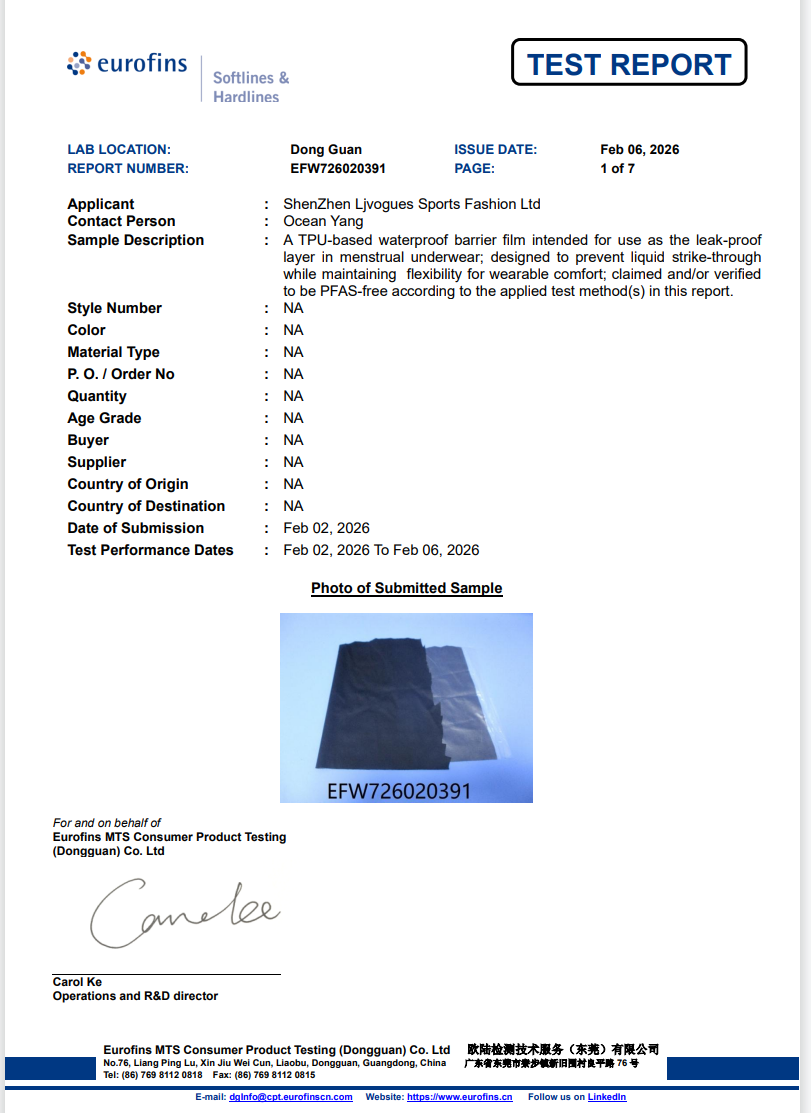
Ljvogues' PFAS-Free Test Report
Mistake 4: Partnering With a Factory That Cannot Scale With You
A factory that delivers a perfect first order is not necessarily a factory that can support your second year of growth.
The brands I see hit walls 12–18 months after launching are rarely killed by their first order. They are killed by the second category extension — when they want to add overnight styles, sport-specific designs, postpartum lines, or men's incontinence — and discover their manufacturer can only do one thing.
Common scaling failures:
Limited size range: Factory does S–L only. Your brand wants XS–3XL for inclusivity. Either limit your market or change suppliers (and lose your tech pack).
No category breadth: Factory makes daily-wear panties only. You want to launch period swimwear or sport leggings. Different machinery, different fabric expertise, different barrier tech — your factory cannot help you.
Fixed absorbency: Factory produces one absorbent core construction. You want light/moderate/heavy/overnight tiers. They quote the same core thickness for all four — and your overnight style fails.
Capacity ceiling: Factory has 30,000 units/month total capacity. Your fall reorder needs 25,000 units in 4 weeks. Your order goes to the back of the queue.
No R&D capability: When your customer feedback identifies a fit issue, the factory has no in-house pattern engineer to solve it — every adjustment becomes a slow, external process.
What to do instead: Evaluate manufacturing partners on technical breadth, not current order fit.
Questions that reveal scalability:
What categories do you currently produce beyond period panties? (Period swimwear, sport, incontinence, postpartum, nursing bras?)
What absorbency range can you deliver? (Specific ml capacities, not "light to heavy")
What is your monthly production capacity, and what is current utilization?
Do you have in-house pattern development for size grading XS–3XL?
If I want to add a new style 12 months from now, what is your typical development timeline?
A factory that produces only a single product can, at best, be considered a mere supplier; however, a facility capable of building a comprehensive ecosystem of functional intimate apparel—spanning menstrual care, incontinence support, activewear, and swimwear—is the true partner that can walk alongside you for a decade. This distinction often becomes strikingly evident by the 18th month of collaboration.

Ljvogues' Design Process
Mistake 5: Overlooking Pattern Engineering and Fit Validation
Fit is the most underestimated technical challenge in period panties manufacturing — and the source of more 1-star reviews than any other single factor.
Standard underwear sizing does not work for absorbent garments. Here is why:
Variable | Standard Underwear | Period Panties |
Gusset behavior | Flat, lightweight, follows body contour | 4–5 layers, becomes heavier when wet, shifts under gravity |
Compression dynamics | Uniform across garment | High at gusset, low at outer panels — needs calibration |
Fit through wear cycle | Stable across 8–12 hours | Changes as gusset absorbs (wet weight 3–5x dry weight) |
Layer interaction with leg opening | Single-layer transition | Multi-layer transition — gapping point if not engineered |
Size grading impact | Linear scaling | Non-linear — gusset position must shift relative to torso |
A factory that uses standard underwear patterns for period panties produces predictable failures:
Side leakage — gusset width does not scale with hip measurement, so XL bodies leak from sides
Gusset migration — without a properly engineered seat-to-gusset ratio, the absorbent zone shifts during sleep or movement
Gapping at the leg opening — multi-layer transition is bulky if the pattern does not flatten the seam line
VPL (visible panty line) — heavier gusset construction shows under fitted clothing if the surrounding fabric is not properly graded
Overnight fit failures — gusset designed for daytime wear migrates when the user is horizontal and side-sleeping
Fit is not solved by buying samples and "wearing them yourself." It requires dedicated absorbent garment pattern development, ideally tested across multiple body types before bulk commitment.
What to do instead:
Request pre-production fit samples in your full size range — not just M and L. If a factory can only show you S–L, that is your real size capability, regardless of what their catalog says.
Conduct wear testing across your target demographic — minimum 5–8 testers per size, wearing through full menstrual cycle on different flow days.
Ask the factory for size-grading documentation — proper period panty grading shows non-linear gusset placement adjustments across the size range. Linear grading (everything scales proportionally) is the red flag.
Test the dynamic fit — fit when dry, fit when fully saturated, fit after 50 washes. A pattern that works at wear #1 and fails at wear #50 is not a real product.
Verify in-house pattern engineering capability — does the factory have a dedicated patternmaker for absorbent garments, or do they outsource? In-house capability means faster iteration when fit issues emerge in the market.
Supplier Comparison: Key Evaluation Criteria
Criteria | Low-Cost Supplier | Quality-Focused Supplier |
MOQ | 500–1,000 pieces | 500–1,000 pieces |
Layer construction | 2–3 layers, undisclosed | 4–5 layers with documented GSM |
Absorbency testing | Basic or none | 200+ wash cycles independently verified |
Certifications | Limited or unverifiable | OEKO-TEX, REACH/SVHC (253 substances), ISO 9001 & 14001 |
PFAS compliance | "We don't add PFAS" (no proof) | Third-party finished-product test on file |
Pattern engineering | Generic underwear sizing scaled up | Dedicated absorbent garment R&D, non-linear grading |
Size range | Often S–L | XS–3XL with full grading |
Category scalability | Single product type | Period, incontinence, sport, swim, nursing — full ecosystem |
Sample lead time | 14–21 days | 7–14 days |
Production lead time | Variable, often delayed | 25–45 days, predictable |
QC standard | Visual inspection | AQL 2.5 major / 1.0 critical |
Documentation provided | On request, often delayed | Proactively included with shipment |
What Successful Brands Prioritize Instead
The brands that build durable positions in the period panties market — Knix, Saalt, Modibodi, and the next generation of emerging labels — share a consistent set of priorities at the sourcing stage:
They evaluate technical absorption systems before visual design. The product story starts with how it performs, not how it looks. Beautiful packaging with poor absorption produces one-time customers.
They verify material safety through documentation, not assumptions. Every claim has a corresponding lab report. PFAS-free is not a sentence on the website — it is a PDF in the compliance folder.
They build supplier relationships designed to last beyond a single order. They invest in NDA-protected co-development with their manufacturer. They share market feedback. They plan category extensions 12 months ahead.
They treat their manufacturing partner as an extension of their product development team. The factory is not a vendor that "makes what's on the tech pack." It is the engineering capability that makes the brand viable.
They prioritize wash-cycle durability over peak absorbency. A core that holds 50ml on day one but degrades to 25ml by wash #30 is worse than a core that holds 35ml stably across 200 washes. Real-world performance is averaged over the product's lifespan.
Frequently Asked Questions
What is the typical MOQ for private label period panties?
Most reputable Chinese manufacturers require 500–1,000 pieces per style/colour for custom private label orders. This range balances production setup efficiency with manageable inventory risk for emerging brands. Some flexible OEM partners accept 300–500 pieces for first-order trials before scaling.
How do I verify absorbency performance claims?
Request third-party lab testing documentation from accredited laboratories (SGS, Eurofins, Bureau Veritas, Intertek). Quality suppliers should provide wash-cycle testing covering a minimum of 100 cycles, ideally 200+ cycles, demonstrating consistent absorbency retention across the product's expected lifespan. Test reports should be on production samples — not just one-off lab samples.
Are PFAS-free options available, and how do I verify them?
Yes. Leading manufacturers offer PFAS-free absorbent technologies meeting US (California, New York) and EU (France, Denmark) regulatory requirements. Verification requires a third-party lab test on the finished garment, not just a fabric supplier declaration. Test reports should reference total organic fluorine analysis as the primary indicator of intentionally added PFAS.
What certifications should period panties carry for international markets?
Essential certifications for global market access:
OEKO-TEX Standard 100 — material safety
REACH/SVHC compliance — covering 253 substances of very high concern (EU mandatory)
PFAS-free verification — increasingly required in US and EU
ISO 9001 — quality management system indicator
BSCI or SEDEX — ethical labour practices (often required by major retailers)
How long does production typically take?
Standard production runs of 500–2,000 pieces typically require 25–45 days after sample approval, plus 15–30 days for international shipping. Sample development before bulk production adds 2–4 weeks depending on revision rounds. Total realistic timeline from confirmed brief to delivered inventory: 8–12 weeks.
Can manufacturers support multiple absorbency levels in one product line?
Yes — but capability varies significantly. Quality manufacturers offer tiered absorbency options (light 20–30ml / moderate 30–50ml / heavy 50–80ml / overnight 80ml+) within the same collection, using different core constructions for each tier. Lower-quality factories use the same core for all tiers and adjust marketing language only — a common cause of overnight product failures.
How do I know if a "factory" is actually a trading company?
Request a copy of their business licence — the registered entity type indicates manufacturing vs. trading. Ask for a live video factory tour showing cutting tables, sewing lines, and QC stations. A genuine manufacturer provides both readily. A trading company will delay, deflect, or offer photos instead of live video.
Ready to Source Smarter?
If you are evaluating suppliers for period panties — or any absorbent garment category — the quality of your manufacturing partnership will determine product performance, brand reputation, and your ability to scale.
We would rather you use this guide to evaluate any supplier rigorously than skip evaluation entirely and choose us by default. The brands that get the most value from this category are the ones who select carefully and develop thoroughly.
If you would like to compare our capabilities, certifications, and pricing against other suppliers you are considering, we are happy to provide full documentation and arrange a factory video call.

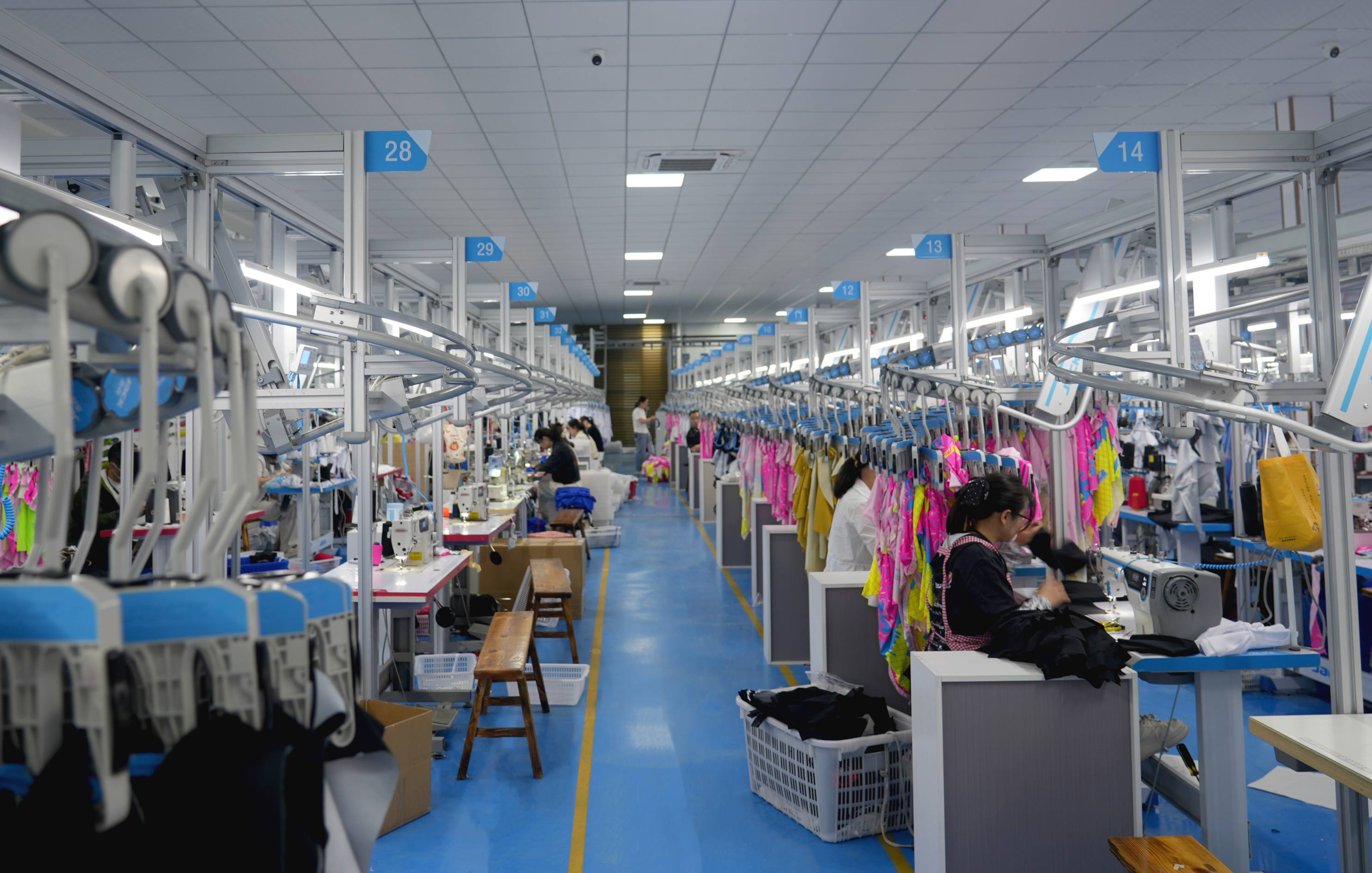
Ljvogues' Hanging Cutting Workshop
WhatsApp: +86-199-2880-2613
About Ljvogues
Ljvogues (USPTO Reg. No. 6,378,310) is a Shenzhen-based OEM and private label manufacturer specialising in period panties, incontinence underwear, and functional intimate apparel. Since 2015, we have served 500+ brands across 108 countries with PFAS-free verified production, REACH/SVHC compliance (253 substances), and ISO 9001 & 14001 certified quality systems.
Our facility supports MOQ from 500 pieces, sample turnaround in 7–14 days, and production capacity of 20,000–100,000+ pieces per month across daily, overnight, teen, sport, swim, and incontinence categories. Whether you are launching a new brand or scaling an established line, we work alongside your team as a product development partner — not just a production resource.