


Why We Bet on Medical-Grade TPU in 2019
I'm Ocean Yang. I founded Ljvogues in 2015 after 8 years at Alibaba as a Marketing Manager. I'm not a textile engineer by training — but in 2019, I made the single most important technical decision of this company's history: we tore out our PVC waterproof film line and
replaced it with medical-grade TPU thermal bonding.
The reason was a phone call from a US buyer. She'd been selling our PVC-lined panties for 18 months. Then a customer complained the gusset cracked after 30 washes, and a journalist found phthalates in the PVC layer. Her brand was about to be pulled from Whole Foods.
That call cost me three months of sleep and ¥4M in equipment investment. But it taught me something: in this category, the waterproof membrane isn't a commodity — it's the single point of failure for the entire brand. If the membrane cracks, leaches chemicals, or feels like a plastic bag against skin, every other investment (organic cotton, OEKO-TEX, sustainable packaging) is
worthless.
So we did three things, and we've done them on every single SKU since:
1. Medical-grade TPU only (not PVC, not PE) — same polymer class used in surgical drapes and IV bag liners
2. Thermal-bonded, not glued — no chemical adhesives between the membrane and the absorbent core (this is where 70% of competitor products fail at the seams)
3. Third-party PFAS testing every batch — not annually, every batch (Intertek or SGS)
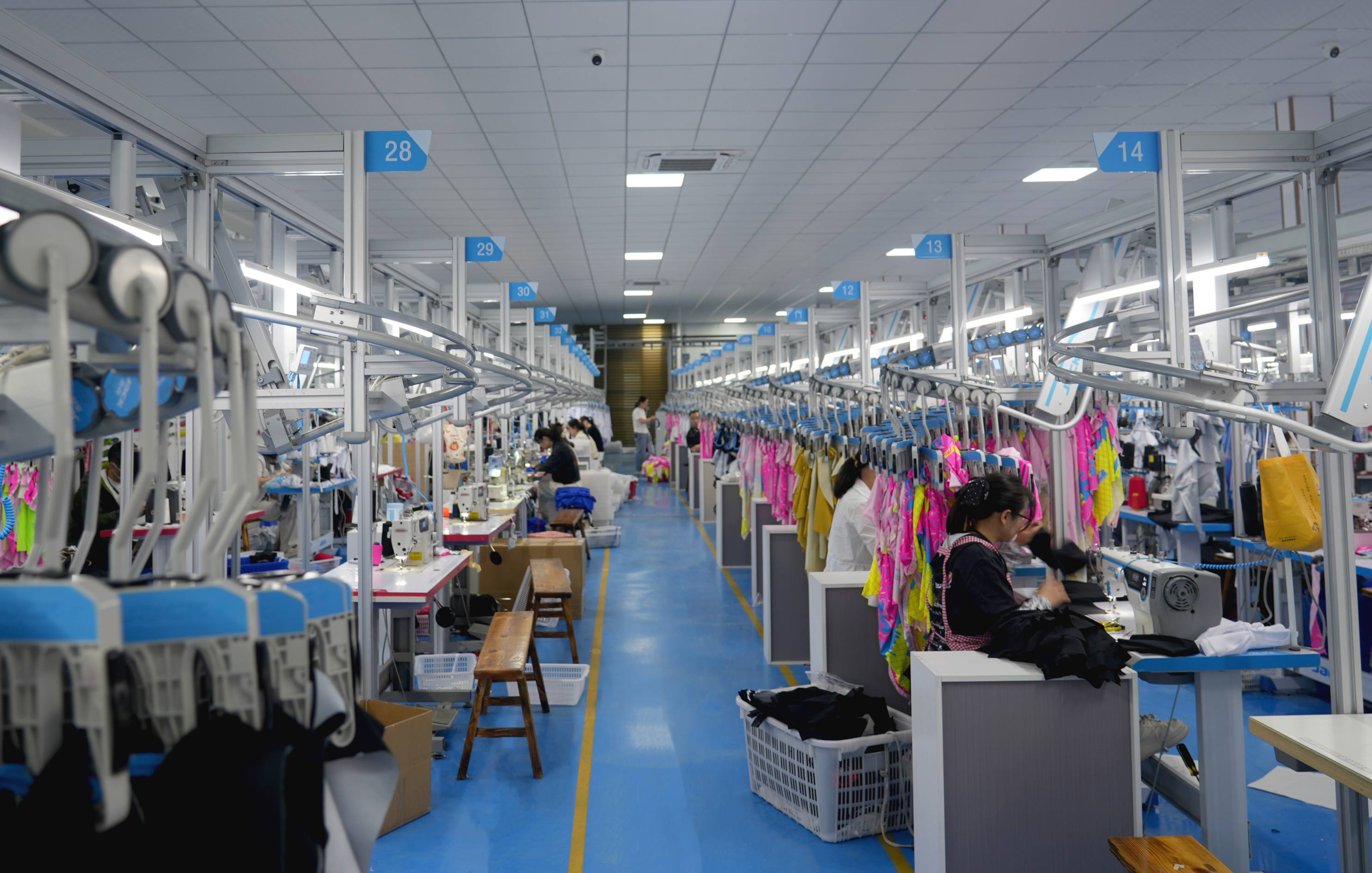
If you want to see the actual TPU bonding machines on a Shenzhen factory tour, my WhatsApp is at the bottom of this page.
— Ocean Yang, Founder & CEO, Ljvogues

| Property | Medical-Grade TPU (Ours) | PVC (Common) | PE (Cheap) |
| Phthalate content | Zero (verified) | Common contaminant | Variable |
| PFAS-free verified | ✓ Every batch | Often contains C8/C6 | Often contains C8/C6 |
| Flexibility at -20°C | Stays soft | Becomes brittle | Cracks |
| Wash durability | 100+ cycles | 30-50 cycles | 20-40 cycles |
| Breathability (MVTR | 5,000-8,000 g/m²/24h | < 500 g/m²/24h | < 200 g/m²/24h |
| Skin feel | Soft, fabric-like | Plastic, sticky | Crinkly, "plastic bag" |
| Heat-bonding compatibility | ✓ Bonds directly to cotton/bamboo/nylon | ✗ Needs adhesive | ✗ Needs adhesive |
| FDA approval | Yes (food contact + medical) | No (apparel only) | No (apparel only) |
| Cost per garment | $0.18-0.24 | $0.06-0.10 | $0.03-0.05 |
| Parameter | Spec |
| Polymer grade | Medical-grade TPU (Class VI biocompatibility tested) |
| Thickness | 18-25 microns (selectable per SKU) |
| MVTR (breathability) | 5,000-8,000 g/m²/24h |
| Tensile strength | ≥ 30 MPa |
| Elongation at break | ≥ 500% |
| Temperature stability | -30°C to +90°C |
| PFAS testing | Per batch (Intertek or SGS) |
| FDA status | Compliant with 21 CFR 177.2600 |
| ISO 10993 biocompatibility | Tested (skin irritation, sensitization) |
| Spec | Range |
| Material options | Organic cotton (GOTS) · Bamboo viscose · Tencel modal · Recycled polyester mesh |
| GSM (weight) | 80-120 g/m |
| Wicking speed | < 3 seconds to absorb 5ml |
| Antibacterial (if bamboo) | 70-99% inhibition of S. aureus / E. coli |
| Certifications | OEKO-TEX 100 (every lot) |
| Spec | Range |
| Material | High-density needle-punched microfiber + SAP (Super Absorbent Polymer) |
| Capacity tiers | 15-25ml (Light) · 25-35ml (Moderate) · 35-50ml+ (Heavy/Overnight) |
| Thickness (compressed) | < 2mm (Light/Moderate) · < 3mm (Heavy) |
| Backflow under 5kPa pressure | < 5% (industry typical: 15-25%) |
| Dry time (full saturation) | 4-6 hours air-dry |
| Spec | Range |
| Material | Medical-grade TPU (PFAS-free, phthalate-free) |
| Thickness | 18 microns (Light/Moderate SKUs) · 25 microns (Heavy/Overnight SKUs) |
| Bonding method | Thermal-bonded to absorbent core (no chemical adhesive) |
| MVTR (breathability) | 5,000-8,000 g/m²/24h |
| Waterproof rating | 10,000 mmH2O (vs typical 3,000-5,000) |
| Wash durability | 100+ cycles at 40°C |
| Certifications | FDA 21 CFR 177.2600 · ISO 10993 biocompatible |
| Spec | Range |
| Material options | Organic cotton · Bamboo · Recycled nylon (GRS) · Cotton-elastane blend |
| GSM | 180-220 g/m² |
| Stretch | 4-way stretch, 30-50% recovery |
| Seam construction | 4-needle 6-thread flatlock (standard) or ultrasonic-bonded (seamless premium) |
| Certifications | OEKO-TEX 100, GRS (for recycled nylon) |
Test 1 — Dynamic Absorbency Under Pressure
Method: ISO 11948 modified · 5kPa pressure simulating seated posture · Synthetic menstrual fluid analog
| SKU Tier | Stated Capacity | Tested Capacity | Backflow at 5kPa |
| Light | 15-20ml | 22ml ± 2ml | < 3% |
| Moderate | 25-35ml | 38ml ± 3ml | < 4% |
| Heavy | 35-50ml | 54ml ± 4ml | < 5% |
| Overnight | 50ml+ | 62ml ± 5ml | < 6% |
Test 2 — Wash Durability (Membrane Integrity)
Method: AATCC 135 modified · 40°C wash · standard tumble · cycles to first visible delamination
| Construction | Cycles Tested | Cycles to First Failure | Industry Benchmark |
| Thermal-bonded TPU (Ljvogues) | 100 | None observed | 30-50 cycles (glued PVC) |
| Glued PVC (competitor sample) | 100 | 47 cycles | — |
| Glued PE (competitor sample) | 100 | 31 cycles | — |
Test 3 — PFAS Verification
Method: EPA Method 1633 · Third-party (Intertek)
Frequency: Every fabric lot + every TPU batch
Tested: PFOA, PFOS, PFHxS, PFNA + 36 other PFAS compounds
Result: ≤ Limit of Detection (LOD) on every Ljvogues leak-proof SKU since Q1 2023
Test 4 — Skin Sensitization (ISO 10993-10)
Method: Guinea pig maximization test · 100 wears equivalent
Result: No sensitization observed across all 5 SKUs
Test 5 — Wicking Speed (Top Layer Dry-Down)
Method:AATCC 195 modified · 5ml synthetic fluid drop · time to "barely damp"
| Topsheet Material | Time to Absorption | Time to "Barely Damp" |
| Bamboo viscose | 2.1 sec | 4 min |
| Organic cotton | 3.4 sec | 8 min |
| Tencel moda | 2.6 sec | 5min |
| Recycled poly mesh | 1.4 sec | 3 min |
5 Failure Points We've Engineered Out
After 8 years and ~95 million units, here are the 5 most commonways leak-proof underwear fails — and how we've solved each.
The problem:Standard polyester thread wicks fluid like a candle wick — moisture travels through needle holes from inside to outside,defeating the TPU membrane.
Our fix:Anti-wicking thread (75D polyester with hydrophobic silicone coating) at the entire gusset perimeter. Tested to repel fluid at 5kPa pressure for 60 minutes without seepage.
The problem:Glued TPU membranes start separating from the absorbent core after 30-50 washes. The leak-proof zone literally falls apart inside the garment.
Our fix:Thermal-bonded TPU at 130-145°C / 0.3 MPa / 8-second dwell — creates a single fused core unit. Lab-tested past 100 wash cycles with zero delamination.
The problem: Standard panty patterns place the absorbent zone too narrow at the rear or front, leaving 1-2cm gaps where fluid escapes during side-sleeping or active motion.
Our fix:Extended absorbent zone — front-to-back 14-18cm (SKU-dependent) plus 2cm overlap into the leg openings. Pattern-engineered for sleeping, sitting, and athletic motion.
Failure 4: Loss of Compression After 20-30 Washes
The problem:The absorbent core's compressed microfiber gradually "relaxes," losing capacity by 20-30%.
Our fix:High-density needle-punched core at 220-280 GSM (vs typical 150-180). Compression-recovery tested past 100 washes with < 8% capacity loss.
Failure 5: Phthalate / PFAS Leaching from Cheap Membranes
**The problem:** PVC and some PE membranes contain phthalateplasticizers and may carry PFAS contamination. Both can migrate to skin during wear.
Our fix:Medical-grade TPU only + per-batch third-party PFAS testing (Intertek or SGS). Phthalate-free verified by GC-MS. Documentation provided with every order.


| Certification | What It Proves | Why Buyers Need It |
| FDA 21 CFR 177.2600 | TPU polymer is food-contact safe (closest US standard to medical apparel) | Required for US retail entry / Amazon FBA Health & Personal Care |
| ISO 10993-10 | TPU does not cause skin sensitization or irritation | Required for "skin-safe" claims under EU MDR-adjacent rules |
| EN 1186 | TPU does not leach harmful substances into wet contact | Required for EU eco-retail claims |
| PFAS-Free Verified (Intertek/SGS per batch) | TPU and all fabrics free of forever chemicals | Mandatory for NY/CA 2025+ apparel laws |
| Phthalate-Free Verified (GC-MS testing) | No DEHP, DBP, BBP, DINP | Required for kids/teen SKUs under CPSIA (US) |
Leak-Proof Engineering — Frequently Asked Questions
Medical-grade TPU is tested to FDA 21 CFR 177.2600 (food-contact safety) and ISO 10993-10 (skin sensitization). It's also produced without phthalate plasticizers or PFAS contamination. Most apparel-grade "TPU" in mass-market period panties is unverified industrial-grade material — physically similar but never tested for skin or chemical safety. The cost difference is about $0.12-0.18 per garment. We use medical-grade only.
Q6: What's the MOQ for leak-proof private label?
Q7: How long does sampling take for a custom leak-proof SKU?
Q8: Do you offer ultrasonic seam bonding (seamless leak-proof)?
Q9: Can you ship leak-proof DDP to Amazon FBA?
Q10: What absorbent material do you use for the core? Is it SAP-based?
