



Table of Contents
Last week, a brand founder sent us an email that began with a sentence I've now seen variations of dozens of times in 2026:
"I want to make sure our period underwear is the cleanest on the market with zero hidden chemicals."
Then she sent a list. Twenty-three questions, ranging from OEKO-TEX class verification to whether our crotch adhesive is water-based to whether the cotton was bleached with chlorine or peroxide. By the third question I knew what kind of buyer she was: serious, technically literate, and already burned by a previous supplier who told her what she wanted to hear instead of what was true.
Halfway through her follow-up message, she added: "You are right that 'zero chemicals' is not realistic. Let me clarify what we actually need."
That sentence — that admission, mid-negotiation, that the goal she started with was technically impossible — is the most important sentence in the period underwear industry right now. Because most buyers haven't gotten there yet, and most manufacturers are still letting them believe the impossible.
Let me explain what's really going on, what "clean" actually means in textile manufacturing, and what an honest manufacturer should be willing to commit to in writing.
"Zero Chemicals" Is a Marketing Phrase, Not a Manufacturing Reality
I want to start with a hard truth that no manufacturer wants to say out loud, because it sounds like an excuse.
There is no such thing as a chemical-free textile.
Every fiber on earth — including organic cotton — interacts with chemicals to become a finished garment. Cotton has to be scoured. Polyester has to be polymerized. Elastane has to be spun. Dyes have to fix. Films have to laminate. Threads have to bond. Even the cleanest GOTS-certified organic cotton garment has been processed with — at minimum — water, surfactants, scouring agents, and dye fixatives.
When a brand markets a product as "chemical-free" or contains "zero chemicals," one of three things is happening:
The brand doesn't understand textile chemistry and is repeating their supplier's claim
The supplier is lying to win the order
The brand is deliberately misleading consumers and may face FTC or equivalent regulatory action
In December 2024, the U.S. Federal Trade Commission updated its Green Guides to specifically target unsubstantiated "chemical-free," "natural," and "non-toxic" claims in consumer products. Brands using these phrases without verifiable evidence are now exposed to enforcement actions and consumer class action lawsuits. EU regulations under the Green Claims Directive carry similar enforcement risk.
Yet a search across major DTC period underwear brands in April 2026 still returns dozens using language like "chemical-free," "clean," "non-toxic," and "100% natural" — almost all of them without supporting documentation that would survive a regulatory audit.
The brands that will still be standing in 2028 are the ones that stop saying "chemical-free" and start saying something more honest, more specific, and more defensible.

What "Clean" Should Actually Mean
If "zero chemicals" is impossible and "chemical-free" is a regulatory liability, what does clean actually mean for a serious period underwear brand?
The answer is a four-part standard:
Transparent
Every chemical class used in production is disclosed to the buyer in writing. Not "proprietary blend." Not "advanced moisture-wicking technology." The actual material composition, the actual finishing chemicals, the actual barrier construction.
Verified
Every safety claim is backed by third-party laboratory testing on the finished garment — not on raw fabric, not on supplier declarations, not on certificates whose scope doesn't actually cover the product as sold.
Below the Strictest Threshold
Where regulatory limits exist (REACH 253-substance SVHC, OEKO-TEX residue limits, EU formaldehyde restrictions), the product tests below the strictest applicable threshold — not just below the local minimum.
Free of the Worst Offenders
Specific chemical classes with documented health concerns are affirmatively excluded, not just "not added" — with test reports verifying their absence in the finished product.
That is what "clean" means. It is not a marketing word. It is a documentation standard.

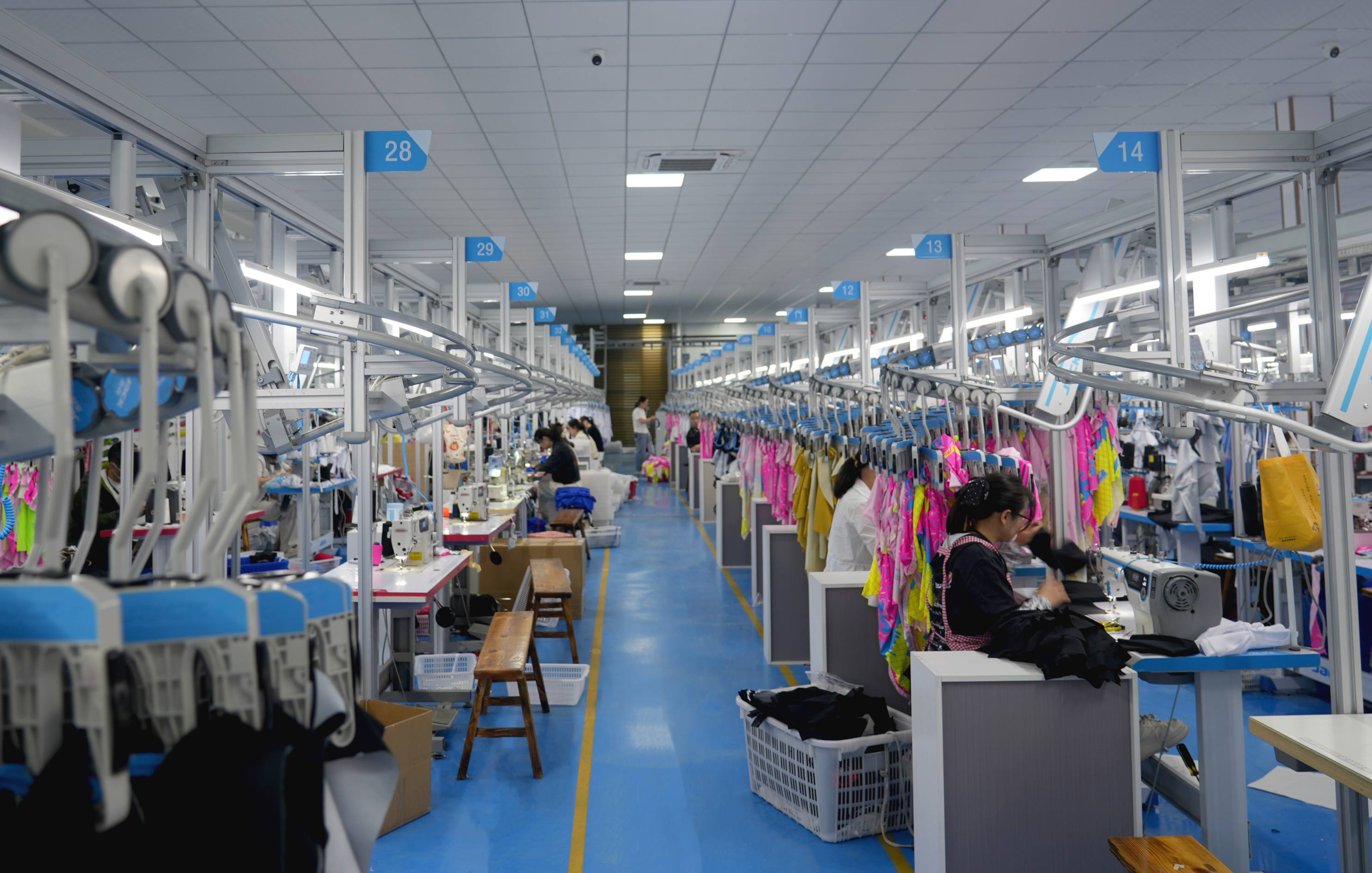
Cutting workshop
The Six Worst Offenders: What Should Be Affirmatively Excluded
Below are the six chemical classes that any period underwear brand serious about "clean" positioning should explicitly exclude — with verification documentation. These are the ones that come up repeatedly in regulatory enforcement, scientific literature, and customer complaints.
PFAS (Per- and Polyfluoroalkyl Substances)
The "forever chemicals." Used historically in waterproofing finishes. Linked to kidney cancer, immune suppression, endocrine disruption, and reduced fertility.
Status in 2026: Banned in textiles in California, New York, and France. Denmark's ban activates July 2026. Texas opened an active investigation against Lululemon over PFAS contamination in April 2026. EU-wide REACH restriction is advancing.
What "clean" looks like: Third-party total organic fluorine test on the finished garment — not just a fabric supplier declaration.
Antimicrobial Treatments (Silver, Copper, Zinc, Triclosan)
Used in some "anti-odor" period underwear to inhibit bacterial growth. The intimate contact zone is exactly the wrong place to apply broad-spectrum antimicrobials, because doing so disrupts the natural vulvar microbiome — which exists for protective reasons.
Status in 2026: Triclosan banned by FDA in personal care (2016). Nano-silver restricted under EU Biocidal Products Regulation. Silver-treated textiles increasingly facing consumer pushback.
What "clean" looks like: Written exclusion of all antimicrobial chemistries, with finished-garment test confirming their absence.
Formaldehyde-Based Wrinkle / Shrink Resistance
Used in some woven fabrics to provide easy-care properties. Classified as a known carcinogen by IARC. EU REACH limits formaldehyde in skin-contact textiles to 75 mg/kg.
What "clean" looks like: Test report showing formaldehyde below detection limit (typically 16 mg/kg laboratory reporting limit), not just "below the regulatory ceiling."
Stain-Resistant / Repellent Finishes
Historically PFAS-based. Newer "C6 chemistry" still includes fluorinated compounds. Provides minimal benefit on intimate apparel — and the marginal benefit doesn't justify the regulatory and health risk.
What "clean" looks like: No stain-resistant finish applied, period.
Chlorine-Bleached Cotton
Cotton can be bleached with either chlorine or oxygen (hydrogen peroxide). Chlorine bleaching produces dioxin byproducts and AOX (adsorbable organic halogens) that remain in trace amounts in finished fabric. Oxygen bleaching produces only oxygen and water as byproducts.
Status: GOTS standard prohibits chlorine bleaching. OEKO-TEX includes AOX testing.
What "clean" looks like: Oxygen/peroxide bleaching only, documented through GOTS Scope Certificate or equivalent.
Solvent-Based Adhesives
The crotch construction in period underwear typically requires bonding multiple layers. This bonding can be done three ways:
Solvent-based adhesives — fastest, cheapest, leaves residual VOCs
Water-based adhesives — slower, slightly more expensive, no VOC residue
Ultrasonic / heat bonding — no chemistry at all, premium method
Most factories use solvent-based because it's fastest. Water-based and ultrasonic are markers of a manufacturer who chose to invest in the harder method.
What "clean" looks like: Written confirmation of water-based or ultrasonic bonding, with adhesive Safety Data Sheet (SDS) on file.
The Documentation Stack: What a Serious Manufacturer Should Provide
If a brand wants to make defensible "clean" claims in 2026, the manufacturing partnership needs to produce a documentation stack that survives regulatory audit and skeptical buyer due diligence.
A serious manufacturer should be able to provide, on request:
Document | What It Proves |
OEKO-TEX Standard 100 certificate | Tested for harmful substances. Critical: must specify Class (I = baby-grade strictest, II = direct skin contact, III = limited contact, IV = decorative) and whether it covers finished garment or only individual components |
GOTS Scope Certificate (factory) | The factory itself is GOTS-certified — required to legally sell GOTS-labeled organic cotton garments |
GOTS Transaction Certificate (per order) | This specific order is GOTS-compliant. Critical: must be final, not draft |
GRS (Global Recycled Standard) certificate | Required for any "recycled material" claims |
PFAS-free finished-garment test | Third-party lab test for total organic fluorine |
REACH/SVHC compliance report | Test against current 253 substances of very high concern |
Antimicrobial-free declaration | Written confirmation, ideally with test |
Adhesive SDS | Safety Data Sheet for any glue used in construction |
Material composition disclosure | Specific fiber, dye, finish, and trim chemistry |
When a brand asks for these and a manufacturer says "we'll send what we have" — that's the answer. The manufacturer is telling you they don't have the full stack. Note it and proceed accordingly.

Hanging and cutting workshop
What Ljvogues Actually Holds — In Writing
I'm going to do something most manufacturers won't: state our exact compliance position publicly, with no marketing language, so any prospective buyer can verify before our first conversation.
Standard | Ljvogues Status |
OEKO-TEX Standard 100 | Class II · Finished Garment · Active (not expired) |
GOTS Scope Certificate | Held — factory-level certification |
GRS (Global Recycled Standard) | Certified |
PFAS-Free | Verified by independent Eurofins finished-garment test |
REACH / SVHC | Compliant against current 253-substance ECHA Candidate List (Feb 4, 2026 update) |
Antimicrobial treatments | None — no silver, copper, zinc, or triclosan. Test reports available |
Bleaching | Oxygen / peroxide only — no chlorine bleaching |
Crotch adhesive | Water-based — no solvent-based glue. SDS available |
Sewing thread | Natural fiber |
Waistband elastic | Spandex / Elastane blended with polyester (disclosed composition) |
This is not a marketing pitch. It is the operating standard that determines whether we can serve a brand that takes "clean" seriously.
If your current manufacturer cannot match this stack with documentation, you have an answer about why their per-unit price is lower.
What Brands Should Stop Saying — and Start Saying
A reality check for the marketing language that appears across the period underwear category in 2026:
Stop Saying | Start Saying |
"Chemical-free" | "PFAS-free verified by Eurofins · OEKO-TEX Class II certified" |
"100% natural" | "GOTS-certified organic cotton (Scope Certificate verified)" |
"Non-toxic" | "Tested below REACH 253-substance limits" |
"Clean ingredients" | "Full material disclosure available · No antimicrobial treatments · No PFAS" |
"Toxin-free" | "Below detection limits for formaldehyde, banned amines, and heavy metals" |
"Eco-friendly" | "GRS-certified recycled materials · Oxygen-bleached only" |
The first column is becoming a regulatory liability. The second column is what defensible marketing looks like in 2026.
The brands that make this transition first will own the "clean" positioning — because they'll be the only ones with documentation when consumers, journalists, and regulators start asking for proof.
The Larger Shift: From Marketing Claims to Verified Claims
Behind all of this is a broader shift the period underwear industry hasn't fully absorbed yet.
Through roughly 2022, consumers bought "clean" period underwear based on brand storytelling. The packaging said it was clean. The website said it was clean. That was enough.
In 2026, three forces have converged to end that era:
Regulatory enforcement — California AB 1817, EU Green Claims Directive, FTC Green Guides updates
High-profile failures — Thinx PFAS class action settlement, Lululemon Texas AG investigation
Consumer literacy — A generation that grew up reading skincare ingredient lists is now reading textile compliance certificates
The brands that will thrive in this environment are the ones that engineer their compliance position before they engineer their marketing position. And the manufacturers that will serve those brands are the ones who can produce the documentation that backs the compliance position up.
This is why the brand founder I mentioned at the start of this article — the one with twenty-three questions — is exactly the kind of buyer the industry needs more of. She isn't difficult. She's responsible. She's protecting her brand the way every brand will need to protect itself in two years.
The manufacturers who answer her questions clearly, completely, and in writing are the ones who will still be in business in 2030. The ones who deflect, hedge, or oversell will not.
We'd rather lose an order on a question we can't answer perfectly than win an order on a half-truth.
If that sounds like the kind of partnership you want, talk to us.
Frequently Asked Questions
What's the difference between "chemical-free" and "non-toxic" period underwear?
Both are marketing phrases without standardized definitions, and both are increasingly subject to regulatory scrutiny. "Non-toxic" can mean tested below toxicity thresholds, but the threshold is rarely specified. "Chemical-free" is technically impossible — every textile contains chemicals. Defensible alternatives: "PFAS-free verified," "OEKO-TEX certified," "tested below REACH limits."
How can I tell if a period underwear brand's "clean" claims are real?
Three steps:
Ask for the documentation stack. OEKO-TEX certificate (with class and scope clearly stated), GOTS Scope Certificate (if claiming organic), PFAS-free third-party test on finished garment, REACH/SVHC compliance report. A brand making clean claims should have these immediately available.
Verify certificates independently. OEKO-TEX certificates can be verified at oeko-tex.com. GOTS certificates at global-standard.org. GRS at textileexchange.org. If a certificate cannot be found in the issuing body's database, it is not valid — regardless of the PDF you were sent.
Check certificate scope and dates. Many "OEKO-TEX certified" claims cover only a single fabric component (not the finished garment), or reference an expired certificate, or are at Class IV (decorative use) rather than Class I or II (skin contact).
Is OEKO-TEX Standard 100 enough by itself?
OEKO-TEX is necessary but not sufficient for a strong "clean" position. It tests for harmful substances at residue level, but it doesn't certify organic content (that's GOTS), doesn't certify recycled content (that's GRS), and doesn't independently verify PFAS absence at the strictest detection thresholds (that requires separate finished-garment testing). A serious clean-positioning brand uses OEKO-TEX as the foundation, then layers GOTS, GRS, and PFAS-free testing on top.
What is the difference between OEKO-TEX Class I and Class II?
OEKO-TEX Standard 100 has four product classes based on level of skin contact:
Class I — Articles for babies and small children up to 3 years (strictest limits)
Class II — Articles with direct skin contact (underwear, t-shirts, bedding) — period underwear belongs here
Class III — Articles without direct or limited skin contact (jackets, coats)
Class IV — Decoration materials (curtains, table linens) — least strict
For period underwear, Class II is the appropriate standard because it specifically covers direct-skin-contact intimate apparel for adults. Class I limits are stricter (designed for infant exposure scenarios) but are not technically required for adult intimate apparel. Brands marketing to teens or claiming "baby-grade safety" may want to upgrade to Class I.
Does "GOTS organic cotton" require any specific documentation?
Yes — and this is where many brands fail an audit. To legally label a product "GOTS Organic," the supply chain must produce two documents:
GOTS Scope Certificate — the certifying body confirms the factory itself is qualified to produce GOTS-compliant goods
GOTS Transaction Certificate — the specific order/shipment is verified as GOTS-compliant
A Transaction Certificate alone without a Scope Certificate is not sufficient — the factory must be certified, not just the cotton. Additionally, draft Transaction Certificates are not valid for retail labeling. Many brands accept draft certificates without realizing this.
What does "PFAS-free" actually require to be a defensible claim?
A defensible PFAS-free claim requires:
Third-party laboratory testing (Eurofins, SGS, Bureau Veritas, or equivalent accredited lab)
Testing performed on the finished garment, not just on raw fabric components
Total organic fluorine analysis as the primary screening method
Test results demonstrating below-detection-limit results across all garment components — including the waterproof barrier layer where PFAS is most commonly found
Documentation refreshed for each production run, not relied upon indefinitely from initial testing
Manufacturers that simply forward a fabric supplier's declaration without finished-garment testing are not providing defensible PFAS-free verification.
What about ultrasonic vs. water-based vs. solvent-based bonding?
Period underwear construction requires bonding multiple layers in the absorbent gusset zone. Three methods exist:
Solvent-based adhesives — fastest production, lowest cost, contains volatile organic compounds (VOCs) that may leave trace residues
Water-based adhesives — slower curing, slightly higher cost, no VOC residue, considered the cleanest adhesive option
Ultrasonic / heat bonding — no chemistry at all, premium method, requires specialized equipment
Ultrasonic and water-based are markers of a manufacturer who has invested in the cleaner method. Solvent-based bonding is more common simply because it's cheaper to operate.
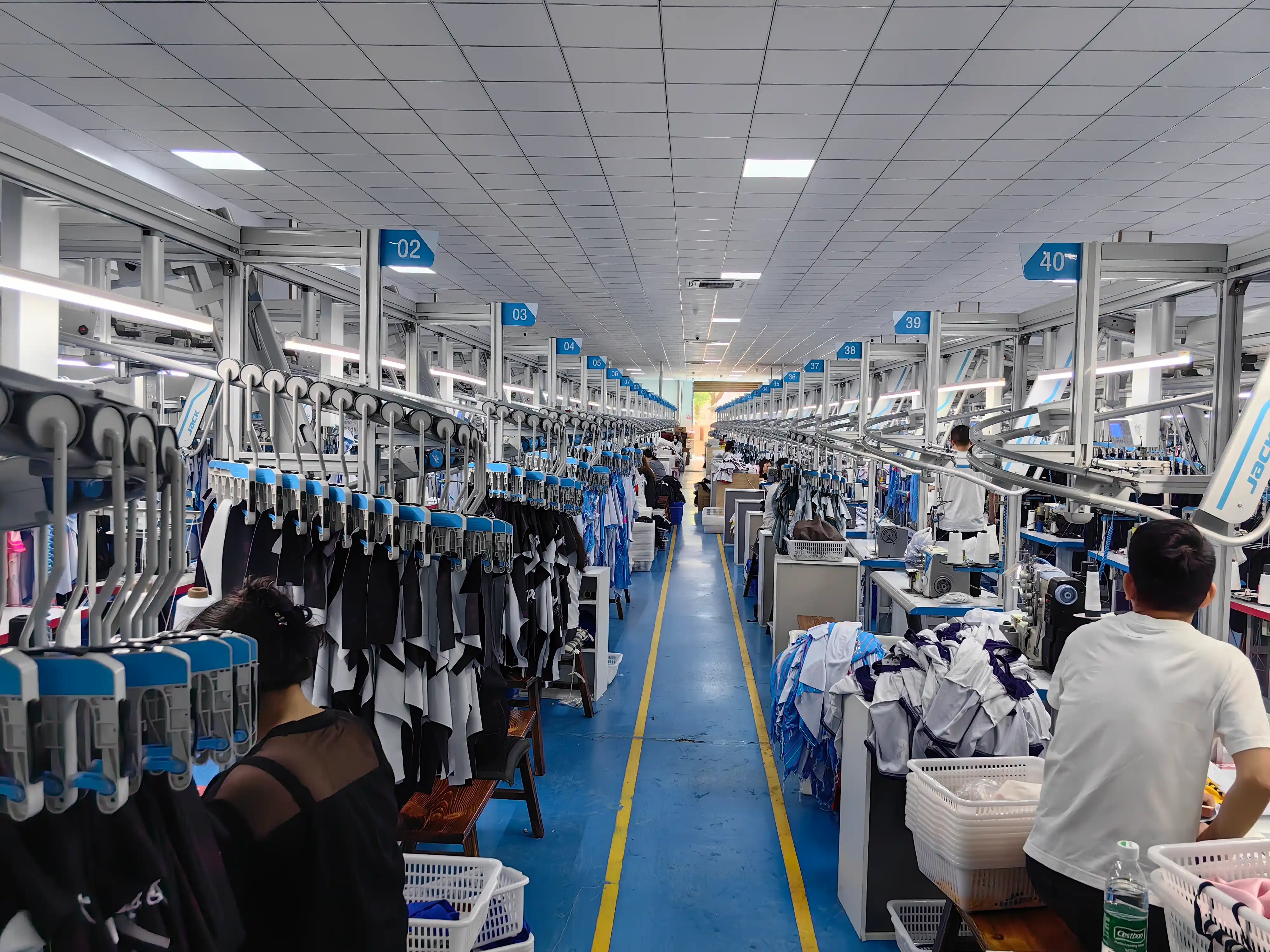
Hanging Cutting Workshop
The Path Forward
If you're a brand founder reading this and wondering whether your current "clean" marketing language can survive 2026 regulatory scrutiny, the question is simpler than it appears:
Can you produce, today, the documentation that proves every claim on your packaging?
If the answer is yes — your supply chain is already ahead of most of the category.
If the answer is no — you have a window of approximately 12-18 months before regulatory enforcement, retailer due diligence, and consumer skepticism close it. Use that window to either upgrade your supplier's documentation stack or change suppliers.
The "cleanest period underwear" isn't a marketing claim. It's a documentation discipline. And the brands that internalize this distinction first will own the next decade of the category.
If you want a manufacturing partner who has already built that documentation discipline — and is willing to share it openly — talk to us.
WhatsApp: +86-199-2880-2613
About Ljvogues
Ljvogues (USPTO Reg. No. 6,378,310) is a Shenzhen-based OEM and private label manufacturer specializing in period underwear, incontinence underwear, and functional intimate apparel. Since 2015, we have served 500+ brands across 108 countries with full compliance documentation:
OEKO-TEX Standard 100 — Class II — Finished Garment
GOTS Scope Certificate (factory-level)
GRS (Global Recycled Standard) certified
PFAS-Free verified by independent Eurofins testing
REACH / SVHC compliant against the current 253-substance ECHA Candidate List
No antimicrobial treatments (silver, copper, zinc, triclosan)
Oxygen / peroxide bleaching only (no chlorine)
Water-based crotch adhesives
Natural fiber sewing thread
Every product ships with verifiable documentation. Every claim is built to survive an audit.
