



Table of Contents
If you are planning to launch or expand a period underwear brand, choosing the right OEM manufacturer in China is the most consequential supply chain decision you will make. We have been manufacturing period underwear for international brands since 2021, and before that spent years building export manufacturing infrastructure for functional intimate apparel. The pattern we observe consistently: brands that succeed select manufacturers carefully and develop thoroughly. Brands that struggle almost always skipped one of those two steps.
This guide reflects what we have learned on the manufacturing side — what separates a reliable factory from one that looks reliable until your first bulk order arrives.
Transparency note: Ljvogues is a period underwear OEM manufacturer. This guide is written to be genuinely useful to any brand evaluating Chinese suppliers, including those who ultimately work with our competitors.
Why Source Period Underwear from China?
China remains the world's largest production base for period underwear, and the reasons are structural rather than temporary:
Complete vertical supply chain: Absorbent core materials, PFAS-free waterproof membranes, moisture-wicking knits, and certified sustainable fabrics are all available domestically — within hours of most major manufacturing clusters
Manufacturing depth: The factories that have been producing functional intimate apparel for 5+ years have already solved the hard problems — seam leakage, layer delamination, elastic degradation — through production experience that cannot be replicated quickly
Cost efficiency: Per-unit manufacturing costs 30–50% lower than equivalent Western production, without necessarily compromising on materials or construction quality
Flexibility for emerging brands: Progressive OEM manufacturers now accept 500–1,000 piece MOQs for custom private label orders — low enough for market testing before scaling
The challenge is not finding Chinese manufacturers. It is identifying the ones who actually have the technical depth, compliance documentation, and delivery discipline that your brand needs.

Crotch panel of menstrual underwear
7 Factors to Evaluate a Period Underwear OEM Manufacturer
Product-Specific Experience
Period underwear is technically complex. It is not regular underwear with a thick gusset — it requires a multi-layer absorbent core system, a PFAS-free waterproof barrier, moisture-wicking surface construction, and bonding processes that maintain integrity through 100+ wash cycles. Factories that sew garments well but lack experience with functional absorbent construction will produce products that fail in real use.
What to ask:
How many years have you been producing period underwear specifically — not just regular underwear or shapewear?
Can you describe your absorbent core construction in detail — layer count, materials, bonding method?
What absorbency range can you produce, in ml? (Standard: 20–30ml light, 30–50ml moderate, 50–80ml heavy, 80ml+ overnight)
Do you produce period swimwear, sports period underwear, or incontinence products — categories that require additional technical demands?
Red flags:
Factory entered period underwear production within the last 1–2 years with no adjacent functional apparel experience
Cannot explain core construction beyond "multi-layer absorbent technology"
No samples available for independent testing before ordering
A factory with 5+ years of period underwear production has encountered and resolved most failure modes — seam leakage at the gusset edge, core delamination after washing, elastic degradation from repeated stretch. That problem-solving history is not visible in a product catalogue, but it is real.

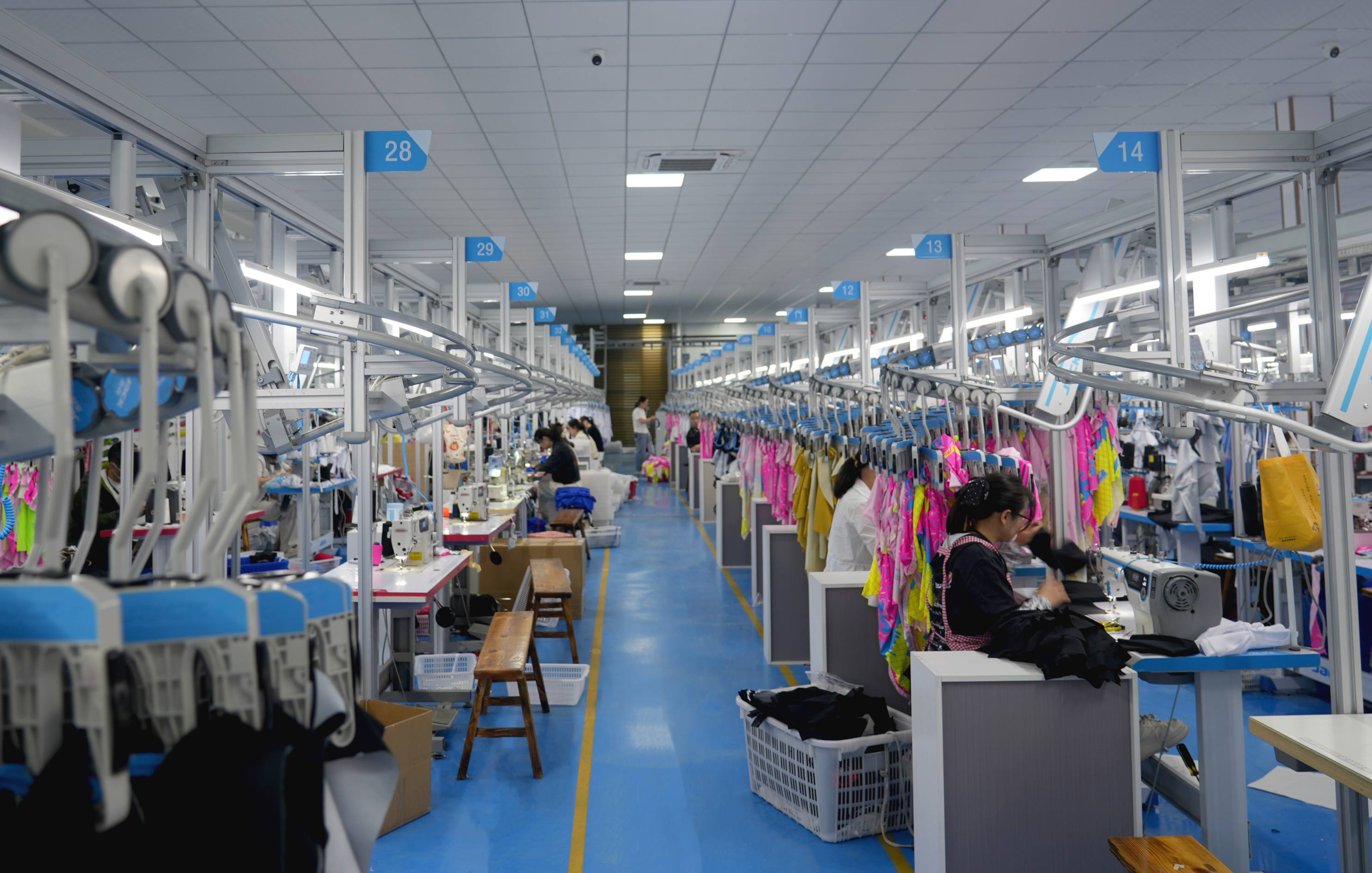
Ljvogues-Professional manufacturing plant
Absorption Technology and Independent Testing
Absorption is the product's core function. If a manufacturer cannot prove their products perform to specification — independently, on production samples, not just on one-off lab samples — nothing else matters.
What to ask:
What is the absorption capacity per style, measured in ml?
Do you conduct third-party absorbency testing through an accredited laboratory (SGS, Bureau Veritas, Intertek, or equivalent)?
Can you provide test reports covering: absorption rate, retention capacity under pressure, and rewet performance?
How many wash cycles does your absorbency testing cover?
What reliable manufacturers do:
Use standardised testing protocols (ISO 11948, ASTM, or equivalent)
Provide test reports on production samples — not just pre-production prototypes
Test multiple samples per batch to verify consistency, not just the best unit
Can demonstrate wash-cycle durability testing (minimum 50 cycles; quality manufacturers test to 100–200 cycles)
At Ljvogues, we test every production batch for absorbency, leak resistance, and wash durability before shipment. Our standard period underwear styles are tested to 200+ wash cycles before we publish wash-cycle durability claims — because a product that degrades at wash 30 is a warranty and reputation problem for the brand we serve.

Washing test of menstrual underwear
Certifications and Chemical Safety Compliance
For period underwear entering major export markets, certifications are purchasing requirements — not optional differentiators. Different markets require different standards, and claiming a certification without being able to verify it is one of the most common forms of supplier misrepresentation.
Certification | What It Covers | Required For |
OEKO-TEX Standard 100 | No harmful substances in finished product | EU and global intimate apparel |
PFAS-free (third-party verified) | No per- and polyfluoroalkyl substances | US (CA, NY bans active) · EU (France 2026 ban) |
REACH / SVHC Compliance | 253 substances of very high concern | EU market — mandatory |
GRS (Global Recycled Standard) | Validates recycled content claims | Any brand making recycled material claims |
GOTS (Global Organic Textile Standard) | Organic cotton from fibre to finished product | Any brand claiming organic cotton |
BSCI or SEDEX | Ethical labour practices audit | EU retailers — often required |
ISO 9001 | Quality management system | Indicator of systematic QC |
How to verify — not just accept:
Ask for certificate numbers and issuing body — then verify in the issuing body's online database
Check certificate validity dates — certifications expire and may not have been renewed
Confirm scope — a factory may hold OEKO-TEX certification for their fabric supplier but not for the finished garment. The finished product certificate is what protects your brand
PFAS: the issue that matters most right now
PFAS (per- and polyfluoroalkyl substances) have been used as waterproofing treatments in some period underwear products. Several US states have active bans; France implemented a PFAS textile ban in 2026; EU-wide regulation is advancing. If your products test positive at retail, you face recalls and potential regulatory action.
A PFAS-free declaration from the manufacturer is not sufficient. You need a third-party lab test report on finished garments — not a material declaration from their fabric supplier. Ask for this documentation before placing any bulk order.
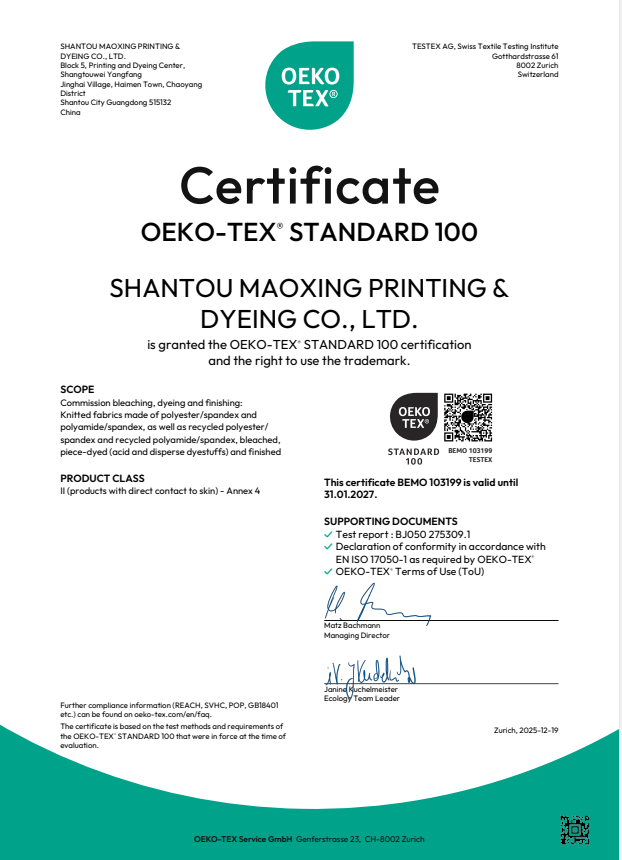
Ljvogues-OEKOreport provided by upstream dyeing plant
MOQ Flexibility and Pricing Transparency
Minimum Order Quantity varies significantly between factories, and understanding the real MOQ — not the marketing MOQ — is essential for cash flow and inventory planning.
Manufacturer Type | Typical MOQ per Style | Best Suited For |
Large volume factories | 1,000–3,000 pieces | Established brands with proven demand |
Mid-size OEM manufacturers | 500–1,000 pieces | Growing brands scaling from test orders |
Flexible OEM manufacturers | 300–500 pieces | Early-stage brands testing the market |
What affects the real MOQ:
Custom fabric development (requires larger minimums to justify mill lead times)
New pattern or construction development beyond standard styles
Custom packaging — branded boxes, hang tags, retail-ready presentation
Colour and size combinations within a style
What reliable pricing looks like:
A credible manufacturer provides a clear, itemised quotation:
FOB unit price per style and quantity tier
Sample cost (usually credited against first bulk order)
Any tooling or pattern development fees
Packaging cost separated from garment cost
Payment terms — standard is 30% deposit, 70% balance before shipment
If a manufacturer gives you a single price without breakdown, or is reluctant to separate costs, that is a negotiation tactic — not a sign of a transparent partner.

Customisation Capabilities
If you are building a brand rather than reselling stock products, customisation depth determines how differentiated your product line can be. Evaluate three levels:
Fabric and materials:
Can they source certified fabrics to your specification? (GOTS organic cotton, TENCEL Modal, GRS-certified recycled nylon, bamboo)
Do they have direct relationships with certified fabric mills, or do they buy from traders who cannot provide origin documentation?
What is the lead time and MOQ for custom fabric development?
Construction and design:
In-house pattern making capability — can they take a design brief and produce a tech pack?
Sample development timeline: first sample in 7–14 days is standard; longer than 21 days suggests limited in-house capacity
How many sample revision rounds are standard before bulk production?
Can they produce different absorbency levels within the same style silhouette?
Branding and packaging:
Custom woven labels, printed care labels, hang tags
Private label and white label packaging
Retail-ready packaging (poly bags, kraft boxes, compostable options)
Compliance labelling for specific markets (EU REACH labelling, US care label requirements)
The brands that build the strongest differentiation invest in custom fabric or construction development rather than applying their label to stock styles that five other brands are also selling.

Production Capacity and Lead Times
Understanding a factory's actual capacity — not their stated capacity — helps you plan inventory and avoid the most common sourcing failure: launch timing delays.
Questions that reveal actual capacity:
What is your current monthly production output for period underwear specifically?
How many production lines are dedicated to functional intimate apparel?
What is your current order backlog — how many weeks are you booked ahead?
What causes your lead times to extend beyond the standard?
Realistic lead time benchmarks:
Order Type | Realistic Lead Time |
Pre-production sample | 7–14 days from confirmed tech pack |
Small production (100–500 pieces) | 15–25 days |
Standard production (500–2,000 pieces) | 25–35 days |
Large production (2,000+ pieces) | 35–45 days |
Seasonal planning: Chinese factories are at peak capacity from August through November, serving brands building holiday season inventory. If your launch is Q4, confirm production slots by June. Late orders placed in September–October routinely experience 2–3 week delays beyond standard lead times.
Communication Quality
Communication quality is the most reliable predictor of partnership quality — and the most commonly underweighted factor in supplier evaluation.
Indicators of a reliable partner:
Responds to detailed technical enquiries within 24–48 hours
Gives specific answers to specific questions — not marketing language in response to technical questions
Proactively updates production status without being asked
Is honest about challenges (material delays, quality issues) rather than concealing them until shipment
Has English-speaking account management for international clients — not just sales staff who pass questions to production
Indicators of a problematic partner:
Response delays of 3+ days on initial enquiries — this will worsen during production
Vague answers to questions about certifications, core construction, or testing
Pressure to skip sample approval and proceed to bulk
Reluctance to provide factory photos, video call tours, or client references
Step-by-Step Evaluation Checklist
Step 1: Initial Contact (Week 1)
Request company profile, product catalogue, and capability overview
Ask for MOQ, lead time, and indicative pricing
Request certification documents with verification links or certificate numbers
Evaluate response time and specificity of answers
Step 2: Sample Evaluation (Weeks 2–3)
Order samples of relevant styles — pay the sample fee; free samples without lead time are usually stock items, not your specification
Absorbency test: pour measured liquid (water with food colouring) and observe absorption rate and surface rewet
Wash test: minimum 10 cycles, checking for core delamination, elastic degradation, and seam integrity
Fit and construction assessment: seam flatness, gusset geometry, waistband recovery
Step 3: Factory Verification (Weeks 3–4)
Request a video call factory tour — a genuine manufacturer will provide this readily
Ask for two to three references from brands in your target market (North America, EU, or equivalent)
Verify certifications directly with issuing bodies using the certificate number
Discuss your specific customisation requirements and confirm their technical capability
Step 4: Trial Production Order (Weeks 4–8)
Place a small production order of 100–300 pieces before committing to larger volumes
Monitor communication frequency and proactiveness during production
Conduct or commission a pre-shipment inspection before the balance payment
Assess quality against approved samples before scaling
Common Mistakes That Cost Brands Months and Money
Choosing on price alone
The cheapest manufacturer becomes the most expensive when quality failures require remakes, delayed launches cost marketing spend, and customer returns damage early brand reputation. Per-unit price is one factor, not the decision.
Skipping the sample phase
Ordering bulk production based on catalogue photos is the fastest route to receiving 2,000 units with leaked cores, misaligned gussets, and elastic that failed on the first wash. Sample, test, wash-test — then order.
Accepting certificate images without verification
A factory can claim OEKO-TEX, PFAS-free, or GRS certification and provide a PDF image of a certificate that expired two years ago or covers only their fabric supplier. Verify every certificate in the issuing body's database before relying on it for your market entry.
Misunderstanding MOQ scope
A factory advertising "300 piece MOQ" may only apply this to stock styles in two colour options. Custom design, custom fabric, and custom packaging may each carry separate minimums. Clarify the full MOQ structure for your specific project before building financial projections.
Underestimating seasonal capacity constraints
Placing orders in September for November delivery at a factory operating at 100% capacity is not a reasonable plan. Build seasonal lead times into your production calendar.

A professional and efficient communication team
Frequently Asked Questions
What is the typical MOQ for custom period underwear from a Chinese OEM?
For custom private label orders with your design and specification, expect 500–1,000 pieces per style as a standard benchmark. Some manufacturers offer lower MOQs (300–500 pieces) for startups testing the market; larger factories typically start at 1,000–2,000 pieces. MOQ increases when custom fabric development, tooling, or complex packaging is involved.
How long does it take to develop a custom period underwear style?
A realistic end-to-end timeline from initial brief to approved pre-production sample:
Design and pattern development: 5–7 days
First sample production: 7–14 days
Sample revision rounds: 3–5 days per round (typically 1–3 rounds)
Bulk production: 25–35 days
Total from concept to ex-factory: 6–10 weeks depending on complexity and revision count.
What certifications do I need for the US market?
Minimum: OEKO-TEX Standard 100 (finished garment, not just fabric) and PFAS-free declaration backed by third-party lab test on finished products. For retail distribution through major retailers: BSCI or SEDEX social compliance audit is typically required. For brands making organic cotton claims: GOTS certification from fibre to finished product.
What is the difference between OEM and ODM manufacturing?
OEM (Original Equipment Manufacturing): You provide the design, tech pack, and specification. The factory manufactures to your exact requirements. Higher investment in development; results in a product unique to your brand.
ODM (Original Design Manufacturing): The factory provides existing designs that you can brand as your own. Lower development investment and faster time to market; the trade-off is that other brands may sell similar or identical products.
Most serious brand-building projects use OEM for hero products and ODM for supplementary styles. A manufacturer with strong in-house R&D capability can support both approaches within the same partnership.
Can I verify that a Chinese manufacturer is a real factory and not a trading company?
Yes. Request a copy of their business licence (营业执照) — the registered business type indicates whether they are a manufacturing entity or a trading company. Ask for a live video call tour of the production floor showing cutting tables, sewing lines, and QC stations. A genuine manufacturer provides both without hesitation. A trading company will delay, redirect, or offer photos instead of live video.
How do I protect my design when sharing tech packs with a Chinese manufacturer?
Sign a Non-Disclosure Agreement and a supply agreement with explicit IP ownership clauses before sharing any design documentation. If your construction is genuinely novel, consider filing a design patent in China before sharing specifications — Chinese patent protection is faster and less expensive than most brands assume. Choose manufacturers with an established international client base; they understand IP protection as a condition of keeping global partnerships.
Finding the Right Partner
The manufacturers worth working with expect rigorous evaluation. They provide documentation proactively. They give specific answers to specific questions. They welcome sample testing and factory verification. They have references who will speak honestly.
The sourcing process described in this guide takes four to eight weeks. The consequences of skipping it — product quality failures, certification gaps, and delivery unreliability — can cost a brand its first year of growth.
If you are currently evaluating period underwear OEM manufacturers and want to compare our capabilities, certifications, and pricing against other suppliers you are considering, we are happy to provide full documentation and arrange a factory video call.
WhatsApp: +86-199-2880-2613
This guide is based on Ljvogues' experience as a period underwear manufacturer and is intended as a practical sourcing resource. It does not constitute legal or compliance advice. Always conduct independent due diligence and verify certifications directly with issuing bodies before entering manufacturing agreements.
About Ljvogues
Ljvogues (USPTO Reg. No. 6,378,310) is a Shenzhen-based OEM and private label manufacturer specialising in period underwear, incontinence underwear, and functional intimate apparel. PFAS-free verified · REACH/SVHC compliant · 200+ wash cycle durability · serving brands across North America, Europe, and Australia.