



Table of Contents
Yesterday, a client asked us to develop something I had never been asked to make before.
Not a period panty. Not a nursing bra. Not a sports bra.
She wanted a period bralette — a wire-free, cup-free, vest-like top designed specifically for the days when a young woman's breasts are swollen, tender, and hypersensitive during her menstrual cycle. No underwire. No molded cups. No hooks. No structure at all. Just a second skin that holds her gently and lets her forget she is wearing anything.
My first reaction was: this is not a product. This is just a soft bralette.
My second reaction — after I thought about it for ten minutes — was: this might be one of the smartest product concepts I've seen all year. Not because of what it is, but because of what it means.
The Pain Nobody Talks About
Let's start with the biology, because most people in this industry — including many women's intimate apparel brands — don't fully understand it.
Cyclical mastalgia is the medical term for breast pain that follows the menstrual cycle. It is driven by fluctuating levels of estrogen and progesterone, particularly during the luteal phase (the 1–2 weeks between ovulation and the start of menstruation). During this phase, hormonal changes cause breast tissue to swell with fluid retention, become denser, and become acutely sensitive to pressure and touch.
The symptoms are not trivial:
Breasts feel heavy, full, and aching — like carrying extra weight on the chest
Swelling can be significant enough that a bra that fit last week feels tight this week
Tenderness can be so severe that any contact — including the pressure of a bra cup, underwire, or strap — causes pain
The pain can radiate into the underarm area
How common is this? Far more common than the industry acknowledges. Clinical research on young college-age women found that 57% experienced cyclical mastalgia, with 17.6% reporting moderate pain and 21.5% reporting severe pain. Another study found that approximately 8–10% of premenopausal women experience moderate to severe breast pain monthly — pain severe enough to interfere with daily activities.
And here is the part that matters for product development: this pain begins at puberty. A girl who starts menstruating at age 11 or 12 may experience cyclical breast tenderness from her very first cycle. Her breasts are still developing, her body is unfamiliar, and every month she experiences swelling and soreness that she may not even have the vocabulary to describe.
What does the industry offer her?
A training bra with a scratchy tag. A sports bra that compresses her already-tender chest. Or her mother's advice: "Just deal with it."
That's not a product category. That's a failure of imagination.

Product Photos of Menstrual Underwear for Teenagers
Why a "Period Bralette" Is Not Just a Regular Bralette
When my client described the product, I initially thought: "This is just a soft bralette. We already make those."
But as we discussed the concept deeper, I realized the distinction is not in the construction — it is in the intent, the positioning, and the specific design details that make it right for this particular use case.
A regular bralette is designed to look good. A period bralette is designed to disappear — to create so little sensation against the skin that the wearer forgets it exists during the most physically uncomfortable days of her month.
Here are the specific design differences:
1. Zero Compression, Maximum Coverage
Most bralettes still provide some degree of compression — a snug band, a close-fitting cup, a tight elastic hem. That compression is what gives shape and a "smooth look under clothes."
For a period bralette, compression is the enemy. Swollen, tender breast tissue responds to pressure with pain. The design philosophy is the opposite of shaping: it is containing without compressing. Think of the difference between a tight hug and an open palm gently supporting from below.
This means:
Wide, flat bands instead of narrow elastics — distributing any residual pressure across a larger surface area
Extended coverage through the underarm and side body — preventing fabric edges from cutting into swollen tissue
Relaxed fit with 3–5% more ease than a standard bralette — allowing for cyclical swelling without the garment becoming constrictive
2. Fabric That Doesn't Trigger Sensitivity
During the luteal phase, skin sensitivity increases alongside breast tenderness. Fabrics that feel fine on Day 10 of the cycle can feel scratchy, hot, or irritating on Day 24.
The ideal period bralette fabric is:
Modal or bamboo viscose — both have a smoother surface friction coefficient than cotton, meaning less micro-abrasion against sensitive skin
Single-jersey knit (not ribbed) — eliminating any textured ridges that could press into tender tissue
200–220 GSM — heavy enough to feel substantial and protective, light enough to prevent heat buildup
OEKO-TEX certified — because the last thing sensitive skin needs is residual chemical irritants from processing
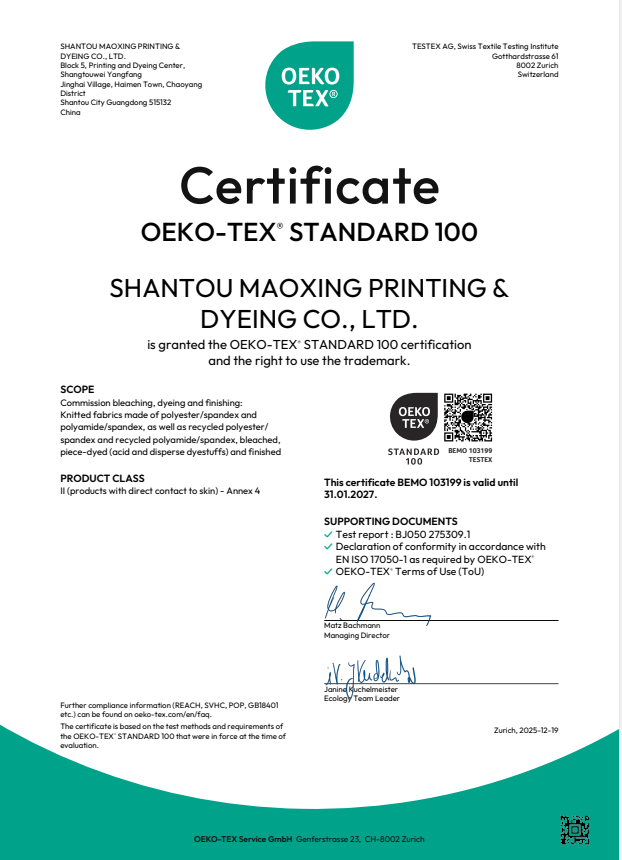
OEKO-TEX certified dyed fabric provided by the upstream factory.
3. Completely Tagless, Seamless Interior
This sounds basic, but execution matters enormously. "Tagless" does not just mean a heat-transfer label instead of a sewn-in tag. It means:
No interior seams crossing the nipple area (which becomes hypersensitive during the luteal phase)
No overlocked seam allowances on the inside that create ridges against skin
Flat-lock stitching or bonded construction throughout
If a label must exist, it goes on the exterior — not the interior
4. The Vest Silhouette: Not a Bra, Not a Crop Top
The product my client envisioned is neither a traditional bralette (which still reads as "underwear") nor a crop top (which implies athleticism). It is closer to a soft vest or camisole — something that looks and feels like the most comfortable layer in her wardrobe, not like a medical device or a piece of lingerie.
This silhouette choice is psychologically important, especially for teens. A teenage girl experiencing her period may already feel self-conscious, anxious, and uncomfortable in her body. Asking her to wear a "special bra for her period" adds another layer of stigma. But giving her a beautiful, soft vest that she chooses to wear because it feels incredible — that is empowerment, not accommodation.
The Cultural Moment: Why This Category Is Emerging Now
This product concept didn't emerge in a vacuum. It sits at the intersection of three powerful cultural and market shifts:
The Wire-Free Revolution
Gen Z has effectively killed the underwired bra. Sales data, consumer surveys, and cultural commentary all point in the same direction: younger women view underwired bras not as support garments but as "instruments of female torture", as one 23-year-old quoted in a recent feature put it.
The bralette market is projected to grow at 14.8% CAGR from 2026 to 2033, driven by "a shift towards comfort, the rising popularity of athleisure, and a growing emphasis on body positivity". The broader bra market will reach $60 billion by 2034 at 9.16% CAGR, with wireless and comfort-first styles leading growth.
Brands like Skims, True & Co, and emerging Gen Z-focused labels are riding this wave. Even Victoria's Secret — the brand that built an empire on push-up underwire — now prominently features a wireless and lounge category.
The message is clear: the next generation of bra consumers has decided that comfort is non-negotiable.
Body Positivity and Puberty Anxiety
More than a third of young people have serious concerns about how they look during puberty. The physical changes — breast development, widening hips, new body hair — can trigger anxiety, social withdrawal, and negative body image.
The intimate apparel industry has historically made this worse, not better. Training bras are often miniaturized versions of adult bras — padded, structured, and implicitly saying: "Your developing body needs to be shaped into the correct form".
A period bralette sends the opposite message: "Your body is going through something. This is here to make you comfortable, not to reshape you." That is a brand story with extraordinary emotional resonance — for teens, for their parents, and for the growing community of consumers who reward brands that demonstrate genuine understanding of women's experiences.

Light support during exercise; comfortable and gentle on the skin.
The "Period Care" Category Expansion
The period underwear market has proven that consumers will pay a premium for products designed around the menstrual cycle. But the innovation has been almost entirely below the waist — panties, shorts, leggings, swimwear.
Above the waist, the menstrual cycle has been invisible in product design. No major brand has launched a bra or bralette specifically designed for the physical symptoms of menstruation — despite the fact that more than half of menstruating women experience cyclical breast pain.
This is an open category with zero established competition.
The Business Case: Who This Product Is For
From a B2B perspective, a period bralette line makes strategic sense for several brand archetypes:
1. Existing Period Underwear Brands
If you already sell period panties, a period bralette is the most natural category extension possible. Your customer already trusts you with her menstrual comfort below the waist. Offering comfort above the waist — as a matching set or a standalone product — deepens the relationship and increases average order value.
Key advantage: You already own the "period comfort" positioning. This is a line extension, not a new brand story.
2. Teen / Tween First-Bra Brands
Brands like Bleuet have built loyal followings by designing soft, wire-free first bras from Modal and TENCEL™. A period-specific variant — even softer, even less structured, positioned around the physical experience of early menstruation — would be a natural evolution of their product line.
Key advantage: Parents are actively searching for ways to make their daughters' puberty experience less stressful. A product that explicitly addresses period breast discomfort is a powerful differentiator in the teen bra market.
3. Wellness / Self-Care Brands
Brands that sit at the intersection of wellness, skincare, and intimate care (like the German brand that recently approached us for period and incontinence underwear) have an audience that already thinks about the body holistically. A period bralette fits perfectly into a curated "cycle care" collection alongside period panties, heating pads, and supplements.
Key advantage: The product's value is primarily emotional and experiential, not technical. It aligns with wellness brand storytelling far more naturally than engineered period panties do.

Menstrual Underwear Brand Design for Teenagers
How to Develop a Period Bralette Line: The Practical Roadmap
For brands interested in entering this category, here is how we recommend structuring the development:
SKU Architecture
Start lean. You don't need ten styles. You need two silhouettes in three colors:
SKU | Silhouette | Description | Size Range |
PB-01 | Longline Bralette | Extended band below the bust, maximum coverage, vest-like feel | XS–3XL |
PB-02 | Racerback Pullover | Sporty pullover, no hooks or clasps, easy on/off for tender days | XS–3XL |
Colors: Start with universals — Black, Heather Grey, and a soft Blush/Mauve. These are the colors that feel safe, calming, and un-clinical. Avoid white (reads "medical") and bold colors (reads "fashion statement"). The aesthetic should whisper, not shout.

Comfortable and Stylish Vest-Style Menstrual Underwear for Teens
Fabric Recommendation
Component | Fabric | Why |
Body | 95% Bamboo Viscose / 5% Spandex | Ultra-soft, naturally thermoregulating, minimal skin friction |
Alternative Body | 95% Modal / 5% Spandex | Equally soft, excellent drape, slightly more structured hand feel |
Band Lining | 100% Organic Cotton | Breathable, hypoallergenic, familiar skin feel at the contact points |
All fabrics should be OEKO-TEX Standard 100 certified. If selling into the EU, REACH/SVHC compliance is strongly recommended — and we can provide Eurofins-tested fabrics that already carry this certification.
Size Inclusivity: Non-Negotiable
A period bralette that only comes in S, M, L is a contradiction. The entire philosophy of this product is inclusivity and understanding of women's bodies. If the product doesn't fit a 3XL body as comfortably as it fits an XS body, the brand message is hollow.
We recommend a minimum of six sizes (XS through 3XL) with size grading that accounts for:
Bust circumference variation
Underbust band width (wider bands for larger sizes to maintain zero-compression support)
Strap width (wider straps for larger sizes to prevent shoulder digging)
Body length (longer torso coverage for larger sizes)
Pricing and Positioning
Positioning | Retail Price | Target Consumer |
Premium / Wellness | $32–42 | Women 25–45, health-conscious, willing to invest in cycle comfort |
Mid-Market / Teen | $18–26 | Teens 12–18 (purchased by parents), focus on first-period comfort |
Value Multi-Pack | $38–48 (2-pack) | Practical buyers who want a rotation of 2–3 for their cycle week |
The multi-pack strategy is particularly strong. If a woman's luteal phase lasts 7–10 days, she ideally wants 2–3 period bralettes in rotation. A 2-pack at a slight discount drives higher AOV and establishes the product as a routine purchase, not a one-time experiment.
The Deeper Idea: Products as Empathy
I want to close with something that goes beyond product specs and market sizing.
When my client described this product, she didn't start with GSM weights or fabric blends. She started with a feeling: "I want a teenage girl to put this on during her period and feel like someone understands what she's going through."
That is not a tech pack. That is an act of empathy translated into textile.
The period bralette has no special technology. There is no absorbent core, no waterproof membrane, no patented construction. It is, in purely material terms, just a very well-made soft bralette.
But in emotional terms, it is something much more powerful: it is a product that acknowledges a physical experience that has been ignored by the intimate apparel industry for decades. It says: "We know your breasts hurt during your period. We know your regular bra feels like armor on those days. We made this for exactly that moment."
In an industry increasingly driven by functional innovation — smarter cores, thinner barriers, more absorbency — it is worth remembering that sometimes the most innovative thing you can do is simply pay attention to what women actually experience, and build the product that meets them there.
No wire. No cup. No structure. No pretense.
Just softness, when softness is what she needs most.
Interested in developing a period bralette line? We can prototype both longline and racerback silhouettes in bamboo viscose or modal, with full size grading from XS to 3XL, OEKO-TEX certified fabrics, and your custom branding. First samples in 25–30 days.

Ocean Yang is the CEO of Ljvogues, a Shenzhen-based manufacturer of functional intimate apparel. He believes the best products don't just solve problems — they show the wearer that someone was paying attention.