



Table of Contents
If your supplier sent you a PDF labeled "OEKO-TEX Standard 100 Certified" and you accepted it as proof your period underwear is safe — you may be in trouble.
Not because OEKO-TEX is meaningless. It is one of the most rigorous textile safety standards in the world, and a real OEKO-TEX certificate genuinely confirms a product has been tested against hundreds of harmful substances.
The problem is that the phrase "OEKO-TEX certified" has been used so loosely across the period underwear industry that it now obscures more than it reveals. The same three words can describe:
A finished period panty tested at the strictest baby-grade limit
A single fabric component tested at the most lenient decorative-use limit
A certificate that expired eighteen months ago
A certificate that covers only the polyester outer shell while the cotton, gusset core, and elastic remain untested
These are not equivalent products. They are not equivalent levels of safety. And brands that don't understand the differences are exposing themselves to consumer trust failures, regulatory enforcement, and increasingly — class action lawsuits.
This article is the field manual for understanding what an OEKO-TEX claim actually means, what it doesn't, and how to verify the real safety position of any period underwear product before you commit to a supplier.

What OEKO-TEX Standard 100 Actually Tests For
OEKO-TEX Standard 100 is a textile certification system administered by OEKO-TEX, an independent international association of testing institutes. It tests textile products for hundreds of harmful chemicals — including those regulated by REACH and many that are not yet regulated but considered scientifically problematic.
The full test panel includes screening for:
Banned aromatic amines (carcinogenic dye breakdown products)
Formaldehyde (free and hydrolyzed, multiple methods)
Pesticides (residues in natural fibers like cotton)
Heavy metals (lead, cadmium, mercury, chromium VI, others)
Phthalates (plasticizers, especially in printed or coated fabrics)
Organotin compounds (DBT, TBT used in synthetic fiber processing)
Pentachlorophenol and other chlorinated phenols (preservatives)
PFAS / PFOS / PFOA (perfluorinated compounds)
Allergenic disperse dyes
Carcinogenic and disperse dyes
VOCs (volatile organic compounds)
Odor emission (through olfactory testing)
Color fastness to perspiration, water, saliva
pH value (skin compatibility)
When a product passes OEKO-TEX Standard 100 testing, it has been verified that all of these substances are below specified residue limits in the finished sample submitted to the lab.
This is genuinely meaningful. The catch is in what "specified residue limits" means — because the limits change dramatically depending on the product class.
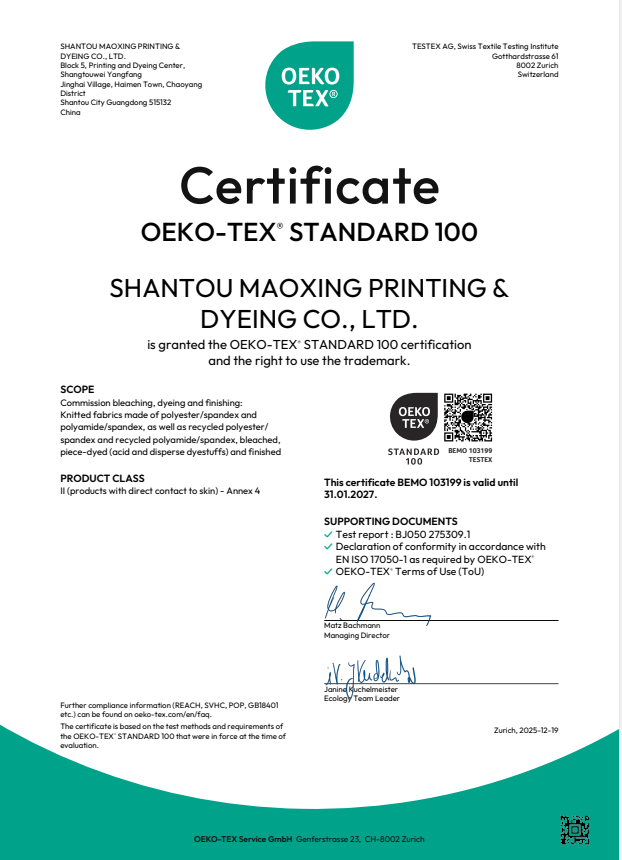
OEKO report provided by upstream dyeing plant
The Four OEKO-TEX Product Classes — and Why Class Matters More Than Brands Realize
OEKO-TEX Standard 100 sorts products into four classes based on level of skin contact. The class determines how strict the testing limits are. The same chemical may be allowed at, for example, 75 mg/kg in Class IV but only 16 mg/kg in Class I — a more than 4× difference.
Most brands don't realize this. The certificate looks the same. But the class — printed in small text near the top — completely changes what the certificate is actually claiming.
Class | Description | Examples | Testing Strictness |
Class I | Articles for babies and toddlers up to 3 years | Baby clothes, baby bedding, toys with textile components | Strictest |
Class II | Articles in direct skin contact | Underwear, T-shirts, bedding, swimwear | Strict |
Class III | Articles without direct skin contact, or limited contact | Outerwear, jackets, lined coats | Moderate |
Class IV | Decoration materials | Curtains, tablecloths, upholstery | Most lenient |
Where Period Underwear Belongs
Period underwear falls into Class II — direct, prolonged skin contact with the most sensitive areas of the body, including extended overnight wear.
Class I (baby grade) limits are technically stricter, designed for infants who may put fabric in their mouths and have more permeable skin. Class I limits are not legally required for adult intimate apparel, but they represent the highest possible safety bar in the OEKO-TEX system.
The real question for buyers is not whether a product is "OEKO-TEX certified" — it's which class.
If a supplier sends a Class IV certificate (decoration materials) for a period underwear product, the certificate is technically valid but the testing was performed against limits roughly 4× more lenient than what's appropriate for direct skin contact intimate apparel.
This happens more often than the industry admits. Some manufacturers obtain Class IV or Class III certifications because they're cheaper and faster to acquire, then market the product simply as "OEKO-TEX Standard 100 certified" without disclosing the class.
What to ask your supplier: "What product class is your OEKO-TEX certificate? Class I, II, III, or IV?" If the answer is anything other than Class I or Class II for period underwear, the certificate doesn't reflect the level of safety the product actually requires.
The Even Bigger Trap: Component Certification vs. Finished Garment Certification
The class question is important. The scope question is more important — and more commonly misrepresented.
OEKO-TEX certificates can be issued at three different scopes:
Component-Level Certification
A single fabric, yarn, trim, or accessory has been tested in isolation. For example, the polyester outer shell may carry an OEKO-TEX Class II certificate.
What this actually proves: That single component, tested alone, is safe.
What this does NOT prove: That the finished garment — with all its layers, the absorbent core, the elastic, the dyes, the bonding adhesive, and the construction chemistry — is safe.
Article-Level Certification (Finished Product)
The entire finished garment has been tested as a whole — every component, the construction, the chemistry between layers, all assessed together against the appropriate class limits.
What this proves: The product as actually sold to consumers is safe. This is the certificate that genuinely backs up a "safe period underwear" claim.
Made in Green by OEKO-TEX
A separate certification combining Standard 100 with environmental and social criteria. Confirms both safety and responsible production.
Why This Distinction Destroys Most "OEKO-TEX Certified" Claims
In our experience evaluating competitor documentation across the industry, the most common scenario is:
The manufacturer's fabric supplier holds a Class II certificate covering the outer shell polyester. The manufacturer cites this certificate as proof their finished period underwear is "OEKO-TEX Standard 100 certified."
This is technically misleading and increasingly legally risky. The cotton inner layer, the absorbent microfiber core, the TPU waterproof barrier, the gusset adhesive, the elastic waistband, the sewing thread, and the dye chemistry of the finished product are all untested under that certificate. The certificate covers one component out of ten or more.
A real OEKO-TEX certificate for a period underwear brand should cover the finished garment. Not the outer fabric. Not "the main fabric." The complete finished article.
What to ask your supplier: "Does your OEKO-TEX certificate cover the finished garment, or only specific components?" Then ask to see the certificate and verify the scope statement printed on it.
If the certificate scope reads as a list of fabrics or yarns rather than the finished article, the certificate is component-level. The finished product itself has not been certified.
How to Read an OEKO-TEX Certificate — Field Guide
A real OEKO-TEX Standard 100 certificate contains specific elements that allow you to evaluate its scope, validity, and meaning. Here is what to look for:
Element | What to Check | Red Flag |
Certificate Number | Format like | Missing or formatted differently |
Issuing Institute | One of the 18 official OEKO-TEX member institutes (Hohenstein, TESTEX, ITS, etc.) | Unrecognized issuer name |
Certificate Holder | The certified company — should match your supplier's legal entity | Held by a different company (often the fabric mill, not the garment factory) |
Product Class | Class I, II, III, or IV — clearly labeled | Class IV for skin-contact intimate apparel |
Scope of Certification | "Articles for…" followed by specific product description | Generic "fabrics for textile use" rather than finished article |
Validity Period | Issued date and expiry date — typically valid for 1 year | Expired. This is extraordinarily common. |
Substances Tested | Reference to current OEKO-TEX limit values (updated annually) | References outdated limit values |
Verifying a Certificate Independently
Every legitimate OEKO-TEX certificate can be verified directly on the official OEKO-TEX website at oeko-tex.com/en/label-check. Enter the certificate number; the database returns the certified product, holder, scope, and validity status.
If a certificate cannot be found in this database, it is not valid — regardless of the PDF you were sent. Forged or modified certificates are not rare in textile sourcing, and the forgery is often subtle: a real certificate with the holder name changed, or with the expiry date pushed forward by twelve months.
Always verify before relying on a certificate for marketing or compliance.
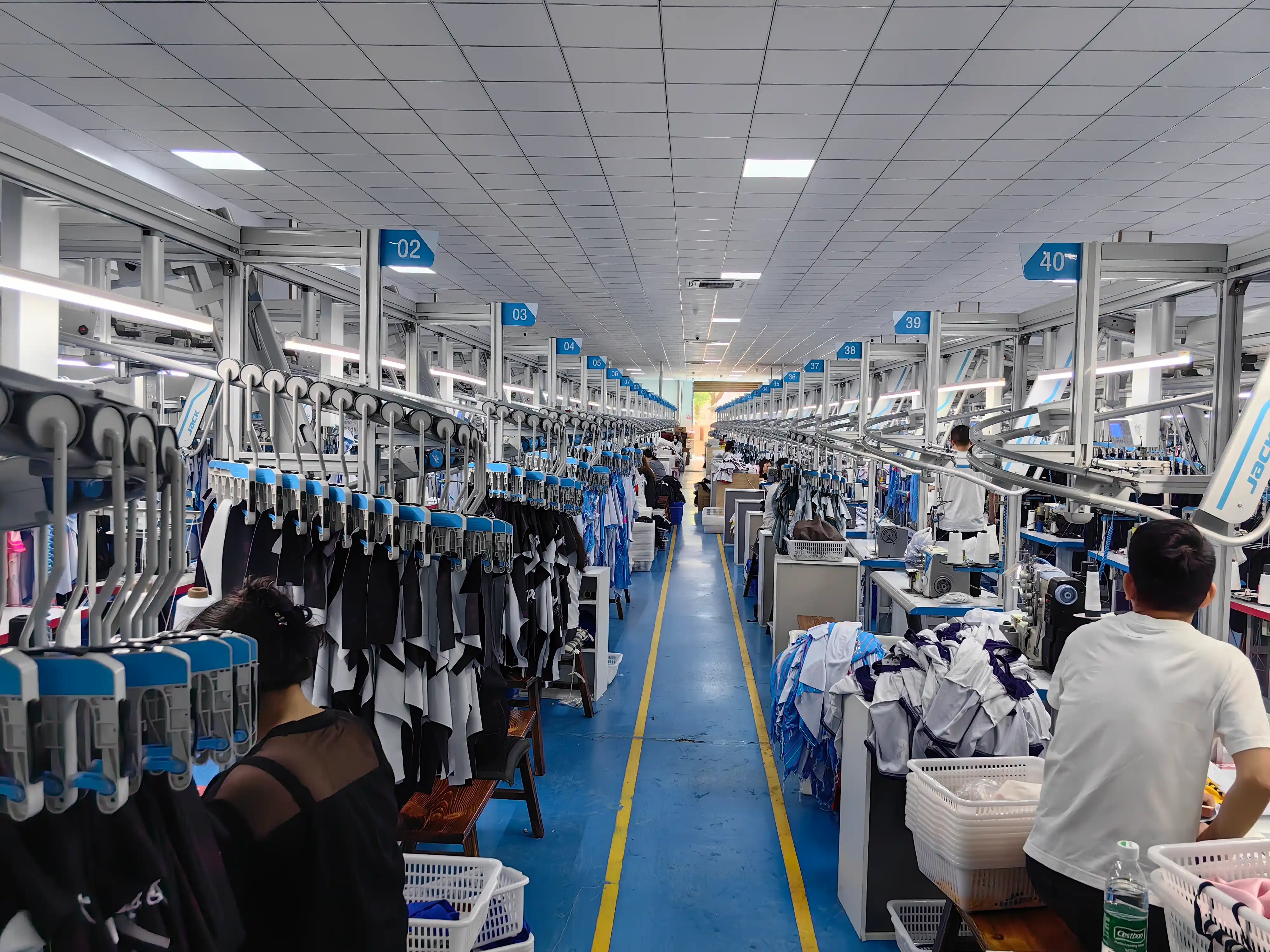
Hanging sewing workshop
The Expired Certificate Problem
OEKO-TEX certificates are valid for one year and must be renewed annually with retesting. Yet a remarkable number of "OEKO-TEX certified" claims in the period underwear industry rest on certificates that have expired — sometimes by months, sometimes by years.
This happens for two reasons:
Renewal lag — Manufacturer's old certificate expired; new testing is in progress; the manufacturer continues using the expired certificate "while the new one is being processed"
Cost avoidance — Annual retesting costs $1,500–4,500 per certificate. Some manufacturers simply skip renewal and continue using the expired document
For a brand making "OEKO-TEX certified" claims on packaging or marketing, an expired certificate creates immediate consumer protection liability. FTC enforcement under the Green Guides has explicitly addressed unsubstantiated certification claims. EU Green Claims Directive enforcement begins to activate through 2026.
What to ask your supplier: "What is the expiry date on your current OEKO-TEX certificate? Can you send the certificate showing the expiry?"
A supplier that responds with anything except a current, unexpired certificate is telling you something important. Take it seriously.
What OEKO-TEX Doesn't Cover
Even a perfect OEKO-TEX Standard 100 Class II finished-garment certificate doesn't fully prove "clean" period underwear. There are gaps.
What OEKO-TEX Tests | What OEKO-TEX Doesn't Cover |
Harmful substance residues | Organic content claims (requires GOTS) |
pH and skin compatibility | Recycled content claims (requires GRS) |
Many regulated chemicals at residue level | Social responsibility / labor practices (requires BSCI/SEDEX/Fairtrade) |
Color fastness | Animal welfare (requires RWS for wool, etc.) |
PFAS in some test scopes | Comprehensive PFAS verification (requires dedicated PFAS testing) |
Banned amines from dyes | Antimicrobial treatments (requires separate disclosure) |
OEKO-TEX is the foundation, not the entire structure. A serious clean-positioning brand layers OEKO-TEX with GOTS (for organic content), GRS (for recycled content), and dedicated PFAS finished-garment testing on top.
We'll cover GOTS in Week 4 of this series and the chemical disclosure layer (antimicrobials, formaldehyde, finishing chemistry) in Week 3.
The Buyer's OEKO-TEX Verification Checklist
Before relying on a supplier's OEKO-TEX claim:
☑ Request the certificate as a PDF — not a screenshot, not a verbal claim
☑ Check the product class — must be Class I or Class II for period underwear
☑ Check the scope — must cover the finished garment, not isolated components
☑ Check the validity dates — issuance date and expiry date both visible and current
☑ Check the certificate holder — must be your supplier's legal entity (not a fabric mill or third party)
☑ Verify on oeko-tex.com — enter the certificate number; confirm the database returns matching information
☑ Compare scope description to your actual product — make sure the certified article matches what the supplier is producing for you
If any of these verification steps fail or the supplier resists providing documentation, the OEKO-TEX claim is not what it appears to be.

Quality inspectors check the loose threads on the cut pieces.
Where Ljvogues Stands
We've been transparent throughout this series, and we'll be transparent here:
Element | Ljvogues OEKO-TEX Status |
Class | Class II — direct skin contact |
Scope | Finished garment (article-level) |
Validity | Active, not expired |
Verification | Available via the oeko-tex.com label check database with certificate number on request |
This is the configuration that genuinely matters for period underwear: Class II for the skin contact context, finished-garment scope so the entire product is certified, and current validity so the certificate can actually be cited in marketing without legal exposure.
We can upgrade to Class I (baby-grade) testing for brands targeting teen markets or making baby-grade safety claims — typically a $1,500–2,500 additional testing cost per product line and a 4–6 week timeline through an accredited OEKO-TEX institute. We can recommend lab partners and manage the process.
Frequently Asked Questions
Is OEKO-TEX Standard 100 mandatory for selling period underwear?
No — OEKO-TEX is voluntary, not legally required. However, retailer due diligence (Amazon, Target, Walmart, major European chains) increasingly requires OEKO-TEX or equivalent certification as a purchasing condition. And for brands making "safe" or "non-toxic" marketing claims, OEKO-TEX (or REACH/SVHC) testing is increasingly necessary to defend the claims under FTC and EU Green Claims enforcement.
What's the difference between OEKO-TEX Standard 100 and OEKO-TEX Made in Green?
Standard 100 tests for harmful substances in the product itself. Made in Green adds verification of environmentally and socially responsible production processes — combining substance testing with the STeP by OEKO-TEX certification of the manufacturing facility. Made in Green is a stronger sustainability claim but is not required for chemical safety purposes.
Should my brand pay for Class I (baby-grade) certification on period underwear?
For most adult period underwear, Class II is appropriate and sufficient. Class I makes sense in three scenarios:
Teen or first-period products marketed to younger users
Brands making "safe enough for babies" comparison claims in marketing
Brands targeting hyper-sensitivity markets (chemical-sensitive consumers, post-cancer recovery, etc.)
The additional testing cost is real but modest in the context of a product line investment.
**How long does OEKO-TE
How long does OEKO-TEX Standard 100 testing take, and what does it cost?
For a finished garment (article-level) Class II certification, expect:
Testing timeline: 4–6 weeks from sample submission to certificate issuance, depending on the issuing institute's queue
Testing cost: Approximately $1,500–3,500 per product line, depending on the number of components requiring testing and the specific institute
Class I upgrade: Additional $500–1,000 over Class II testing
Annual renewal: Required every 12 months; renewal testing typically costs 70–100% of initial testing
For a brand launching a new period underwear line, OEKO-TEX testing should be planned 8–10 weeks before product launch to ensure the certificate is in hand before marketing claims go live.
Can I cite my supplier's OEKO-TEX certificate in my own brand marketing?
This is one of the most common — and risky — practices in the industry. Generally:
If your supplier holds a finished-garment certificate for the product they're producing for you, and you're selling that exact product unchanged, citing the certificate is generally appropriate
If your supplier holds a component-level certificate covering only some materials in your finished garment, citing it as proof your finished product is certified is misleading and creates regulatory risk
If you make any modifications to the product (different elastic, different dye, different lining) after the certified product was tested, the certificate no longer applies to your modified version
Best practice: Either obtain your own OEKO-TEX certificate in your brand's name (the certificate can be transferred or co-issued in some cases), or write your marketing language to specifically reference your supplier's certification rather than implying your brand independently holds it.
What happens if my OEKO-TEX certificate expires while I'm mid-production?
If you're making OEKO-TEX claims on your packaging, marketing, or product pages, an expired certificate means:
Your claims are technically unsubstantiated as of the expiry date
Inventory produced under the expired certificate cannot legitimately be marketed as "OEKO-TEX certified"
Continuing to make the claims after expiry is the kind of unsubstantiated certification claim FTC Green Guides and EU Green Claims Directive specifically address
Practical solution: Plan renewal testing 60–90 days before expiry. The renewal process can run in parallel with normal production, so there's no operational disruption if you start early.
Does OEKO-TEX testing cover PFAS?
Partially. OEKO-TEX Standard 100 includes testing for several specific PFAS compounds (PFOA, PFOS, certain related substances) and has tightened these limits over recent years. However, OEKO-TEX is not a comprehensive PFAS-free verification system. For brands making explicit "PFAS-free" claims, dedicated total organic fluorine testing on the finished garment — typically through Eurofins, SGS, or equivalent — is the appropriate verification. We covered this in the previous article in this series.
What if my supplier says "we're getting OEKO-TEX certified soon"?
Treat this the same way you'd treat "the check is in the mail." Until the certificate is issued and verifiable in the OEKO-TEX database, the supplier does not have certification. "In progress" is not a certificate.
If your timeline can accommodate waiting (4–6 weeks for testing + buffer), that may be acceptable. If your timeline cannot accommodate waiting, you have two choices: find a supplier who is already certified, or accept the timeline implications. Don't accept "we're working on it" as equivalent to "we're certified."
The Verification Mindset
Beneath all the technical detail in this article is a simple shift in buyer behavior that the period underwear industry needs more of:
Stop treating certificates as marketing assets. Start treating them as verifiable claims.
Every OEKO-TEX claim, every GOTS claim, every PFAS-free claim should come with:
A specific certificate number
A specific product class or scope
A specific issuing body
A specific expiry date
A specific verification path (the database link or method)
If a supplier cannot provide these five things on request, the certification claim is not real — regardless of how the certificate looks in PDF.
The brands that will lead the period underwear category through 2030 are the ones who internalized this verification mindset early. The ones still accepting "OEKO-TEX certified" as a phrase rather than a verifiable claim will lose ground every year as regulatory enforcement, retailer due diligence, and consumer literacy continue rising.
The good news: verification is fast, free, and entirely within your control as a buyer. Every legitimate certificate is one database lookup away from confirmation.
What's Next in This Series
Next week (Week 3), we tackle the topic that produces more "is this safe?" questions from consumers than any other: the hidden chemicals in period underwear — silver and copper antimicrobials, anti-odor treatments, formaldehyde-based wrinkle resistance, fabric softener residues, and stain-repellent finishes. Why some of these are increasingly regulated, why none of them belong in intimate apparel, and how to read between the lines when a supplier describes their "advanced moisture-wicking technology."
If you'd like to be notified when the next article publishes, email us and we'll add you to the series notification list.
Talk to Us
If you're sourcing period underwear and want to verify a supplier's OEKO-TEX claims — yours or theirs — we're happy to help walk through the verification process. We've done it dozens of times. Half the time the certificate checks out cleanly. The other half is where the conversation gets interesting.
WhatsApp: +86-199-2880-2613
About Ljvogues
Ljvogues (USPTO Reg. No. 6,378,310) is a Shenzhen-based OEM and private label manufacturer specializing in period underwear, incontinence underwear, and functional intimate apparel. Since 2015, we have served 500+ brands across 108 countries with full compliance documentation:
OEKO-TEX Standard 100 — Class II — Finished Garment — Active
GOTS Scope Certificate — factory-level certification
GRS (Global Recycled Standard) — certified
PFAS-Free — verified by independent Eurofins finished-garment testing
REACH / SVHC — compliant against the current 253-substance ECHA Candidate List
No antimicrobial treatments — no silver, copper, zinc, or triclosan
Oxygen / peroxide bleaching only — no chlorine
Water-based crotch adhesives — no solvent-based glue
Natural fiber sewing thread
Every certificate we cite is verifiable by certificate number on the issuing body's official database. We share verification links on request — because a certificate that can't be verified isn't a certificate.