



TL;DR
Starting a period underwear brand requires defining a clear niche, validating demand, choosing an OEM or private-label manufacturing model, and budgeting $12,000–$130,000 for the full launch cycle. With an MOQ of 500–1,000 units, a reliable manufacturer, and a focused marketing strategy, most founders reach their first sale within 10–12 months of beginning the process.
Why Now Is the Right Time to Start a Period Underwear Brand
The numbers are hard to argue with. According to Grand View Research, the global period panties market was valued at USD 157.03 million in 2025 and is forecast to reach USD 700.18 million by 2033 — a compound annual growth rate of 21.1% from 2026 to 2033. North America holds the largest regional share at 39.33%, while Asia Pacific is the fastest-growing region, with India posting an even steeper 22.6% CAGR.
This is not a category that peaked and flattened. The tailwinds are structural: sustainability mandates, growing intolerance for single-use plastics, mainstream retail adoption, and the simple fact that the category is still underpenetrated in most markets.
The early builders proved the model works. Thinx, founded in 2011, grew to a reported USD 80 million in revenue by 2020 before being acquired by Kimberly-Clark. Knix, founded in Toronto in 2013, reached USD 170 million in sales in 2022 before selling a majority stake to Essity for USD 320 million. Both started with a specific consumer insight, not a broad "period underwear for everyone" approach.
The cultural proof points reinforce this. Period underwear brands have appeared on Shark Tank and its international equivalents — including a period panty pitch on Shark Tank India — signalling that mainstream investor and consumer awareness has arrived. When period products get airtime on primetime television, you are no longer educating a market; you are competing in one. That is a materially better place to start a business.
The window for first-mover advantage in general-audience period underwear has closed. But the window for niche-specific period underwear brands is wide open.
Step 1 — Define Your Niche and Target Customer
The most common mistake first-time founders make is launching "period underwear for everyone." That is not a brand; it is a product description. Thinx and Knix had to spend hundreds of millions building their brands before their names carried weight. A new entrant competing directly against them on the same terms will lose on marketing spend before the first unit ships.
The smarter path is to own a niche so completely that your target customer feels the product was designed specifically for them.
Heavy-flow specialists. Mainstream brands optimise for average absorbency (15–20ml) because that serves the median customer. Women with heavy flow — those who go through a super tampon in two hours — are systematically underserved. A brand that leads with 40–50ml absorbency, overnight coverage, and heavy-flow testimonials will win this segment without needing to outspend anyone.
Teen and tween market. Thinx launched a (BTWN) teen line in 2018, but it remained a secondary product line for an adult brand. A brand built from the ground up for first-time period havers — with age-appropriate messaging, school-safe absorbency levels, and parent-friendly purchase pathways — addresses a genuinely underserved demographic.
Athletic and swim. Period swimwear is a distinct sub-category with its own technical requirements (DWR coating, chlorine resistance, fast-dry fabrics). Athletes who swim competitively, surfers, triathletes, and recreational swimmers all have specific needs that standard period underwear does not meet. [internal link: Article 1 — How to Choose a Period Underwear Manufacturer: The Complete 2026 Buyer's Guide]
Eco-luxury. GOTS-certified organic cotton, OEKO-TEX-certified fabrics, plastic-free packaging, and carbon offset programmes serve a buyer who is willing to pay USD 45–65 per pair when the provenance is verifiable. This segment is small in volume but high in margin and loyalty.
Plus-size focused. Most period underwear brands offer extended sizing as an afterthought — the same design graded up, not re-engineered for a different body. A brand that repatterns from the hip rather than simply scaling up will generate disproportionate loyalty in a segment that has historically been ignored by intimate apparel.
Cultural-specific formats. Markets outside Western Europe and North America present format-specific needs that generic brands miss entirely. Indian consumers wearing sarees require different waistband heights and coverage geometry. Southeast Asian markets have specific preferences around undyed fabrics and natural materials. These are entry points that a brand with cultural fluency can own.
Choose one. Start there.
Step 2 — Market Research and Validation
Before placing a single sample order, validate that real buyers exist for your specific niche at your intended price point.
Online community research. r/PeriodUnderwear, Facebook groups for menstrual health, and TikTok comment sections are primary research resources. Search for complaints about existing products — absorbency failures, sizing gaps, price objections, fabric sensitivities. Every complaint is a potential positioning statement.
Keyword demand analysis. Use Google Keyword Planner, Ahrefs, or Semrush to confirm search volume exists for your niche. "Period underwear for heavy flow," "teen period underwear," and "organic period underwear" all carry meaningful search volume. If you cannot find keyword demand, the market may be too small or the audience is not searching in that language.
Pre-sell validation. Launch a Shopify pre-order page or email waitlist before committing to production. If you cannot collect 200 email sign-ups in 30 days of social content, that is data — the niche, price point, or messaging needs revision, all of which are cheaper to fix before manufacturing.
Competitive gap analysis. Map the top five brands in your niche. Note price points, absorbency ratings, size range, certifications, and review patterns. Where reviewers consistently express frustration is your product brief.
Step 3 — Choose Your Business Model
Your manufacturing model determines your upfront capital requirement, your product differentiation potential, and your long-term margin structure. There are three principal options.
OEM (Original Equipment Manufacturer): You provide the design specifications; the manufacturer produces to your spec. Highest design flexibility, highest MOQ, highest upfront investment. Best for brands that have a genuinely differentiated product concept.
ODM (Original Design Manufacturer): The manufacturer provides existing product designs that you can modify — fabric, colour, waistband, label. Lower development cost and faster time-to-market. Best for founders who want to move quickly and refine based on market feedback before investing in custom development.
Private Label: You brand the manufacturer's existing, validated product. Lowest barrier to entry, lowest MOQ, fastest launch timeline. Best for retail buyers or distributors testing the category before committing to a proprietary line.
Each model carries different trade-offs between speed, cost, and competitive differentiation. covers this decision in full detail. Most first-time founders who successfully scale started with ODM or private label for their first run, then transitioned to OEM once they had customer data to justify custom development.

Step 4 — Estimated Startup Costs
Transparency matters here. The range between a lean launch and a fully funded brand launch is wide, and understanding where each dollar goes helps you prioritise intelligently.
Cost Category | Low-End Estimate | High-End Estimate | Notes |
Inventory (first production run) | $5,000 | $50,000 | 500 units at $10/unit vs. 2,000+ units at $20+/unit with custom spec |
Sampling and prototyping | $300 | $2,000 | 2–5 sample rounds; [internal link: Article 9 — Sampling & Prototyping Period Underwear: Timeline & Costs] |
Design and branding | $1,000 | $10,000 | Logo, brand identity, packaging design; lower if founder-led |
Website and e-commerce | $500 | $15,000 | Shopify basic vs. custom-built DTC platform with UX investment |
Marketing launch (first 90 days) | $5,000 | $50,000 | Organic-first vs. paid social + influencer seeding |
Legal and compliance | $500 | $3,000 | Business registration, trademark filing, terms of service |
TOTAL | $12,300 | $130,000 |
The majority of well-executed launches we see at LJVOGUES land in the $25,000–$60,000 range for the first twelve months. Founders who launch on the lower end of that range typically succeed because they are lean and iterative, not because the category is cheap to enter.
One category where founders consistently underinvest: sampling. Rushing through one sample round to save $500 routinely leads to a production run with absorbency failures that costs ten times more to correct. Budget for at least two full sample rounds.
Step 5 — Find Your Manufacturer
Your manufacturer is your longest-term operational partner. A wrong choice here compounds across every batch you produce.
The criteria that matter most for period underwear specifically:
Absorbent layer technology. Period underwear is not regular underwear with a gusset insert. The absorbent core — typically a laminated multi-layer construction — requires specialist equipment and textile chemistry knowledge. Ask your prospective manufacturer how many years they have been producing specifically period underwear (not just intimate apparel), and request production samples from their current run, not showroom stock.
Certifications. For any brand selling into the US, EU, UK, or Australian markets, the minimum credible certification stack is OEKO-TEX® STANDARD 100 (for material safety), BSCI or SEDEX (for factory social compliance), and 100% PFAS-free verification. FDA compliance is mandatory for US market entry. Without these, you will face retailer rejection and potential regulatory liability.
MOQ flexibility. Established manufacturers with proprietary absorbent systems often start MOQs at 500–1,000 pieces per style. Be wary of factories offering 100-piece MOQs on custom period underwear — the unit economics rarely support the material and lamination setup costs at that volume, and it typically signals an inexperienced operator.
Lead time commitments in writing. Sample lead times run 10–15 days for most established manufacturers. Bulk production lead times are 35–45 days from approved sample and deposit receipt for a 5,000-unit order. Any manufacturer unable to give you a written lead time guarantee is giving you a scheduling problem, not a promise. provides a detailed evaluation framework and red-flag checklist for manufacturer vetting.

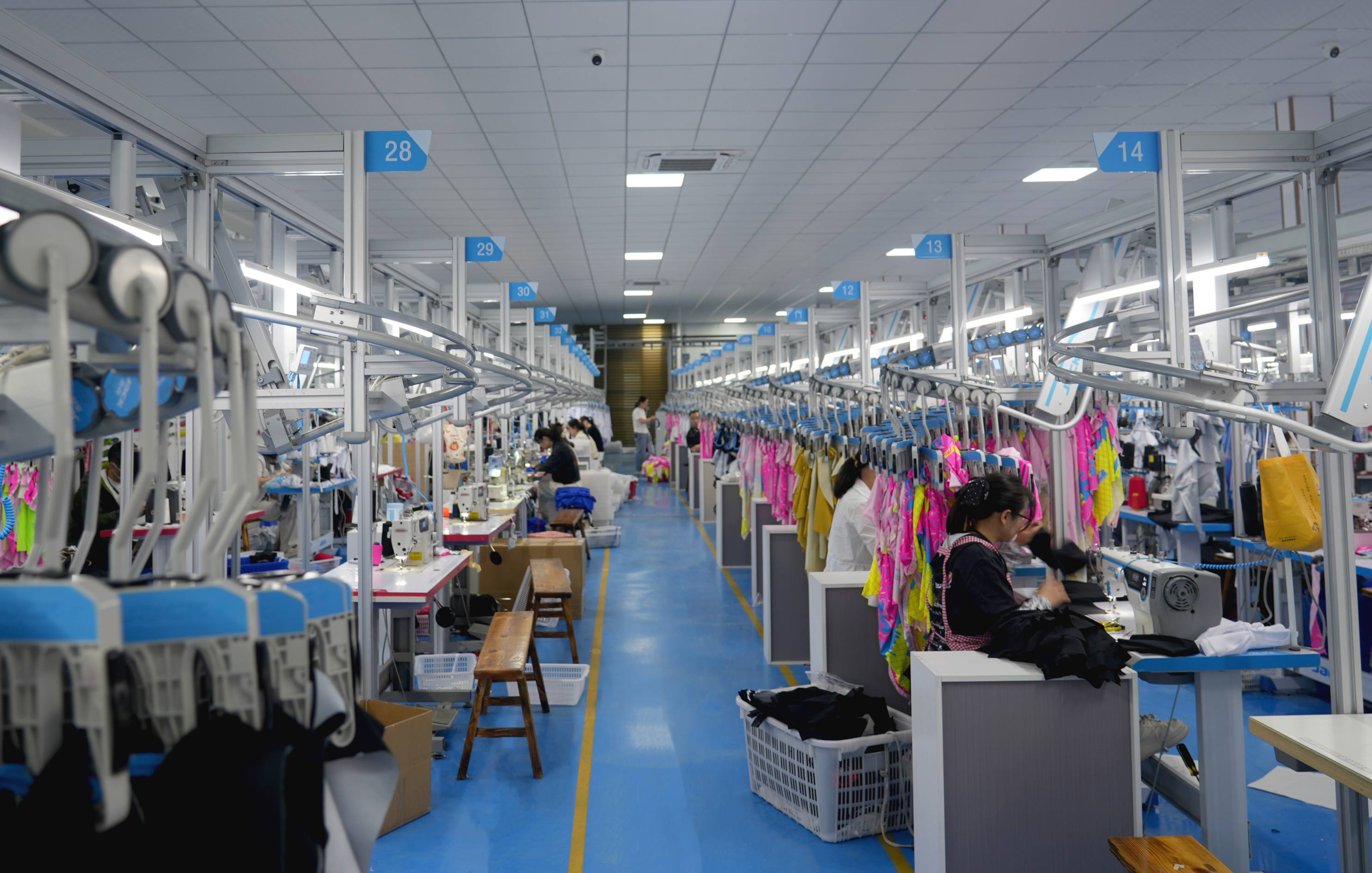
Production Workshop
Step 6 — Product Development and Sampling
Product development is where most timeline slippage happens, and where the quality of your finished product is actually decided.
A standard development sequence:
Technical brief submission — Absorbency target (ml), fabric composition, style silhouette, size run, colourways, label and packaging specifications.
First sample (Prototype) — Structural and fit review. Expect to iterate on waistband height, leg opening, and gusset depth.
Second sample (Pre-production) — Correct materials, correct construction. Wash-test and absorbency-test this sample independently.
Pre-production sample (PPS) — Pulled from the actual production fabric roll and trim lot. This is the legal reference sample against which your production run will be inspected.
Bulk production — Should match PPS within AQL 2.5 tolerances.
Independent absorbency testing is non-negotiable before first shipment. Standard test: saturate a single pair to its stated capacity, weigh before and after, confirm the claimed ml rating. Do this across multiple size variants — absorbency does not scale linearly with size unless the manufacturer has re-engineered the core. covers the full sampling process, what to test at each stage, and how to interpret test results.
Step 7 — Branding, Packaging and Storytelling
Period underwear brands that win on DTC are not winning on product specs alone. They win on the story they tell about why their product exists.
Name and positioning. Your brand name should be memorable, spell-checkable, and ideally free of period-specific puns that date quickly. More importantly, it should signal your positioning — whether that is clinical confidence, playful irreverence, eco-consciousness, or inclusivity.
Packaging. For DTC e-commerce, your packaging is the unboxing experience. Recyclable or compostable packaging is increasingly expected at the premium tier, not optional. Include a care card (washing instructions extend product life and reduce refund rates) and a brand story card that gives the customer the language to recommend your product to others.
Photography. Period underwear lives or dies by photography. The product needs to convey both function and desirability. Inclusive casting — diverse body types, ages, and skin tones — is commercially effective as well as expected. Your photography will serve as the primary asset across every channel for at least twelve months.
Storytelling. Customers buying period underwear are switching from a product they have used since adolescence — that requires an emotional as well as functional justification. Your brand story needs to answer: why does this brand exist, and why does it understand my specific situation? Founder stories, material sourcing transparency, and social mission statements all work as narrative anchors when authentic.
Step 8 — Compliance and Certifications
Compliance is not bureaucratic overhead — it is a market access requirement and a brand trust signal.
OEKO-TEX® STANDARD 100 certifies that every component of the product has been tested for harmful substances. This is the minimum standard for any brand selling to informed consumers and is a retailer requirement for most European chains.
PFAS-free verification. Per- and polyfluoroalkyl substances have been used as DWR coatings in some water-resistant fabrics, including early-generation period underwear. Several class-action suits and regulatory bans have made PFAS-free status non-negotiable for any brand launched from 2025 onwards. Require written confirmation from your manufacturer and request third-party test reports.
FDA compliance. Period underwear sold in the United States falls under FDA regulatory oversight. Your manufacturer should be able to provide documentation of compliance and, ideally, prior FDA registration records.
BSCI / SEDEX. These social compliance audits document that the factory meets labour rights, health and safety, and environmental standards. Required by most European retailers and increasingly expected by US buyers.
GRS (Global Recycled Standard). If your brand proposition includes recycled materials, GRS certification substantiates the claim and prevents greenwashing accusations. covers each certification in detail, including how to request documentation and what to do when a supplier cannot produce it.

Ljvogues Certificates
Step 9 — Pricing Strategy
Period underwear pricing follows a logic that is different from most fashion categories because customers are comparing it to a recurring disposable product spend, not to other underwear.
DTC (Direct-to-Consumer) margins. At retail price points of USD 25–45 per pair, and landed unit costs of USD 8–15 depending on specifications and volume, DTC gross margins typically run 50–70%. This is before marketing and fulfilment costs, which at early-stage DTC brands often run 30–40% of revenue combined.
Wholesale margins. Selling through retail partners at 50–60% of MSRP, wholesale contribution margins run 30–40%. Lower margin, but no customer acquisition cost and predictable volume.
Most founders start DTC to protect margin while building brand equity, then selectively add wholesale channels once the brand has the revenue to absorb the margin compression. The reverse rarely works — launching wholesale-first locks you into price structures that are difficult to unwind.
Pricing anchoring. Set your lowest-priced style at a minimum USD 22–25 MSRP. Pricing below USD 20 signals to consumers that the product is a commodity, which undermines the absorbency and material quality story you need to tell. It also collapses your margin structure before you have scale.
Multi-pack bundling. Three-pair bundles at a 10–15% discount increase average order value and reduce per-unit fulfilment costs simultaneously. Most period underwear DTC brands find that multi-pack SKUs account for 30–40% of their revenue once the brand is established.
Step 10 — Launch and Marketing
Pre-launch email list building. Start collecting emails at least 60 days before launch. Offer early access or a founding member discount as the opt-in incentive. A list of 1,000 engaged subscribers is more valuable at launch than 10,000 cold social followers.
Micro-influencer seeding. Period underwear requires trial to believe. Identify 20–30 micro-influencers (10,000–100,000 followers) whose audiences match your target customer and seed them with product 4–6 weeks before launch. Authentic reviews from trusted voices convert more efficiently than paid ads at early stage.
Content SEO. Publish educational content targeting questions your customer searches before they know your brand: "how to wash period underwear," "how much can period underwear hold," "is period underwear safe." These are high-intent, low-competition queries that compound over time.
Paid social. Meta remains the primary paid channel for intimate apparel at launch. Budget USD 2,000–5,000 for the first 60 days, focused on retargeting website visitors and lookalike audiences built from your email list.
PR and editorial. Period underwear continues to attract editorial interest where health, sustainability, and social progress intersect. A targeted pitch to women's health editors and sustainability journalists can generate coverage paid media cannot replicate.
Common Mistakes First-Time Founders Make
Skipping niche definition. Launching without a clear, specific target customer is the single most common error. It produces generic positioning, unfocused creative, and wasted ad spend.
Over-ordering on the first run. The temptation to hit lower unit costs by ordering 3,000–5,000 pieces on an untested style is understandable but routinely catastrophic. Start with 500–1,000 units. Validate the product, price point, and channel before scaling inventory.
Under-investing in sampling. Approving a production run from a single prototype sample is a quality risk. The pre-production sample must be tested for absorbency, wash durability, and fit before bulk production begins.
Ignoring certifications until a retailer asks. OEKO-TEX certification can take 8–12 weeks from sample submission. If you wait until a buyer asks, you will lose the order. Build certification into your product development timeline from the start.
Neglecting packaging and post-purchase experience. The unboxing experience and care instructions directly affect product satisfaction, repeat purchase rate, and social sharing. This is not where to cut costs.
Mispricing to compete with mass-market. Competing on price against Primark or Target is not a viable strategy for a startup DTC brand. Compete on specificity, story, and quality.
Ocean Yang, Founder of LJVOGUES, on what separates brands that scale from those that stall:
"In 20 years of manufacturing, we have worked with 500+ brands at every stage of development. The ones that scale consistently share three things: they chose a clear niche before they ordered samples, they validated demand before they committed to bulk production, and they started with MOQs of 500–1,000 pieces rather than over-ordering at launch. The brands that struggle either launched without a differentiated position, or placed a 5,000-unit order on their first style before they had a single customer. Starting small and scaling progressively is not a compromise — it is the model that works."
Frequently Asked Questions
How much does it cost to start a period underwear brand?
The realistic range is $12,000 at the lean end (small inventory run, founder-built website, organic-only marketing) to $130,000 for a fully funded launch with custom development, professional branding, and paid marketing. Most founders launch successfully in the $25,000–$60,000 range. The biggest variables are inventory volume and marketing spend.
How long until my first sale?
From the decision to launch to first sale typically takes 10–12 months when following a disciplined process: 3 months for research and validation, 3 months for sampling and development, 3 months for production and setup, and 1–3 months to build to first sale post-launch. Founders who skip validation and rush sampling can compress this timeline — and usually pay for it in unsold inventory.
Do I need a degree or industry experience to start a period underwear brand?
No. Most successful founders in this category came from outside the textile industry — from technology, healthcare, finance, and consumer goods backgrounds. What matters is commercial judgement, product empathy, and the discipline to validate before you scale. Technical manufacturing knowledge is valuable but can be sourced through your manufacturer relationship.
Can I dropship period underwear?
You can use a dropship model with a manufacturer's or distributor's existing products. However, period underwear dropshipping is more complex than typical apparel dropshipping because customers need accurate, style-specific absorbency information before purchase, returns are more sensitive, and brand trust is a core purchase driver. Dropship is a viable model for testing the category, but most DTC founders move to inventory ownership quickly to control the customer experience.
What is the profit margin on period underwear?
DTC gross margins are typically 50–70% on period underwear at retail price points of USD 25–45, with factory cost of goods in the USD 8–15 range depending on specifications and volume. Wholesale margins run 30–40% of retail. These are gross margins — net profit depends heavily on marketing cost, which for DTC brands typically runs 15–30% of revenue in the first two years.
What is the minimum order quantity (MOQ) for a first production run?
Most reputable period underwear manufacturers with proprietary absorbent technology set MOQs at 300–1,000 pieces per style. LJVOGUES supports first-run programs from 300 pieces for private label and 500 pieces for ODM programmes, scaling to 1,000+ for fully custom OEM development. Be cautious of factories offering 50–100-piece MOQs on functional period underwear — the unit economics typically cannot support proper material lamination at that volume.
How do I protect my brand design from being copied by the manufacturer?
Use a non-disclosure and non-compete agreement before sharing your technical brief. Trademark your brand name in your target markets before production begins (this can take 8–18 months depending on jurisdiction, so file early). Distribute production across more than one factory once you have the volume to do so.
What certifications do I need before I can sell in the US or EU?
For the US: FDA compliance documentation is the baseline. OEKO-TEX® STANDARD 100 is required by most retailers and expected by informed consumers. For the EU: OEKO-TEX® is the minimum; BSCI or SEDEX social compliance audit is required by major European retail chains. PFAS-free verification is mandatory in an increasing number of jurisdictions and should be confirmed in writing from your manufacturer.
How do I know if my period underwear is actually absorbing the stated amount?
Conduct independent absorbency testing, not relying solely on your manufacturer's internal claims. The standard test involves saturating the garment with a saline solution to its stated ml capacity, then measuring the retained volume by weight. Test multiple size variants — absorbency does not scale automatically with garment size.
Can I start with just one style?
Yes, and it is often the right decision. Starting with one style in three to four sizes allows you to validate your core product-market fit, understand your customer, and generate cash flow before expanding your line. Most successful period underwear brands launched with a brief or bikini style — brief is the highest-volume style segment — and expanded from there once the unit economics were confirmed.
Work with LJVOGUES to Build Your Brand
LJVOGUES has supported 500+ brands through the manufacturing process described in this guide — from the first sample request to scaled production runs shipping to DTC warehouses and retail buyers across North America, Europe, and Asia Pacific.
Our 8,000 m² Shenzhen facility handles the full development cycle in-house: fabric R&D, absorbent core lamination, cutting, sewing, and packaging. We hold OEKO-TEX® STANDARD 100, BSCI, SEDEX, ISO 9001/14001, GRS, FDA, and 100% PFAS-free certification — documentation your buyers will ask for, ready before you need it.
MOQs start at 300 pieces for private-label programmes and 500 pieces for ODM development. Sample turnaround runs 10–15 days. Bulk lead times are 35–45 days from approved sample and confirmed deposit.
If you are at the research stage and want to understand what a realistic development programme looks like for your specific niche, contact the LJVOGUES team with your product brief. We will respond with a programme outline, indicative costing, and a sample timeline — no obligation.
Sources: Grand View Research — Period Panties Market Report | Grand View Research — Period Panties Market Press Release | Modern Retail — Knix post-acquisition growth | Adweek — Thinx USD 80M revenue 2020 | Wikipedia — Thinx founding history | OEKO-TEX Standard 100