



Table of Contents
Why This Article Exists
Seven weeks of this series have walked through what defensible clean positioning requires: PFAS testing, OEKO-TEX scope, hidden chemistry audits, GOTS Transaction Certificates, synthetic material specifications, construction chemistry, and a 7-step verification workflow.
If you've been reading from the beginning, by now you know what's possible. The question that's been sitting underneath the entire series is the one I get asked in every commercial conversation:
"What does this actually cost?"
Brand owners deserve an honest answer to that question, in numbers, before they commit to building a clean program. Not "premium pricing," not "a meaningful investment," not "varies by specification" — actual finished-garment cost in dollars, broken down by tier, with the trade-offs explicit.
This article is the answer. It's also, deliberately, the most commercially uncomfortable article in the series. Talking about cost openly is something the manufacturing side of this industry mostly avoids. The reason I'm going to do it is the same reason I've written all eight of these: brands building real clean positioning need to be able to make the financial case to their CFOs, their boards, and their retailers. They can't make that case with vague directional language. They need numbers.
So here are the numbers.
The Three Tiers, Defined
Period underwear in 2026 sources at three roughly distinct tiers. Each tier corresponds to a different chemistry stack, a different documentation chain, and a different finished-garment cost.
Tier 1: Commodity
Mass-market period underwear without specific chemistry positioning. Sold under generic brands, marketplace-only labels, and lower-end retail.
What's typically in the construction:
Conventional cotton or cotton-poly blend (no organic certification)
Generic spandex (typically dry-spun with DMAc residue)
Generic TPU (often polyester base, sometimes with phthalate plasticizer)
Often includes antimicrobial finish (silver or quat)
Solvent-based or generic hot-melt adhesive at gusset
Overlock seams throughout, including gusset
Plastisol-printed care information or sewn polyester tag
No pre-wash, immediate packaging
PVC or mixed-material retail bag
Documentation:
Sometimes OEKO-TEX certified at fabric component level
Rarely at finished garment level
No GOTS, no GRS, no PFAS testing
Finished garment cost (size M, standard 3-layer): $2.50–4.50 USD FOB
Tier 2: Premium Clean
Brands with credible clean positioning — typically $25–40 retail price point, sold through DTC, Amazon premium tier, and natural-products retail channels.
What's typically in the construction:
OEKO-TEX certified body fabric (often Made with Organic Cotton, sometimes full GOTS)
Premium-brand spandex (Creora, LYCRA, OEKO-TEX certified)
Polyether-based TPU, phthalate-free, OEKO-TEX certified
No antimicrobial finishes
Water-based PU adhesive at gusset
Mix of overlock and bound seams; gusset typically overlock
Tagless heat-transfer labels with water-based ink
Sometimes pre-wash, typically 24–48 hours cure time
Recycled LDPE polybag
Documentation:
OEKO-TEX Standard 100 finished garment, current
GOTS Transaction Certificates per shipment for organic-content products
Independent PFAS testing on annual basis
Some chemistry SDS available
Finished garment cost (size M, standard 3-layer): $5.00–7.50 USD FOB
Tier 3: Defensible Clean (The Standard This Series Has Been Describing)
Brands building positions that survive regulatory scrutiny, retailer compliance audits, and class-action discovery. Typically $30–55 retail price point, sold through specialty DTC, premium clean-living retail, and select compliance-conscious mass retail.
What's typically in the construction:
GOTS Organic Cotton or full Made with Organic Cotton with TC chain
ROICA V550 (C2C Gold) spandex on skin-contact zones; OEKO-TEX certified Creora or equivalent on body blends
Polyether-based, aliphatic-isocyanate, phthalate-free TPU; heat lamination preferred
No antimicrobial finishes anywhere
Heat lamination + water-based PU adhesive only; no solvent-based at any bond line
Flatlock at gusset-to-body inner seam; bound at leg openings; encapsulated waistband elastic
Tagless heat-transfer with water-based ink + cotton woven brand label
72-hour cure time minimum; pre-wash with hypoallergenic detergent
Recycled cardboard primary packaging + OEKO-TEX certified LDPE if needed
Documentation:
Full Phase A audit pass (Weeks 1–4 verified)
Full Phase B per-shipment compliance bundle (Weeks 5–7)
Annual independent finished-garment lab testing across the full panel
Marketing claim mapping with document references
BOM transparency to retailer compliance teams
Finished garment cost (size M, standard 3-layer): $7.50–11.00 USD FOB

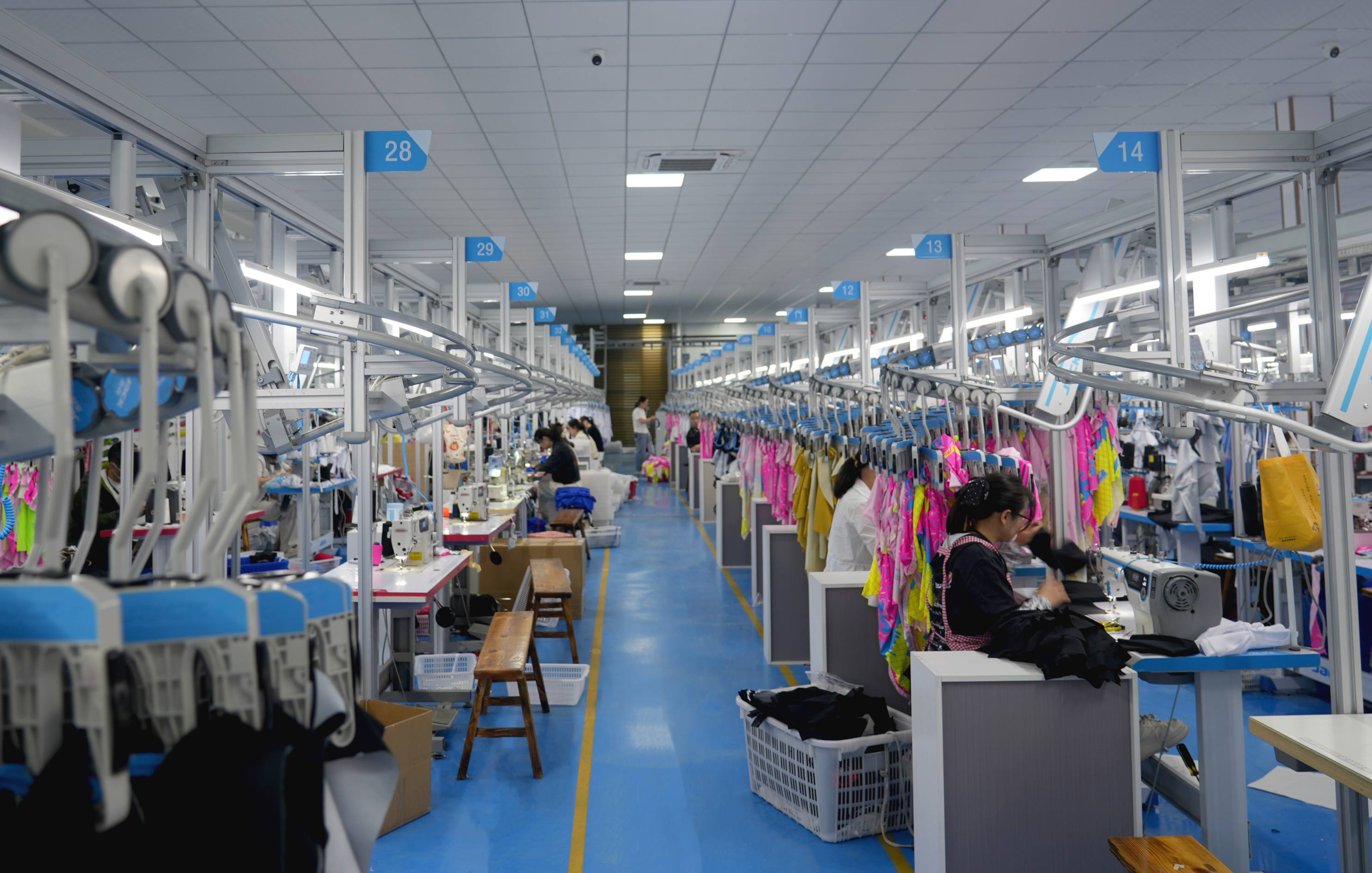
Ljvogues workers are at work
The Cost Premium, Component by Component
To understand where the money goes between Tier 1 and Tier 3, here's the same product specified at each tier, with cost differentials called out at the component level.
Component | Tier 1 (Commodity) | Tier 2 (Premium Clean) | Tier 3 (Defensible Clean) |
Body fabric | $0.80 (conventional cotton blend) | $1.40 (OEKO-TEX Made with Organic) | $1.80 (GOTS Organic with TC) |
Absorbent core | $0.40 (microfiber blend) | $0.55 (organic cotton terry) | $0.70 (GOTS organic cotton terry with TC) |
TPU film | $0.25 (polyester base, generic) | $0.40 (polyether, phthalate-free) | $0.55 (polyether, aliphatic, OEKO-TEX certified) |
Spandex (waistband + legs) | $0.20 (commodity dry-spun) | $0.45 (OEKO-TEX Creora or LYCRA) | $0.85 (ROICA V550 on skin-contact) |
Sewing thread | $0.05 | $0.10 (OEKO-TEX certified) | $0.12 (OEKO-TEX, untreated, no bonded nylon) |
Adhesive (gusset bond) | $0.10 (solvent or generic hot-melt) | $0.20 (water-based PU) | $0.25 (heat lamination + minimal water-based) |
Labels and trim | $0.10 (sewn polyester tag, plastisol) | $0.18 (tagless water-based ink) | $0.25 (tagless + cotton woven sewn-in) |
Cutting and sewing labor | $0.80 (overlock standard) | $1.00 (mixed seams, slower) | $1.30 (flatlock, bound, encapsulated, slower) |
Pre-wash + cure time | — | $0.10 | $0.30 (full pre-wash + 72 hr cure) |
Packaging | $0.15 (PVC or mixed) | $0.25 (recycled LDPE) | $0.40 (recycled cardboard + LDPE) |
Documentation overhead | — | $0.20 (certifications and TCs) | $0.40 (full audit + lab testing amortized) |
Factory margin | $0.15–1.20 | $0.20–1.50 | $0.60–1.80 |
TOTAL FOB | $2.50–4.50 | $5.00–7.50 | $7.50–11.00 |
The math summary:
Tier 1 → Tier 2: Roughly +100% finished-garment cost ($2.50 → $5.00 floor)
Tier 2 → Tier 3: Roughly +50% finished-garment cost ($5.00 → $7.50 floor)
Tier 1 → Tier 3: Roughly +200% finished-garment cost ($2.50 → $7.50 floor)
These are real numbers from real production runs. They will vary modestly by quantity (higher MOQ reduces unit cost across all tiers), by complexity (multi-flow product lines cost more than single-flow), and by region (Chinese vs. Vietnamese vs. Pakistani sourcing has structural cost differences). But the directional gaps between tiers are stable.

Ljvogues' quality control workers are conducting OQC inspections.
What These Numbers Mean at Retail
A standard rule of thumb in DTC apparel is 5x markup from FOB to retail, accounting for inbound logistics, warehousing, fulfillment, customer acquisition, returns, customer service, and brand margin. The math shifts based on channel — wholesale to physical retail typically takes a 2.5–3x slice off retail before the brand sees revenue, and Amazon FBA economics differ from direct DTC.
Using the 5x DTC heuristic:
Tier | FOB Cost | DTC Retail Range | Wholesale Retail Range |
Tier 1 | $2.50–4.50 | $12–22 | $20–35 |
Tier 2 | $5.00–7.50 | $25–37 | $35–55 |
Tier 3 | $7.50–11.00 | $37–55 | $55–80 |
What this tells you about category positioning:
The $12–20 retail tier on Amazon is structurally Tier 1. The chemistry stack at that price point cannot be Tier 3 — the math doesn't work.
The $25–35 retail tier (most premium DTC period underwear today) is structurally Tier 2. Some brands at this tier are upgrading toward Tier 3 selectively, but the standard construction is Tier 2.
The $37–55 retail tier is the natural home for Tier 3 — defensible, fully documented, premium positioning.
Above $55 retail, brands are typically buying additional differentiation (high-design, specialty fabrics, athletic features) on top of Tier 3 chemistry, not paying more for chemistry alone.
This matters for how you read the competitive landscape. A brand selling at $20 retail that markets "PFAS-free, GOTS organic, no antimicrobials" is making claims their cost structure cannot support — at least not with the documentation chain to back the claims. Either they're operating at a loss, or they're operating at a margin so thin that their claims are not separately verifiable, or one of the claims is overreach.
Where the Money Actually Goes (And Where It Doesn't)
The most important insight from the cost breakdown above is which line items actually move when you upgrade to Tier 3.
The big movers (50%+ of the total premium):
Component | Tier 1 → Tier 3 Premium | % of Total Upgrade |
Body fabric upgrade | +$1.00 | ~20% of upgrade |
Spandex upgrade (ROICA V550) | +$0.65 | ~13% of upgrade |
Cutting and sewing labor (flatlock, bound) | +$0.50 | ~10% of upgrade |
Adhesive upgrade (heat lamination) | +$0.15 | ~3% of upgrade |
Documentation overhead | +$0.40 | ~8% of upgrade |
Pre-wash + cure time | +$0.30 | ~6% of upgrade |
Packaging upgrade | +$0.25 | ~5% of upgrade |
The non-movers (often surprising to brands):
Component | Tier 1 → Tier 3 Premium |
Sewing thread | +$0.07 (negligible) |
TPU film | +$0.30 (modest) |
Labels and trim | +$0.15 (modest) |
The strategic implication:
If you're a brand on a constrained budget trying to upgrade from Tier 2 to Tier 3 selectively, the highest-leverage components to upgrade are:
Spandex (Tier 2 → ROICA V550) — adds $0.40–0.65 per garment and unlocks Cradle to Cradle Gold documentation, which is a meaningful marketing differentiator
Body fabric (Made with Organic → full GOTS Organic) — adds $0.30–0.50 per garment and upgrades the documentation chain
Documentation (selective audit + annual lab testing) — adds $0.40 per garment amortized but unlocks defensibility against regulatory and class-action exposure
Adhesive (water-based PU → heat lamination) — adds $0.05–0.15 per garment and eliminates the bond-line chemistry contribution entirely
These four upgrades together represent roughly 50% of the total Tier 2 → Tier 3 cost gap, and they unlock the majority of the documentation and positioning value. The remaining 50% of the gap is in incremental improvements to thread, labels, packaging, and pre-wash process — meaningful but lower-leverage.
The framework: don't try to upgrade everything at once. Identify the four high-leverage upgrades, fund those first, and stage the rest as your category position scales.

Ljvogues' various main fabrics
The ROI Math: When Does Tier 3 Pay For Itself?
A CFO asked this directly two years ago, and it's the right question:
"If Tier 3 costs me $3 more per garment than Tier 2, and I sell 50,000 units a year, that's $150,000 in extra COGS. What's the return?"
The honest answer has three parts:
Part 1: The Premium Pricing Capture
If your Tier 3 chemistry lets you move from a $25 retail price to a $35 retail price (which is what defensible clean positioning typically supports), the gross margin math changes dramatically.
Scenario | Tier 2 at $25 retail | Tier 3 at $35 retail |
Retail price | $25.00 | $35.00 |
FOB cost | $5.00 | $8.00 |
Inbound + ops + CAC + margin allocation (typical 4x markup on FOB above the 1x cost) | $20.00 | $27.00 |
Brand contribution margin | ~$8–10 | ~$12–15 |
Annual contribution at 50,000 units | $400K–500K | $600K–750K |
Net annual benefit of upgrading | — | +$200K–250K/year |
The $150K extra COGS pays for itself roughly 1.3–1.7x over in incremental contribution margin, if the Tier 3 documentation supports a real $10 retail price upgrade. The "if" is real — Tier 3 doesn't automatically command a higher price. It supports a higher price, which then has to be earned through positioning, marketing, and channel selection.
Part 2: The Risk Mitigation
The harder-to-quantify part. The exposure for an unsupported clean claim has accelerated since 2023:
PFAS class actions — settlements in the period underwear category reached eight figures by 2023. Brands without independent PFAS testing on finished garments are exposed.
FTC Green Guides update — finalized in 2026, with materially higher documentation requirements for textile organic and clean claims.
EU Green Claims Directive — enforcement starts 2027 with explicit documentation chain requirements for sustainability and organic claims in all consumer goods.
State-level regulation — California, New York, Washington, and several others have textile-specific chemistry restrictions enforced through consumer protection statutes.
A brand operating at Tier 3 with a complete documentation chain and an annual lab testing program has effectively bought insurance against this entire risk surface for $0.40 per garment in documentation overhead.
A brand operating at Tier 2 with marketing claims that exceed their documentation has a regulatory and class-action exposure that's hard to quantify in advance and easy to quantify after the fact. The financial structure of these settlements typically includes legal fees in the high six to low seven figures, refund and remediation costs in the low to mid seven figures, and reputational damage that's harder to put a number on but real.
For most brands operating above ~$2M annual revenue on a SKU, the risk-mitigation case for Tier 3 stands on its own without any premium-pricing benefit. The premium-pricing benefit is upside on top.
Part 3: The Retail Channel Access
Increasingly, the major retailers — Whole Foods, Target Clean, Sephora Clean at Sephora, MEC, Erewhon, Boots, Sephora EU — operate "clean" criteria that explicitly require Tier 3-level documentation. Brands that don't have the documentation chain don't get listed in these channels regardless of how clean their actual product is.
The math here is binary: either your brand qualifies for the channel or it doesn't. The annual revenue available through clean-channel listings for a credible brand in this category typically ranges from $500K to $5M per channel, depending on scale and listing depth. The cost of Tier 3 documentation ($0.40 per garment + some upfront audit cost) is essentially the price of being eligible at all.
Where Brands Get the Math Wrong
Three patterns I see consistently:
Pattern 1: Underpricing Tier 3 Chemistry
A brand commits to Tier 3 chemistry but prices the product at Tier 2 retail because they're afraid to move price. The chemistry investment is real, the contribution margin is squeezed, and the brand ends up with an under-margined product whose positioning cost more than the market position it's competing in. The math signals that the brand should either move price up to Tier 3 retail (where the chemistry economics work) or stage down to Tier 2 chemistry (where the price economics work). Holding both at the wrong combination is the unsustainable middle.
Pattern 2: Tier 1 Chemistry With Tier 3 Marketing
Far more common. The brand commits to Tier 3 marketing language ("PFAS-free, GOTS organic, no antimicrobials") at Tier 2 or even Tier 1 sourcing economics. The product cost is $4 FOB, the marketing claim implies $8 FOB, and the documentation chain is missing. This is the economically appealing trap because it temporarily produces unusually high margins. It's also the pattern with the highest regulatory exposure. Brands operating in this pattern tend to scale until they hit a class action, a retailer compliance audit, or a regulatory inquiry — and then they collapse fast.
Pattern 3: Over-Investing in One Component, Under-Investing in Documentation
A brand spends heavily on premium spandex or specialty TPU, but skips the per-shipment Transaction Certificates, the annual lab testing, and the marketing claim mapping. The product is genuinely cleaner than competitors. The documentation chain that proves it's cleaner doesn't exist. The premium chemistry is real, but the brand can't substantiate it under audit, so the premium positioning fails to convert. This is the engineer's pattern — get the materials right and assume documentation is administrative overhead. It isn't. Documentation is the asset. Materials are the substrate that makes the documentation defensible.

The Top 10 Synthesis — Everything From All 8 Weeks
For the executive summary you can hand to your CEO, your board, or your investors:
PFAS Is the Litmus Test, Not the Whole Story
PFAS testing on finished garment is the entry-level credential for any clean-positioning period underwear brand. Independent total organic fluorine testing (EPA 1633 or ASTM F3530), under 100 ppm, ideally non-detect — annually, on finished product. Brands without this aren't in the conversation.
OEKO-TEX Standard 100 Must Be Class II Finished Garment, Not Anything Less
Class III is for non-skin-contact apparel — wrong category. Fabric-component certificates don't cover finished construction. The minimum acceptable credential is Standard 100, Class II, finished garment, current. Verify on the OEKO-TEX public database.
The Hidden Chemistries Are More Common Than the Visible Ones
Antimicrobial finishes (silver, copper, zinc, triclosan, PHMB, quats) are everywhere in this category and almost always undisclosed in marketing. They're a regulatory time bomb, a vaginal microbiome concern, and a chronic exposure issue. The right answer for period underwear is none — ever. Solve odor with fabric and wash protocol.
GOTS Scope Certificate ≠ GOTS Product
A factory's Scope Certificate establishes eligibility. It doesn't certify any specific shipment. Every PO needs a Transaction Certificate in the brand's name with PO reference and matched quantity. Without the TC, "GOTS organic" claims are unsubstantiated. Most brands that get this wrong are doing it because nobody told them the TC was a separate document.
The Synthetic 30% Is As Important As the Organic 70%
Spandex (ROICA V550 for the cleanest tier), TPU (polyether base, phthalate-free), recycled PET (GRS-certified, antimony-free), sewing thread (OEKO-TEX certified, no antimicrobial). Each of these has its own chemistry profile and its own documentation. The "Made with Organic Cotton" claim covers the cotton; the synthetic chemistry has to be specified separately.
Construction Decisions Reintroduce Chemistry That Components Don't Have
Solvent-based adhesives, plastisol prints, bare elastic, and overlock at gusset can all bring chemistry exposure into a garment whose components were individually clean. Heat lamination, water-based adhesive, encapsulated elastic, flatlock at gusset, tagless heat-transfer with water-based ink — these are construction-level decisions that determine whether the upstream chemistry work delivers to the wearer's skin.
The 7-Step Verification Workflow Is the Operational Bar
Phase A (scope, database, chemistry questionnaire, lab test) at supplier onboarding. Phase B (TC, documentation bundle, marketing validation) at every shipment. The discipline is to never advance past a Red. Three hours of supplier-side work plus 30 minutes per shipment plus $1.5–3.5K annual lab testing — that's the cost of running a defensible program.
Documentation Is the Asset, Not the Materials
A brand with one fully documented certification (verified in database, with TCs in their name, on every shipment) is in a stronger position than a brand with five undocumented certifications. The documentation chain — not the chemistry per se — is what survives a regulatory audit, a retailer compliance review, and a class-action discovery.
The Cost of Defensible Clean Is Real but Manageable: 35–55% Finished-Garment Premium Over Commodity
Tier 1 to Tier 3 is roughly +200% finished-garment cost. Tier 2 to Tier 3 is roughly +50%. Within the Tier 3 upgrade, four components (body fabric, spandex, adhesive, documentation) deliver about 50% of the value. The math fits inside a $35–55 retail price point that defensible-clean brands are already commanding.
The Window Is Closing
EU Green Claims Directive enforcement starts 2027. FTC Green Guides updated 2026. State-level chemistry regulations tightening continuously. The brands building Tier 3 documentation chains in 2025–2026 are positioning ahead of regulatory requirements. The brands waiting for regulation to force the move are going to be reformulating in panic on someone else's timeline.
What This Series Has Argued, In One Paragraph
Period underwear is becoming a documented-chemistry category, the way baby skincare became one in 2010 and clean beauty did in 2015. Brands building the documentation chain now — verifiable certifications, per-shipment Transaction Certificates, independent finished-garment testing, full BOM transparency, claim-to-document mapping — are buying premium positioning, regulatory protection, and channel access that compounds over time. The cost is real (35–55% finished-garment premium over commodity). The trade-off is favorable (premium pricing capture + risk mitigation + channel access). The window for being early is closing rapidly. The brands that act in 2026 will define the premium tier of this category through 2030.
Where Ljvogues Stands — Final Time
Same transparency principle, applied one last time:
We operate at Tier 3 as a baseline, not as an upgrade. Every period underwear product we ship has finished-garment OEKO-TEX Class II certification, GOTS Transaction Certificates available per shipment, ROICA V550 spandex on premium product lines, polyether phthalate-free TPU, water-based or heat-laminated adhesives only, no antimicrobial treatments anywhere, flatlock gusset construction, tagless water-based-ink labels, 72-hour cure time, recycled cardboard packaging.
Our finished-garment FOB price range is $7.50–11.00 USD for standard 3-layer constructions in size M, depending on quantity, complexity, and specific upgrades. We can quote at this tier confidently because we already have the documentation chain in place — there's no audit cost or premium for clean positioning, it's the standard.
We offer Tier 2 production for brands with pricing constraints, but we will not produce Tier 1 chemistry under any brand's label, and we will not allow Tier 3 marketing claims on a Tier 2 specification.
Our offer to brands sourcing elsewhere stands: send us a sample, send us your supplier's certificates. We'll run the full Phase A audit (Steps 1–4 from Week 7) and deliver a written audit report with specific findings and specific remediation. Free. We've done this for dozens of brands. The findings are consistent: most period underwear suppliers globally are operating at Tier 1 or Tier 2 chemistry while being marketed as Tier 3. The gap is fixable, but only if you find it.
If you've read all eight articles in this series, you now know more about period underwear chemistry, certification, and supply chain integrity than 95% of the brand owners currently selling in this category. Use it.
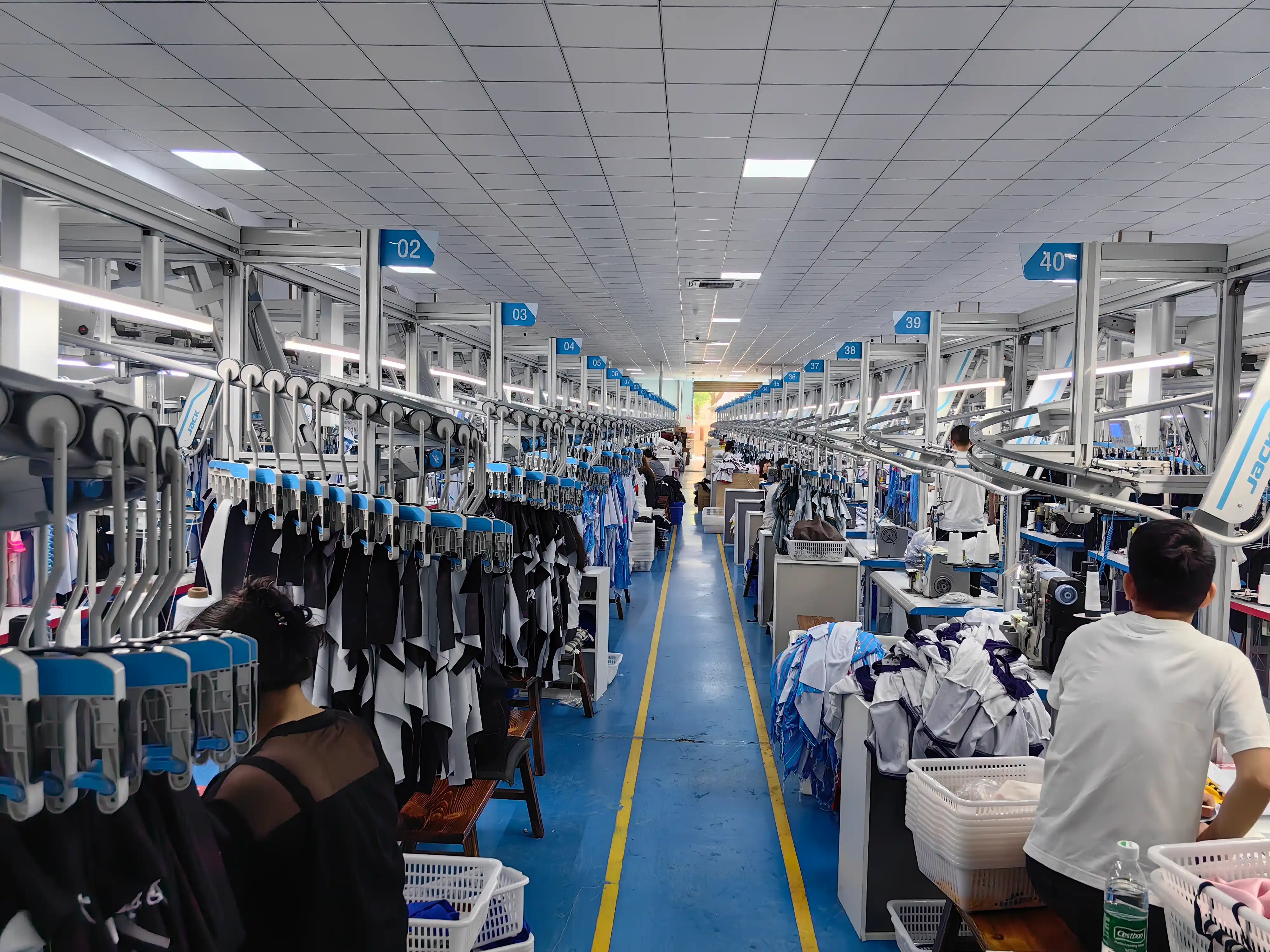
Ljvogues' hanging sewing assembly line workshop
Talk to Us
If you want a quote at Tier 3 specification, an audit on your current supplier, a sample dissection, or a 30-minute conversation on what your specific positioning would require — we're here. We've worked with 500+ brands across 108 countries and we've seen the failure patterns enough times to be useful in 30 minutes.
WhatsApp: +86-199-2880-2613
Closing the Series
Eight weeks. Eight articles. About 60,000 words on what it actually takes to build a defensible clean period underwear brand in 2026.
I wrote this series for a specific reason. There's a lot of marketing language in this category and very little technical literacy. Brand owners get told "GOTS organic" by a factory and don't know what to ask next. They market "PFAS-free" without finished-garment testing. They build positioning on factory Scope Certificates that don't actually certify their products. The information asymmetry is real, and it's not in the brand's favor.
If even one brand owner reads this series, runs the 7-step audit on their current supplier, finds a gap that would have become a class action 18 months from now, and fixes it before it scaled — that justifies the entire effort.
We've covered the chemistry. We've covered the documentation. We've covered the construction. We've covered the workflow. We've covered the economics. There's nothing strategic left to write about clean period underwear that hasn't been in these eight articles.
What's next, on this account, is going to be more case-based — specific brand projects, specific sourcing situations, specific regulatory developments as they happen. The strategic foundation is in this series. The applied work is what comes next.
Thank you for reading.
If you want to be notified when new content publishes, email us — we'll add you to the list.
— Ocean Yang
CEO, Ljvogues
About Ljvogues
Ljvogues (USPTO Reg. No. 6,378,310) is a Shenzhen-based OEM and private label manufacturer specializing in period underwear, incontinence underwear, and functional intimate apparel. Since 2015, we have served 500+ brands across 108 countries.
Tier 3 baseline production:
GOTS Scope Certificate — current, GOTS 7.0, period underwear scope
GOTS Transaction Certificates per shipment, in brand's name
OEKO-TEX Standard 100 — Class II — Finished Garment — Active
GRS — certified for recycled-content product lines
PFAS-Free — verified by independent Eurofins finished-garment testing
ROICA V550 (Cradle to Cradle Gold) spandex on premium product lines
Polyether-based, aliphatic-isocyanate, phthalate-free TPU
Heat lamination + water-based PU adhesive only
Flatlock gusset construction
Tagless heat-transfer with water-based ink
72-hour cure time + pre-wash protocol
Full BOM + Construction Spec Sheet disclosure to qualified buyers
Free services for brand-side buyers:
OEKO-TEX certificate verification (Week 2)
9-question chemistry audit on any supplier (Week 3)
GOTS document chain review (Week 4)
Sample dissection and construction audit (Week 6)
Full Phase A onboarding audit on any supplier's documentation (Week 7)
Every certificate we cite is verifiable. Every component has a name. Every claim has a document. That's the bar.
— End of the Cleanest Period Underwear Series.