



Table of Contents
Why This Article Exists
In Week 1 we talked about PFAS. In Week 2 we walked through how to read an OEKO-TEX certificate without getting fooled. Both of those topics have something in common: the consumer-facing conversation has at least started. People search for "PFAS-free period underwear." Retailers ask for OEKO-TEX numbers in onboarding paperwork.
The chemistries in this article are different. They sit one layer deeper, behind marketing language that sounds like a feature rather than a chemical:
"Antimicrobial protection"
"Odor control technology"
"Stay-fresh finish"
"Wrinkle-resistant fabric"
"Soft hand feel" / "ultra-soft finish"
"Stain-release treatment"
"Quick-dry technology"
Every one of those phrases can be a real performance benefit. Every one of them can also be a chemical residue sitting against the most absorbent skin on the human body, eight to twelve hours per wear, multiple wears per cycle, multiple cycles per year.
Most B2B period underwear buyers I talk to have never been told exactly what those treatments are. Their suppliers describe them as "technology." Their marketing teams describe them as "innovation." Their lab reports — when they exist — list compounds the buyer has never heard of.
This article exists so that the next time a supplier shows you a sample with "advanced odor-control technology," you know exactly what to ask, exactly what to test for, and exactly what answer should make you walk away.
The Core Problem: Period Underwear Is the Worst Possible Carrier for Chemical Finishes
Before we go through the chemistries one by one, it helps to understand why intimate apparel is uniquely sensitive to finish chemistry.
Most clothing has three things working in your favor:
It doesn't sit against mucosal tissue. A T-shirt touches the outside of your skin — the stratum corneum, which is built to keep things out. Vulvar and labial skin is non-keratinized, thinner, and significantly more permeable to chemical exposure.
It's worn dry. A blouse stays dry. A finish that's "stable when dry" can be perfectly safe in a blouse and behave very differently when it's saturated for hours in a warm, slightly acidic, biologically active environment.
It doesn't get worn during a hormonally elevated permeability window. During menstruation, the local pH shifts, blood flow to the area increases, and the tissue becomes more reactive — both immunologically and chemically.
Period underwear violates all three conditions simultaneously. It sits against the most permeable skin on the body, in a wet warm environment, during the exact biological window when that skin is most reactive.
That's why a finish chemistry that's "generally recognized as safe" for a sock or a pillowcase is not automatically safe for a period gusset. Context determines risk.
This is also why the EU, several US states, and an increasing number of major retailers have started writing intimate-apparel-specific chemical restrictions that go beyond general apparel rules. The regulatory direction of travel is clear: what's acceptable in a hoodie is not automatically acceptable in a panty.

Category 1: Antimicrobial Treatments — The Most Common, Most Misunderstood Finish
What it is on the marketing page:
"Antimicrobial," "antibacterial," "anti-odor protection," "fresh technology," "silver-infused," "copper-infused," "zinc protection."
What it actually is in the lab:
A chemical or metallic agent applied to the fabric to kill or suppress bacterial growth. The most common in period underwear are:
Agent | Form | Common Trade Names | Concern |
Silver | Nano-silver, ionic silver, silver chloride | X-Static, SilverPlus, Polygiene | Leaches through wash cycles; bioaccumulation in waterways; EU is restricting silver biocides in textiles |
Copper | Copper oxide, copper-impregnated yarn | Cupron, CopperZap | Skin discoloration in some users; aquatic toxicity; restricted in EU intimate apparel |
Zinc | Zinc pyrithione, zinc oxide | Various | Endocrine disruption concerns under review; restricted concentrations |
Triclosan / Triclocarban | Phenol-class biocide | Microban (older formulations) | FDA-banned in soap; restricted in EU textiles; persistent in environment |
Quaternary Ammonium ("Quats") | Various quat compounds | BioFresh, Sanitized AM | Skin sensitization; respiratory irritation in production workers |
PHMB (polyhexamethylene biguanide) | Polymer biocide | Reputex, Purista | EU-classified Carc 2 (suspected carcinogen) for some applications |
Why suppliers love these treatments:
They let the marketing team write "antibacterial" on the package, which sells.
They reduce odor complaints in customer reviews, which improves star ratings.
They're cheap to apply — pennies per garment in most cases.
They allow the supplier to advertise "stays fresh longer," which is hard for the brand to argue with.
Why I, as a manufacturer, do not use any of these in period underwear, and recommend you don't either:
1. They wash out — and the wash-out is the exposure.
Most antimicrobial finishes are not permanently bonded. They release their active agent over time, which is precisely how they "kill bacteria." A silver finish that's still antimicrobial after 50 washes is, by definition, a finish that has been releasing silver into 50 wash cycles — into your customer's washing machine, into the local water system, and into the skin contact surface of the garment in between.
This is not a hypothetical. The EU's ECHA has been actively restricting silver biocides in textile applications precisely because of measured environmental release.
2. The "odor problem" they solve is mostly a fabric problem.
Period underwear that smells after one wear smells because:
The fabric is synthetic and traps bacterial byproducts (polyester is the main culprit)
The construction holds moisture against the skin too long
The wash care instructions are wrong for menstrual fluid
The right answer to all three is fabric and construction engineering, not a chemical bandage. A well-engineered cotton or TENCEL Modal gusset with an oxygen-bleach wash protocol does not have an odor problem. A poorly engineered polyester gusset with a silver finish has the same odor problem six months in, plus a chemical residue problem.
3. They damage the vaginal microbiome — which is the actual problem you're trying not to cause.
This is the part that almost never gets discussed. Antimicrobial finishes don't distinguish between "bad" bacteria (the ones that cause odor) and "good" bacteria (the ones that maintain vaginal health). Repeated, long-duration contact with a broad-spectrum antimicrobial directly against vulvar and vestibular skin is exactly the kind of disruption that's associated with increased rates of bacterial vaginosis, yeast overgrowth, and recurrent UTIs.
A garment marketed as "protecting" the wearer from bacteria, while simultaneously disrupting the bacterial environment that protects the wearer, is a product whose mechanism of action and marketing claim are pointing in opposite directions.
4. They're a regulatory time bomb.
The EU's Biocidal Products Regulation, California's Proposition 65, New York's S4389, and Washington State's Safer Products program are all moving in the same direction: tighter restrictions on antimicrobial textile treatments, especially in intimate apparel and children's clothing. A brand whose entire product line is built on "silver-infused antimicrobial protection" is a brand that has to reformulate every two to three years as another active ingredient gets restricted in another jurisdiction.
What to ask your supplier:
"Does this product contain any antimicrobial, antibacterial, or anti-odor finish? If yes, what is the active agent, what concentration, and can you provide the SDS and a wash-fastness study showing release over 50 wash cycles?"
If the answer is anything other than a clean "no" with a written confirmation, you are buying an antimicrobial product whether the marketing says so or not.
Category 2: Anti-Odor Without Antimicrobials — What's Actually in There
If "antimicrobial" is off the table, suppliers will often pivot to "odor control" or "freshness technology" — same marketing benefit, different chemistry. The common ones:
Technology | What It Actually Is | Concern |
Activated carbon / charcoal | Carbonized bamboo or coconut shell embedded in fiber or applied as finish | Generally safer; check for binder chemistry and dust release |
Cyclodextrin (e.g., Febreze-style) | Sugar-derived odor-trapping molecule | Generally safe; effectiveness drops sharply after washing |
Mineral-based (zeolite, ceramic) | Crushed mineral applied to fiber | Generally safe; abrasion concerns on sensitive skin |
Photocatalytic (titanium dioxide) | Reacts with light to break down odor compounds | Nano-form is under review for inhalation risk during production; finished-garment risk is low |
Mint, tea tree, "essential oil" finishes | Plant extract applied as finish | Can trigger contact dermatitis; effectiveness extremely short-lived |
The honest truth: most of these work for the first 5–10 washes and then function as a marketing claim rather than an active technology. For period underwear specifically, the entire category is solving the wrong problem. A clean-fabric, clean-wash period panty doesn't develop an odor that needs a finish to manage.
What to ask:
"Is this odor-control claim based on a finish, an embedded fiber additive, or the inherent properties of the base fabric? If finish or additive — what is it, and what's the wash-fastness data?"
The cleanest answer is "the inherent properties of the base fabric," and that answer is achievable. We do it every day with TENCEL Modal, GOTS-certified cotton, and merino blends. No finish required.
Category 3: Formaldehyde — Yes, Still
Formaldehyde in textiles in 2026 sounds like an anachronism. It is not. It is one of the most consistently flagged substances in routine textile testing, and it shows up in period underwear more often than any of us would like to admit.
Where it comes from:
Wrinkle-resistant / "easy care" finishes (the original use case — formaldehyde-based resins crosslink cellulose fibers to prevent wrinkling)
Dye fixatives in certain reactive and direct dye processes
Anti-shrink finishes on cotton
Some printing inks, especially for screen-printed graphics and patterns
Adhesive residues in bonded constructions
Why it matters:
Formaldehyde is a known human carcinogen (IARC Group 1) and a strong skin sensitizer. The relevant question for period underwear isn't whether formaldehyde is dangerous in general — that's settled — but how much residual formaldehyde is acceptable in a finished garment and where the line is for intimate apparel specifically.
The current limits:
Standard | Skin-Contact Apparel | Intimate Apparel | Baby Apparel |
OEKO-TEX Standard 100 | 75 ppm (Class II) | 75 ppm (Class II) | 16 ppm or below detection limit (Class I) |
EU REACH Annex XVII | 75 ppm | 75 ppm | Not separately specified, follows general rule |
Japan Law 112 | 75 ppm | 75 ppm | "Below detection" for infant products |
China GB 18401 | 75 ppm (Class B — direct skin contact) | 75 ppm (Class B) | 20 ppm (Class A — infant) |
For period underwear specifically, the OEKO-TEX Class II limit (75 ppm) is the de facto floor. But the cleanest brands target the Class I infant standard — under 16 ppm, often under detection — even on adult products, on the principle that mucosal-adjacent skin should be treated like infant skin from a chemical-exposure perspective.
What to ask:
"What is the measured formaldehyde level on the finished garment — not the fabric component — by ISO 14184-1 testing? Is it Class I (under 16 ppm) or Class II (under 75 ppm)?"
If the supplier can only provide a fabric-component number, that's a yellow flag. Formaldehyde can be introduced at multiple stages downstream of fabric milling — printing, finishing, sewing thread, elastic. The only number that matters is the finished-garment number.

Category 4: Stain-Release and "Easy-Wash" Finishes — The PFAS Lookalikes
We covered PFAS in Week 1, but it's worth noting that a number of finishes marketed as "stain-resistant," "moisture-wicking," "quick-dry," or "easy-wash" are PFAS-adjacent — either they are PFAS, or they are PFAS-replacement chemistries with their own risk profile.
The honest landscape in 2026:
Finish Type | What It Is | Status |
C8 fluorochemical (PFOA-based) | Long-chain PFAS | Banned in EU, US, most major markets |
C6 fluorochemical | Short-chain PFAS | Restricted; phasing out in EU 2026–2028 |
C4 fluorochemical | Ultra-short-chain PFAS | Under active review; not safe to assume long-term legality |
"Fluorine-free" silicone-wax finishes | Modified silicone polymers | Generally lower-concern but not residue-free |
"Bio-based" plant-wax finishes | Carnauba, soy, etc. | Generally safe but performance is limited |
No finish, hydrophilic fiber | TENCEL, modal, cotton with no DWR | The cleanest option — just engineering, no chemistry |
For period underwear, the cleanest answer is the same as it is for odor: solve it with fabric and construction, not with finish.
What to ask:
"Does the finished garment have any durable water-repellent (DWR), stain-release, or moisture-management finish applied? If yes, what chemistry, and is there independent total organic fluorine testing on the finished garment?"
Category 5: Softeners, "Hand Feel" Finishes, and What "Ultra-Soft" Often Means
Nearly every period underwear sample I see from outside our factory comes with some kind of softener finish. Softeners are mostly invisible in spec sheets — they're not listed on the trim card, they're not on the fabric component breakdown, and they're rarely on the certification scope.
The common categories:
Cationic softeners (quaternary ammonium-based): the most common; some overlap with the antimicrobial quats discussed earlier
Silicone softeners: amino-functional silicones, generally lower-concern but residue-dependent
Nonionic softeners: ethoxylates and related; some have endocrine concerns
Fatty-acid-based softeners: generally the cleanest category
The reason you should care: a "soft hand feel" that comes from finish chemistry will degrade with washing, often dramatically by wash 10–15. A "soft hand feel" that comes from yarn selection (combed cotton, TENCEL Modal, micro-modal) and construction (gauge, knit structure) is durable for the life of the garment.
When a sample feels noticeably softer than the same fabric should feel based on yarn and construction alone, that's almost always a finish doing the work. And finishes wash out.
What to ask:
"Is there any softener, hand-feel finish, or fabric conditioner applied to the finished garment? If yes, what's the chemistry and what's the wash-down behavior?"

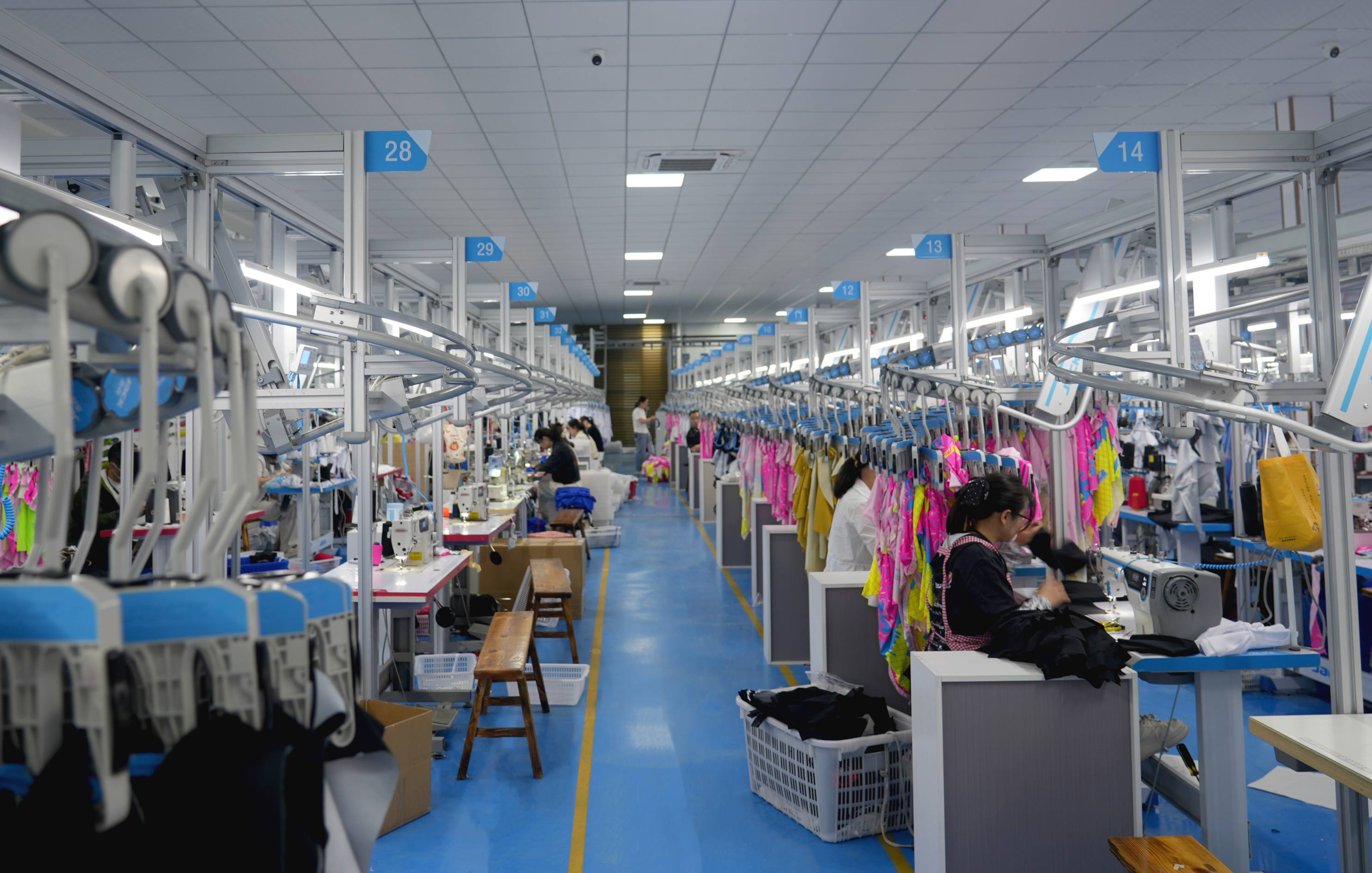
Ljvogues' washing test
How to Read Between the Lines on a Supplier Spec Sheet
Here are the marketing phrases I see most often in period underwear spec sheets and what each one actually means:
What the spec says | What it usually means | What you should ask |
"Antibacterial protection" | Silver, copper, zinc, or quat finish | "What's the active agent and SDS?" |
"Anti-odor technology" | Same as above OR carbon/cyclodextrin finish | "Is this a finish or an inherent fabric property?" |
"Stay-fresh treatment" | Silver, zinc, or PHMB | "What chemistry, and is wash-fastness tested?" |
"Moisture-wicking finish" | Could be PFAS, could be silicone, could be hydrophilic finish | "Is there fluorine in the finish? Total organic fluorine result?" |
"Wrinkle-resistant" | Formaldehyde-based resin crosslink | "What's the formaldehyde level on the finished garment?" |
"Easy-care fabric" | Often formaldehyde finish + softener | Same as above + "What softener?" |
"Quick-dry technology" | Sometimes fiber, sometimes DWR finish | "Fiber-based or finish-based?" |
"Stain-release coating" | Fluorochemical or silicone | "Is this fluorine-free?" |
"Ultra-soft finish" | Silicone or quat softener | "Is the softness from fiber or finish?" |
"Naturally antimicrobial" (re: bamboo, copper yarn, etc.) | Embedded fiber additive — still releases over wash | "Is the active ingredient embedded in the fiber, and is wash-release tested?" |
The pattern across all of these: any benefit described as a "treatment," "technology," "finish," "coating," or "protection" is a chemistry until proven otherwise. The benefits described as inherent properties of the fiber or construction are usually the cleaner choice.
What "Clean" Period Underwear Looks Like at the Construction Level
To bring this full circle, here's what an actually clean period underwear construction looks like — meaning no hidden finish chemistry:
Component | Clean Specification |
Top sheet (skin contact) | GOTS-certified organic cotton OR TENCEL Modal OR micro-modal — no antimicrobial, no DWR, no softener finish |
Absorbent core | Bamboo viscose or microfiber — no antimicrobial, no chemical odor-control |
Leak-proof barrier | TPU film (polyurethane) — not PFAS-coated; not PVC |
Outer body fabric | Organic cotton, TENCEL, or recycled nylon — OEKO-TEX or GOTS certified |
Elastic | OEKO-TEX certified spandex; no chlorine-resistant treatment for non-swim products |
Sewing thread | Cotton or polyester thread — OEKO-TEX certified, no antimicrobial |
Crotch bonding | Water-based adhesive — no solvent-based glue |
Dye process | Reactive dyes, no formaldehyde fixative; or undyed |
Bleaching | Oxygen / peroxide bleach only — no chlorine bleach |
Final wash | Plain hot water, no softener, no DWR finish, no antimicrobial finish |
Formaldehyde target | Under 16 ppm (Class I) — not just under 75 ppm (Class II) |
Total organic fluorine | Under 100 ppm finished-garment, ideally non-detect |
Antimicrobial | None — no silver, copper, zinc, quat, triclosan, or PHMB |
This is what we manufacture. None of it is exotic. None of it is more expensive than the alternative once you've engineered the construction and the supply chain to do it consistently.
What it requires is a manufacturer who has decided, as a matter of principle, that finish chemistry is not allowed to be the way the product solves problems.
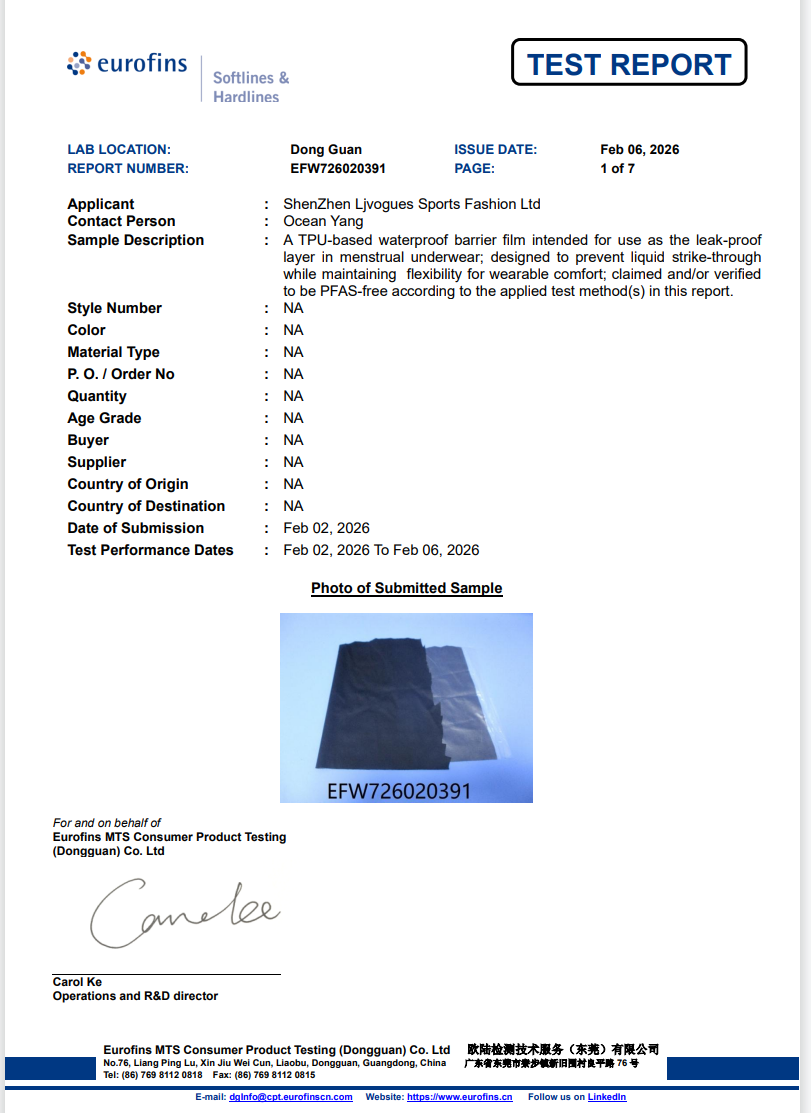
Ljvogues menstrual underwear PFAS certified
The B2B Buyer's 9-Question Audit
Print this and use it on every period underwear supplier. The cleanest factories will answer all nine without flinching. The ones that get evasive on three or more are not your supply chain.
Are any antimicrobial, antibacterial, or biocide finishes applied at any stage of production? Including silver, copper, zinc, triclosan, quats, PHMB, or proprietary blends?
Is the finished-garment formaldehyde level tested per ISO 14184-1, and is it under 16 ppm (Class I)?
Is there independent finished-garment total organic fluorine testing, and is the result available?
Is the leak-proof layer TPU, PUL, or another chemistry — and is it bonded with water-based or solvent-based adhesive?
Is the bleaching process oxygen-based or chlorine-based?
Are dye fixatives formaldehyde-based or formaldehyde-free?
Are softeners, hand-feel finishes, or fabric conditioners applied to the finished garment?
Are stain-release, DWR, moisture-wicking, or quick-dry finishes applied?
Will you provide an SDS for every chemical applied at every stage of the production process?
The ninth question is the one that separates serious factories from everyone else. A factory that can produce SDS documentation for every dye, every auxiliary, every adhesive, every finish — that factory has chemistry under control. A factory that cannot produce SDS documentation does not actually know what's in its own products.
Where Ljvogues Stands
Same transparency principle as Week 2:
No antimicrobial treatments. No silver, no copper, no zinc, no triclosan, no PHMB, no quats. Period.
No anti-odor finishes. Odor is solved by fabric selection, construction, and wash protocol — not chemistry.
Formaldehyde levels. All period underwear product lines tested under 16 ppm (Class I) on finished garment, regardless of the product's market segment.
No DWR, no stain-release, no easy-care finishes on period underwear gussets or top sheets.
Oxygen bleaching only. No chlorine bleach.
Water-based crotch adhesive only. No solvent-based glue.
Reactive dyes, formaldehyde-free fixatives.
OEKO-TEX certified sewing thread. No antimicrobial thread treatments.
Full SDS documentation available for every chemical input on request, for every product line we ship.
If a buyer asks us for any of these documents, we send them. If a buyer asks us a question we can't answer in writing, we tell them and find out. That's the bar.
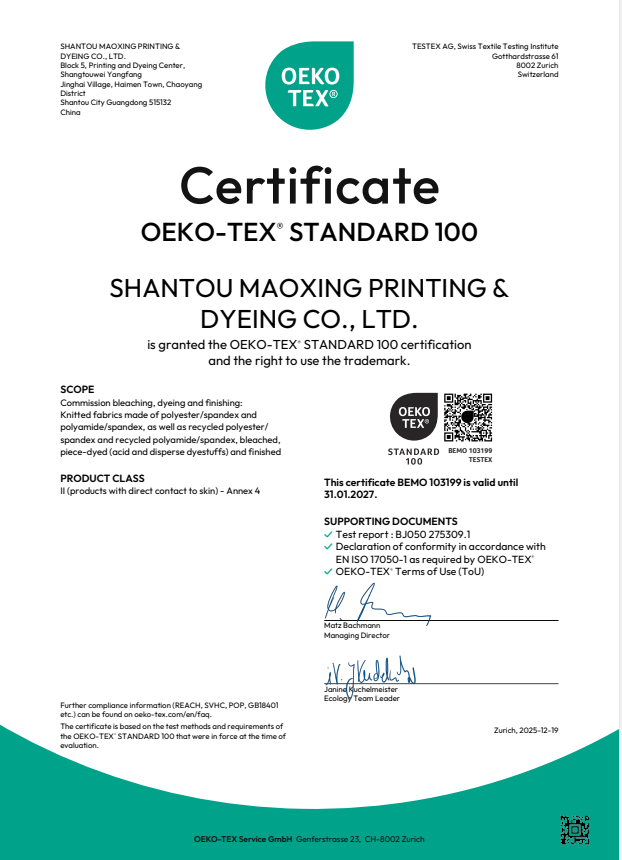
OEKO certification provided by Ljvogues' upstream suppliers
Frequently Asked Questions
My current supplier says "OEKO-TEX certified" covers all of this. True?
Partially. OEKO-TEX Standard 100 tests for formaldehyde, certain restricted antimicrobials (including triclosan and a list of biocides), specific PFAS, and a long list of restricted substances. It does not test for every antimicrobial treatment, every softener, or every finish chemistry. A product can be OEKO-TEX Class II certified and still contain silver, copper, or zinc antimicrobial treatments at concentrations below the OEKO-TEX limit but well above what an intimate apparel buyer would want.
OEKO-TEX is a strong floor. It is not a complete answer to finish chemistry questions. The audit checklist above goes beyond OEKO-TEX scope deliberately.
Is "naturally antimicrobial" bamboo or copper-infused fiber safer than a finish?
Marginally. The active agent — copper, silver, zinc — is the same. Embedding it in the fiber instead of applying it as a finish slows the wash-out rate, but doesn't eliminate it. The skin-contact exposure is similar. The vaginal-microbiome disruption concern is similar. The regulatory risk is similar.
For period underwear, my recommendation is the same regardless of how the antimicrobial agent is delivered: don't use it. Solve odor with fabric and wash protocol.
Are silver-infused products safe for the vaginal area, given that medical silver is used in wound care?
The medical-grade silver argument is one of the most common ones suppliers use, and it's misleading. Medical wound dressings use ionic silver in controlled, short-duration, supervised applications on damaged tissue where infection control is the priority and the patient is being monitored.
A consumer panty with silver finish is a chronic, unsupervised, daily-exposure use case on healthy intact mucosal-adjacent tissue, with no infection-control indication. The risk-benefit calculation that supports medical silver does not transfer to the consumer apparel context. EU regulators have reached the same conclusion in their biocide review.
What about "natural" antimicrobials like tea tree oil or mint extract?
The "natural" framing is marketing, not chemistry. Tea tree oil is one of the more potent skin sensitizers in the cosmetic ingredient world, and contact dermatitis from tea-tree-treated textiles is well documented. Mint and other essential-oil finishes have similar concerns.
For period underwear, where the wearer's skin is in a more reactive biological state, "natural" finish chemistry should be evaluated by the same standard as synthetic finish chemistry: what's the residue, what's the wash-out behavior, and what's the contact-sensitization data?
My retailer requires antimicrobial treatment for shelf-life or hygiene reasons. What do I do?
This is becoming less common, but it does still come up — typically with older wholesale and institutional buyers. Two paths:
Push back with documentation. The hygiene argument for antimicrobial treatment in new, packaged period underwear is essentially zero. New garments don't have a microbial load that requires treatment. The retailer is repeating an old textile-industry assumption that doesn't apply to this category.
Use packaging-level controls instead. If the retailer's concern is between-purchase hygiene during retail handling, the answer is sealed individual packaging — not a chemical treatment baked into the product the consumer wears against their body for years.
If a retailer truly will not accept the product without antimicrobial treatment, that's a strategic question for your brand, not a supply chain question. We can produce both versions, but we'll always recommend the untreated version for the consumer, and we'll write the marketing accordingly.
How does this affect my certification stack? Do I need to add another certificate?
No new certificate is required. What's required is a more rigorous reading of the certificates you already have, plus the 9-question audit applied to your supplier's process. The audit is not a certificate — it's a written supplier statement. Most clean factories will provide this in writing on letterhead. If yours won't, that's the signal.
For brands wanting an additional layer of independent verification beyond OEKO-TEX, the options are:
MADE SAFE certification (US, consumer-facing brand) — covers a wider chemistry list than OEKO-TEX
Cradle to Cradle Material Health Certificate (Gold or Platinum tier) — comprehensive substance list
Custom panel testing through SGS / Eurofins / Bureau Veritas, scoped to your specific concern list
These are all incremental tools. The audit checklist plus OEKO-TEX plus PFAS testing plus GOTS, done correctly, is already a stronger position than 95% of period underwear products on the market.
Will eliminating finishes hurt my product's performance vs. competitors?
For odor: no. A correctly engineered fabric and construction does not have an odor problem in the first place. Products that need anti-odor finish are products that have a fabric or construction problem the brand is choosing to solve with chemistry.
For wrinkle resistance: irrelevant. Period underwear is not a category where wrinkle resistance is a consumer purchase driver.
For stain release: marginally. A good GOTS cotton or TENCEL Modal gusset releases menstrual stains acceptably with proper wash protocol. The argument for stain-release finish on period underwear was always thin.
For softness: not at all in the medium term. Finish-based softness washes out by wash 15. Yarn-based and construction-based softness lasts the life of the garment. The two products feel similar at unboxing; by month 6, the un-finished version actually feels better than the finished version.
The honest answer: removing finish chemistry from period underwear does not hurt performance. In most cases it improves long-term performance. The category just hasn't been engineered with that goal yet at scale, which is the gap where the next wave of premium brands is being built.
The Pattern Underneath All Five Categories
If you read this article and Week 2 together, a pattern emerges in how the period underwear industry currently handles chemistry:
The default assumption in textile manufacturing is that chemistry is a feature. Antimicrobials are a feature. Wrinkle-resistance is a feature. Stain-release is a feature. Softeners are a feature. The factory's job is to add features. The brand's job is to market features.
The default assumption in period underwear manufacturing should be the opposite. Chemistry is a liability until a specific safety, regulatory, and exposure case has been made for it. The factory's job is to remove chemistry that doesn't pass that case. The brand's job is to communicate that the absence of chemistry is itself the feature.
This is the same shift that happened in baby skincare 15 years ago, in clean beauty 10 years ago, and in pet food 5 years ago. The category leader in each case was the brand that stopped describing what they added and started credibly documenting what they removed.
Period underwear is roughly where baby skincare was in 2010. The brands building documentation today — the brands asking the audit questions, the brands citing finished-garment numbers, the brands building supplier scorecards on chemistry rather than just price — are the brands that will define the premium tier of this category through 2030.
The brands still buying on price and accepting "antibacterial protection" as a feature claim are the brands that will be reformulating in panic in 2027 when the next jurisdiction restricts the next finish.
What's Next in This Series
Next week (Week 4), we go deep on GOTS — Scope Certificate vs. Transaction Certificate, and why the difference matters more than most brands realize. A factory can hold a GOTS Scope Certificate and still ship you a non-GOTS product. A product can be marketed as "GOTS organic" without a single Transaction Certificate to back the claim. We'll walk through both documents, what each one actually proves, how to verify them, and the specific paperwork chain that has to be intact for a GOTS claim on your finished period underwear to survive a regulator's audit or a retailer's compliance review.
If you want to be notified when the next article drops, email us — we'll add you to the series list.
Talk to Us
If you're trying to evaluate finish chemistry on a current supplier — yours or a candidate — we're happy to walk through the 9-question audit with you and help interpret the answers. We've reviewed dozens of supplier responses over the past two years. The patterns are consistent enough that we can usually flag the issues from the first three questions.
WhatsApp: +86-199-2880-2613
About Ljvogues
Ljvogues (USPTO Reg. No. 6,378,310) is a Shenzhen-based OEM and private label manufacturer specializing in period underwear, incontinence underwear, and functional intimate apparel. Since 2015, we have served 500+ brands across 108 countries with full chemistry transparency:
OEKO-TEX Standard 100 — Class II — Finished Garment — Active
GOTS Scope Certificate — factory-level certification
GRS (Global Recycled Standard) — certified
PFAS-Free — verified by independent Eurofins finished-garment testing
REACH / SVHC — compliant against the current 253-substance ECHA Candidate List
No antimicrobial treatments — no silver, copper, zinc, triclosan, PHMB, or quats
Formaldehyde under 16 ppm (Class I) on all period underwear product lines
Oxygen / peroxide bleaching only — no chlorine
Water-based crotch adhesives — no solvent-based glue
Full SDS documentation for every chemical input, available to qualified buyers on request
Every certificate we cite is verifiable. Every audit answer we give is in writing. Every finish we don't use, we don't use on purpose.