



Table of Contents
Why This Article Exists
In Article 1, I argued that postpartum is structurally a different product category from period — three different fluids, different absorbency curves, different chemistry standards, different fit dynamics. The C-section variant is the most engineering-intensive sub-category within postpartum.
It's also the sub-category most often misengineered. Brand owners ask for "C-section postpartum underwear" and receive samples that are essentially high-waist period panties. The waistband sits 5cm higher than standard. The leg-opening elastic is the same. The fabric is the same. The compression structure is the same. Only the cut has changed.
This isn't malicious. It's what most factories know how to do. The actual C-section engineering — what does and doesn't compress an abdominal incision through six weeks of healing, how to support a soft postpartum abdomen without restricting uterine involution, how to grade a pattern for a body that changes 5–10cm in waist circumference per week — sits outside what most period underwear factories have studied.
This article exists to lay out the engineering specifically. If you're a brand owner working with a manufacturer on a C-section variant, you should be able to read this article and have a more rigorous conversation with your supplier on Monday morning. If you're a manufacturer reading this and discovering your "C-section panty" is mostly a high-waist period panty, the audit questions at the end will tell you exactly where to upgrade.
What Actually Happens to the Body After C-Section: The 6-Week Healing Map
Before discussing construction, the engineering target needs to be defined. C-section recovery isn't a single state — it's a 6-week sequence of overlapping healing processes, each with different sensitivity, different swelling profile, and different garment-contact tolerance.
Postpartum Week | Incision Stage | Abdominal State | Garment-Critical Constraints |
Week 1 | Fresh wound, sutures or staples in place; staples typically removed days 3–5 | Significant swelling — abdomen often 8–15cm larger circumference than pre-pregnancy at navel | Zero pressure on incision line; smooth-only contact; daily fit changes |
Week 2 | Wound closing but tender; underlying tissue layers still healing | Swelling beginning to reduce 2–4cm per week; uterus still 4–5cm above pubic bone | Light contact OK above incision; no friction across incision |
Week 3–4 | Surface healed; deep tissue still consolidating | Swelling 50% resolved; uterus involuting toward pre-pregnancy position | Pressure tolerance returning; still no compression across incision |
Week 5–6 | Visible healing; scar formation in early stage | Abdomen approaching but not at pre-pregnancy state; diastasis recti still present | Gentle compression tolerable; scar tissue needs protection from friction |
Week 7–12 | Deep tissue healing continues for months; scar maturation 6–12 months | Body shape stabilizing; pelvic floor recovery ongoing | Standard postpartum fit; scar still sensitive to direct seam contact |
Two engineering principles emerge from this map:
A single garment cannot serve all six weeks equally well. The Week 1 fit requirements (oversized, no compression below navel, smooth all surfaces) and the Week 6 fit requirements (closer to standard postpartum fit, light support permitted) are different products. The cleanest C-section product strategies offer either a multi-stage SKU lineup or a single garment deliberately engineered for the middle of the curve (typically Weeks 2–4).
The incision line is a no-pressure zone for the entire 6-week window. The exact location varies — most C-sections in 2026 are low transverse incisions, sitting 2–4cm above the pubic hairline, 10–15cm horizontal. Some older or specialty incisions are vertical or higher-positioned. The garment has to assume the worst-case incision location and avoid pressure across that zone regardless.

The Waistband Decision: Where It Sits and Why
The single most important construction decision in a C-section postpartum product is the vertical position of the primary structural waistband.
Three viable positions, ranked by appropriateness:
Position 1: Above-Navel (10–15cm above incision line) — Cleanest
The structural waistband sits at or above the natural waist, typically 5–8cm above the navel for an average adult body. The panty body drapes from the waistband downward, with no structural elastic crossing the lower abdomen.
Why this works:
The incision sits 15–20cm below the waistband — well clear of any elastic pressure
The waistband itself is on the upper abdomen, where post-C-section sensitivity is minimal
The drape construction means fabric across the lower abdomen has no compression load
Daily abdominal volume change (highest in Week 1) is accommodated by fabric stretch, not by waistband repositioning
Construction implications:
Requires more fabric per garment (typically 15–25% more than standard high-waist period panty)
Requires a longer panty body pattern, with engineered fabric drape from waistband to leg openings
Waistband itself must be smooth-construction — no raised seams, no decorative trim, no narrow-elastic structure that creates pressure point
Position 2: At-Navel (5–10cm above incision line) — Acceptable for Late-Stage Recovery
The structural waistband sits at the navel level. The panty body covers the incision zone but the structural compression element is above it.
Why this works for some weeks:
Beyond Week 3, when swelling has reduced and the incision is surface-healed, navel-positioned waistband is tolerable
Less fabric requirement than above-navel position
Closer to standard panty patterns, easier to manufacture
Why this doesn't work for early weeks:
Week 1 swelling pushes the navel position downward toward the incision
Daily volume changes make the fit unpredictable in the first 2 weeks
For some body types, the navel sits closer to the incision than average, eliminating the safety margin
This position is acceptable for products marketed as "Week 3+ recovery" or for general postpartum with C-section as a secondary use case. It's not appropriate for products marketed specifically for early C-section recovery.
Position 3: Just Above Incision (2–5cm above) — Inappropriate for C-Section
The structural waistband sits low, just above the incision line. This is what a "high-waist period panty" delivers when applied to C-section bodies.
Why this fails:
The waistband elastic compression sits directly adjacent to the healing wound
Daily abdominal volume change pushes the waistband down toward or onto the incision
Friction during normal movement transmits to the incision line
Skin reactivity in the incision zone amplifies any chemistry exposure from the waistband
This position is what most "C-section panties" actually deliver when sourced from factories without dedicated postpartum engineering. It's not appropriate, regardless of how the marketing describes it.

The Compression Question: Why Knit-Structure Replaces Elastic
A standard period panty uses elastic compression for fit retention. The fabric body is held in place against the body by elastic at the waistband and leg openings. This works fine for period use because the body shape is stable and the elastic compression doesn't impede any biological process.
For C-section postpartum, elastic compression in the abdominal zone is contraindicated — both because of the incision and because of the underlying biological processes (uterine involution, diastasis recti recovery, pelvic floor recovery) that need the abdomen to be uncompressed.
The engineering solution is knit-structure mechanical containment — a fabric structure that provides directional support without elastic compression. The two main approaches:
Approach A: Power Mesh Panel Construction
A high-density knit fabric (power mesh) is integrated into the front body panel. The mesh provides directional support — holding the soft postpartum abdomen against gentle inward force — without elastic stretch-and-recovery dynamics.
Spec parameters:
Parameter | Target |
Mesh density | 180–240 GSM (lighter than shapewear power mesh, heavier than standard knit) |
Stretch ratio | 1:1.6–1:1.8 (moderate stretch, not high-stretch shapewear range) |
Recovery rate | 95%+ after 24-hour stretch hold |
Spandex content in mesh | 15–22% (for recovery only, not for compression) |
Skin contact face | Brushed cotton or modal (not the mesh itself) |
The power mesh is the structural layer. The skin-contact layer is a soft natural fiber. Skin sees fabric, not mesh.
Approach B: Compression-Graded Knit Body
The body fabric itself is knit with varying density across zones — heavier knit at the lower abdomen where mechanical support is wanted, lighter knit at the upper abdomen and over the incision zone.
Spec parameters:
Zone | Knit Density | Function |
Upper abdomen / waistband | 220–260 GSM | Smooth retention, no compression |
Mid abdomen (above incision) | 200–220 GSM | Light containment, low pressure |
Lower abdomen (incision zone) | 160–180 GSM | Drape only, zero compression |
Below incision / pelvic | 200–230 GSM | Standard postpartum support |
This approach requires more sophisticated knit programming (jacquard or engineered-knit construction), but produces a single integrated fabric panel with no seam transitions across the incision zone.
Both approaches share one critical property: no elastic compression across the incision line. The structural mechanics are entirely within the knit fabric, not within elastic bands. This is the engineering principle that distinguishes a real C-section construction from a high-waist period construction.
The Seam Map: Where Seams Can and Cannot Be Located
A standard period panty has seams wherever pattern pieces join — typically at the side hips, the gusset edges, the waistband join, and the leg-opening hems. Most of these locations are fine for C-section.
The exception: no seam can cross or sit adjacent to the incision line through the entire 6-week recovery window.
For an average adult body, the C-section incision sits roughly:
2–4cm above the pubic hairline
10–15cm horizontal width, centered
6–10cm below the navel
In garment-construction terms, this is the lower-front center zone of the panty, exactly where conventional pattern construction often places a seam (the gusset-to-front-body seam in some constructions, or the front waistband seam in others).
The C-section seam map:
Seam Location | Incision-Zone Compatibility | Construction Solution |
Center front, lower abdomen | Critical — must avoid | Use single-piece front panel construction; no center front seam |
Side hips | Acceptable | Standard side-seam construction OK |
Front waistband (if at-navel) | Risky if at-navel | Use bonded or smooth-stitched construction; no raised ridge |
Front waistband (if above-navel) | Acceptable | Standard waistband construction OK |
Gusset front edge | Critical if extending to incision zone | Position gusset to terminate well below incision line; flatlock seam |
Gusset back edge | Acceptable | Standard flatlock OK |
Leg-opening hem | Acceptable but consider | Bound or flatlock; avoid raised serge across upper thigh |
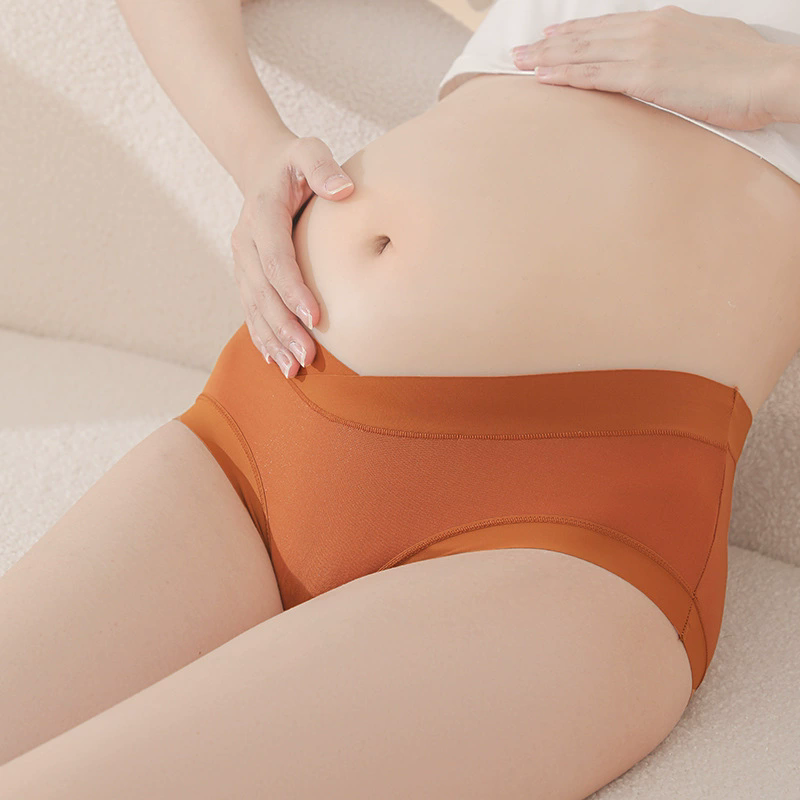
The single-piece front panel is the most important seam-map decision. Standard pattern construction often joins a front body piece to a gusset piece with a horizontal seam exactly where the C-section incision sits. The cleanest C-section construction uses a single-piece front-and-gusset cut, with the gusset zone integrated into the front body panel — no horizontal seam in the incision zone at all.
This is more fabric-intensive (less efficient cutting, more waste), and it requires a different pattern philosophy than period underwear. It's also the engineering choice that makes the product genuinely C-section-appropriate.
Pattern Grading for the Postpartum Body Shape Curve
A standard adult panty pattern is graded against stable adult body measurements — waist, hip, rise. The size run is built around a single body state.
A postpartum panty has to accommodate a body that changes shape across the 6-week recovery window. Not just abdominal swelling, but waist circumference, hip circumference, and rise (the vertical distance from waistband to gusset).
Typical postpartum shape change for an average adult body:
Postpartum Day | Waist Circumference Change vs. Pre-Pregnancy | Hip Change | Rise Change |
Day 1–3 | +12 to +18cm | +3 to +5cm | +4 to +6cm |
Day 7 | +8 to +12cm | +2 to +4cm | +3 to +5cm |
Day 14 | +5 to +8cm | +1 to +3cm | +2 to +3cm |
Day 28 | +3 to +5cm | +0 to +2cm | +1 to +2cm |
Day 42 | +1 to +3cm | Returns to pre-pregnancy | +0 to +1cm |
A garment that fits at Day 28 doesn't fit at Day 7. A garment that fits at Day 7 is uncomfortably loose at Day 42.
Three viable strategies:
Strategy 1: Single-Stage Garment with Wide Fit Range
Pattern grade for the mid-recovery state (Day 14–28) with sufficient stretch tolerance to accommodate Day 1–7 (wearer sizes up one) and Day 28–42 (wearer sizes down one). Customers buy two sizes — current postpartum size for early weeks, intended recovery size for later weeks.
Pros: Single SKU, simpler inventory, customer can transition through recovery with two sizes.
Cons: Less optimized for any single stage; customers may need both sizes which doubles initial purchase cost.
Strategy 2: Multi-Stage SKU Lineup
Stage 1 (Day 1–10) — heavy postpartum capacity, oversized fit, no abdominal compression
Stage 2 (Day 10–28) — transitional, moderate capacity, light containment
Stage 3 (Day 28+/general postpartum) — closer to standard postpartum fit, full feature set
Customer purchases according to stage; brand provides stage-transition guidance.
Pros: Each SKU optimized for its window, better fit experience at each stage.
Cons: Higher inventory complexity, customer needs to understand which stage to buy when, MOQ implications across multiple SKUs.
Strategy 3: Adjustable / Modular Garment
A single garment with adjustable elements — e.g., a removable waistband panel, an adjustable closure, or interchangeable absorbent inserts. Fits across the recovery window through modularity rather than through fabric stretch.
Pros: Single garment serves entire window, customer makes adjustments as body changes.
Cons: More complex construction, higher COGS per unit, customer education required.
For most brands, Strategy 2 (multi-stage SKU lineup) is the cleanest approach for a dedicated postpartum line, with the option to start with Strategy 1 (single-stage with wide fit range) for a lower-MOQ launch.
Fabric Selection Specifically for the Incision Zone
The fabric in contact with the C-section incision area faces requirements beyond standard postpartum:
Requirement | Specification |
Smoothness | No texture, no mesh structure, no knit pattern variation in incision-contact zone |
Hypoallergenic chemistry | OEKO-TEX Class I limits (infant standard) |
No antimicrobial finishes | Critical for postpartum more than period (microbiome disruption + healing wound) |
Moisture management | Pull moisture away from incision area; surgical wounds heal best in slightly humid but not wet environment |
Heat dissipation | Postpartum night sweats are extremely common; fabric must breathe |
Pre-washed | Removes residual processing chemistry that's particularly problematic for healing skin |
Tested for residual VOC | Off-gassing chemistry is more problematic on healing wound contact |
The fabric most often used: GOTS-certified organic cotton interlock (220–260 GSM), undyed or low-impact reactive dyed, pre-washed before construction. Modal blends work for the upper abdomen but should not be used directly in the incision zone — modal's silkier hand feel can create micro-friction patterns that aren't ideal for fresh scar tissue.
The fabric not used in the incision zone: any synthetic blend, any fabric with antimicrobial finish, any printed fabric, any fabric with significant texture variation, any TPU or barrier laminate (the leak-proof barrier should sit below the incision zone, in the gusset only).
What "Light Compression Support" Actually Looks Like in Construction
Brand briefs almost always include some version of "gentle abdominal support for postpartum recovery." Translating this from marketing language to construction language:
What the customer experiences as "support":
The soft postpartum abdomen feels gently held, not pulled in
Walking and movement don't create a sensation of the abdomen "sloshing"
The product holds its shape through the day without needing readjustment
The fit feels stable across the 6-week recovery window
What this requires in construction:
Construction Element | Specification |
Front panel knit density | 200–240 GSM, with directional stretch (more stretch horizontally than vertically) |
Power mesh integration (if used) | Internal layer only; soft fabric on skin side |
Spandex content | 12–18% in body fabric (lower than shapewear, higher than standard period panty) |
Stretch recovery | 95%+ after 24-hour hold; no progressive sag |
Waistband | Encapsulated or wide flat construction; no narrow elastic |
No "compression zones" | Avoid medical-device-style graduated compression in adult intimate apparel |
What this is NOT:
Not shapewear-grade compression (which is 30–50 mmHg pressure, contraindicated postpartum)
Not medical compression hose-grade (which is 15–30 mmHg, also contraindicated for non-prescribed use)
Not "tummy control" panel construction designed for visual slimming
The line between "gentle postpartum support" and "shapewear" matters legally and medically. Postpartum products marketed with shapewear-grade compression have been the subject of regulatory action in multiple jurisdictions — both because of the medical contraindications and because of the marketing claims around "weight loss" or "body recovery" that often accompany them. The cleanest brands stay well clear of this line.

Ljvogues offers a variety of fabrics
The Manufacturing Decisions That Distinguish Real C-Section Construction
Pulling all of the above together, here are the construction decisions that determine whether a "C-section postpartum" product is actually engineered for the use case:
Decision | Real C-Section | Period Panty With Higher Waist |
Waistband position | Above navel (10–15cm above incision) | At or just above incision |
Front body construction | Single-piece with no horizontal seam at incision | Standard pattern with seams wherever pattern dictates |
Compression structure | Knit-structure mechanical (power mesh or graded knit) | Elastic compression at waistband and leg openings |
Fabric in incision zone | GOTS organic cotton interlock, smooth, undyed/low-impact | Whatever the body fabric is, including printed or textured |
Chemistry standard | OEKO-TEX Class I | OEKO-TEX Class II |
Pattern grading | Postpartum-specific (Strategy 1, 2, or 3 above) | Standard adult sizing |
Pre-wash protocol | Yes — standard for postpartum production | Sometimes |
Cure time before packaging | 72 hours minimum | Variable |
Stage-specific SKU architecture | At minimum, single-stage with documented recovery-window fit range | Single SKU, no recovery-window guidance |
A factory that delivers all nine on the left column has engineered for C-section. A factory that delivers fewer than five is selling a period panty in a higher-waist cut.
The B2B Buyer's C-Section Audit — 12 Questions
Use this directly with any factory pitching a C-section postpartum product:
Construction:
Where does the structural waistband sit relative to the C-section incision line — at-navel, above-navel, or above the natural waist?
Is the front body panel constructed as a single piece, or with a horizontal seam that crosses the incision zone?
Is the compression structure knit-based (power mesh / graded knit) or elastic-based?
What's the GSM and stretch profile of the front body fabric?
Fabric:
What's the skin-contact fabric in the incision zone — fiber content, certifications, finish status?
Is the fabric pre-washed before construction?
Has finished-garment chemistry been tested to OEKO-TEX Class I (infant) limits?
Pattern:
What's the pattern grading approach for postpartum body shape change — single-stage with wide fit range, multi-stage SKU lineup, or modular?
What's the recovery-window the SKU is optimized for — early (Days 1–10), transitional (Days 10–28), or late (Days 28+)?
Chemistry:
Are antimicrobial treatments used anywhere in this construction? (Should be a hard no.)
What adhesives are used in the construction, and are they water-based / heat-laminated only?
Documentation:
Will the factory provide written specification documenting all of the above, signed and on letterhead?
A factory answering all 12 in alignment with the standards described in this article is a factory engineered for postpartum C-section production. A factory getting vague on three or more is a factory adapting period production to a postpartum SKU label.
Where Ljvogues Stands on C-Section Construction
Same transparency principle:
Above-navel waistband as standard on dedicated C-section variants. Structural support sits 12–15cm above incision line; lower abdomen drapes without compression.
Single-piece front body construction — no horizontal seam crossing the incision zone. Pattern is engineered for C-section specifically, not adapted from period pattern.
Knit-structure mechanical support via integrated power mesh panel (180–220 GSM) with brushed cotton skin-contact face. No elastic compression in the abdominal zone.
GOTS organic cotton interlock as the skin-contact layer in the incision zone, undyed or reactive-dyed only, pre-washed before construction.
OEKO-TEX Class I chemistry standard on C-section product lines — formaldehyde under 16 ppm finished garment, full restricted-substance panel to infant standard.
No antimicrobial treatments anywhere in C-section construction, ever.
Heat lamination and water-based PU adhesive only — no solvent-based adhesives.
Multi-stage SKU architecture available — Stage 1 (Days 1–10, oversized fit, heavy capacity), Stage 2 (Days 10–28, transitional), Stage 3 (Days 28+, recovery). Brands can launch with single-stage and add stages over time.
Pattern grading specific to postpartum body shape change — sized to fit across the recovery window, not to fit a single static body state.
MOQ from 1,500 pieces per SKU for new brand launches; lower per-unit cost at 3,000+ per SKU.
Free C-section sample dissection service — send us a competitor sample, we'll dissect it and write you a report on whether it's actually engineered for C-section or repackaged from period production.
If a brand asks us for a C-section spec sheet, we send the C-section spec sheet — single-piece front construction, above-navel waistband position, power mesh knit structure, Class I chemistry standard. Not a period spec with annotations.

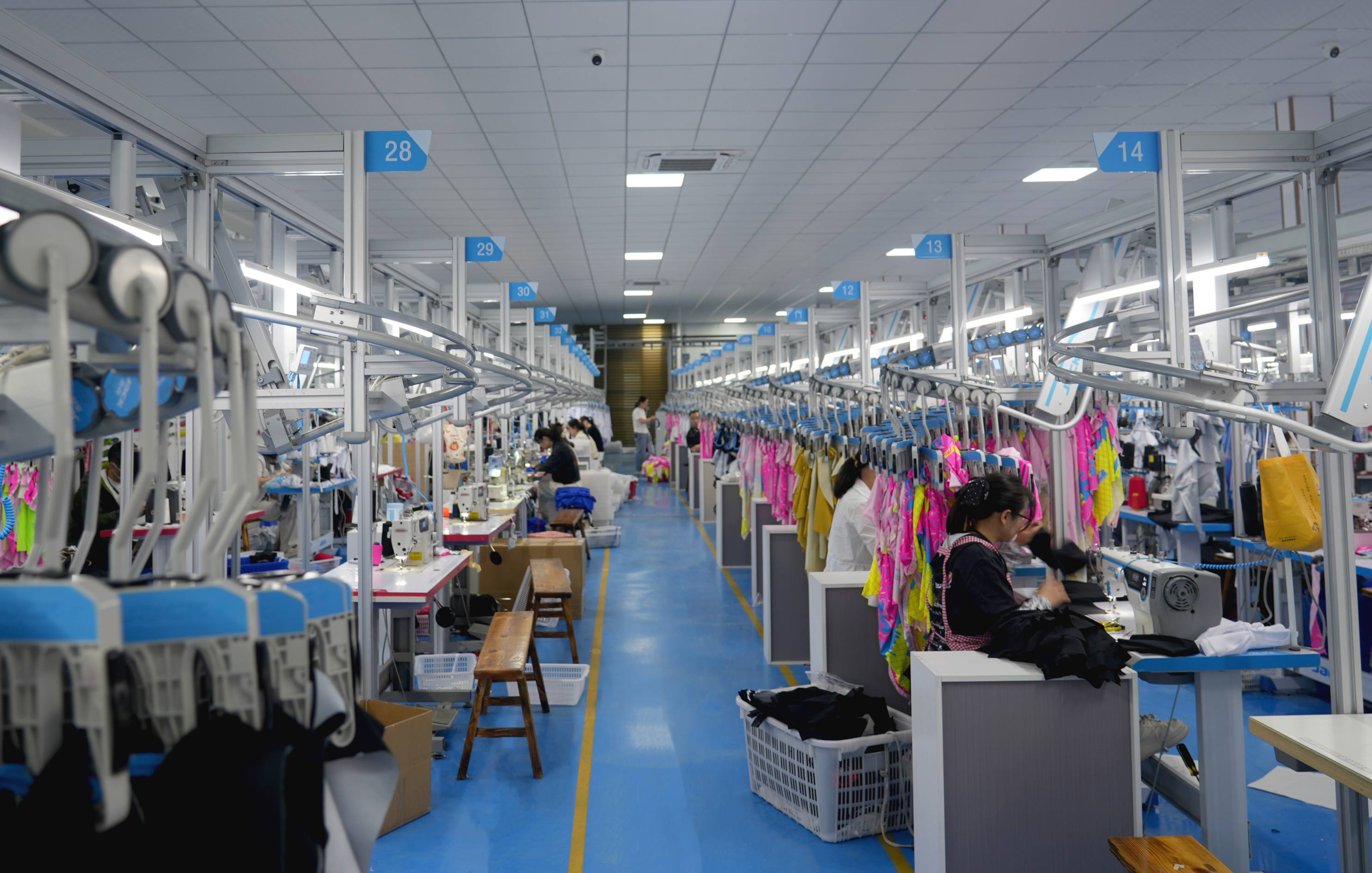
Ljvogues' hanging sewing production line
Frequently Asked Questions
Can the same C-section product work for vaginal-delivery postpartum users?
Mostly yes, with one consideration. C-section variants typically have above-navel waistbands and no compression below the incision zone — both of which are also fine for vaginal-delivery postpartum. The C-section variant is therefore a "more inclusive" construction in that sense.
The one consideration: vaginal-delivery postpartum users may have perineal trauma (tears, episiotomy) that creates different sensitivity in the gusset zone. The C-section variant's gusset construction should still meet general postpartum standards (smooth seams, no antimicrobial, organic cotton skin contact, Class I chemistry), which it does in our standard spec.
For a brand launching a single product line, a well-engineered C-section variant typically serves both delivery types. For a brand launching multiple variants, dedicated vaginal-delivery products can optimize the gusset for perineal recovery while the C-section variant optimizes for incision recovery.
What about repeat C-section users — does the product work for second or third C-section?
Engineering is the same. The incision is in approximately the same anatomical location, healing follows the same general timeline, and garment requirements are similar. Some users with multiple C-sections have slightly different scar patterns or sensitivity profiles, but the construction principles in this article apply across primary and repeat C-sections.
How does the product accommodate users who plan to wear it through nursing weeks?
Breastfeeding extends the postpartum hormonal recovery window — estrogen levels remain low through the breastfeeding period, abdominal muscle tone returns more slowly, and skin sensitivity persists. For brands targeting the breastfeeding postpartum window (typically 2–6 months postpartum), the C-section construction continues to serve well — same chemistry standard, same fabric choices, same support structure.
The fit may need adjustment over time as the abdomen recovers further — which is why the multi-stage SKU lineup (or single-stage with wide fit tolerance) matters. A user breastfeeding at 3 months postpartum is in a different fit state than a user at 1 month postpartum, even though both are still in the "postpartum" period.
Is the no-compression principle the same for users with diastasis recti?
Diastasis recti (abdominal muscle separation) is present in 60%+ of postpartum women, often persisting beyond the 6-week recovery window. Conventional shapewear or compression garments can either help or hurt diastasis recti recovery depending on the specific compression pattern and the individual case — and this is genuinely a medical question, not a garment-design question.
The C-section construction described in this article — knit-structure mechanical containment without elastic compression — is generally compatible with diastasis recti recovery. It provides gentle containment without the compression patterns that physical therapists typically advise against. For brands wanting to make explicit diastasis recti claims, that's a separate medical-claim category that requires its own substantiation; the construction supports it but the claim itself is regulatory territory.
What's the difference between this and "postpartum recovery shapewear"?
Postpartum recovery shapewear is typically 40–60 mmHg compression garments designed for full-torso compression, marketed for "body recovery" and visible slimming. It's medical-grade compression, often made from medical-device fabric, and is regulated differently in different jurisdictions.
The C-section postpartum underwear described in this article is the opposite design philosophy — gentle, non-compressive, supportive without restrictive. Brands selling shapewear and brands selling postpartum recovery underwear typically target different customers, even though both categories overlap in the postpartum buying window. Mixing the two product strategies in a single SKU usually produces a product that fails at both — too compressive for postpartum recovery, not compressive enough for shapewear users.
Can the product be marketed for medical purposes — incision protection, recovery support, etc.?
In most jurisdictions, no — at least not without crossing into medical device territory. The product is intimate apparel designed for postpartum comfort, not a medical device for wound management or recovery acceleration. Marketing language should reflect that distinction.
The cleaner positioning is "designed for postpartum comfort during C-section recovery" rather than "supports incision healing" or "protects surgical wounds." The first describes the product accurately; the second crosses into medical claims that require regulatory substantiation that intimate apparel doesn't have.
What about scar care products — silicone sheets, scar tape — used with the underwear?
Many C-section postpartum users apply silicone scar sheets or scar tape directly to the incision starting at 2–4 weeks postpartum. The C-section underwear should accommodate this — meaning the fabric in the incision zone must not interfere with adhesive adhesion (no slippery synthetic surfaces) and must not generate friction that displaces scar tape during wear.
GOTS organic cotton interlock as the skin-contact fabric works well with scar tape. Synthetic blends or microfiber surfaces can cause scar-tape adhesion failures. This is one more reason the fabric choice in the incision zone matters.
Does the product work for users with abdominal hernia or other complications?
Abdominal hernia, incision dehiscence (wound separation), and other surgical complications are medical situations that require physician guidance. The C-section underwear is designed for normal recovery; it's not designed to accommodate or treat complications.
For brands wanting to address users with complications, the appropriate path is to direct those users to medical-grade products (abdominal binders, post-surgical garments) rather than to position consumer postpartum underwear as the solution.
What's Next in This Series
This article completes the engineering case for postpartum and C-section specifically. The final article in this 3-article series shifts from engineering to sourcing operations:
Article 3: B2B Postpartum Sourcing Guide — The 12-question audit consolidated into a sourcing workflow, plus the MOQ/cost/lead-time economics for postpartum specifically, plus the documentation chain that survives retail compliance audits and regulatory review.
If you want to be notified when the next article publishes, email us — we'll add you to the postpartum-series list.
Talk to Us
If you're developing a C-section postpartum product and want to walk through the engineering decisions specifically — single-piece front construction vs. seamed, power mesh vs. graded knit, multi-stage SKU lineup vs. single-stage — we offer 30-minute development calls free of charge. We've helped dozens of brands move from concept to first sample, and the engineering trade-offs typically map clearly in a single conversation.
If you're evaluating a current C-section sample from another factory, send it to us. We'll dissect it and write you a written audit on whether the construction matches what's described in this article, and where the gaps are.
WhatsApp: +86-199-2880-2613
About Ljvogues
Ljvogues (USPTO Reg. No. 6,378,310) is a Shenzhen-based OEM and private label manufacturer specializing in period underwear, postpartum underwear, incontinence underwear, and functional intimate apparel. Since 2015, we have served 500+ brands across 108 countries.
C-Section postpartum specific capabilities:
Above-navel waistband construction as standard on C-section variants
Single-piece front body construction — no seam crossing incision zone
Knit-structure mechanical support — power mesh and graded-knit options
GOTS organic cotton interlock skin-contact in incision zone
OEKO-TEX Class I chemistry standard on postpartum product lines
Multi-stage SKU architecture available — heavy / transitional / recovery
Pattern grading specific to postpartum body shape change
No antimicrobial treatments anywhere
Heat lamination + water-based PU adhesive only
MOQ from 1,500 pieces per SKU
Free sample dissection and audit on competitor products
Every construction decision has a reason. Every reason maps to a specific recovery requirement. That's the bar.