
Views: 0 Author: Ocean Yang Publish Time: 2026-05-13 Origin: Ljvogues


Table of Contents
TL;DR — What Certifications Matter for Period Underwear?
For most markets, OEKO-TEX® STANDARD 100 (Class II) is the baseline requirement — it confirms the fabric is free of harmful substances. PFAS-free verification via third-party lab testing is now non-negotiable following 2025 US and EU regulations. BSCI or SEDEX audits satisfy European retailer ethical sourcing requirements. GOTS is relevant for organic cotton styles. Together, these four form the minimum certification stack for any brand targeting the US, EU, or UK market.
Period underwear occupies a unique regulatory position in the garment industry. Unlike a T-shirt or a pair of jeans, period underwear is worn in prolonged, intimate contact with the vulvar and perianal region — some of the most absorptive and hormonally sensitive tissue on the human body. That single anatomical fact changes the risk calculus for every material input in the product.
It also changes the commercial calculus. Retailers, particularly mass-market chains and specialist health retailers, now conduct supplier audits that explicitly check for certification documentation before agreeing to shelf space. "Without certifications, your products won't make it onto Target shelves or pass EU customs," says Ocean Yang, Founder of LJVOGUES. "We've seen brands lose major retail accounts at the last stage — not because the product was bad, but because they couldn't produce a valid OEKO-TEX certificate."
The skin in the genital area is thinner than most body sites, more vascularised, and — particularly during menstruation — can have micro-abrasions that increase chemical absorption. Substances that would be harmless on outer garments become a genuine concern at this site. Residual formaldehyde from anti-wrinkle finishes, azo dyes that release aromatic amines, heavy metals from pigment dyes, and fluoropolymer water-repellent treatments all appear on the risk list for intimate apparel.

Products intended for direct skin contact
Retail buyers operating in the EU must comply with REACH (Registration, Evaluation, Authorisation and Restriction of Chemicals). Amazon's Seller Central, as discussed below, can require FDA documentation for sellers listing products in categories flagged as medical devices. UK retailers increasingly reference OEKO-TEX as a minimum supplier standard in their vendor contracts post-Brexit. Australian brands importing from China are subject to the ACCC's Australian Consumer Law, which holds importers liable for product safety claims.
For DTC brands and private-label retailers, certifications function as marketing infrastructure. Third-party certification logos on packaging signal that an independent body — not the brand itself — has verified the safety claim. This matters particularly in the period care category, where the Thinx PFAS litigation (discussed below) fundamentally altered consumer scepticism. Brands that can show documented, third-party-verified certification close the trust gap that marketing copy alone cannot bridge.
Certification | What It Tests / Covers | Who Issues | How to Verify | Typical Cost (Factory) | Required Markets |
OEKO-TEX® STANDARD 100 | Harmful substances, dyes, formaldehyde, heavy metals, pesticides, PFAS | OEKO-TEX® (via institutes e.g. Hohenstein) | OEKO-TEX Label Check portal (label.oeko-tex.com) | USD 1,500–5,000 per certification | EU (de facto), UK, US DTC, Australia |
GOTS | Organic fibre content (min. 70–95%), processing chemicals, social criteria | GOTS-approved certifiers | USD 1,000–3,000/year | EU, UK, US organic-positioned brands | |
PFAS-Free (Third-Party Lab) | Full-spectrum PFAS panel (40+ compounds) | Accredited labs (SGS, Intertek, Eurofins) | Lab report with accreditation number | USD 300–800 per test | California (AB 1817), New York, EU, UK |
BSCI | Ethical labour practices, wages, working hours, child labour | amfori (formerly FTA) via accredited auditors | USD 800–2,500 per audit | EU (required by most chain retailers) | |
SEDEX / SMETA | Labour, Health & Safety, Environment, Business Ethics (4-pillar audit) | SEDEX (self-assessment + third-party audit) | sedex.com supplier portal | USD 500–2,000 | UK, EU, Australia, global retailers |
ISO 9001 | Quality management systems | ISO-accredited certification bodies | IAF CertSearch (iafcertsearch.org) | USD 2,000–8,000 | B2B buyers, procurement departments |
ISO 14001 | Environmental management systems | ISO-accredited certification bodies | IAF CertSearch | USD 2,000–8,000 | EU sustainability tenders, ESG buyers |
GRS (Global Recycled Standard) | Recycled material content, chain of custody | Control Union, Bureau Veritas, others | UL Responsible Sourcing database | USD 1,000–3,000 | Eco-positioned DTC, EU green claims |
FDA 21 CFR 884.5435 | Period underwear product code (NUQ) — establishment registration if required | US FDA | USD 0 (registration fee) | US market (Amazon may require) |
OEKO-TEX® STANDARD 100 is arguably the most important certification for any period underwear supplier to hold. It is a testing and certification standard for textile products, issued by the OEKO-TEX® Association — a collective of 18 independent research and testing institutes across Europe and Japan. The standard (oeko-tex.com) tests every component of a finished garment: fabric, thread, buttons, elastic bands, labels, and print inks.
The OEKO-TEX® STANDARD 100 testing protocol evaluates more than 100 harmful substances, including:
Formaldehyde — used in anti-crease and anti-shrink finishing; toxic above threshold concentrations
Heavy metals — arsenic, cadmium, chromium VI, lead, mercury and others from dye fixatives and pigments
Pesticide residues — from conventionally grown cotton
Azo dyes — certain azo colorants release carcinogenic aromatic amines on reduction
pH value — skin-neutral pH (4.5–7.5) is required for direct-contact articles
Colour fastness — dye transfer onto skin assessed under perspiration and friction conditions
PFAS/fluorocarbons — DWR coatings and water-repellent treatments are tested
Allergenic dyes, optical brighteners, biocides, flame retardants
For period underwear specifically, the PFAS testing within OEKO-TEX is particularly relevant given the regulatory environment described later in this article.
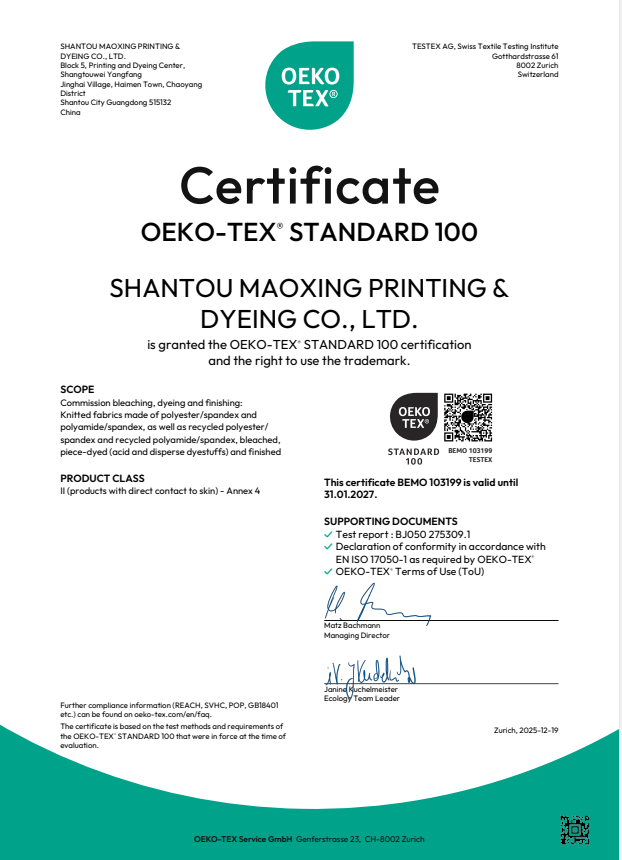
OEKO-TEX Certification provided by Ljvogues' upstream dyeing factory.
OEKO-TEX® STANDARD 100 organises products into four classes based on the level of skin contact and vulnerability of the end user:
Class | Product Category | Examples | Key Distinction |
Class I | Articles for babies and toddlers (under 36 months) | Baby bodysuits, nappies, plush toys | Most stringent limits |
Class II | Articles with direct, prolonged skin contact | Underwear, T-shirts, bed linen, hosiery | Applies to period underwear |
Class III | Articles without direct skin contact | Jackets, outer coats, upholstery fabrics | Less stringent |
Class IV | Decoration materials without skin contact | Tablecloths, curtains, wall textiles | Least restrictive |
Period underwear is tested to Class II standards. The limits for harmful substances are significantly tighter than Class III or IV — for example, the formaldehyde limit drops from 300 mg/kg (Class III) to 75 mg/kg (Class II). Any supplier claiming OEKO-TEX certification for period underwear should specifically hold a Class II certificate — a Class III certificate issued for a different product line does not automatically cover an intimate apparel article.
Every valid OEKO-TEX® STANDARD 100 certificate includes a unique certificate number. Buyers can verify authenticity via the OEKO-TEX Label Check portal at label.oeko-tex.com. Enter the 12-digit certificate number and the portal shows:
Certified company name and address
Testing institute
Certificate validity dates
Product scope (which article types are covered)
A common fraud is suppliers presenting an expired certificate or a certificate issued for a different product scope (e.g., a certificate for woven outerwear fabric used to substantiate a claim for an intimate apparel product). Always check the scope field, not just the certificate status.
OEKO-TEX® STANDARD 100 certificates are valid for one year and must be renewed annually. Testing costs typically range from USD 1,500 to USD 5,000 per certification cycle, depending on the number of components, the testing institute selected, and whether expedited testing is required. Re-certification is required if production facility, key supplier, or a material input changes materially.
At LJVOGUES, all production fabrics used in period underwear carry valid OEKO-TEX® STANDARD 100 certification. We maintain annual renewal as a standard procurement requirement — meaning buyers receive documentation-ready fabric from the start of sampling, not as an afterthought at retailer onboarding.
GOTS (global-standard.org) is the leading international standard for organic fibre processing. It covers the entire post-harvest processing chain — from raw organic fibre through spinning, weaving, dyeing, sewing, and labelling — and includes both ecological and social criteria.
GOTS has two labelling grades:
"Organic" — requires a minimum of 95% certified organic natural fibres
"Made with Organic" — requires a minimum of 70% certified organic natural fibres
The remaining percentage may include non-organic natural fibres but not synthetic fibres. GOTS does not certify fully synthetic fabrics — polyester, nylon, or elastane — so it is not applicable to the synthetic-dominant layers in a period underwear absorbent system.
For brands positioning cotton-rich period underwear (typically the top comfort layer or the outer shell in a cotton brief construction), GOTS certification provides a verifiable organic supply chain claim. This is relevant for brands targeting health-conscious consumers who want assurance that the cotton in contact with their skin was grown without synthetic pesticides or fertilisers.
The GOTS standard also covers:
Prohibition of toxic bleaching agents (chlorine bleach is prohibited)
Restriction of synthetic dyes and finishing auxiliaries
Prohibition of formaldehyde and aromatic solvents
Social criteria aligned with ILO conventions (fair wages, no child labour)
GOTS cannot be applied to the functional layers of a period underwear product — the absorbent core typically uses polyester, viscose, or TPU laminate materials that are inherently non-organic. Brands must therefore be careful not to claim GOTS certification for the whole product when only the outer shell fabric is GOTS-certified. The accurate claim would be "made with GOTS-certified organic cotton (outer layer)" with full disclosure of the complete material composition.

No topic in period underwear compliance has moved faster or generated more legal and regulatory risk than PFAS. Buyers in 2026 who are not actively verifying PFAS-free status across their supply chain are operating with significant product liability exposure.
Per- and polyfluoroalkyl substances (PFAS) are a family of more than 12,000 synthetic fluorine-based chemicals. They are used industrially for their extreme resistance to water, oil, heat, and staining. In textiles, PFAS appear most commonly in:
Durable Water Repellent (DWR) coatings on outer shells
Moisture-wicking finishes on synthetic fabrics
Anti-stain treatments on polyester blends
The term "forever chemicals" refers to the fact that PFAS do not biodegrade in the environment or in the human body. They accumulate in blood, liver, and breast tissue. Long-chain PFAS (PFOA, PFOS) are associated with thyroid disruption, immune suppression, and increased cancer risk. Short-chain PFAS, once promoted as safer alternatives, are now under regulatory scrutiny for similar persistence profiles.
In January 2023, Thinx — one of the most prominent period underwear brands globally — settled a class-action lawsuit for up to USD 5 million (NPR). The plaintiffs alleged that independent third-party testing had detected short-chain PFAS in Thinx underwear at material concentrations, despite the brand's marketing positioning the product as a safer, non-toxic alternative to disposable products. Thinx denied intentional PFAS use and denied liability, but committed to enhanced supply chain controls and adjusted marketing language as part of the settlement.
The commercial consequences were significant — not just for Thinx, but for the entire category. Retail buyers, Amazon category managers, and DTC consumers began requesting documentary proof of PFAS absence. The "trust gap" that the lawsuit exposed cannot be closed with marketing language alone. It requires a third-party lab certificate.
PFAS restrictions on textiles have moved from voluntary to mandatory across multiple major markets:
California AB 1817 (effective 1 January 2025): Prohibits manufacture, distribution, sale, or offer for sale of any new textile article containing regulated PFAS in California. As of January 2025, the threshold is 100 ppm total organic fluorine; this tightens to 50 ppm from January 2027. Manufacturers must provide distributors with a written certificate of compliance (California AB 1817 text via LegiScan).
New York S1322/A994 (effective 1 January 2025): Prohibits the sale of new apparel containing intentionally added PFAS in New York state. The NY Department of Environmental Conservation is required to set enforceable numerical thresholds by January 2027 (Morgan Lewis PFAS analysis).
EU REACH restrictions: PFAS are progressively being added to the REACH restriction list. EU importers are legally responsible for compliance.
UK REACH: Post-Brexit UK has implemented its own REACH framework and is tracking EU PFAS restriction updates.
Together, California and New York represent more than 60 million people and a significant portion of US addressable market for period underwear brands. Any brand without PFAS-free documentation is now legally non-compliant in these states.
A particularly important deception in the market: "PFOA-free" is not the same as "PFAS-free." PFOA (perfluorooctanoic acid) is a specific long-chain PFAS compound. Many suppliers switched to short-chain alternatives after PFOA was banned, and began marketing products as "PFOA-free" — technically accurate but meaningless as a comprehensive safety claim. Buyers must insist on full-panel PFAS testing, not simply a declaration about one compound.
The standard approach for textile PFAS verification involves submission of fabric samples to an accredited third-party laboratory for extraction and analysis by liquid chromatography / mass spectrometry (LC-MS/MS). The EPA finalized Method 1633A in December 2024 (EPA Method 1633A) — this is now the reference method for detecting 40+ PFAS compounds across solid and aqueous matrices. Accredited commercial labs including SGS, Eurofins, Intertek, and Bureau Veritas offer textile-specific PFAS panels using this or equivalent validated methods.
A credible PFAS-free claim requires:
Sample submission covering all production fabric lots, not just the first run
Testing by an ISO 17025-accredited laboratory
Results below the applicable regulatory threshold for each compound in the PFAS panel
Retention of lab reports for at least five years (required under California AB 1817)
At LJVOGUES, all fabrics used in period underwear production are verified 100% PFAS-free by accredited third-party labs. We provide test reports with every production order upon request.
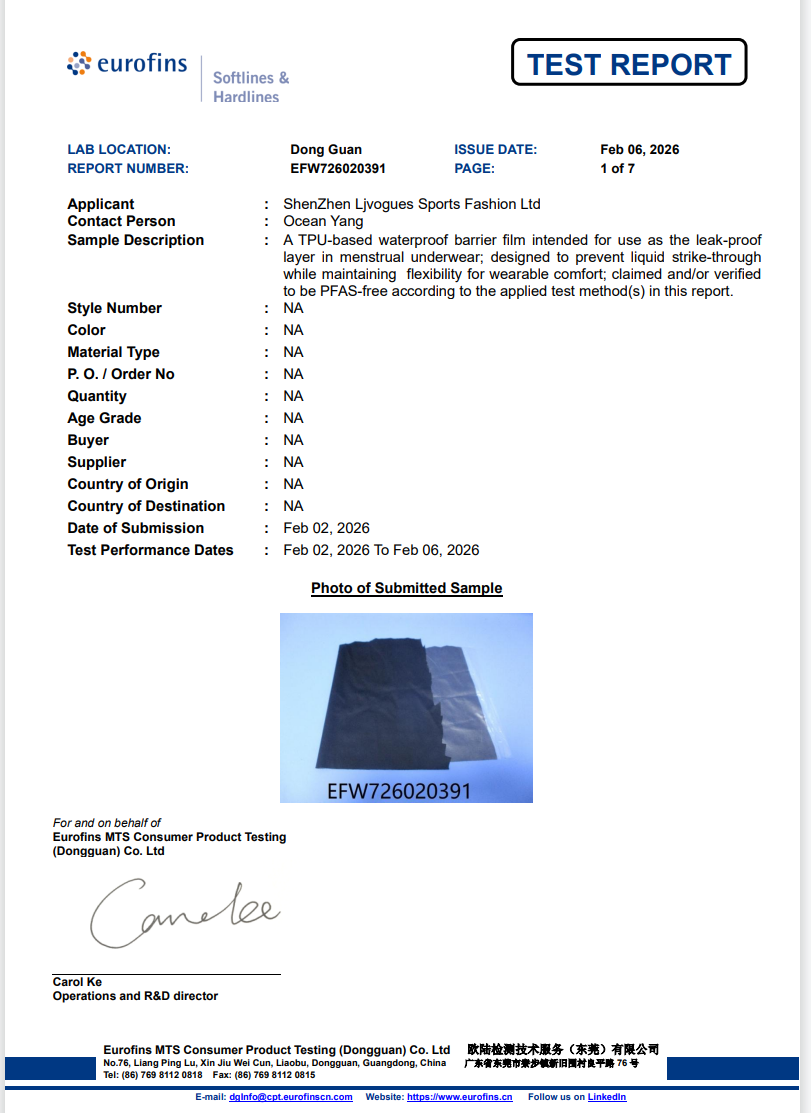
Ljvogues-PFAS-Free-report
BSCI, now operating under the amfori umbrella, is an industry-driven social compliance programme used extensively by European retail buyers to assess ethical practices in their supply chains. It is not a product safety standard — it assesses the factory as a workplace, not the product as a material.
A BSCI audit examines:
Management systems — whether the factory has documented social compliance procedures
Workers' rights — freedom of association, right to collective bargaining
Fair remuneration — wage levels against local minimums; payment regularity
Decent working hours — overtime limits, rest periods
Child labour and forced labour — age verification systems, retention of personal documents
Occupational health and safety — fire safety, machine guarding, sanitation
Environment — waste management, effluent handling
Ethical business conduct — anti-bribery, anti-corruption
Audits are conducted by accredited third-party audit firms: SGS, TÜV Rheinland, Intertek, Bureau Veritas, and others. The factory receives a grade (Outstanding, Good, Acceptable, Needs Improvement, Unacceptable). Results are shared on the amfori platform, visible to all amfori member brands that the factory has granted access.
Most major European retail chains — including supermarkets, fashion chains, and specialty health retailers — are amfori BSCI members and require their suppliers to have a current BSCI audit on file. Without it, a factory cannot typically be onboarded as a supplier. The audit is valid for two years for factories with Acceptable or better ratings, and more frequently for factories with corrective action requirements.
SEDEX is a non-profit membership organisation that operates a shared online platform for managing and exchanging data on responsible sourcing. Rather than issuing a certification per se, SEDEX facilitates SMETA audits (Sedex Members Ethical Trade Audit) — the most widely used social audit methodology globally.
Pillar | What Is Assessed |
Labour | Working hours, wages, contracts, freedom of association, child labour |
Health & Safety | Premises safety, emergency procedures, chemical handling, PPE |
Environment | Energy and water use, waste management, emissions |
Business Ethics | Anti-bribery, anti-corruption, whistleblowing procedures |
SEDEX audits can be either 2-pillar (Labour + Health & Safety) or 4-pillar. Major global retailers increasingly require the full 4-pillar audit. SEDEX membership allows buyers to access supplier audit reports directly via the platform, reducing the need for duplicated audits across multiple buyer relationships — a significant efficiency advantage for factories like LJVOGUES that serve buyers across multiple markets simultaneously.
ISO 9001 is the international standard for quality management systems (ISO.org). It does not certify the quality of a specific product — it certifies that the organisation has implemented systematic processes for consistently meeting customer requirements and regulatory obligations. For a B2B buyer, an ISO 9001-certified factory indicates documented procedures covering:
Design and development controls
Incoming material inspection
In-process and finished-goods QC
Non-conformance management and CAPA (corrective and preventive action)
Customer complaint handling
In practical sourcing terms, ISO 9001 is a proxy for operational maturity. A factory with ISO 9001 has documented its processes; deviations are traceable; corrective actions are recorded. This significantly reduces the risk of quality inconsistency across production runs.

Ljvogues-ISO9001-Certificate
ISO 14001 certifies an environmental management system — evidence that the factory monitors and works to reduce its environmental impact. For brands making sustainability claims or participating in ESG reporting frameworks, ISO 14001 from their manufacturing partner provides supply-chain-level evidence. It is increasingly required by publicly listed retailers with scope 3 emissions targets.
The Global Recycled Standard (GRS) is an international, voluntary, full-product standard that verifies the recycled content of a product and tracks that content through the supply chain. It is relevant to period underwear brands using recycled polyester (rPET), recycled nylon, or other recycled synthetic inputs.
The percentage of recycled content in the final product
Chain of custody — that the recycled material is traceable from collection through processing and manufacturing
Social and environmental practices of processors in the recycled supply chain
GRS labelling requires a minimum of 20% recycled content for an article to carry the certification. For "made with X% recycled content" claims to be credible, GRS certification is the recognised verification mechanism.
As recycled-fabric period underwear becomes an increasingly common positioning strategy (particularly for brands targeting millennial and Gen Z consumers in the EU and North America), buyers building sustainability narratives need to ensure their recycled content claims are verifiable. A supplier's verbal claim of "rPET fabric" is insufficient without GRS documentation tracing the material back to a certified recycler.
LJVOGUES holds GRS certification, enabling clients to use verified recycled content claims in their product marketing and retailer documentation.
The FDA regulatory situation for period underwear is one of the most frequently misunderstood areas of US market compliance, particularly on Amazon.
Period underwear is regulated under 21 CFR 884.5435, under FDA product code NUQ (FDA). This classifies them as Class I medical devices — a lower-risk classification than menstrual cups (Class II) or tampons (Class II). Critically, Class I period underwear devices are generally exempt from premarket notification (510(k)) requirements, meaning manufacturers do not need to submit a 510(k) application to the FDA before selling.
However, FDA Establishment Registration (21 CFR Part 807) may apply depending on how the product is classified at point of entry or listing.
Amazon has consistently flagged period underwear listings and required sellers to provide:
FDA Establishment Registration number
FDA Device Listing documentation
This creates a compliance challenge because — as numerous Amazon sellers have confirmed in Seller Central forum discussions (Amazon Seller Forum, November 2023) — the FDA itself, when contacted directly, may advise that specific registration is not required for Class I exempt devices. Despite this, Amazon's category algorithms flag products and require documentation.
The practical resolution: sellers listing period underwear on Amazon.com should be prepared to obtain and provide FDA Establishment Registration documentation proactively. The registration process is free of charge and handled via the FDA's online portal. Some Amazon sellers have also had success providing a letter from the FDA confirming the exempt status of their specific product — as documented in the February 2025 Seller Central thread (Amazon Seller Forum, February 2025).
The key operational point: do not launch a US Amazon listing without preparing FDA documentation in advance. It is one of the most common causes of listing suppression for period underwear brands entering the US market.
Different markets impose different mandatory and de facto certification requirements. The table below summarises the landscape for 2026.
Market | Mandatory Requirements | De Facto / Retailer Requirements | Notes |
USA | No mandatory pre-market certification for Class I exempt devices; California AB 1817 PFAS compliance | OEKO-TEX STANDARD 100, FDA registration for Amazon | CPSA enforcement for consumer product safety; Amazon may suppress without FDA docs |
EU | REACH compliance (hazardous substances); General Product Safety Regulation (GPSR) from Dec 2024 | OEKO-TEX STANDARD 100, BSCI or SEDEX, GRS if eco claims | EU plans comprehensive PFAS restriction under REACH; CE marking not required for textiles |
UK | UK REACH (post-Brexit equivalent); UKCA not required for textiles | OEKO-TEX STANDARD 100, SEDEX/SMETA preferred by UK retailers | UK PFAS restrictions tracking EU trajectory |
Canada | Canada Consumer Product Safety Act; no specific period underwear pre-market cert | OEKO-TEX STANDARD 100, PFAS compliance documentation | Canadian Environmental Protection Act covers PFAS contamination |
Australia | ACCC Australian Consumer Law (safety claims liability on importer) | OEKO-TEX STANDARD 100, SEDEX audits for major retailers | No mandatory pre-market approval; importers bear liability for safety claims |
India | BIS compulsory registration not currently required for period underwear; GST-exempt category | OEKO-TEX increasingly requested by premium Indian buyers | Fastest-growing market (22.6% CAGR); standards infrastructure developing rapidly |
[internal link: Article 11 — Importing Period Underwear from China: Shipping, Customs & Compliance]
Accepting a certification document at face value is insufficient. Fraudulent or misrepresented certifications are a documented problem in the Chinese textile supply chain. Follow these verification steps for each certification:
Certification | Verification Portal | What to Check |
OEKO-TEX® STANDARD 100 | Certificate number, scope (product types), validity date, issuing institute | |
GOTS | Certificate holder name, facility address, product categories, valid until date | |
GRS / RCS | UL Responsible Sourcing database (rsb.ul.com) | Certificate holder, scope, recycled content categories |
ISO 9001 / ISO 14001 | IAF CertSearch (iafcertsearch.org) | Certificate number, scope, certification body, expiry date |
BSCI | amfori portal (requires buyer membership) | Audit date, grade, factory name and address |
SEDEX | sedex.com supplier portal | Membership status, SMETA audit report dates |
Important: Always verify that the certified entity name and address on the certificate exactly matches the factory from which you are ordering. Certification fraud most commonly involves a valid certificate issued to one facility being presented as applicable to a different, uncertified facility.
When reviewing supplier certification documentation, the following red flags indicate potential issues:
Expired certificates — OEKO-TEX certificates expire annually. Any certificate more than 12 months old without a renewal date is invalid. Ask for the current-year renewal before sampling.
Scope mismatch — A certificate issued for "knitted outerwear fabrics" does not cover intimate apparel. The scope must explicitly include underwear or intimate apparel product types.
Facility address mismatch — The address on the certificate must match the facility producing your goods. Contract manufacturers sometimes present their trading company's certifications rather than the factory's.
Missing certificate number — A certification document without a verifiable certificate number cannot be checked in the issuing body's database. This is a significant red flag.
PFOA-free but no full PFAS panel — As discussed, a declaration of "PFOA-free" or "DWR-free" is not equivalent to full PFAS panel testing results. Require the actual lab report, not just a declaration.
Certification "in progress" — This means the product is not currently certified. Do not proceed on the basis that certification will be obtained before shipment unless you have a specific timeline, a named testing institute, and a contractual penalty clause.
Social audit with excessive corrective actions — A BSCI or SEDEX audit with a long open CAP (Corrective Action Plan) list, particularly on issues like fire safety, working hours, or wages, indicates systemic compliance problems that may resurface.
[internal link: Article 12 — 10 Red Flags When Sourcing Period Underwear]
At LJVOGUES, certification management is an ongoing operational function, not a one-time tick-box exercise. Our current certification stack covers the following:
OEKO-TEX® STANDARD 100 — Class II, covering all period underwear and intimate apparel fabrics; renewed annually via our testing institute partner
BSCI — current audit on file with amfori; valid for distribution to European retail buyer partners
SEDEX — active membership and current SMETA audit available to buyers via the SEDEX platform
ISO 9001 — quality management system covering our 8,000 m² Shenzhen production facility
ISO 14001 — environmental management system certification
GRS (Global Recycled Standard) — for recycled content fabric options in our period underwear range
PFAS-free verification — 100% PFAS-free confirmed by third-party accredited lab testing; documentation provided with each production order
FDA readiness — we can provide documentation support for US Amazon sellers, including Establishment Registration guidance
"Our investment in certifications is not primarily about cost — it's about making it possible for our clients to walk into a retailer meeting with a complete compliance package," says Ocean Yang, Founder of LJVOGUES. "In the past five years, the documentation bar for period underwear has moved from nice-to-have to table stakes. Brands that skip it lose deals at the finish line."
For buyers who need a full certification dossier for retail buyer submission or customs documentation, we provide a pre-formatted certification pack as part of the standard ODM onboarding process.
[internal link: Article 1 — How to Choose a Period Underwear Manufacturer: The Complete 2026 Buyer's Guide]

Q: Are period underwear regulated by the FDA?
A: Yes. Period underwear fall under 21 CFR 884.5435, FDA product code NUQ, classified as Class I medical devices. Most are exempt from premarket notification (510(k)) requirements, meaning no pre-market FDA approval is required before selling. However, FDA Establishment Registration may be required for some importers, and Amazon's seller platform frequently requests FDA documentation before permitting listings in this category.
Q: What does OEKO-TEX Class II mean for period underwear?
A: OEKO-TEX® STANDARD 100 divides products into four product classes based on skin contact level. Class II covers articles with direct and prolonged skin contact, which includes all underwear. Class II has tighter limits on harmful substances than Class III or IV — for example, the formaldehyde limit for Class II is 75 mg/kg vs. 300 mg/kg for Class III. Period underwear must be tested and certified to Class II, not lower classes.
Q: Is GOTS better than OEKO-TEX?
A: They test different things and serve different purposes. OEKO-TEX® STANDARD 100 tests the finished textile for the presence of harmful substances — it is a product safety certification. GOTS certifies organic fibre content and processing standards throughout the supply chain — it is an organic and ethical supply chain certification. GOTS also requires social compliance criteria similar to BSCI. For most period underwear brands, OEKO-TEX is the baseline priority. GOTS is additionally relevant if organic cotton content is a key brand positioning element.
Q: How much does period underwear certification cost?
A: Costs vary by certification type. OEKO-TEX® STANDARD 100 typically costs USD 1,500–5,000 per certification cycle (annual). GOTS certification runs USD 1,000–3,000 per year for the factory. BSCI audits cost USD 800–2,500. Third-party PFAS lab testing costs USD 300–800 per test. ISO 9001/14001 certification runs USD 2,000–8,000 per cycle. For buyers working with LJVOGUES, the factory-level certifications (OEKO-TEX, BSCI, SEDEX, ISO, GRS) are already in place — buyers do not pay these costs separately.
Q: How long is an OEKO-TEX® STANDARD 100 certificate valid?
A: One year from the issue date. It must be renewed annually. If a supplier's production materials, chemical inputs, or processing facilities change, re-testing may be required before the annual renewal date.
Q: Can a Chinese factory have real, verifiable certifications?
A: Yes. China has a well-developed third-party audit and testing infrastructure. All major certification bodies — SGS, Intertek, Bureau Veritas, TÜV Rheinland, Hohenstein — operate testing laboratories in China. Certifications issued by these bodies are verifiable in the same global databases as certifications issued anywhere else. The key is verification: always check the certificate number in the issuing body's online portal, confirm the facility address matches, and confirm the scope covers your product type.
Q: What is the difference between BSCI and SEDEX?
A: Both address social compliance, but they operate differently. BSCI is a code of conduct programme run by amfori; factories are audited and scored, and results are visible to amfori member brands. SEDEX is a data-sharing platform; factories share their SMETA audit reports directly with multiple buyers through a single account. In practice, many factories maintain both, as different buyers require different documentation formats. European supermarket chains typically ask for BSCI; UK-headquartered brands often ask for SEDEX/SMETA.
Q: What does "PFAS-free" actually mean on a period underwear label?
A: A credible "PFAS-free" claim requires third-party lab testing showing that no PFAS compounds (or PFAS below regulatory threshold levels) are present in the product. It should not be based solely on supplier declarations or ingredient lists. Since January 2025, California and New York legally require manufacturers to provide written certificates of compliance confirming PFAS absence. Buyers should request the actual lab test report, not just the brand's label claim.
Q: Is PFOA-free the same as PFAS-free?
A: No. PFOA (perfluorooctanoic acid) is one specific compound within the broader PFAS family of over 12,000 chemicals. Products marketed as "PFOA-free" may still contain other PFAS compounds, including short-chain alternatives. Full PFAS-panel testing — covering 40+ compounds — is required to substantiate a comprehensive PFAS-free claim.
Q: Does GRS certification mean a product is fully sustainable?
A: GRS certifies recycled material content and chain of custody — it does not make a comprehensive sustainability claim about the whole product. A GRS-certified garment may use 50% recycled polyester alongside virgin materials and conventional dyestuffs. GRS is a verifiable recycled content claim, not a holistic environmental certification.
Q: Do I need GOTS certification if my period underwear has any cotton content?
A: Not necessarily. GOTS is required only if you want to make an organic cotton claim or use the GOTS label in your marketing. If your product uses conventional cotton, GOTS is not applicable. If you use organic cotton but choose not to pursue GOTS labelling rights, your factory still needs to source the organic cotton from a GOTS-certified supply chain for any organic claim to be credible — otherwise, the claim is unverifiable.
Q: What happens if my period underwear fails a retailer certification audit?
A: Retailers typically issue a corrective action request with a defined timeline. For product safety issues (failed OEKO-TEX, PFAS detected), the consequence is usually removal from sale until remediated — this can mean product recalls and stock write-offs. For social compliance gaps (BSCI audit issues), retailers usually give 30–90 days for a corrective action plan before suspending the supplier relationship. Acting proactively — by establishing a complete certification stack before pitching to retailers — is significantly less expensive than remediation after listing.
Building a period underwear brand in 2026 without a documented certification strategy is a commercial risk that most retail buyers, Amazon category managers, and EU customs authorities will not accept. The standards have moved — OEKO-TEX, PFAS-free lab verification, and social compliance audits are the baseline, not the premium tier.
At LJVOGUES, our 8,000 m² Shenzhen facility carries a complete certification stack — OEKO-TEX® STANDARD 100, BSCI, SEDEX, ISO 9001/14001, GRS, and 100% PFAS-free verified — across our full period underwear and period swimwear OEM/ODM range. We support MOQs from 300 pieces, provide full certification documentation with every production order, and have supplied more than 500 brands globally over 20+ years of manufacturing.
If you are building a new brand, extending an existing line into period care, or sourcing for retail distribution, contact our team at ljvogues.com to request a certification dossier and product quote.
[internal link: Article 3 — How to Start a Period Underwear Brand: Step-by-Step Guide]
[internal link: Article 7 — Period Underwear Cost Breakdown: Factory to Shelf]
External references: OEKO-TEX® STANDARD 100 | GOTS Global Organic Textile Standard | ISO Quality Standards | amfori BSCI | SEDEX | EPA PFAS Information | California AB 1817 text | Amazon Seller Forum — FDA period underwear discussion
2026-08-13 11
LJVOGUES-August-2026-New-Arrivals.pdf
2026-07-17 7
LJVOGUES-Period-Underwear-Collection-2026-LJ-style-title-fixed.pdf
2026-06-15 20
LJVOGUES-June-2026-New-Arrivals.pdf
2026-06-05 14
LJVOGUES-May-2026-New-Arrivals.pdf
2026-04-01 197
Plus Size Bra Collection.pdf
2026-02-04 124
Professional Period Underwear OEMODM Manufacturer Catalog 2026.pdf
2026-02-04 119
Ljvogues Period-Panties-Catalog-In-stocks-2026-1.pdf


