



Table of Contents
TL;DR
MOQ (minimum order quantity) for period underwear typically ranges from 300–500 pieces per SKU for basic reusable styles up to 3,000–5,000 pieces for fully custom designs with proprietary fabrics. MOQs exist because of fabric roll minimums, lamination batch economics, and production setup costs. Most growth-stage brands start at 300–500 pcs per style and scale from there.
What MOQ Means in Period Underwear Manufacturing
MOQ — minimum order quantity — is the smallest number of units a manufacturer will produce in a single production run. In period underwear manufacturing, the term is used loosely, and that looseness causes confusion. Before you take any supplier's quoted MOQ at face value, you need to understand exactly what unit they are applying it to.
Per-SKU MOQ vs Total Order MOQ
These are two fundamentally different things, and conflating them is the most common sourcing mistake we see from new brands.
Per-SKU MOQ means the minimum quantity per individual stock-keeping unit — a SKU being a specific combination of style, colour, and size. If a manufacturer quotes 500 pcs per SKU and you want a brief in three colourways across six sizes, that is 3 SKUs × 500 pcs = 1,500 pieces minimum for that style alone (if each colourway is treated as one SKU, sizing being within that SKU).
Total order MOQ means the minimum number of units across your entire order, regardless of how many styles or SKUs are included. A manufacturer might accept a total order of 1,000 pcs spread across three styles, even if each individual style only reaches 300–400 pieces.
At LJVOGUES, we quote primarily on a per-SKU basis for colour runs, but we apply total order logic when a brand is mixing styles. This distinction directly affects how you plan your launch range.

The Three-Layer MOQ Problem
Period underwear is not a simple cut-and-sew product. It involves three distinct production inputs, each with its own minimum:
1. Fabric MOQ — The outer shell fabrics (typically nylon-spandex or cotton-lycra blends) are ordered from mills in roll minimums. A standard mill MOQ is 300–500 metres per colour per fabric type. For a mid-weight nylon period brief, roughly 1.2 metres of fabric covers approximately 3 units, meaning a 300-metre fabric roll supports around 750 pieces in that colour. If your order is smaller than the roll minimum, you are either paying for unused fabric or sharing a run with the manufacturer's stock orders.
2. Absorbent Core Lamination MOQ — The functional heart of period underwear is a multi-layer absorbent sandwich: typically a moisture-wicking top layer, an absorbent middle layer, and a leak-proof TPU or PUL backing. Laminating these layers together is done in batches. At LJVOGUES, our absorbent core lamination runs have a practical minimum of around 300 pieces before the per-unit economics make sense. Below that, the setup and press time outweighs the production value.
3. Packaging MOQ — Custom printed hang tags, poly bags with your branding, or custom boxes each have their own MOQ from the packaging supplier — typically 500–1,000 pieces minimum for anything with custom print. If your order is only 300 pieces, using generic packaging or supplier-stocked packaging is often more practical for a first run.
Understanding these three layers explains why a manufacturer cannot simply make you 50 pieces of a custom style. It is not stubbornness — it is supply chain reality.
Typical Period Underwear MOQ Ranges
The following table reflects standard industry MOQs as of 2026. These are starting points for negotiation, not fixed ceilings.
Product Type | MOQ per SKU | Notes |
Disposable period underwear | 5,000–10,000 pcs | High MOQ driven by nonwoven material batch minimums |
Basic reusable (existing factory pattern) | 300–500 pcs | Lowest entry point; uses stock fabrics and existing tech packs |
Custom reusable (private label, custom branding) | 500–1,000 pcs | Allows label, waistband, and colourway customisation |
Full OEM (custom design, custom tech pack) | 1,000–3,000 pcs | New patterns, fit blocks, and unique construction |
Highly customised fabrics or proprietary coatings | 3,000–5,000 pcs | Custom-dyed fabrics, exclusive DWR or antimicrobial treatments |
For context, a new DTC brand launching a 3-style core range (brief, bikini, boxer) in two colourways each would need a minimum of 6 SKUs. At 300 pcs per SKU, that is a total first order of around 1,800 pieces — realistic for a well-funded startup.
"The brands that struggle most with MOQs are those trying to launch eight styles in four colours simultaneously. We always recommend starting with two or three styles, two colourways, and scaling once you have proof of demand. Three hundred pieces per SKU is genuinely achievable and it is what we allow for new partners on existing styles."
— Ocean Yang, Founder of LJVOGUES
For more on how to structure your first sourcing programme, see [internal link: Article 1 — How to Choose a Period Underwear Manufacturer: The Complete 2026 Buyer's Guide] and [internal link: Article 2 — Period Underwear OEM vs ODM vs Private Label].

Why MOQs Exist — The Real Reasons
Suppliers rarely explain why an MOQ is what it is. Here is the honest manufacturing rationale behind each driver.
Fabric Roll Minimums
As outlined above, most fabric mills supply in rolls of 300–500 metres per colour. A manufacturer ordering a custom colour for your brand must commit to that full roll. If your order cannot absorb the roll, the leftover fabric becomes dead stock, which the manufacturer either warehouses at cost or writes off. MOQs protect against this. When a manufacturer accepts an order below their fabric roll threshold, they are taking on material risk on your behalf — something most factories will not do for new clients.

A full circle of fabric
Absorbent Core Lamination Batch Economics
Laminating a multi-layer absorbent core involves pressing, bonding, and curing stages. The equipment setup time — loading rollers, calibrating pressure and temperature — is roughly the same whether you are running 200 metres or 2,000 metres of material. Spreading that fixed setup cost across a larger run lowers the per-unit contribution dramatically. A 300-piece run is near the break-even point for a lamination run to be economically rational.
Setup Time and Pattern Amortisation
Cutting period underwear involves nested cutting dies or CAD-to-cutter files set up specifically for each style. If a new pattern or fit block is being used, the grading (scaling the pattern across sizes XS–6XL) and marker-making (optimising the cut layout) can take 4–8 hours before a single piece is cut. For a 300-piece run, that setup time is already a significant proportion of total hours. For a 50-piece run, it becomes uneconomic entirely.

Pattern Drafting and Cutting for Menstrual Panties
Cutting and Grading Efficiency
Fabric is cut in multiple-ply stacks — typically 30–80 layers at a time depending on fabric weight. A run of fewer than 300 pieces often cannot fill a practical number of cut spreads, which means the cutting room is running at a fraction of its efficient capacity. This inefficiency gets priced into small-run surcharges when manufacturers allow them at all.
MOQ Negotiation — What Is Actually Possible
MOQs are not always immovable. Here are four strategies that genuinely work.
Consolidate Colourways
Every colour you add is a new SKU with its own fabric order and potentially a new dye run. If your launch range includes a brief in six colours, you are triggering six separate fabric orders. Consolidating to two or three colourways for your first production run dramatically reduces the total order complexity and can allow the manufacturer to extend better per-SKU flexibility because the total order volume remains meaningful.
Offer to Use Manufacturer Stock Fabrics
Most mid-to-large period underwear factories maintain a stock of core fabric colours — typically black, nude, white, and a seasonal palette. Ordering from these stock colours eliminates the fabric roll minimum problem entirely. At LJVOGUES, brands that work within our stocked fabric palette can access 300-piece per-SKU minimums with no fabric surplus risk. It is a practical path for a first run.
Pre-Paid Material Commitments
If you want a custom colour or exclusive fabric that requires a new mill order, you can reduce the effective production MOQ by paying for the full fabric roll upfront, even if your initial production order does not consume it all. The manufacturer holds the remainder for your next order. This arrangement builds goodwill, reduces your quoted MOQ, and locks in fabric availability for your reorder.
Trial Orders vs Production Orders
A trial order (sometimes called a pilot run or proto-production order) is a small initial batch — typically 50–200 pcs across one or two sizes — used to validate fit, quality, and market response before committing to full production. Trial orders typically carry a higher per-unit cost (sometimes 15–25% above standard production pricing) and are not always offered by all manufacturers. At LJVOGUES, we accommodate trial runs for qualifying clients, particularly when there is a clear plan for a follow-on production order.
For a full breakdown of the sampling process before you reach MOQ decisions, see [internal link: Article 9 — Sampling & Prototyping Period Underwear: Timeline & Costs].

MOQ vs Price — The Volume Tier Table
One of the most important things to understand about MOQ is that it is not just a gating threshold — it is a pricing lever. Unit cost drops at each volume step, and the differences are material.
The following table shows indicative unit cost ranges for a standard reusable brief with 4-layer absorbent construction, OEKO-TEX certified fabric, and private label branding. Costs are FOB Shenzhen and exclude packaging, freight, and duties.
Order Quantity | Indicative Unit Cost (USD) | Notes |
300 pcs (per SKU) | $8.50–$11.00 | Small run surcharge applies; stock fabrics recommended |
500 pcs (per SKU) | $7.00–$9.50 | Sweet spot for first production orders |
1,000 pcs (per SKU) | $5.80–$8.00 | Custom colourways become viable at this level |
5,000 pcs (per SKU) | $4.50–$6.50 | Bulk fabric pricing engaged; significant unit cost reduction |
10,000 pcs (per SKU) | $3.80–$5.50 | Volume pricing; suitable for established brands or distributors |
50,000+ pcs (programme) | $2.80–$4.50 | Programme pricing; dedicated production capacity, priority scheduling |
These are indicative ranges for planning purposes. Actual quotes depend on design complexity, fabric specification, absorbency level (15ml vs 35ml vs 50ml core), size range, and certification requirements.
For a detailed cost breakdown covering all components from fabric to retail shelf, see [internal link: Article 7 — Period Underwear Cost Breakdown: Factory to Shelf].
Sample vs Bulk MOQ
The sampling stage operates on entirely different economics from bulk production. This distinction matters because many brands assume that a manufacturer who quotes 500 pcs MOQ will not provide samples — that is incorrect.
Pre-production samples (PP samples) are typically made in quantities of 1–5 pieces per style. They are used to confirm fit, construction, fabric, colour, and functionality before committing to a production run. PP sample cost at LJVOGUES is approximately USD 30–80 per piece depending on complexity, and the lead time is 10–15 business days.
Size-set samples — where a garment is made across the full size range to verify grading — are typically 6–8 pieces (one per size). These are made after PP samples are approved.
Bulk production is what the MOQ applies to. Once samples are approved and you issue a purchase order above the MOQ threshold, the production run begins.
The important point: sampling costs are not waived against your bulk order at most factories. At LJVOGUES, we credit sample costs against your first bulk order above 500 pcs — this is not standard across the industry, so confirm the policy with any supplier you are evaluating.
Lead Time at Different MOQ Levels
Lead time — the time from purchase order confirmation to goods-ready-to-ship — varies with order volume, but not in a linear way. The main variables are fabric procurement lead time, production scheduling, and QC hold time.
Order Quantity | Typical Lead Time | Key Variable |
300–500 pcs | 35–45 days | Stock fabric availability; fast if using factory stock colours |
1,000 pcs | 35–45 days | Comparable to 300–500 pcs if scheduling is aligned |
5,000 pcs | 45–60 days | Larger cut plan; fabric may need mill ordering |
10,000+ pcs | 60–90 days | Priority in production queue; fabric procurement lead time dominant |
50,000+ pcs (programme) | 90–120 days | Planned in advance; dedicated capacity required |
These lead times begin from purchase order confirmation with deposit payment received, not from the date of inquiry or sample approval. The most common error brands make is counting lead time from first contact rather than from PO issuance.
Lead times can be compressed in some cases — rush production is possible for an additional charge — but compression beyond 20% of the standard lead time usually compromises QC, and we do not recommend it.

Common MOQ Mistakes Brands Make
Having worked with over 500 global brands at LJVOGUES, these are the errors that appear repeatedly.
Mistaking sample price for production price. Sample units are made individually or in very small sets. The per-unit cost is irrelevant to production unit cost. Brands sometimes receive a sample invoice and assume bulk production will be similar — it will be lower at volume, but the sample price is not a baseline.
Ordering too many SKUs in one launch. New brands commonly want to launch with a full range immediately. Eight styles, six colourways, and five size runs is not a launch — it is a capital allocation problem. Start with 2–3 styles, 2 colourways, and 4–5 sizes. Prove demand before expanding.
Not asking whether MOQ is per-SKU or per-order. As explained earlier, these are fundamentally different. Always clarify in writing before requesting a formal quote.
Assuming MOQ can always be negotiated down to any level. Some manufacturers genuinely cannot go below a certain threshold due to their supply chain structure. If a factory quotes 1,000 pcs minimum and cannot explain why, that is worth investigating. If they can explain the lamination batch minimum or their mill's fabric roll requirement, the number is credible.
Ignoring packaging MOQs. Custom packaging often has its own supplier with its own MOQ. A 300-piece production order with a custom box that requires a 500-box minimum means you are ordering and paying for 200 empty boxes. Plan packaging runs to align with production runs, or use generic packaging for early orders.
Not accounting for size ratio planning. Your 500-piece order is spread across sizes. If you stock XS through 3XL (7 sizes), and your demand curve is unknown, you are making a size allocation bet. Over-indexing in XS and XL means dead stock; under-indexing in medium means stockouts. Request guidance from your manufacturer on standard size curves for your target market.
How LJVOGUES Approaches MOQ — Flexibility for Growth-Stage Brands
At LJVOGUES, our standard production MOQ starts at 300 pieces per SKU for existing styles using our stocked fabric palette. This is materially lower than the 500–1,000 pcs baseline you will encounter at many comparable Chinese period underwear manufacturers.
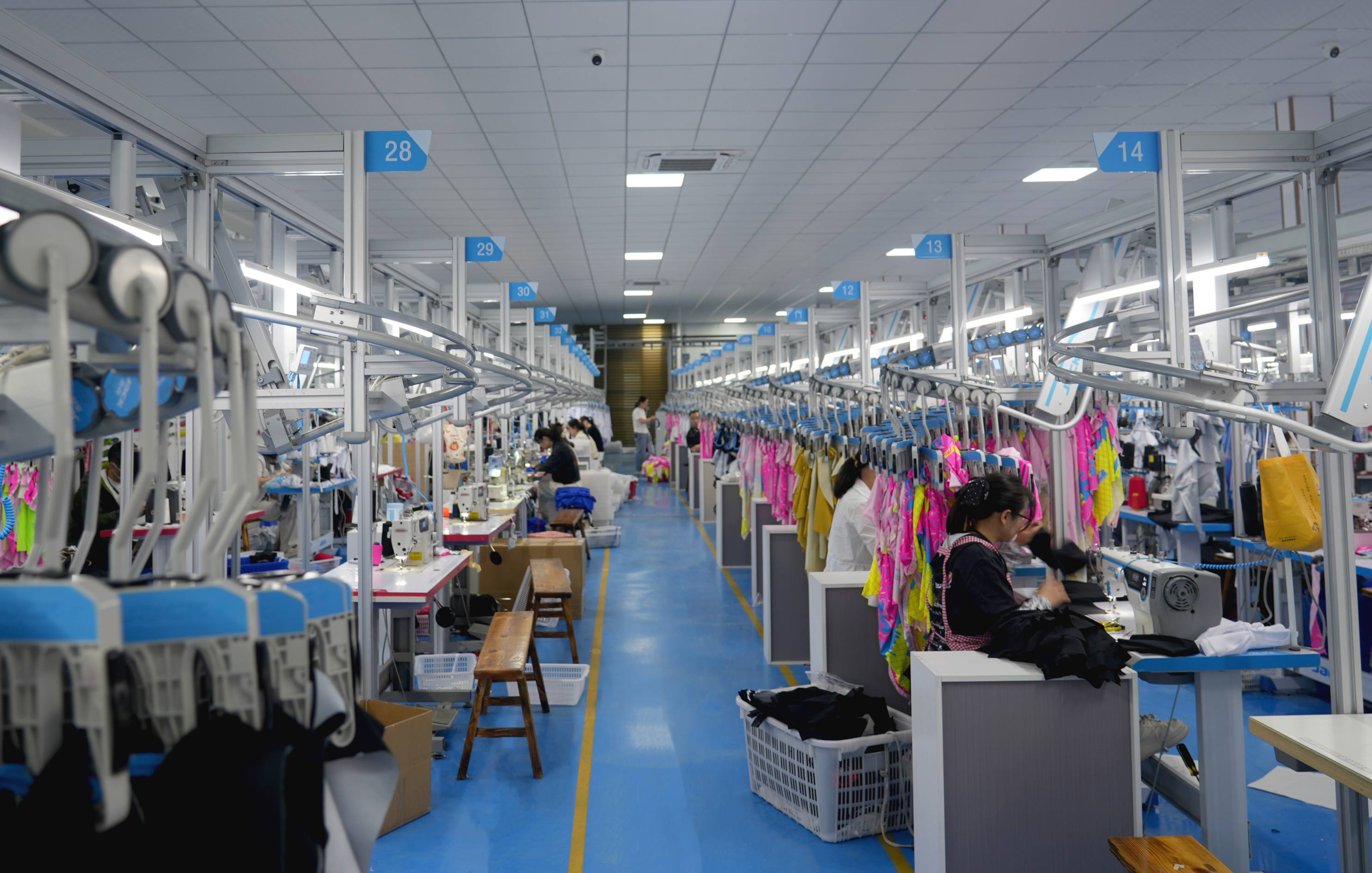
The reason we can support 300-piece runs is structural: our 8,000 m² facility in Shenzhen handles the full production stack in-house, from absorbent core lamination through to finished garment. We are not outsourcing lamination to a third-party factory with its own batch minimums. Vertical integration is what makes lower MOQs viable.
For brands requiring custom fabrics, exclusive colourways, or proprietary constructions, the minimum rises to 500–1,000 pcs per SKU, consistent with industry norms for those product types.
"We designed our production model specifically to accommodate brands in the 0-to-1 growth stage. A 300-piece run is not particularly profitable for us — the economics are thin. But the relationship that starts at 300 pieces often becomes a 10,000-piece programme within eighteen months. We think about MOQ not as a minimum revenue threshold but as the beginning of a long-term manufacturing partnership. As your brand grows, the relationship deepens, pricing improves, and we can reserve dedicated capacity for your programmes."
— Ocean Yang, Founder of LJVOGUES
LJVOGUES holds the following certifications relevant to period underwear production: OEKO-TEX® STANDARD 100, BSCI, SEDEX, FDA (for US market products), ISO 9001, ISO 14001, and GRS (Global Recycled Standard). All fabrics are 100% PFAS-free verified — an increasingly important requirement in the EU and North American markets.

Production Workshop
Frequently Asked Questions
Q: Can I start a period underwear brand with fewer than 300 pieces?
A: It is technically possible through some manufacturers, but realistically you will pay a significant premium per unit — sometimes 30–50% above standard production pricing — and quality consistency on very small runs (under 100 pcs) is harder to maintain because the production process is less standardised. For serious brand launches, 300 pieces per SKU is the practical minimum that gives you enough units to test the market, cover returns, and maintain photography stock. At LJVOGUES, 300 pcs is our minimum on existing styles.
Q: Why are period underwear MOQs higher than regular underwear?
A: Because period underwear is not regular underwear. The absorbent core lamination adds a processing step that does not exist in conventional intimate apparel. Each layer of the absorbent system has its own material minimums, and the lamination equipment has a meaningful setup cost per run. Functional performance products — period underwear, sports bras, compression garments — all carry higher MOQs than plain-construction equivalents for the same reason.
Q: Do MOQs apply per size, per colour, or per style?
A: Typically per SKU, where a SKU is a specific style-colour combination. All sizes within that style-colour are included in the SKU's MOQ. So if your MOQ is 300 pcs for a black brief, you spread those 300 pieces across your size run (e.g., 40 pcs each in sizes XS through 3XL). MOQ does not mean 300 pieces per size — that would be 2,100 pieces across 7 sizes. Always clarify this with your manufacturer before building your order.
Q: What happens if I want multiple colours of the same style?
A: Each colour is treated as a separate SKU and typically requires its own minimum order. If your MOQ is 300 pcs per SKU and you want three colours, your minimum is 900 pieces for that style. To reduce this, you can use stock fabric colours (which share existing material inventory) or consolidate to fewer colourways for your first run.
Q: Is there a way to test a new style before committing to full MOQ?
A: Yes — through the PP sample and trial order process. PP samples (1–5 pcs) confirm design and construction. A trial order of 50–200 pcs can validate fit and quality before your main production run. Trial orders typically carry a higher unit cost. At LJVOGUES, sample costs are credited against your first bulk order over 500 pcs. See [internal link: Article 9 — Sampling & Prototyping Period Underwear: Timeline & Costs] for the full process.
Q: Do disposable period underwear products have the same MOQ as reusable?
A: No — disposables typically have significantly higher MOQs, in the range of 5,000–10,000 pcs per SKU. This is because disposable period underwear uses nonwoven materials processed on high-speed converting lines with large batch minimums. Reusable period underwear (the category most DTC brands launch in) has far more accessible MOQs.
Q: What is the lead time for a first production order?
A: For a first order at 300–1,000 pcs using stock fabrics at LJVOGUES, you should plan for 35–45 days from PO confirmation and deposit receipt. If you require custom fabrics, add 2–3 weeks for mill procurement. If your order is above 5,000 pcs, plan for 45–60 days. These timelines begin at PO confirmation, not at initial inquiry.
Q: Can I split my MOQ across multiple styles to reach the minimum?
A: This depends on the manufacturer and how they define their minimum. Some factories apply a total order minimum (e.g., 1,000 pcs across all SKUs) rather than a strict per-SKU minimum. At LJVOGUES, we apply per-SKU minimums but can be flexible on total order composition for established clients. For a first order, it is best to plan around per-SKU minimums and treat any total-order flexibility as a bonus rather than a baseline.
Q: Will my MOQ go up over time?
A: Not necessarily — but your ability to access better pricing and shorter lead times improves substantially as your order volumes grow. As a brand scales from 300 pcs per SKU to 1,000 pcs or 5,000 pcs, the unit economics improve significantly (see the Volume Tier Table above). Manufacturers also prioritise higher-volume clients in production scheduling, which can reduce lead times. Growing your order volume is in your commercial interest regardless of any MOQ requirements.
Q: What if my sell-through is slow and I do not want to reorder at MOQ?
A: If demand is lower than projected, you have a few options: hold your next order until stock depletes (most brands should plan 3–4 months of runway before reordering); pivot to a different style or colourway for the next run; or work with your manufacturer to apply remaining fabric credit to a different SKU in your range. This is exactly why launching with fewer SKUs at launch makes more sense than a broad range — it reduces the risk of slow-moving inventory in underperforming styles.
Ready to Discuss Your MOQ with a Manufacturer Who Understands Growth-Stage Brands?
MOQ planning is one of the most consequential decisions in your period underwear launch. Getting the structure wrong — ordering too many SKUs, misjudging size ratios, or misunderstanding per-SKU vs total-order minimums — can lock up capital in unsaleable inventory before your brand has traction.
At LJVOGUES, we regularly work with brands on their first production run of 300–500 pieces per SKU and have guided over 500 global brands from launch to scale. Our team can help you structure your first order range, plan your size curve, and identify where stock fabrics can reduce your minimum commitment.
If you are planning a period underwear range and want a frank conversation about what MOQ structure makes sense for your stage of growth, contact our team at www.ljvogues.com with your brief, target range, and timeline. We respond to all sourcing inquiries within 24 hours.
Sources: Grand View Research (period panties market data, 2025–2033 projections); OEKO-TEX® STANDARD 100; LJVOGUES internal production data.