



Table of Contents
TL;DR
To source period swimwear from China, identify manufacturers that combine proven swimwear construction (chlorine-resistant polyester/PBT outer fabric, DWR coating, UPF 50+) with validated period-care engineering (4-layer absorbent system, TPU thermal bonding, 15–50ml capacity tiers). Require chlorine soak reports, 52-wash durability tests, and OEKO-TEX and PFAS-free documentation before committing to a production run.
The Inquiry That Started This Guide
In May 2026, a brand founder reached out to us at LJVOGUES with a well-structured product line: leakproof underwear, biker shorts, and safety shorts — already in development. At the end of the email, almost as an aside, she wrote: "We'll want to add period swimwear eventually. I assume the same factory can do it?"
I appreciated the question because it reflects a gap that is common in the market. Brands that have successfully sourced period underwear often assume that adding a swimwear SKU is a straightforward extension. In most cases it is not — at least not if you want a product that actually performs in water. The manufacturing requirements for period swimwear diverge from period underwear in five measurable ways, each of which affects which suppliers can credibly produce the item and which cannot.
This guide — Article 17 in our B2B Sourcing Guide library, continuing from the Leakproof Activewear trilogy — walks brand founders and sourcing teams through exactly what that founder needed: a complete framework for evaluating, selecting, and qualifying a period swimwear manufacturer China for a 2026 or 2027 launch.
For the consumer-facing explanation of how period swimwear works, see our Period Swimwear Explained guide ).
Part 1: Why Period Swimwear Is the Fastest-Growing Sub-Category in Activewear
The market case for entering period swimwear is straightforward. The global swimwear market reached USD 22.95 billion in 2025 and is projected to grow to USD 34.12 billion by 2034 at a 5.08% CAGR. An alternative forecast from Grand View Research values the category at USD 23.1 billion in 2023 with projected growth to USD 36.15 billion by 2030 at a 6.8% CAGR. Either way, the base market is large and accelerating.
Within that base, the period care sub-segment is growing at a meaningfully faster rate. Period panties are tracking a 20.5% CAGR according to Market.us, and the broader period products segment is expanding at approximately 8.8% annually. Period swimwear benefits from both growth curves simultaneously — it is a swimwear item and a period care item — and there is currently no dominant brand in the category the way Modibodi dominates period activewear or Thinx dominates period underwear.
The Regional Opportunity
Regional distribution of the base swimwear market is roughly balanced across three blocs: North America accounts for 31.78% (USD 6.98 billion in 2025), Europe for 27.20% (approximately USD 6 billion), and Asia Pacific for 31.65–36.1%. Women represent 63.56% of global swimwear demand in 2026. For a period swimwear OEM launch, North America and Europe represent the most commercially mature regulatory and retail environments, while Asia Pacific offers growing mid-market volume.
Why 2026 Is the B2B Entry Window
Three factors converge to make 2026 an unusually good time to enter the category as a brand.
First, category awareness is rising faster than supply. Consumers in the UK, US, and Australia who have adopted period underwear are now asking whether the same protection is available for swimming — and discovering that the product selection is thin. Swim England updated its period wear guidance in 2023 to permit period swimwear in competitive events, normalising the product category for athletes.
Second, the retail channel infrastructure now exists. Period care products are stocked by major sporting goods chains, pharmacies, and DTC swimwear retailers who have already educated their customers on the category. A new wholesale period swimwear supplier entering in 2026 can access retail buyers who are actively looking for product to fill a gap.
Third, Modibodi's 2022 collaboration with Puma — the first mainstream brand to launch period activewear including swim and biker shorts — validated the market commercially and generated substantial press coverage. That validation is now three years old; the consumer education it produced has compounded, and the first brands to enter with well-engineered product will capture a disproportionate share of early-mover loyalty.

Modibodi's 2022 collaboration with Puma
Seasonal Traffic and Purchase Decision Peaks
Search volume for period swimwear terms peaks twice annually: in the Northern Hemisphere summer (May–August) and, to a lesser extent, in the Southern Hemisphere summer (November–February). B2B sourcing decisions that generate inventory for the May–August peak need to begin no later than October–November of the preceding year. Brands planning a 2027 summer launch should begin manufacturer qualification in Q3 2026.
Part 2: What Makes Period Swimwear Different from Period Underwear (Manufacturing-Wise)
This is the question that founder's inquiry prompted, and it is the most important technical distinction for any brand sourcing team to understand before issuing RFQs.
Period underwear and period swimwear share the same core objective — absorb menstrual fluid without leaking — but they operate in radically different physical environments. A period swimwear manufacturer China must solve five engineering problems that do not exist for period underwear.
Comparison Table: Period Underwear vs. Period Swimwear Manufacturing Requirements
Engineering Dimension | Period Underwear | Period Swimwear |
Outer layer function | Leak-proof only — prevents fluid from passing outward | Water-resistant — must also block pool or seawater from entering the absorbent core |
Outer fabric chemistry | Nylon/spandex (standard) | Polyester/PBT blend — chlorine-stable, resists degradation in chlorinated water |
Chlorine resistance | Not required | Required — chlorine-resistant swimwear lasts 5–10x longer than nylon/spandex equivalents |
Fit and seal engineering | Comfortable, moderate compression | High-precision seal at waistband and leg openings — prevents external water ingress |
Absorbent core thickness | 3–5mm acceptable | Must be minimised (typically ≤2mm compressed) to prevent swelling and maintain silhouette in water |
UV protection | Not required | UPF 50+ coating required for outdoor pool and beach use |
DWR (Durable Water Repellent) treatment | Not applicable | Applied to outer layer to shed pool water rapidly and reduce weight-in-water |
Testing scope | Wash cycles, absorption capacity, bio-compatibility | All of the above, plus chlorine soak cycles, swim simulation, UV exposure |
I have reviewed hundreds of RFQs from brands that issued the same brief to their existing period underwear factory and were surprised when the samples failed water-entry testing. The outer layer chemistry difference alone — nylon/spandex versus polyester/PBT — disqualifies the majority of period underwear suppliers from producing period swimwear. This is not a criticism of those factories; it reflects that swimwear and intimate apparel manufacturing are genuinely different disciplines, and a credible period swimwear supplier must have demonstrated competence in both.
Part 3: The 4-Layer Engineering Standard
Every period swimwear product that performs reliably in water is built on a four-layer construction. Understanding what each layer does — and what separates good execution from poor execution — allows sourcing teams to evaluate supplier samples with a structured lens rather than relying solely on lab results.
Layer 1: Top Wicking Layer (Skin-Contact Surface)
Function: Pulls fluid away from the skin surface and into the absorbent core within seconds of contact.
Materials: Bamboo-derived viscose, organic cotton, or microfiber polyester blends. Bamboo and cotton offer better skin compatibility for sensitive users; microfiber offers faster moisture transport rates.
Supplier criteria: Request specific moisture transport rate data (AATCC 195 or equivalent). The wicking layer in period swimwear must manage fluid while also remaining functional when the garment is wet from external water — a requirement that does not exist in period underwear. Ask whether the supplier uses a treated or untreated wicking fabric; chemical treatments that improve dry-state performance sometimes degrade in chlorinated water.
Testing requirement: Confirm wicking performance post-wash (at wash cycle 1 and wash cycle 52) and post-chlorine exposure (after 10 and 52 chlorine soak cycles).
Layer 2: Absorbent Core (Fluid Storage)
Function: Stores absorbed menstrual fluid, maintaining effective capacity throughout the wear period.
Materials: Microfibre padding, bamboo fleece, or proprietary absorbent composites. The absorbent core must balance two competing requirements in swimwear that do not conflict in underwear: high fluid storage capacity and minimum compressed thickness.
Capacity tiers for sourcing evaluation:
Tier | Absorbed Volume | Tampon Equivalent | Recommended Application |
Light | 15–20ml | 1.5–2 tampons | Light flow days, confidence backup |
Regular | 25–35ml | 2.5–3.5 tampons | Moderate flow, active swimming |
Heavy | 40–50ml | 4–5 tampons | Heavy flow, extended wear |
Supplier criteria: Confirm that the factory can manufacture to all three tiers. A supplier offering only a single capacity option is likely producing a simpler product than what genuine period swimwear engineering requires. Capacity tiers require different core constructions, and a manufacturer experienced in period care will have the tooling and material sourcing to support multiple tiers.
Testing requirement: Gravimetric absorption testing (ISO 11948-1 or equivalent) on both pre-wash and post-52-wash samples. Compressed thickness measurement in the wet state (after 10 minutes of submersion) to verify no swelling exceeds 0.5mm above dry state.
Layer 3: TPU Water-Resistant Barrier
Function: This is the most critical engineering layer in period swimwear and the one most often compromised by cost-cutting. The TPU (thermoplastic polyurethane) barrier performs two functions simultaneously: it prevents absorbed menstrual fluid from leaking outward, and it prevents external pool or seawater from penetrating inward into the absorbent core.
Specification: Thermally bonded TPU film, 18–25 microns thickness. Edge sealing at all layer boundaries. No solvent adhesives — solvent lamination introduces chemical compliance risks and produces a stiffer, less durable bond.
Why thermal bonding matters: Thermal bonding fuses the TPU layer to adjacent fabrics using heat and pressure without adhesives. The resulting bond is chemically inert (no PFAS, no VOC solvents), flexible, and maintains integrity through repeated wet-dry cycles. Solvent lamination, by contrast, can off-gas in the first few washes, and the adhesive layer is susceptible to delamination when subjected to chlorine exposure.
Supplier criteria: Request documentation confirming thermal bonding process (not lamination). Ask for delamination test results — specifically pull-force testing after 52 wash cycles and after 52 chlorine soak cycles. Any TPU barrier that cannot provide these documents should be treated as an unverified claim. Our EU compliance article covering ISO 10993-1 and GPSR requirements provides the regulatory context for why TPU chemistry documentation is legally required for EU market entry.
Testing requirement: Hydrostatic pressure test at 10 kPa (minimum) on the assembled garment, in addition to the delamination tests above.
Layer 4: Outer Chlorine-Resistant Fabric (Shell)
Function: Provides the garment's visual appearance, structural integrity, UV protection, and resistance to the chemical environment of swimming pools and saltwater.
Materials: Polyester/PBT (polybutylene terephthalate) blend, or high-tenacity polyester. Polyester/PBT blends offer superior chlorine resistance compared to nylon/spandex because the PBT fibre is chemically inert to chlorine at pool concentrations, whereas nylon degrades measurably after 50–100 hours of chlorine exposure at 1–3 ppm. Chlorine-resistant swimwear lasts 5–10 times longer than nylon/spandex equivalents in regular pool use.
Specification: UPF 50+ rating (AATCC 183 or AS/NZS 4399), DWR treatment applied post-construction to shed water rapidly and reduce wet weight. DWR must be PFAS-free — fluorinated DWR is banned under EU REACH restrictions (PFAS restriction proposal), and leading markets including the UK, Germany, and Sweden have imposed or are imposing domestic prohibitions.
Supplier criteria: Require a chlorine soak test report showing colorfastness and elasticity retention after 52 cycles of 2.5 ppm chlorine exposure at 27°C. Require UPF certification. Confirm DWR chemistry is PFAS-free — ask for the DWR supplier's safety data sheet or PFAS-free declaration.

The 4-Layer System Explained
Part 4: Manufacturer Selection — A 7-Criteria Framework
Sourcing teams frequently ask for a simple scorecard to use when evaluating period swimwear suppliers. The following 7-criteria framework is based on two decades of observing where sourcing relationships succeed and where they break down. Each criterion includes a scoring guide and minimum threshold for qualification.
As covered in How to Choose a Period Underwear Manufacturer and Period Underwear Certifications Explained, manufacturer selection is a structured process — not a comparison of price quotes.
7-Criteria Manufacturer Evaluation Framework
# | Criterion | How to Assess | Minimum Threshold | Scoring Guide (1–5) |
1 | Period care manufacturing experience | Years in production + number of brand clients with period products | 5+ years, 20+ brand clients | 1=new to category; 3=3–5 yr, 10+ clients; 5=10+ yr, 50+ clients |
2 | Swimwear manufacturing capability | Request chlorine soak test reports on previous swimwear production | Valid chlorine resistance report within last 18 months | 1=no swimwear history; 3=swimwear capability, no chlorine test; 5=dedicated swimwear line + chlorine reports |
3 | Certification completeness | Verify OEKO-TEX, BSCI or SEDEX, ISO 9001, PFAS-free declaration, REACH compliance | OEKO-TEX + PFAS-free + one social compliance audit minimum | 1=no certs; 3=ISO only; 5=full stack (OEKO-TEX, BSCI/SEDEX, ISO, PFAS-free, REACH, FDA) |
4 | Absorption capacity tiering capability | Can the factory produce 15ml, 30ml, and 50ml variants? | At least two distinct capacity tiers in production portfolio | 1=single capacity only; 3=two tiers; 5=three or more tiers with test data |
5 | MOQ flexibility | Minimum order quantity per style/colorway for sampling and production | ≤300 units per style for initial production run | 1=5,000+ MOQ; 3=500–1,000; 5=300 or under with no price penalty |
6 | Lead time transparency | Confirmed lead times for sampling and bulk production in writing | Sample ≤25 days; bulk production ≤60 days | 1=no written lead time; 3=general range; 5=contractual lead time with penalty clause |
7 | Compliance documentation | Availability of GPSR technical file, ISO 10993-1 test plan, country-specific import compliance support | Proactive documentation before request | 1=no compliance docs; 3=certs available on request; 5=pre-compiled technical file + ISO 10993-1 program |
A supplier scoring below 3 on criteria 2, 3, or 7 should not advance to sampling regardless of competitive pricing. As covered in 10 Red Flags When Sourcing Period Underwear, low scores on these criteria are the most reliable predictors of production failures and compliance incidents.

Part 5: Testing Protocols Every Brand Should Demand
Testing documentation is the mechanism by which supplier claims become verifiable facts. A manufacturer that produces technically correct period swimwear will proactively provide test reports; a manufacturer that cannot should be asked to explain why not before any money changes hands.
The following five test categories represent the minimum acceptable testing scope for a 2026 period swimwear product. This framework builds on the testing standards covered in Period Underwear Quality Control and extends them for the swimwear environment.
Absorption Capacity Verification
Method: Gravimetric test — synthetic menstrual fluid introduced into the crotch panel under controlled conditions; absorbed volume measured against stated capacity.
Requirement: Test at pre-wash and post-52-wash states. Capacity retention after 52 washes must be ≥90% of the stated value. This is the floor that leading retail buyers now require as a category standard.
Red flag: Any supplier who cannot provide wash-cycle-segmented absorption data is relying on pre-wash figures only. Pre-wash figures for new garments can be 20–30% higher than post-wash real-world performance.

Absorption Capacity Verification
52-Wash Durability Test at 30°C
Method: Repeat wash cycles per ISO 6330 (domestic washing procedures) at 30°C with standard household detergent.
Requirement: Post-52-wash retention of ≥90% absorption capacity; no delamination of TPU layer (pull-force test); no degradation of outer fabric colorfastness (ISO 105-C06 rating ≥4).
Note: 52 washes represents approximately one full year of weekly use. As noted in Absorbent System Across Activewear, the 52-wash standard is now the de facto durability benchmark across all leakproof activewear categories.
Chlorine Soak Testing
Method: Cyclic immersion in 2.5 ppm chlorinated water at 27°C, simulating pool conditions; 52 cycles, each representing one swim session.
Requirement: Post-test colorfastness ≥4 (ISO 105-E03); elasticity retention ≥85% of initial elongation-at-break; no visible delamination at seam edges; absorption capacity retained ≥85% of pre-chlorine-test value.
Why this matters: Chlorine degradation of period swimwear is cumulative and becomes visible — in the form of fabric pilling, colour fading, and seam separation — after 30–50 pool sessions for products built on nylon/spandex. Polyester/PBT construction extends this to 150–300+ sessions at equivalent conditions, which is the five-to-ten-times-longer service life referenced by Swimwear Galore.
UV Exposure Test
Method: ISO 105-B06 xenon arc exposure or AATCC 183 for UPF rating.
Requirement: UPF 50+ rating confirmed; colorfastness after UV exposure ≥4.
Applicability: Required for outdoor pool and beachwear use. Brands targeting the North American and Australian markets should treat UPF 50+ as a non-negotiable specification given consumer expectations in these markets.
ISO 10993-1 Biocompatibility
Method: The ISO 10993-1:2018 framework (updated in the 2025 revision cycle) governs biocompatibility assessment for materials in contact with the body.
Requirement: OEKO-TEX STANDARD 100 certification provides a first-level screening for harmful substances. For EU market entry under the General Product Safety Regulation (GPSR, effective December 2024) and for brands positioning products as medical-adjacent (incontinence, post-surgical), a full ISO 10993-1 risk assessment is increasingly expected.
As detailed in our EU Compliance and ISO 10993-1 article, GPSR has materially raised the documentation standard for intimate apparel sold in the EU. Brands entering the EU market in 2026 should confirm that their manufacturer has an ISO 10993-1 test plan in place or can facilitate third-party biocompatibility testing. Our engineering team at LJVOGUES operates an ISO 10993-1-ready testing program as standard for all new EU-destined SKUs.
Part 6: Common Sourcing Pitfalls and Red Flags
In our two decades manufacturing period care products, the sourcing failures we have observed cluster around five recurring patterns. Each represents a specific type of supplier shortcut that produces garments which either fail in use, fail in compliance review, or fail to survive more than one season of wear.
This section builds on the framework established in 10 Red Flags When Sourcing Period Underwear, applying those principles specifically to the swimwear context.
Red Flag 1: No Chlorine Test Report
A supplier that presents period swimwear samples without an accompanying chlorine soak test report has one of three explanations: the test was never run; the test was run and the results were poor; or the factory does not understand that chlorine resistance is a core specification for swimwear. None of these explanations is acceptable.
Chlorine testing is inexpensive and straightforward. Any legitimate wholesale period swimwear supplier with swimwear manufacturing history will have run this test as standard. The absence of documentation is a qualification failure, not a paperwork oversight.
Red Flag 2: TPU Without Thermal Bonding Documentation
If a supplier confirms they use a TPU barrier but cannot provide documentation confirming thermal bonding (as opposed to solvent lamination), the claim cannot be verified. Solvent lamination and thermal bonding produce garments that look identical in visual inspection but differ substantially in chemical safety and wash durability.
Ask for the specific bonding equipment used and the process temperature parameters. A supplier using thermal bonding will be able to answer these questions precisely. A supplier using solvent lamination — or who does not actually use a TPU barrier — will not.
Red Flag 3: Single Fabric Supplier Dependency
A period swimwear manufacturer China that sources all outer fabric from a single supplier has a supply chain concentration risk that will eventually affect your production. Chlorine-resistant polyester/PBT fabric is a specialised material with a limited number of qualified mills. Suppliers who can name two or more qualified mills for this fabric have built resilience into their supply chain; those who cannot represent a single-point-of-failure risk.
Red Flag 4: No ISO 10993-1 Plan for EU-Destined Products
Any supplier offering to manufacture period swimwear for EU market entry under GPSR without awareness of or preparation for ISO 10993-1 documentation requirements is either new to the EU compliance landscape or is not genuinely manufacturing — they may be sourcing from a third party and reselling. Legitimate manufacturers who have been exporting to the EU market since late 2024 will have adapted their compliance documentation to meet GPSR requirements.
Red Flag 5: MOQ Below 100 Units at Market Price
As covered in Article 4: Period Underwear MOQ Guide and Period Underwear Cost Breakdown, genuine manufacturers have material and production minimums that make sub-100 unit MOQs economically unviable at standard market pricing. A supplier offering 50 units per style at pricing consistent with factory direct production is almost always a trading company that sources from a manufacturer and marks up. This means you have no direct relationship with the producer, no ability to enforce specification compliance, and no recourse when production quality deviates.
Part 7: LJVOGUES's Period Swimwear Manufacturing Approach
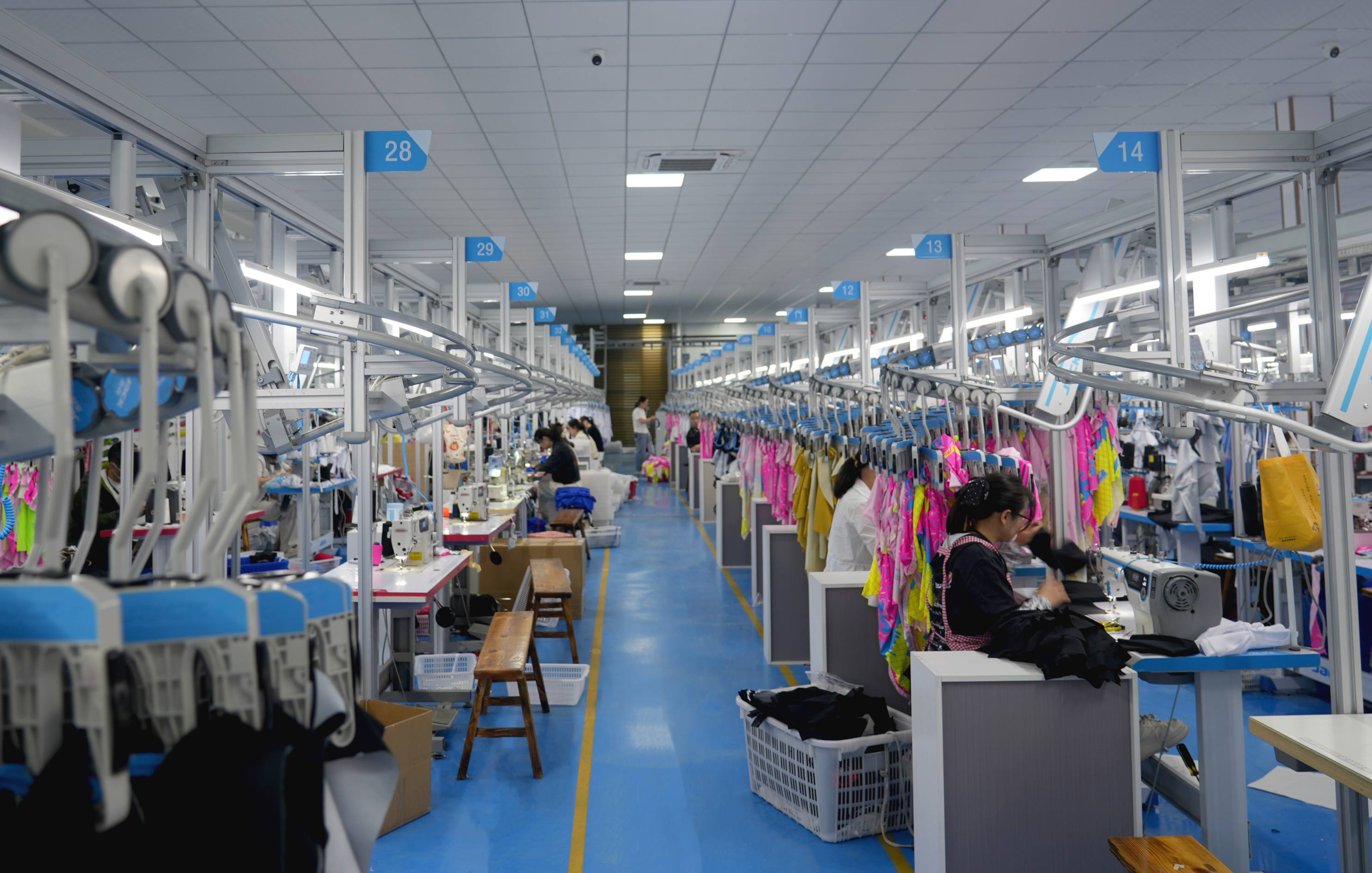
I founded LJVOGUES in Shenzhen with a specific thesis: that the period care category deserved the same engineering rigour that high-performance athleticwear manufacturers apply to technical fabrics. Twenty years later, that thesis has been validated by 500+ brand partners across North America, Europe, and Australia who have built category-leading products on our manufacturing platform.
Our period swimwear manufacturing approach reflects everything described in Parts 3 through 6 of this guide — not as aspirational standards but as operational defaults.
4-Layer Leak-Proof Construction, Swimwear Specification
Every LJVOGUES period swimwear garment is built to the full 4-layer standard:
Layer 1: Bamboo-derived or microfiber wicking surface, tested for moisture transport performance pre- and post-52-wash chlorine cycles
Layer 2: Absorbent core in three capacity tiers — 15ml (light/backup), 30ml (regular), and 50ml (heavy) — with compressed thickness controlled to ≤2mm wet state to prevent silhouette disruption in water
Layer 3: TPU barrier, thermally bonded at 18–25 microns, edge-sealed at all construction boundaries, zero solvent adhesives, zero PFAS
Layer 4: Polyester/PBT chlorine-resistant outer fabric with DWR treatment and UPF 50+ certification
Selective Absorption Technology
Our proprietary Selective Absorption Technology is the engineering feature that addresses the concern raised most often by period swimwear consumers: that the garment will absorb pool water and become heavy or ineffective. The wicking and absorbent layers are engineered to preferentially absorb the warmer, lower-surface-tension fluid produced by the body, while the TPU barrier and water-resistant outer layer prevent external water ingress. The result is a garment that performs to rated capacity even after submersion.
4-Needle 6-Thread Flatlock Stitching
All critical seam junctions — particularly at waistband and leg openings where seal integrity is non-negotiable — are constructed using 4-Needle 6-Thread Flatlock stitching. This construction method creates the structural seal that prevents external water ingress while maintaining the stretch recovery required for competition-level fit.
Quality Standards
AQL 2.5 quality inspection standard across all production runs
99.8% order consistency rate across 20+ years of production
Third-party tested at independent laboratories; all test reports available to brand partners on request
Full compliance documentation package prepared as standard for EU, US, and Australian market entry

ljvogues' AQL quality inspection report
Certifications
OEKO-TEX STANDARD 100, BSCI, SEDEX, FDA, ISO 9001, ISO 14001, OCS, GRS, 100% PFAS-free (confirmed via third-party laboratory analysis, not self-declaration). ISO 10993-1-ready testing program available for EU-market SKUs.
For brands that have been following our Leakproof Activewear trilogy , period swimwear represents the natural extension of the same multi-category manufacturing platform. A brand that sources leakproof biker shorts and safety shorts from us can add period swimwear without introducing a new manufacturer, new quality system, or new compliance documentation process. That is the answer I gave to the brand founder in May 2026 — and I am confident it remains the right answer for brands at every stage of scaling.
Reach our team directly at ljvogues.com/contact to request a period swimwear sampling brief, technical specification sheet, or pricing inquiry.
Frequently Asked Questions
Q1: What is the typical MOQ for period swimwear?
For a qualified period swimwear manufacturer China, minimum order quantities typically range from 300 to 500 units per style for first production runs, with some manufacturers offering 200-unit MOQs for brands with established relationships or premium pricing. Sub-100 unit offers at standard market pricing are a strong indicator of trading company involvement rather than direct factory access. For a detailed MOQ analysis across the period care category, see Period Underwear MOQ Guide. LJVOGUES offers flexible MOQ structures for qualified brand partners; contact us to discuss your launch scale.
Q2: How long does sampling take?
Sampling lead times for period swimwear are typically 18–25 days for initial prototypes after brief confirmation, assuming all fabric and component materials are in stock. If a custom outer fabric colorway or print is required, add 10–15 days for fabric procurement. Revision rounds add 7–14 days each. A realistic timeline from initial brief to approved pre-production sample is 6–10 weeks. For detailed sampling process guidance, see Period Underwear Sampling and Prototyping.
Q3: Can the same factory make period underwear and period swimwear?
Sometimes, but not automatically. The determining factor is whether the factory has an active swimwear manufacturing line with verified chlorine-resistant fabric sourcing and chlorine soak test documentation. A factory that manufactures period underwear on a standard nylon/spandex fabric base does not have the material sourcing, construction tooling, or testing protocols required for period swimwear. Request specific evidence of swimwear production history — not a general statement of capability — before issuing a swimwear RFQ to an existing period underwear supplier.
Q4: What certifications should I require?
At minimum: OEKO-TEX STANDARD 100 (confirms no harmful substances in fabric), PFAS-free declaration from a third-party laboratory (not self-declaration), and one social compliance audit (BSCI or SEDEX). For EU market entry: GPSR-compliant technical documentation and an ISO 10993-1 test plan or completed assessment. For US market: FDA compliance documentation for intimate apparel. See Article 6: Period Underwear Certifications Explained and our EU Compliance article for the full certification framework.
Q5: How does pricing compare to regular swimwear?
Period swimwear carries a manufacturing cost premium of approximately 35–55% over standard swimwear at equivalent construction quality. The premium is driven by the cost of the multi-layer crotch panel assembly, TPU thermal bonding process, and extended testing requirements. At retail, well-positioned period swimwear brands price at USD 55–110 per unit depending on style and capacity tier, compared to USD 30–70 for standard swimwear at equivalent fabrication quality. For a detailed cost structure breakdown, see A Period Underwear Cost Breakdown. Wholesale pricing from LJVOGUES for period swimwear OEM production is available on request.
Q6: Does LJVOGUES offer private label for period swimwear?
Yes. LJVOGUES offers full OEM and ODM manufacturing services for period swimwear, including private label production. OEM production uses your technical design files; ODM production begins from our existing validated constructions, which you can customise with your brand's fabric, colour, and label specifications. We support both bikini bottom and one-piece swimwear formats. For an overview of OEM vs. ODM models in the period care category, see OEM vs. ODM vs. Private Label, and for customisation options, see Private Label Customisation Options. Contact us at ljvogues.com/contact to start a conversation.
Q7: What sizes can be produced?
LJVOGUES produces period swimwear in sizes XS through 4XL as standard, with extended sizing up to 8XL available for plus-size specialist brands. Grading is performed in-house against your brand's size specifications. All size ranges are tested for seal performance and absorption capacity — not only the sample size — to confirm consistency across the full range before bulk production approval.
Q8: How do I verify chlorine resistance?
Request the supplier's chlorine soak test report directly. The report should specify the test concentration (typically 2.5 ppm chlorine), temperature (27°C), number of cycles, and measured outcomes for colorfastness, elasticity, and in the case of period swimwear, absorption capacity retention. If no existing report is available, a credible manufacturer will be willing to include chlorine soak testing as part of the pre-production sample validation protocol at agreed cost. Any supplier that dismisses the request or claims chlorine testing is unnecessary for their product is disqualified on criterion 2 of the 7-criteria framework above. This is Article 17 in our B2B Sourcing Guide library, continuing from the Leakproof Activewear trilogy (Articles 14–16); the chlorine resistance standard discussed here applies to all water-contact activewear in that series.
Sources
Fortune Business Insights — Global Swimwear Market Size, Share & Industry Analysis: https://www.fortunebusinessinsights.com/swimwear-market-103877
Grand View Research — Swimwear Market Size, Share & Trends Analysis Report: https://www.grandviewresearch.com/industry-analysis/swimwear-market
Market.us — Period Panties Market Report (CAGR 20.5%): https://market.us/report/period-panties-market/
Swim England — Period Wear Guidance Changed (2023): https://www.swimming.org/sport/period-wear-guidance-changed/
Swimwear Galore — Chlorine-Resistant Swimwear: Why It's Worth the Investment: https://swimweargalore.com/en-us/blogs/the-swim-report/chlorine-resistant-swimwear-why-its-worth-the-investment
Modibodi — Period Swimwear and Activewear (including 2022 Puma collaboration reference): https://www.modibodi.com/
OEKO-TEX STANDARD 100 — Official certification information: https://www.oeko-tex.com/en/our-standards/oeko-tex-standard-100
ISO 10993-1:2018 — Biological evaluation of medical devices: https://www.iso.org/standard/68936.html
EU General Product Safety Regulation (GPSR) — EUR-Lex: https://eur-lex.europa.eu/legal-content/EN/TXT/?uri=CELEX%3A32023R0988
REACH Regulation — PFAS Restriction (European Chemicals Agency): https://echa.europa.eu/registry-of-restriction-intentions/-/dislist/details/0b0236e18663449b
AATCC 183 — Transmittance or Blocking of Erythemally Weighted Ultraviolet Radiation Through Fabrics: https://www.aatcc.org/183/
AS/NZS 4399:2017 — Sun protective clothing — Evaluation and classification: https://www.standards.org.au/standards-catalogue/sa-snz/textiles/tx-002/as-nzs--4399-2017
ISO 6330:2021 — Textiles — Domestic washing and drying procedures for textile testing: https://www.iso.org/standard/79354.html
LJVOGUES Period Swimwear — Product and OEM enquiries: https://www.ljvogues.com/
About the Author
Ocean Yang
Founder & Head of Production, LJVOGUES (Shenzhen Ljvogues Sports Fashion Limited)
Ocean Yang leads production and engineering at LJVOGUES, the Shenzhen-based OEM/ODM manufacturer specialising in period care and technical swimwear. With over 20 years of manufacturing experience and 500+ global brand partners, Ocean brings a practitioner's perspective to every article in the B2B Sourcing Guide library.
LJVOGUES Certifications: OEKO-TEX STANDARD 100 | BSCI | SEDEX | FDA | ISO 9001 | ISO 14001 | OCS | GRS | 100% PFAS-Free | AQL 2.5 | 99.8% Order Consistency
Ready to source period swimwear? Contact our team at ljvogues.com/contact to request a sampling brief, technical specification sheet, or wholesale pricing inquiry for your 2026 or 2027 launch.
ljvogues.com | Engineering Comfort. Manufacturing Growth.