



Table of Contents
TL;DR
Period swimwear works through a multi-layer fabric system: an outer water-resistant shell keeps pool or ocean water out, while an inner absorbent core captures menstrual flow and holds it against your body. The garment does not absorb water from the outside. Most styles hold the equivalent of 1–3 tampons. You can wear them alone on light days or paired with a tampon or cup on heavier days.
Every June, the Search Volume for One Question Doubles
Every June, as temperatures climb and swim season opens, one question surges across search engines and Reddit threads alike: can you swim on your period without leaking?
For decades, the answer was tampon, tampon, or tampon. Then came menstrual cups. Both work — but neither was designed for three hours in chlorinated water, a beach afternoon, or a waterpark day with a 12-year-old who does not want to pause every 90 minutes.
Period swimwear changes that equation. In 2026, it is no longer a niche product sold by two specialty brands. It is a fast-growing swim category stocked by retailers from Australia to Germany, reviewed by Good Housekeeping, and recognized by Swim England in its 2023 rule changes.
But the product still confuses people. How can a swimsuit hold menstrual fluid without also soaking up pool water? Is the absorbency real, or marketing exaggeration? Does it work on heavy days?
I have spent 20 years manufacturing performance intimate apparel at LJVOGUES. I have engineered period underwear, period swimwear, and leakproof activewear across hundreds of product runs for global brands. What follows is the clearest, most technically accurate explanation of period swimwear available — written from the factory floor up.

Period swimwear
Part 1: The Question Everyone Googles in June
Why 2026 Is the Year Period Swimwear Goes Mainstream
The global swimwear market reached USD 22.95 billion in 2025 and is on track for USD 34.12 billion by 2034, growing at roughly 5–6.8% per year. That is a large, healthy market. But the period-specific sub-segment is growing dramatically faster.
Market.us research puts the period panties CAGR at 20.5%. Grand View Research identifies period care as one of the fastest-accelerating functions within the broader swimwear category at 8.8% CAGR. North America holds the largest regional share at USD 6.98 billion, or 31.78% of the global total, while Asia Pacific accounts for 31.65–36.1%.
What is driving this? Three converging forces:
Awareness of PFAS risk. Early leakproof products used fluorinated DWR coatings that contained PFAS (per- and polyfluoroalkyl substances). Consumer demand for PFAS-free options has pushed manufacturers — including LJVOGUES — to reformulate entirely. Our products are 100% PFAS-free and independently certified.
Gen Z comfort with period talk. Younger consumers research period products with the same thoroughness they apply to skincare. They find Reddit threads, compare tampon equivalencies, and expect brands to be transparent about materials.
Rule changes in sport. In 2023, Swim England updated its guidance to allow period swimwear in competitive events — with the caveat that swimmers cannot wear two full swimsuits simultaneously. That institutional recognition signals legitimacy across the broader sport community.
Women account for 63.56% of global swimwear purchases. Period swimwear is not a side category — it is central to the fastest-growing part of a multi-billion-dollar market.

Period swimwear
Part 2: How Period Swimwear Actually Works (The Engineering)
The 4-Layer System Explained
The most common question I hear — and the most misunderstood one — is this: "If the fabric absorbs liquid, won't it just fill up with pool water?"
The answer is no. Here is why, layer by layer.
Layer 1 — Top Wicking Layer (Next to Skin)
This is a soft, moisture-wicking fabric — often recycled polyester microfiber — that sits against the skin. Its job is to pull menstrual fluid away from the body and toward the absorbent core. It keeps the skin-contact surface dry by moving liquid in one direction: inward.
Layer 2 — Absorbent Core
This is where fluid is held. The core uses superabsorbent fibers — typically a blend that includes microfiber, bamboo viscose, or similar high-surface-area materials — that trap and retain liquid. In LJVOGUES period swimwear, this layer is engineered to remain thin even when saturated, so the garment maintains its shape and fit in water.
Layer 3 — TPU Water-Resistant Barrier
This is the critical layer that distinguishes period swimwear from period underwear. A thermally bonded TPU (thermoplastic polyurethane) film, typically 18–25 microns thick, sits between the absorbent core and the outer shell. TPU is chemically inert, flexible, and waterproof in both directions — meaning it prevents absorbed fluid from leaking outward and prevents external water from passing inward to the absorbent layers.
This is not an adhesive or a chemical coating. Our process uses heat, not solvents, to bond the barrier. That matters for durability and for safety.
Layer 4 — Outer Chlorine-Resistant Shell
The outermost layer is the swimsuit fabric itself: typically a polyester-PBT blend or high-quality recycled polyester. This fabric is engineered to resist chlorine degradation and to repel water via a DWR (Durable Water Repellent) surface treatment — one that, in LJVOGUES-made garments, is entirely PFAS-free.

The 4-Layer System Explained
The Fluid Dynamics: Why Pool Water Stays Out
Think of the garment as a one-way valve. The inner layers are hydrophilic — they attract and hold fluid from inside. The outer layer is hydrophobic — it repels water from outside. The TPU barrier between them prevents any cross-contamination.
When you submerge in a pool, the outer shell gets wet, but surface tension and the DWR coating prevent bulk water penetration. The absorbent core never "sees" the pool water. When menstrual fluid is produced internally, the inner wicking layer pulls it through and into the core, where it is locked in by the absorbent fibers.
This is not magic. It is the same principle used in high-performance wound dressings, incontinence products, and athletic leakproof gear. The physics works. The engineering is the differentiator between products that perform and products that fail.
Why Some Period Swimwear Fails
Not all products are built equally. Failures typically occur when:
The TPU barrier is too thin (under 15 microns) and degrades with chlorine exposure
The leg openings and waistband do not form a proper seal against the body
The absorbent core is too thick, causing garment deformation during wear
The DWR treatment contains PFAS, which degrades faster under UV and chlorine cycling
At LJVOGUES, our 4-Needle 6-Thread Flatlock Stitching is applied at every seam, including the leg openings, to ensure continuous seal integrity throughout the garment. This is the same stitching standard used in competitive performance swimwear.
Part 3: Period Swimwear vs Period Underwear — The 5 Key Differences
Many consumers assume period swimwear is simply period underwear with a different cut. It is not. The two products share a design philosophy but differ in almost every engineering specification.
Feature | Period Swimwear | Period Underwear |
Outer Layer Treatment | DWR (PFAS-free) water-repellent coating; must repel external water | Standard moisture-wicking; only needs to block internal leaks |
Fabric Composition | Polyester-PBT or recycled polyester; chlorine-resistant | Cotton, modal, bamboo, or nylon blends; not chlorine-resistant |
Absorbent Core Design | Engineered thin to prevent swim-drag and shape distortion | Can be thicker; no swim performance requirement |
Typical Lifespan | 50–60 washes if cared for correctly; chlorine-resistant fabrics last 5–10x longer than standard swimwear | 50–100 washes depending on brand and fabric type |
Care Requirements | Cold rinse immediately after pool/ocean use; gentle machine wash; air dry flat; no tumble dry | Machine wash warm acceptable for most styles; tumble dry low for some brands |
The single most important difference is the outer layer. Period underwear only needs to prevent internal fluid from escaping. Period swimwear must do the opposite simultaneously: block external water from entering while still absorbing internal fluid. That bidirectional barrier requirement is what makes period swimwear a more complex engineering challenge.
Part 4: Capacity Tiers — Light, Moderate, and Heavy Days
Understanding the Tampon Equivalency
The industry standard for measuring period product absorbency is the tampon equivalent. One regular tampon holds approximately 5ml of fluid. Here is how the major period swimwear brands compare:
Brand | Stated Capacity | Tampon Equivalents | Best For |
~10ml | ~2 tampons | Light to moderate days | |
5–15ml | 1–3 tampons | Light to moderate; teen-friendly | |
~12.5ml | ~2.5 tampons | Moderate days; teen-strong | |
~15ml | ~3 tampons | Moderate to heavy; athletic focus | |
15–50ml | 1.5–5 tampons | Light through heavy; brand-configurable |
A few notes on reading these numbers honestly. Absorbency ratings are measured under lab conditions. Real-world performance depends on flow rate, garment fit, body movement, and how long you wait between changes. A garment rated for 3 tampons does not guarantee three-tampon performance in open water for five hours.
When to Wear Solo vs. When to Pair
Solo wear (swimwear only) works reliably when:
Your flow is light to moderate (1–2 tampons worth per 2–3 hours)
You can change or rinse the garment within 3–4 hours
You are in a controlled environment (lap pool, private pool, beach with facilities)
Pair with a tampon, disc, or cup when:
Your flow is heavy (3+ tampons per hour at peak)
You are at an event or waterpark where changing is inconvenient
You are near the start of your cycle when flow is least predictable
As I always tell the brands we produce for: period swimwear is not designed to replace all other period products for all people on all days. It is a superior option for most people on most days — and it eliminates the anxiety of choosing between staying home and managing a complicated tampon situation at the beach.

Capacity Tiers
Part 5: Real-World Scenarios — Pool, Beach, Hot Tub, Waterpark, and More
Scenario 1: The Lap Pool
The lap pool is the most controlled scenario. Chlorinated water is your main consideration — specifically, whether repeated chlorine exposure will degrade the garment.
Look for polyester-PBT blends or 100% polyester outer shells. Chlorine-resistant swimwear fabrics last 5–10 times longer than standard nylon-spandex under pool conditions. After each swim, rinse the garment immediately in cold fresh water — this removes chlorine before it can break down the DWR treatment and TPU barrier over time.
For lap swimming, the Good Housekeeping 2026 evaluation named Beautikini Best for Laps specifically because of its higher absorbency and athletic fit.
Scenario 2: The Ocean and Beach
Saltwater is generally gentler on swimwear fabrics than chlorine. The challenge at the beach is environmental: sand, sun, and extended wear time.
UPF-rated outer fabrics help protect against UV degradation of the DWR layer. If you are spending more than 3–4 hours at the beach, consider pairing with a tampon or cup at peak flow times. Rinse the garment with fresh water as soon as you have access.
Scenario 3: The Waterpark
Waterparks involve alternating dry walking, slide rides, and pool immersion — often for 6–8 hours. This is the scenario where capacity planning matters most.
For a long waterpark day, I recommend: (1) start the day with a fresh period swimsuit and a tampon or cup in place if your flow is moderate to heavy; (2) plan a mid-day change or removal if facilities allow; (3) carry a wetbag for the used garment.

Menstrual underwear used at the water park
Scenario 4: The Hot Tub or Thermal Pool
Hot tubs present a specific challenge: elevated water temperature accelerates fabric breakdown and can potentially encourage bacterial growth in any fluid-retaining garment. Keep hot tub wear time short — under 30 minutes. Do not use period swimwear in heavily shared public hot tubs at peak flow.
Scenario 5: The Beach Walk and Casual Wear
Period swimwear works perfectly as casual beachwear when you are not actively swimming. The garment functions identically to period underwear in this context — the outer layer simply adds DWR protection you do not strictly need for walking, but it does not hinder the absorbent core in any way.

Menstrual underwear used in beach casual wear
Part 6: Addressing the Reddit Questions (Honestly)
Reddit threads on period swimwear are invaluable for understanding real consumer concerns. The r/PeriodUnderwear and r/Swimming communities surface the same five doubts repeatedly. Here is my direct response to each, from a manufacturer's perspective.
"Water is a liquid. Period underwear will just absorb the pool water."
This concern makes intuitive sense — but it misunderstands how the outer layer works. Standard period underwear would indeed absorb pool water because its outer fabric is not water-resistant. Period swimwear is a different product. The polyester outer shell combined with PFAS-free DWR treatment creates a hydrophobic surface that sheds water rather than absorbing it, and the TPU barrier underneath adds a second line of defense. The absorbent core never contacts pool water under normal wear.
"It will leak out the moment you stand up or exit the pool."
This concern is about what happens when hydrostatic pressure changes — standing, bending, or climbing out. The answer is: fit is everything. A well-engineered period swimsuit forms a continuous seal at the leg openings and waistband. The absorbed fluid is held in the core by the absorbent fibers and cannot drain out under gravity alone.
If a garment does leak on exit, it is almost always a fit problem, not a product failure. This is why sizing accuracy matters. I address sizing in the care and selection section below.
"Chlorine will destroy the technology."
Chlorine does degrade swimwear over time — that is true for any swimsuit. The difference is that chlorine-resistant polyester and PBT fabrics resist degradation 5–10x longer than nylon-spandex. The TPU barrier is also chemically inert to chlorine at typical pool concentrations (1–3 ppm free chlorine). Cold rinsing after each use dramatically extends garment life.
The industry benchmark for period swimwear lifespan is approximately 50 wash cycles before absorbency begins to decrease. With proper care, many swimmers report good performance well past that threshold.
"It stays wet forever and feels horrible."
This is a legitimate concern with poorly constructed products. High-quality period swimwear uses fast-drying polyester microfiber — not cotton or bamboo blends — for the absorbent core when water contact is expected. Our engineering team designs the inner layer to balance absorbency with rapid moisture redistribution, so the wet-against-skin sensation is minimized even mid-swim.
After you exit the water, a period swimsuit dries significantly faster than period underwear because the outer fabrics are performance polyester rather than natural-fiber blends.
"It only works for light flow."
This was true of first-generation products (2015–2019) when absorbent layers were thin and technology was limited. It is no longer accurate as a blanket statement. Current period swimwear from multiple brands holds 2–3 tampon equivalents as standard, and LJVOGUES produces styles up to 50ml (approximately 5 tampon equivalents) for brands that target the heavy-flow segment.
The honest caveat: no period swimwear works for everyone on their heaviest flow day without any backup. But for most people on most days, moderate-absorbency period swimwear is a fully functional standalone solution.
Part 7: How to Choose and Care for Yours
The 5-Item Selection Checklist
Before purchasing, verify these five things:
Absorbency rating matches your flow. If your heaviest day is 2–3 tampons worth of flow, choose a garment rated for at least that. Do not round down.
Outer fabric is chlorine-resistant. Look for polyester-PBT or 100% polyester. Avoid nylon-dominant fabrics for lap swimming use.
Certifications are real. At minimum, look for OEKO-TEX STANDARD 100 certification (confirms no harmful substances in the fabric). PFAS-free certification is increasingly important. LJVOGUES products carry OEKO-TEX, BSCI, SEDEX, FDA, ISO 9001, and ISO 14001 certifications.
Fit is true to size. A period swimsuit that is too loose at the leg openings will not maintain the seal needed to prevent leaks. Follow the brand's sizing guide specifically — these garments are typically engineered to fit closer than a standard swimsuit.
The product is genuinely period swimwear, not repurposed period underwear. This distinction matters. Look for explicit DWR outer treatment and chlorine-resistance claims. If neither is stated, it may be a period underwear style sold with swimwear photography.
For parents shopping for teens, our companion article A Parent's Guide to Period Swimwear for Teens covers sizing, first-conversation tips, and age-appropriate product selection in detail.
For brand buyers and sourcing teams evaluating period swimwear as a product line, our B2B Sourcing Guide: How to Source Period Swimwear covers MOQ, certifications, OEM timelines, and cost structure.
The 5-Item Care Checklist
Proper care is the single biggest factor in how long your period swimwear performs.
Rinse immediately in cold fresh water after every swim. This removes chlorine, salt, and sunscreen before they can degrade the DWR layer and TPU barrier.
Machine wash cold, gentle cycle, in a mesh laundry bag. Hot water breaks down the TPU barrier faster than anything else. Do not wash warm or hot.
No fabric softener, bleach, or stain removers. These products coat or damage the absorbent fibers. If pre-treating a stain, use cold water only.
Air dry flat or hang dry. Never tumble dry. Heat is the primary cause of early period swimwear failure.
Track your wash count. The industry benchmark for absorbency lifespan is approximately 50 washes. After 50 wash cycles, test absorbency before relying on the garment for a swim day.

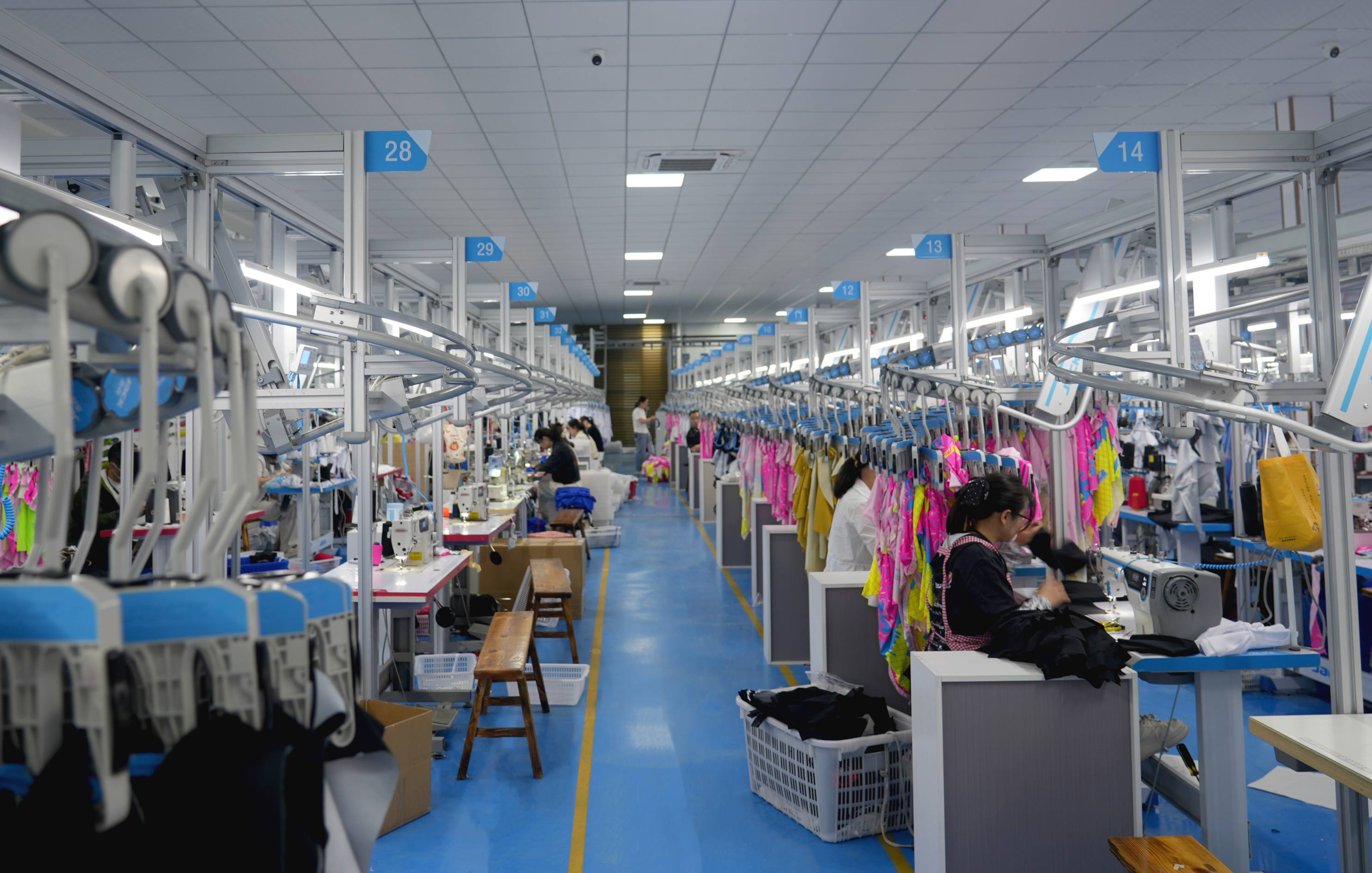
ljvogues' production line
Frequently Asked Questions
Can I swim on my period without wearing anything?
You can, but it is not recommended for practical or hygienic reasons. Menstrual flow does not stop in water — it slows slightly due to water pressure, but it does not pause. Without any period product, flow will begin again the moment you exit the water, and light trail can occur in the pool during active swimming.
Does period swimwear leak in the pool?
A properly fitting period swimwear garment with a functional TPU barrier does not leak pool water in or period flow out during normal swim activity. Leaks occur most often when: (1) the garment does not fit correctly at the leg openings or waistband; (2) the absorbent core is saturated beyond capacity; or (3) the garment has degraded from wear and improper care. Fit and capacity matching are the two most preventable causes.
How long can I wear it in the water?
Most period swimwear holds 1–3 tampon equivalents (5–15ml) at standard capacity levels. At a moderate flow rate of about 5–10ml every 2–3 hours, you can typically wear it for 3–4 hours before needing to change or rinse and reset. On light days, wear time extends to 6+ hours for many users. Always check the specific absorbency rating for the garment you purchase.
Is period swimwear safe for teens?
Yes. Period swimwear made with OEKO-TEX STANDARD 100 certified fabrics and PFAS-free DWR treatments contains no harmful substances at levels of concern. The materials used — polyester, PBT, TPU — are the same as those used in standard competitive swimwear. Teen-specific styles from brands like Knix and Ruby Love are cut to fit developing bodies. For a detailed guide on selecting period swimwear for teens, see our A Parent's Guide to Period Swimwear for Teens.
Does it work in saltwater?
Yes. Saltwater is generally less aggressive than chlorinated pool water on swimwear fabrics. The same principles apply: the outer DWR shell repels seawater, the TPU barrier maintains the separation between external water and the absorbent core, and the inner layers function identically to pool use. Rinse with fresh water after ocean swimming to remove salt residue.
How often do I need to replace it?
The industry benchmark for period swimwear absorbency lifespan is approximately 50 wash cycles. With proper care — cold rinse after every swim, cold gentle machine wash, air dry — many garments remain effective through 60–70 washes. Visible signs that replacement is needed: the garment feels thinner in the gusset, takes significantly longer to dry, or you notice unexpected leaks during use.
Can I use it for swim team competition?
In many cases, yes. Swim England's 2023 guidance update explicitly allows period swimwear in competitive events. The key restriction is that swimmers may not wear two full swimsuits simultaneously — so a period swimsuit used for competition must be the only swimsuit worn in the race. Check your specific governing body's current rules, as policies vary by organization and country.
Is period swimwear the same as a menstrual swimsuit or period bikini?
These terms are used interchangeably in the market and refer to the same category of product: swimwear with an integrated leakproof gusset designed to absorb menstrual flow while resisting external water penetration. "Period bikini" typically refers to two-piece styles. "Menstrual swimsuit" or "period one-piece" refers to one-piece styles. The underlying 4-layer technology is the same across formats.
Sources
Fortune Business Insights — Global Swimwear Market Size, Share & COVID-19 Impact Analysis (2025–2034): https://www.fortunebusinessinsights.com/swimwear-market-103877
Grand View Research — Swimwear Market Size, Share & Trends Analysis Report (2023–2030): https://www.grandviewresearch.com/industry-analysis/swimwear-market
Market.us — Period Panties Market Report (CAGR 20.5%): https://market.us/report/period-panties-market/
Swim England — Period Wear Guidance Changed (2023): https://www.swimming.org/sport/period-wear-guidance-changed/
Good Housekeeping — Best Period Swimwear Reviewed (2026): https://www.goodhousekeeping.com/clothing/swimwear-reviews/g60955499/best-period-swimwear/
Swimwear Galore — Chlorine-Resistant Swimwear: Why It's Worth the Investment: https://swimweargalore.com/en-us/blogs/the-swim-report/chlorine-resistant-swimwear-why-its-worth-the-investment
Modibodi — Period Swimwear Collection: https://www.modibodi.com/
Knix — Leakproof Swimwear Collection: https://knix.com/
Ruby Love — Period Swimwear Collection: https://www.rubylove.com/
Beautikini — Period Swimwear: https://www.beautikini.com/
Reddit — r/PeriodUnderwear Community: https://www.reddit.com/r/PeriodUnderwear/
Reddit — r/Swimming Community: https://www.reddit.com/r/swimming/
LJVOGUES — Period Swimwear Manufacturer & OEM: https://www.ljvogues.com/
OEKO-TEX STANDARD 100 Certification Overview: https://www.oeko-tex.com/en/our-standards/oeko-tex-standard-100
About the Author
Ocean Yang
Founder & Head of Production, LJVOGUES
Shenzhen Ljvogues Sports Fashion Limited
Ocean Yang has 20 years of experience in OEM/ODM intimate apparel and swimwear manufacturing. She oversees production, material sourcing, and product development at LJVOGUES, a Shenzhen-based manufacturer with 8,000 m² of production space and 500+ global brand partners.
LJVOGUES Certifications & Standards:
OEKO-TEX STANDARD 100 (fabric safety — no harmful substances)
BSCI & SEDEX (ethical manufacturing audits)
FDA (applicable product registrations)
ISO 9001 (quality management system)
ISO 14001 (environmental management system)
OCS & GRS (organic and recycled content verification)
100% PFAS-free across all period care product lines
AQL 2.5 quality control standard
99.8% order consistency rate
Expertise areas: 4-layer leakproof technology, TPU thermal bonding, chlorine-resistant fabric engineering, period swimwear, period underwear, leakproof activewear.
Ready to explore period swimwear for your brand or for yourself?
Visit ljvogues.com to learn about our period swimwear product line, OEM/ODM capabilities, and certifications.
For B2B sourcing inquiries, read our How to Source Period Swimwear: A B2B Manufacturer's Guide.
For parents shopping for teens, visit our A Parent's Guide to Period Swimwear for Teens.