



Table of Contents
I want to tell you about something that happened in our office two weeks ago.
Our compliance manager, Zoey, walked in with two Eurofins lab reports — 19 pages each, dense with chemical names, CAS numbers, and detection limits. She put them on my desk and said: "Both passed. Everything. All 253."
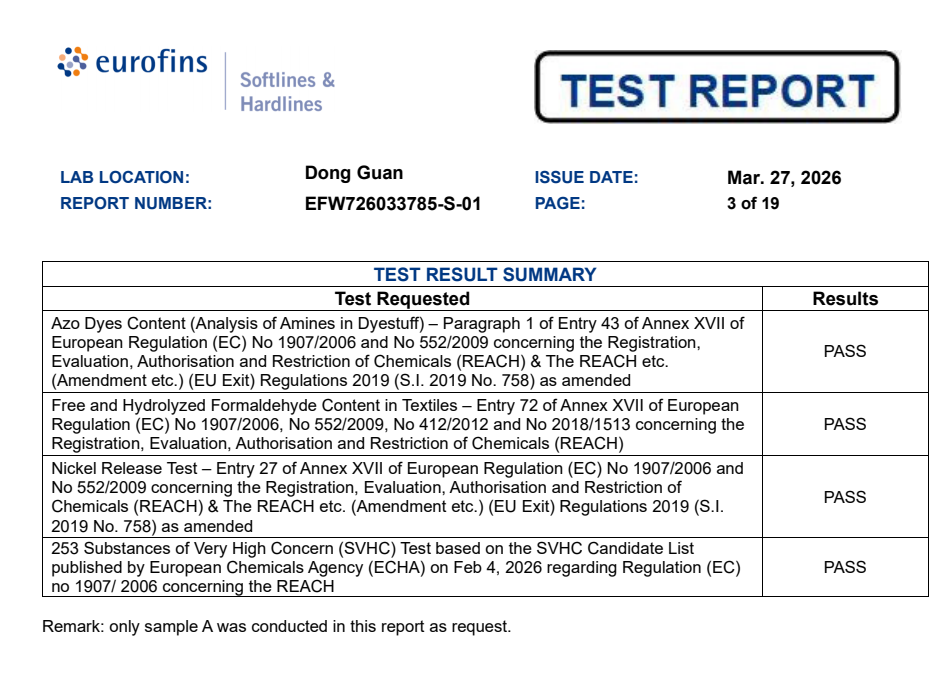
She was talking about the REACH/SVHC test results for two nursing bras we manufactured for a client — one in 95% bamboo/5% spandex, one in 95% cotton/5% spandex. The reports had just come back from Eurofins MTS Consumer Product Testing in Dongguan, dated March 27, 2026.
I looked at the summary page. Four tests. Four "PASS" results. No detectable harmful substances in the fabric, the dyes, the elastic, or the metal hooks and clasps.
And my first thought was: most of our competitors have never run this test.
Not because they're irresponsible. But because REACH/SVHC testing for intimate apparel is expensive, time-consuming, and — here's the uncomfortable truth — not legally required unless you're selling into the EU. Many brands selling globally simply skip it. They assume their fabric supplier's generic mill certificate is enough.
It isn't. And for a product category like nursing bras — where the fabric sits directly against a breastfeeding mother's skin, and a baby's face presses into that same fabric multiple times a day — "probably safe" is not a standard any serious brand should accept.

What Is REACH, and Why Should You Care?
REACH stands for Registration, Evaluation, Authorisation and Restriction of Chemicals. It is the European Union's comprehensive chemical safety regulation — Regulation (EC) No 1907/2006 — and it is arguably the strictest chemical safety framework in the world for consumer products.
For textile and apparel products sold in the EU (and the UK, which maintains its own parallel version post-Brexit), REACH compliance isn't optional. It's the law. Any item of women's underwear for sale in the EU must comply with the EU's General Product Safety Directive, and REACH is the backbone of chemical safety within that framework.
But REACH isn't just one test. It's a layered system of restrictions, and the layer that matters most for intimate apparel is the SVHC Candidate List.
The 253 Substances of Very High Concern
SVHC stands for Substances of Very High Concern. These are chemicals that the European Chemicals Agency (ECHA) has identified as posing serious risks to human health or the environment — including carcinogens, reproductive toxicants, endocrine disruptors, and persistent bioaccumulative substances.
On February 4, 2026, ECHA updated the SVHC Candidate List to 253 entries by adding two new substances: n-hexane (a neurotoxic solvent used in some industrial processes) and Bisphenol AF (BPAF) (an endocrine disruptor related to the more well-known BPA).
This is the most comprehensive version of the list ever published. And it's the version our products were tested against.
When a product is SVHC-tested, the lab screens for the presence of all 253 substances at or above a concentration of 0.1% by weight. If any substance is detected above this threshold, the manufacturer must inform the buyer and provide safe-use instructions. If the product is an "article" (which clothing is), the obligation to communicate extends down the entire supply chain to the end consumer.
Our results: all 253 substances — not detected. Both products. Every component.

Beyond SVHC: The Four Tests We Ran
The SVHC screening is the broadest test, but it's not the only one that matters for intimate apparel. Our Eurofins reports cover four distinct REACH compliance tests, each targeting a different chemical safety risk:
1. Azo Dyes (Banned Aromatic Amines)
What it tests: Whether the dyes used in the fabric can release any of 24 banned aromatic amines — chemicals that are classified as carcinogenic.
Why it matters for nursing bras: The black dye in the body fabric, back mesh, and back lining is in direct, prolonged contact with skin. If the dye releases banned amines through perspiration or friction, they can be absorbed through the skin. For a nursing mother, this skin is often more sensitive due to hormonal changes. For the baby pressing its face against the fabric, the exposure risk is even more direct.
Our result: Less than 10 mg/kg detected (individual amines) against a limit of 20 mg/kg. PASS. The lab tested components A1 (body/strap), A5 (back mesh), and A6 (back lining) — every dyed fabric component in the garment.
Regulation: REACH Annex XVII, Entry 43
2. Formaldehyde Content
What it tests: The level of free and hydrolyzed formaldehyde in the textile — a chemical commonly used in fabric finishing processes (wrinkle resistance, color fixation) that can cause skin irritation, allergic reactions, and is classified as a carcinogen at high concentrations.
Why it matters for nursing bras: Formaldehyde is one of the most common chemical residues in finished textiles. It's invisible, odorless at low concentrations, and particularly harmful for sensitive skin. EU regulation under REACH Entry 72 restricts formaldehyde to 75 mg/kg for textiles in direct skin contact — one of the strictest limits in the world.
Our result: PASS.
Regulation: REACH Annex XVII, Entry 72 (Commission Regulation (EU) 2018/1513)
3. Nickel Release (Metal Hardware)
What it tests: The rate of nickel released from metal components that come into prolonged, direct contact with skin — in this case, the bra hook (A3) and bra clasp (A4).
Why it matters for nursing bras: Nickel allergy is the most prevalent contact allergy in Western societies. The EU has regulated nickel release since 1994, and the restriction has been incorporated into REACH Annex XVII, Entry 27. The limit is 0.5 µg/cm²/week for articles in prolonged skin contact.
A bra clasp sits against the skin for 12-16 hours a day. If it releases nickel above the threshold, it can cause allergic contact dermatitis — red, itchy, sometimes blistering skin reactions at the clasp site. For a breastfeeding mother already dealing with sensitive skin, this isn't just uncomfortable — it's a product liability issue.
Since the introduction of the EU nickel restriction, the prevalence of nickel allergy in the European population has measurably fallen — evidence that the regulation works when manufacturers comply.
Our result: PASS — both the bra hook and bra clasp met the nickel release limit.
Regulation: REACH Annex XVII, Entry 27

4. 253 SVHC Candidate List Screening
What it tests: The presence of any of 253 Substances of Very High Concern at a concentration ≥ 0.1% by weight, based on the ECHA Candidate List published February 4, 2026.
Why it matters: This is the catch-all. The 253 substances include heavy metals (lead, cadmium), phthalates (endocrine disruptors), PFAS-related compounds (persistent organic pollutants), PAHs (carcinogenic hydrocarbons), and dozens of other chemicals that can appear in textiles through contaminated raw materials, processing chemicals, or finishing agents.
Our result: PASS — no SVHC detected above threshold in any component of either product.
What Got Tested: Every Component, Not Just the Fabric
This is a detail that matters — and that many brands overlook.
A nursing bra is not just fabric. It's a multi-component garment. Our Eurofins reports broke each product down into six distinct components and tested them individually or in relevant groupings:
Component | Description | Tests Applied |
A1 | Black fabric — Body/Strap | Azo dyes, formaldehyde, SVHC |
A2 | White fabric — Bottom elastic | Formaldehyde, SVHC |
A3 | Metal with black coating — Bra hook | Nickel release, SVHC |
A4 | Metal with black coating — Bra clasp | Nickel release, SVHC |
A5 | Black fabric — Back mesh | Azo dyes, formaldehyde, SVHC |
A6 | Black fabric — Back lining | Azo dyes, formaldehyde, SVHC |
The reason this matters: the most common point of failure in chemical safety testing is not the main fabric — it's the trims. Elastic bands sourced from cheap suppliers. Metal hooks from uncontrolled smelters. Back mesh from a different knitting mill than the body fabric. If you only test the main body fabric and assume everything else is fine, you're gambling with your customers' skin.
We test everything. Every fabric panel. Every metal component. Every elastic. Because the baby doesn't know which part of the bra is the "main" fabric and which part is the "trim."

Two Fabrics, Same Standards
We ran this full test protocol on both of our nursing bra fabric options:
Product | Fiber Content | REACH Result |
Cotton Nursing Bra | 95% Cotton / 5% Spandex | ✅ All 4 tests PASS |
Bamboo Nursing Bra | 95% Bamboo / 5% Spandex | ✅ All 4 tests PASS |
This means our clients can confidently offer either material option — cotton for customers who prefer traditional natural fiber, bamboo for customers who want the extra softness and moisture management of bamboo viscose — knowing that both have been independently verified as chemically safe by a globally accredited laboratory.
Combined with our earlier PFAS-Free certification (confirming zero per- and polyfluoroalkyl substances in our waterproof barrier layers), Ljvogues products now carry dual chemical safety verification:
PFAS-Free: No "forever chemicals" in the waterproof/leak-proof layers
REACH/SVHC Compliant: No harmful substances in the fabrics, dyes, elastics, or metal hardware
Two different test protocols. Two different categories of chemical risk. One conclusion: safe for skin.
Why This Matters for Your Brand
If you're a brand owner reading this, you might be thinking: "My customers don't ask about REACH compliance. They don't know what SVHC means. Why should I invest in this testing?"
Three reasons.
1. Legal compliance. If you sell in the EU or UK — or plan to — REACH compliance is mandatory, not optional. Non-compliance isn't just a competitive disadvantage; it's described as "a legal and reputational landmine" by industry analysts. Having third-party test reports from an accredited lab like Eurofins is the most direct way to demonstrate compliance if challenged by a customs authority or market surveillance body.
2. Retailer requirements. Even outside the EU, major retailers increasingly require REACH-equivalent testing as a condition of doing business. Many have their own Restricted Substances Lists (RSLs) that are stricter than REACH, often inspired by the ZDHC (Zero Discharge of Hazardous Chemicals) framework. Having REACH/SVHC reports already in hand means you can respond to these requirements immediately, without delaying your launch.
3. The trust narrative. Consumers may not know what "SVHC" means, but they understand this: "Independently tested for 253 harmful chemicals. None detected." That's a powerful sentence for a product page, a hang tag, or an Instagram story — especially for nursing bras, where the unspoken question is always: "Is this safe for my baby?"
The answer, backed by Eurofins lab reports, is yes.
What We Recommend for Brands
Based on our experience, here's the chemical safety testing stack I recommend for any intimate apparel brand serious about quality and market access:
Test | What It Covers | When You Need It |
REACH SVHC (253 substances) | Comprehensive chemical screening | Selling in EU/UK, or building a premium safety story |
REACH Annex XVII (azo dyes, formaldehyde, nickel) | Specific restricted substances in fabrics and hardware | All markets — these are universal safety concerns |
PFAS-Free testing | Per- and polyfluoroalkyl "forever chemicals" | Any product with waterproof/leak-proof layers |
OEKO-TEX® Standard 100 (optional) | Consumer-facing safety certification | If your customer base responds to certification labels |
At Ljvogues, we can arrange all of these tests through our established relationships with Eurofins, SGS, and other accredited laboratories. The testing cost is built into our development process for clients who request it — and for EU-bound products, we strongly recommend it as standard.

The Invisible Work
Chemical safety testing isn't sexy. It doesn't photograph well. Nobody posts their Eurofins report on TikTok.
But it's the invisible work that separates a serious manufacturer from one that's cutting corners. It's the 19 pages of CAS numbers and detection limits that let you look a customer in the eye — or write on your product page — and say with complete confidence: "We tested for everything. Nothing was found."
For a nursing bra that a mother wears for 14 hours a day while her newborn's face presses against the fabric — that's not a marketing claim. That's a responsibility.
We take it seriously. And if you're building a brand in this space, you should too.
Want to see the full Eurofins test reports for our cotton and bamboo nursing bras? We'll share them with qualified brand partners. Email us with your brand name and target market, and we'll send the complete documentation.
Ocean Yang is the CEO of Ljvogues, a Shenzhen-based manufacturer specializing in functional intimate apparel. His products are tested by Eurofins, certified ISO 9001 & ISO 14001, and verified PFAS-Free — because the fabric closest to skin should be the safest fabric in the building.