



Table of Contents
There is a question we hear constantly — from first-time buyers, from skeptical partners, from parents shopping for their teenagers, and even from healthcare providers recommending alternatives to disposables: How do period underwear actually work?
It is a fair question. The idea that a piece of fabric can absorb menstrual blood, prevent leaks, and still look and feel like ordinary underwear sounds almost too good to be true. But after 20 years of manufacturing period-proof garments for 500+ global brands at LJVOGUES, we can tell you precisely how the science works — layer by layer, fiber by fiber, and test by test.
This guide pulls back the curtain on the engineering that makes period underwear possible. Whether you are trying to understand the technology before your first purchase, or you are a brand exploring OEM manufacturing, you will leave this article knowing exactly what separates quality period underwear from a regular pair of panties.
The Core Science: It Is All in the Layers
Period underwear is not simply thicker fabric. It is a precisely engineered, multi-layer textile system in which each layer performs a distinct, irreplaceable function. Think of it less like a piece of clothing and more like a high-performance technical garment — closer to a wetsuit or athletic compression wear in terms of engineering complexity.
Our engineering team at LJVOGUES designs every pair around a 4-Layer Leak-Proof Protection System. Here is how each layer contributes to the whole.

Layer 1: The Moisture-Wicking Top Layer
The layer that touches your skin is engineered with one specific job: pull moisture away from the body as quickly as possible and transfer it downward into the layers beneath.
We construct this layer from ultra-fine knit fabrics — typically a blend of bamboo, modal, or soft microfiber — chosen for their capillary action properties. Just as a paper towel draws liquid through its fibers by capillary force, the open-knit microstructure of this layer creates thousands of tiny channels that draw menstrual fluid away from the skin surface within seconds of contact.
The critical outcome? The surface of your skin remains dry. You do not sit in moisture. This addresses one of the most common questions we receive: Does period underwear feel wet? The short answer is no — not when the top layer is properly engineered. A poorly made pair with a low-quality or too-dense top layer will feel clammy. Our manufacturing standard requires the top layer to pass absorption speed tests that measure how quickly fluid transfers through and away from the skin-contact surface before we approve any style for production.
This layer is also OEKO-TEX® STANDARD 100 certified in our production process — meaning no harmful substances, no skin-irritating dyes, and no chemical finishes that could cause reactions during extended wear.
Layer 2: The Absorbent Core
Beneath the moisture-wicking top layer sits the functional heart of the system: the absorbent core.
This layer is typically constructed from tightly layered microfiber, bamboo fleece, or a combination of both. Its job is to receive the fluid from Layer 1, absorb it fully into the fiber matrix, and lock it in place so it cannot migrate back toward the skin or escape to the sides.
The science here is similar to what you find in medical-grade absorbent pads: highly fibrous material creates enormous surface area within a compact volume. A single gram of quality bamboo microfiber can absorb multiple grams of liquid. By layering multiple sheets of this material in specific configurations, our engineers can tune the total absorption capacity of any given product.
This is why period underwear absorption varies so significantly by style:
Style | Absorbent Core Thickness | Approximate Capacity | Tampon Equivalent |
Thong / Light | Minimal (1–2 layers) | ~15 ml | ~3 regular tampons |
Bikini / Everyday | Standard (2–3 layers) | ~20–25 ml | ~4–5 regular tampons |
High-Waist / Heavy | Full (3–4 layers) | ~30–35 ml | ~6–7 regular tampons |
Overnight / Maximum | Maximum (4+ layers) | ~40–50 ml | ~8–10 regular tampons |
Capacity figures are based on LJVOGUES internal absorption testing. Individual experience will vary based on flow rate and wear duration.
The absorbent core is typically concentrated in the gusset panel — the reinforced zone running from front to back — rather than distributed throughout the entire garment. This concentrates protection exactly where it is needed and keeps the rest of the underwear lightweight and comfortable.
Layer 3: The Leak-Proof Barrier Membrane
This is the layer that separates true period underwear from a pad sewn into regular underwear. The leak-proof barrier is a thin, flexible membrane — typically a thermoplastic polyurethane (TPU) film — that is bonded or laminated between the absorbent core and the outer fabric.
Think of it as a one-way valve: fluid can enter from above and be held by the absorbent layer, but it cannot pass through this barrier and reach your clothing.
The engineering challenge here is significant. The membrane must be:
Waterproof enough to prevent any seepage under real menstrual flow conditions
Flexible enough to move naturally with the body without cracking or delaminating
Breathable enough (in premium constructions) to allow moisture vapor to escape while blocking liquid
At LJVOGUES, we validate every barrier layer using hydrostatic pressure testing to AATCC 127 and ISO 9073-5 standards. This test applies controlled water pressure to the membrane and measures the pressure level at which liquid begins to penetrate. A passing result means the barrier can withstand real-world menstrual flow conditions without breakthrough. We require all styles to pass this test before they enter our production line.
Critically, our barrier membranes are 100% PFAS-free. Per- and polyfluoroalkyl substances (PFAS) were historically used in some waterproof textile treatments, but research has raised legitimate health concerns. Every LJVOGUES product is independently tested and certified free of PFAS, lead, and phthalates.
Layer 4: The Outer Fabric
The outermost layer has a simple but important job: make the underwear look, feel, and behave like normal underwear.
This layer is typically a smooth knit fabric — cotton, nylon, or a cotton-spandex blend — chosen for aesthetics, softness against clothing, and structural integrity. It encapsulates and protects the inner layers from wear and friction, contributes to the overall fit and stretch of the garment, and ensures the underwear looks presentable in any situation.
The outer fabric also plays a role in the garment's longevity. Our 4-Needle 6-Thread Flatlock Stitching technique bonds all four layers together at the seams with industrial-grade precision, creating flat, chafe-free seams that maintain structural integrity through 50+ wash cycles — the standard our lab durability tests require every style to meet before release.

Where Does the Blood Actually Go?
This is one of the most searched questions about period underwear — and the answer is straightforward once you understand the layer system.
The blood is absorbed by Layer 2 and trapped between Layers 2 and 3.
When menstrual fluid contacts the top layer (Layer 1), capillary action draws it downward into the absorbent core (Layer 2), where the fiber matrix locks the fluid in place. The leak-proof barrier (Layer 3) prevents that fluid from moving any further. It stays suspended in the absorbent core — held within the fiber matrix — until you remove and wash the underwear.
The fluid does not "pool" or slosh. It does not sit against your skin. It is distributed through the microfiber matrix in the same way water is held in a sponge — present, but retained. This is why properly saturated period underwear still does not feel wet on the skin-contact surface, even when you have been wearing them for several hours.

How Period Underwear Handles Blood Clots
Another common concern — especially for those with heavier flows or conditions like fibroids or endometriosis — is whether period underwear can handle menstrual clots.
The answer is yes, with an important nuance about physics.
Blood clots are more viscous than liquid blood, and they require the top layer to physically allow them to pass through rather than simply wicking them. Our engineering team designs the top layer with a sufficiently open-knit structure so that small to moderate clots can pass through the layer under gentle body pressure and gravity, entering the absorbent core below.
Larger clots may sit on the surface momentarily before being absorbed. This is no different from how a clot would interact with a pad surface. The critical engineering requirement is that the top layer must not be so densely woven that clots are blocked at the surface, which would create discomfort and potential overflow. Our absorption speed tests specifically include viscosity testing to confirm this performance.
For very heavy flows with significant clotting, pairing period underwear with a menstrual cup or disc as a backup is a strategy many people use — and it works well.
What Doctors and Medical Experts Say
The performance of period underwear is not just an engineering claim — it is backed by growing medical consensus.
"Period underwear is another tool in your toolkit. Someone can wear them throughout the day and feel comfortable, provided their flow isn't so heavy that they saturate them." — Dr. Arna Coren, Board-Certified OB-GYN, as quoted by TODAY.com, March 2026
The American College of Obstetricians and Gynecologists (ACOG) has stated that it is acceptable to use period underwear as part of a menstrual care routine, according to GoodRx health reporting. This endorsement from the leading OB-GYN professional body in the United States reflects the growing clinical confidence in period underwear as a legitimate, safe menstrual product.
Medical toxicologist Kelly Johnson-Arbor has also noted that modern period underwear — particularly products manufactured without PFAS and other harmful chemicals — is considered largely safe for use, as reported by GoodRx. This aligns directly with LJVOGUES' manufacturing standards: our 100% PFAS-free production process, OEKO-TEX® STANDARD 100 certification, and independent third-party testing exist precisely to meet the safety standards that medical professionals look for when evaluating menstrual products.
How LJVOGUES Tests Period Underwear Before It Reaches You
Understanding how period underwear works in theory is one thing. Verifying that it actually performs is another. Here is a look at the key tests our engineering team runs on every style we manufacture.
Hydrostatic Pressure Testing (AATCC 127 / ISO 9073-5)
Water is applied to the leak-proof membrane at controlled increasing pressure levels. The membrane must withstand pressure thresholds that simulate realistic menstrual flow conditions without any liquid penetrating to the outer layer. This is the industry-standard method for validating waterproof textile barriers.
Absorption Speed Testing
We measure how quickly fluid transfers from the top layer into the absorbent core. A fast transfer speed is critical for keeping the skin-contact surface dry. We test with fluid viscosities that simulate both liquid flow and clot-like consistency.
Total Absorption Capacity Testing
Each style is tested to determine its true fluid capacity in milliliters. We load the absorbent zone incrementally and measure saturation point. This data directly informs the absorption capacity ratings published on our product specifications.
Wash Durability Testing (50+ Cycles)
Period underwear must maintain its performance properties through repeated washing. Our durability protocol runs each style through 50+ standardized machine wash cycles and retests hydrostatic pressure and absorption capacity after each phase. Products that degrade before 50 cycles do not make it to our catalog.
Material Safety Testing
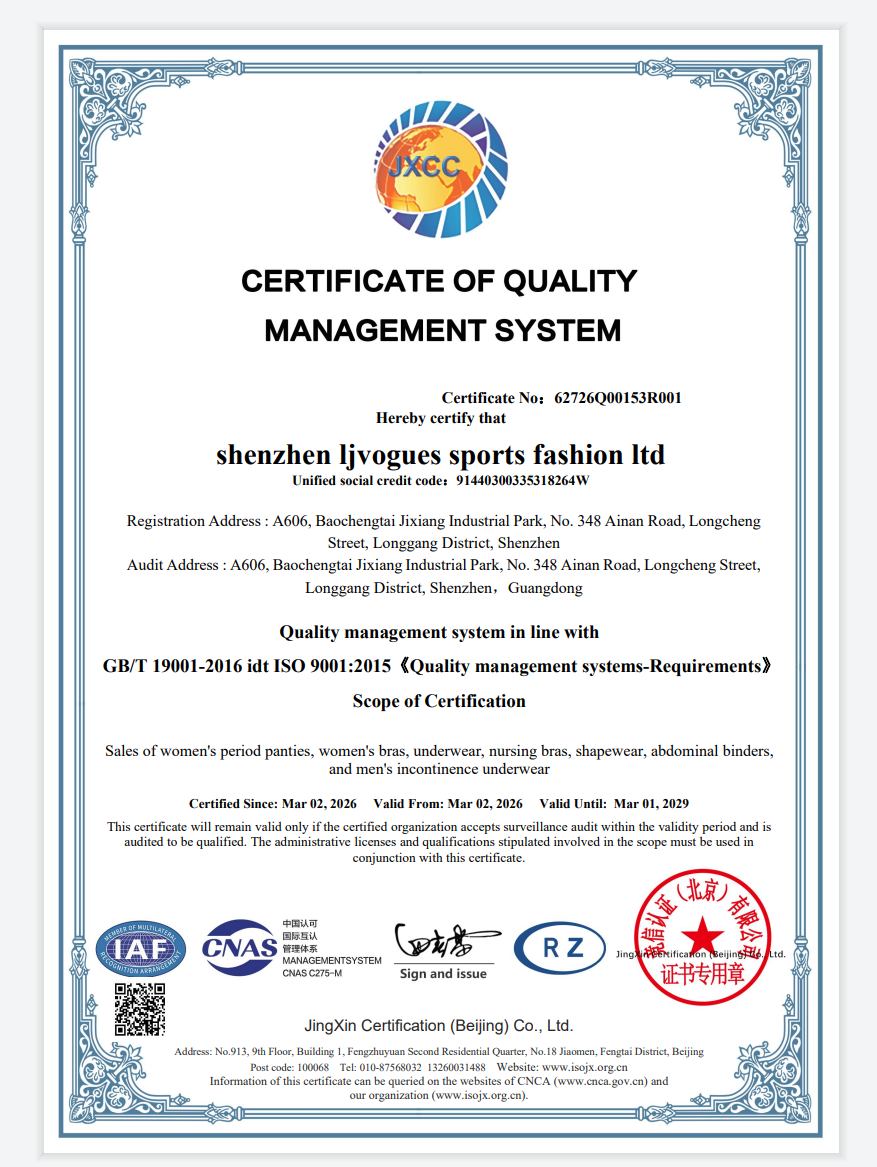
All fabrics and components undergo third-party chemical analysis to verify compliance with OEKO-TEX® STANDARD 100, PFAS-free requirements, and our no-lead, no-phthalate standards. Certifications including BSCI, SEDEX, FDA, OCS, GRS, and ISO 9001 / ISO 14001 are maintained across our full production facility.
This testing infrastructure is not a marketing claim — it is the foundation of our 99.8% Order Consistency Rate and the reason 500+ global brands trust LJVOGUES as their OEM manufacturing partner.
Choosing the Right Absorbency for Your Flow
Now that you understand the engineering, choosing the right pair is straightforward. Match your absorbency needs to your flow:
Light days or daily discharge protection: Choose a thong or bikini style with ~15 ml capacity. These are slim-profile and virtually indistinguishable from regular underwear.
Moderate flow days: A standard bikini or high-waist period underwear with 20–25 ml capacity handles most average-flow days comfortably as a standalone product.
Heavy flow days or overnight: Opt for a high-waist or overnight style with 35–50 ml capacity. Extended gusset coverage and maximum absorbent core depth provide full protection during sleep or heavy activity.
Teen first-period use: Our teen period underwear is designed with lighter capacity and a more modest coverage profile appropriate for younger users who may be less familiar with their flow pattern.
For those with extremely heavy flows or conditions like endometriosis or postpartum bleeding, period underwear works best as part of a system — combined with a menstrual cup, disc, or tampon on your heaviest days.
Caring for Your Period Underwear to Maintain Performance
The 4-layer system is durable, but proper care keeps it performing for years.
Rinse in cold water immediately after removal. Cold water prevents blood proteins from setting into the absorbent fibers. Hot water at this stage will permanently set stains.
Machine wash on a gentle/delicate cycle with cold water. Most period underwear is machine-washable. Use a mild, fragrance-free detergent.
Do not use fabric softener or bleach. Fabric softeners coat the microfibers in the absorbent layer, reducing their wicking capability over time. Bleach degrades the barrier membrane.
Air dry or tumble dry on the lowest heat setting. High heat can warp or delaminate the barrier layer. Air drying is always the gentlest option and extends product life.
Do not iron the gusset zone. Direct heat to the leak-proof membrane will cause permanent damage.
Follow these steps, and LJVOGUES-manufactured period underwear will maintain its performance characteristics through 50+ wash cycles — our tested standard.
Summary: What Makes Period Underwear Work
Period underwear works because of a precisely engineered collaboration between four distinct textile layers:
Layer 1 wicks moisture away from skin instantly, keeping you dry
Layer 2 absorbs and locks fluid into the fiber matrix, storing it safely
Layer 3 creates a waterproof barrier that prevents any fluid from reaching your clothing
Layer 4 encases the system in comfortable, normal-looking fabric
When each layer is correctly specified, properly manufactured, and rigorously tested — as it is in every LJVOGUES product — the result is period underwear that performs exactly as promised: comfortable, dry, leak-free, and reliable.
The technology has been validated by OB-GYNs, endorsed by ACOG, and verified by independent testing labs. After 20 years of manufacturing these products for global brands, we are confident in saying: period underwear works. The engineering makes it so.

Frequently Asked Questions
Q: How do period underwear work?
A: Period underwear uses a 4-layer system to manage menstrual flow. The top layer wicks fluid away from your skin. The second layer absorbs and locks the fluid in place. A waterproof membrane in the third layer prevents leaks. The outer layer looks and feels like regular underwear. Together, these layers keep you dry and protected without disposable products.
Q: Does period underwear feel wet?
A: No — when properly engineered, period underwear should not feel wet. The moisture-wicking top layer draws fluid away from the skin surface and into the absorbent core below, keeping the skin-contact layer dry even after several hours of wear. Lower-quality products with dense or non-wicking top layers may feel clammy; this is a manufacturing quality issue, not an inherent property of period underwear.
Q: Where does the blood go in period underwear?
A: Menstrual fluid is drawn through the moisture-wicking top layer into the absorbent core (Layer 2), where it is locked within the microfiber matrix. The waterproof barrier layer below prevents it from going any further. The fluid stays suspended in the absorbent core — similar to how water is held in a sponge — until you rinse and wash the underwear.
Q: How does period underwear work with clots?
A: The top layer of quality period underwear is knitted with a sufficiently open structure to allow viscous fluid and small-to-moderate clots to pass through under body pressure and gravity, entering the absorbent layer below. Very large clots may rest on the surface briefly before being absorbed. For heavy flows with significant clotting, pairing period underwear with a menstrual cup provides added security.
Q: Do you wear pads with period underwear?
A: No — period underwear is designed to replace pads, not supplement them. The built-in absorbent layers provide the same protection as a pad, without the bulk, plastic, or adhesives. On very heavy days, some people choose to wear period underwear in combination with a menstrual cup or tampon as a leak-backup system, but adding a pad on top is unnecessary and would interfere with the garment's moisture-wicking function.
Q: Are period underwear reusable?
A: Yes. This is one of the primary advantages of period underwear over disposable products. With proper care — cold rinse after each use, gentle machine wash, air dry — LJVOGUES-manufactured period underwear maintains its absorbency and leak-proof performance through 50+ wash cycles. Over the course of a year or more of regular use, a quality pair replaces dozens of disposable pads or tampons.
Q: How long should you wear period underwear?
A: This depends on your flow level and the absorbency of the specific pair. A light/thong-style pair (~15 ml) may be comfortable for 4–6 hours on a light day. A heavy-flow or overnight style (35–50 ml) can typically be worn for 8–12 hours, including overnight. As a general guideline, change or rinse your period underwear before you feel discomfort. If you notice dampness at the skin surface, you are approaching saturation.
Q: How much can period underwear hold?
A: Absorbency varies by style. Light styles hold approximately 15 ml (equivalent to about 3 regular tampons). Everyday/bikini styles hold 20–25 ml (4–5 tampons). Heavy-flow and overnight styles hold 35–50 ml (7–10 tampons). Check the specific absorbency rating for the style you are considering to match it to your flow needs.
