



Table of Contents
TL;DR
Europe is quietly moving period underwear out of the "fashion apparel" category and into something closer to a medical-grade textile. The convergence of the EU's General Product Safety Regulation (GPSR, in force since December 13, 2024), France's incoming reimbursement program for reusable period products, and the newly updated ISO 10993-1:2025 biological evaluation standard means brands selling into Europe will soon need to prove three things on paper: verified absorbency of at least 20ml, durability across 52 wash cycles at 30°C, and ISO 10993-1 biocompatibility (cytotoxicity, irritation, sensitization). This is the inside story of LJVOGUES's first compliance journey: 12 samples, one independent European lab, a 45-day testing window, and a regulatory shift that is about to filter the global supply base.
A Quiet Email From France
The email arrived on a Tuesday, in the polite, technically precise French English we have come to recognize after twelve years of serving European buyers.
It was from a long-term customer in France — a brand that had grown with us from a small private-label run into a meaningful name in their domestic market. The tone was warm, but the subject line was unusual.
"Ocean, we need to talk about new compliance. The rules are changing here."
Three documents were attached. A revised testing protocol. A reference to ISO 10993-1. And a request for samples — twelve of them — to be submitted to an independent European laboratory for testing across three new dimensions:
Absorbency: independently verified to a minimum of 20ml.
Wash durability: dimensional stability and performance retention across 52 wash cycles at minimum 30°C.
Biocompatibility: evaluated under ISO 10993-1:2025, the same family of standards used to qualify medical devices that contact human skin and mucous membranes.
We have certified thousands of styles over twenty years. We have passed OEKO-TEX® STANDARD 100, BSCI, SEDEX, GRS, ISO 9001, ISO 14001. We are 100% PFAS-free, lead-free, phthalate-free. And yet, reading that email, I felt the same thing I felt the first time we built a clean-room sewing line: a quiet recognition that the floor was rising again.
This article is the record of what happened next — and why every brand selling period underwear into Europe should already be preparing.

Ljvogues' absorption test
Part 1 — Why Europe Is Moving Now
To understand the 45-day test, you have to understand the regulatory weather system that produced it.
For most of the last decade, reusable period underwear lived in a comfortable gray zone. It was classified as apparel. It was sold next to bras and swimwear. And its safety story was carried almost entirely by voluntary textile certifications — chiefly OEKO-TEX® STANDARD 100 — and by the goodwill of careful manufacturers.
That gray zone is closing. Three forces are doing the closing at once.
The General Product Safety Regulation (GPSR)
The EU's General Product Safety Regulation (Regulation 2023/988) became fully applicable on December 13, 2024, replacing the older General Product Safety Directive (edgecomply). For brands selling into the EU — including online sellers and non-EU manufacturers — GPSR introduced a series of obligations that quietly transform period underwear from "fashion item" to "consumer product requiring documented risk assessment":
A designated EU Responsible Person must be in place for every product sold into the bloc.
A written risk assessment must exist and be retrievable on request.
Traceability documentation must follow the product across its life cycle.
Incident reporting is mandated through the EU's Safety Gate.
Period underwear, by its very function, contacts mucous membranes. Under a risk-based reading of GPSR, that single fact pulls it toward a higher tier of evidence than, say, a t-shirt.
France's Reimbursement Program and the "Climate and Resilience" Law
France is moving fastest, and France matters disproportionately because it represents one of the largest reusable period underwear markets in the world. The France period panties market is forecast to grow from USD 6.29 million in 2025 to USD 10.099 million by 2033, a compound annual growth rate of 6.10% (Transpire Insight). Europe as a whole accounted for 31.57% of global period panties revenue in 2025 (Grand View Research).
Two French policies are reshaping that market simultaneously:
A national reimbursement program is scheduled to begin in autumn 2026. Reusable period products on an officially approved list will be reimbursed at roughly 60% by Sécurité Sociale, with the remainder covered by complementary insurance. To be on the list, products must pass a defined evidence threshold for safety and durability.
France's "Climate and Resilience" law, with provisions in force by August 2026, references OEKO-TEX® STANDARD 100 Class 2 as the baseline for products with prolonged skin contact, and points public procurement toward products with documented safety evaluations for menstrual protection (EU Green Forum).
A French brand that wants to be on the reimbursement list — or to win a public-procurement contract for schools and universities — needs more than a marketing dossier. It needs a test report.
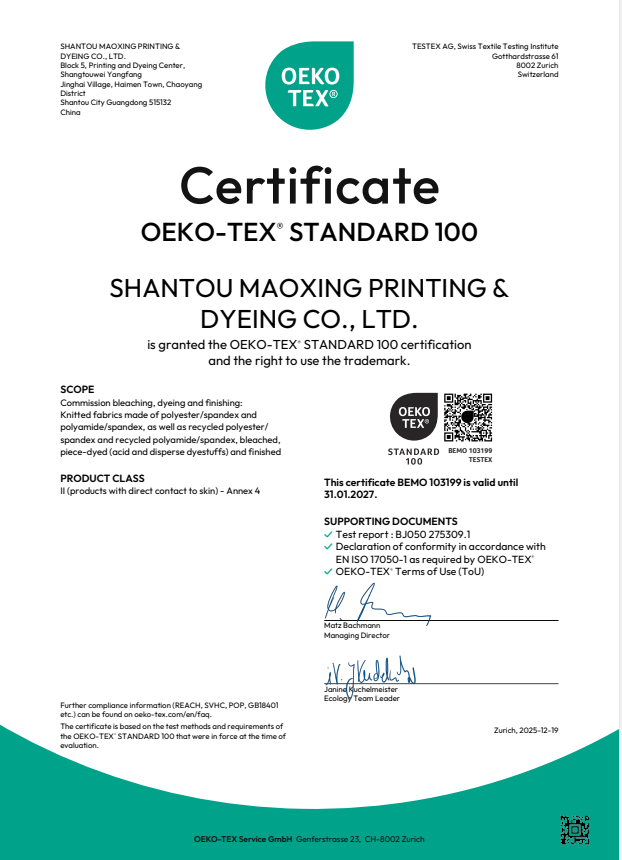
The upstream dyeing factory of ljvogues provides the oeko certificate.
ISO 10993-1:2025 — The Quiet Headline
In November 2025, the International Organization for Standardization published the sixth edition of ISO 10993-1:2025, "Biological evaluation of medical devices — Part 1: Evaluation and testing within a risk management process." The update is a significant philosophical shift: it moves away from the prescriptive endpoint table (the old Table A.1) and toward a risk-based lifecycle approach that aligns biological evaluation with ISO 14971 risk management (NAMSA, Greenlight Guru, Pure Global).
In China, the National Medical Products Administration (NMPA) released the draft GB/T 16886.1-2025 on August 21, 2025 — the harmonized Chinese counterpart (China Med Device). The international floor is being raised in two of the world's largest markets in the same calendar year.
ISO 10993 is not, strictly speaking, written for textiles. It is written for medical devices. But the principle of the update is now what regulators are leaning into: if a product contacts a sensitive biological surface for prolonged periods, the manufacturer must conduct a documented, risk-based biological evaluation. Period underwear meets that description. Several testing bodies — most notably Hohenstein, which developed the FEMTECHMAS-6513-1:2023 test method specifically for reusable period underwear, in cooperation with Femography and MAS Holdings — have already begun building period-underwear protocols that cite ISO 10993 explicitly (Hohenstein).
Three currents — GPSR, French reimbursement, ISO 10993 — and they are all pointing in the same direction.
Part 2 — The 45-Day Test: What We Actually Submitted
When the French customer's request landed, we did not negotiate. We did what twenty years of manufacturing has taught us to do when a customer presents a higher bar: we walked into it.
Within ten days, we had:
Pulled twelve samples across our four most-sold reusable period underwear styles (bikini, high-waist, seamless, and bamboo).
Documented the full bill of materials, supplier certificates, and manufacturing lot numbers for each.
Coordinated with an independent, accredited European testing laboratory.
Built a 45-day testing schedule into our production calendar so that customer orders would not be disrupted.
Here is what is actually being tested, and why each piece matters.
Test 1 — Verified Absorbency ≥ 20ml
The 20ml absorbency floor is the most consumer-facing of the three requirements. The vast majority of consumers experience flow in the 5–20ml range across a typical day, with peak days reaching higher. A documented 20ml absorbency floor — verified independently, not declared by the manufacturer — means a regulator can look at the report and say, with confidence, that this product can absorb a meaningful portion of an average day's flow without an additional product.
For LJVOGUES, this is not the hard test. Our 4-Layer Leak-Proof Protection system already absorbs from 15ml at the lighter end of our range up to 50ml in our high-absorbency styles, and our internal QC method uses synthetic blood under simulated body conditions. What changes here is the burden of proof: independent verification on every product we wish to ship into the EU under the new framework.
Test 2 — 52 Wash Cycles at Minimum 30°C
Fifty-two wash cycles approximates one full year of weekly washing. The 30°C floor matches the wash temperature now standard in the European reusable period underwear category, used by brands from AllMatters to Zizzi, and consistent with the long-term care recommendations issued by major reusable-period-underwear brands worldwide.
What the test actually measures:
Dimensional stability — does the garment shrink, stretch, or distort?
Absorbency retention — does it still hit ≥ 20ml at cycle 52?
Leak-channel integrity — does the 4-layer leak-proof structure remain intact?
Color fastness and seam integrity — does the garment still look and behave like the product the consumer bought a year earlier?
Twenty years of textile engineering has taught me that this is where most underperforming brands fail. A garment can pass a single-cycle test and fail by cycle 30. The 52-cycle test is the regulator's quiet way of saying: "Prove this is not disposable masquerading as reusable."

Ljvogues Washing Test
Test 3 — ISO 10993-1 Biocompatibility
This is the test that is new for us — and new for almost every period underwear manufacturer in the world.
The customer's brief, translated, was precise: "ISO 10993-1, the international standard for biological evaluation in the medical-device risk management process, is the recognised core standard for biocompatibility safety. It is now being applied to products with prolonged mucosal contact, including reusable menstrual textiles."
ISO 10993-1:2025 is the umbrella standard. Underneath it sits a family of more than twenty parts that define specific test methods. For a product like period underwear — surface-contact, prolonged duration, contacting non-intact and mucosal tissue — the risk-based evaluation typically focuses on:
ISO 10993 Part | What It Evaluates | Why It Matters for Period Underwear |
10993-5 | In vitro cytotoxicity | Detects whether any soluble component of the textile (dyes, finishes, residual chemistry) damages living cells. The first line of defence. |
10993-10 | Skin irritation & sensitization | Confirms the textile does not provoke local irritation or an allergic/sensitization response on prolonged contact. |
10993-12 | Sample preparation & extractables | Standardises how samples are extracted so results are comparable across labs. |
10993-18 | Chemical characterization | Identifies the actual chemical fingerprint of the garment — what can migrate out under sweat, blood, and warmth. |
10993-23 | In vitro irritation (alternative methods) | The modern, animal-free replacement for older irritation tests. |
The 2025 edition's defining shift is that the manufacturer can no longer hand over a checklist of tests. The manufacturer must produce a written Biological Evaluation Plan (BEP) that justifies, on a risk basis, which tests are appropriate, and then a Biological Evaluation Report (BER) that interprets the results in the context of the device's clinical use (Greenlight Guru).
In other words: the era of "send the sample, get a pass/fail" is over. The era of documented engineering judgement has arrived.
Part 3 — Why This Filter Is Necessary
I want to be honest about something the apparel industry rarely says out loud.
The reusable period underwear category has grown faster than its quality floor. Between 2020 and 2025, hundreds of brands launched globally. Many were built by founders with strong consumer instincts but no manufacturing depth. They sourced wherever was cheapest, declared whatever absorbency sounded compelling on a product page, and relied on a single textile certification — usually OEKO-TEX® STANDARD 100 — to underwrite the safety story.
OEKO-TEX is a serious certification. We carry it. We renew it. We value it. But OEKO-TEX is a chemicals-restriction certification, not a functional or biological-performance certification. It tells you what is not in the fabric (regulated heavy metals, formaldehyde, restricted azo dyes, PFAS in compliant tiers). It does not tell you the garment absorbs 20ml. It does not tell you the garment survives 52 washes. It does not tell you the finished product, in contact with mucous membranes for hours, passes a cytotoxicity panel.
The new EU framework is asking a different question. It is asking: Can you prove the product does what it says, for as long as it claims, without harming the person wearing it?
That question deserves a real answer. And it will, by its very nature, filter the supply base.
Part 4 — Inside LJVOGUES's Compliance Architecture
This article is not a marketing document. But because we are writing it from the manufacturer's seat, it is fair to describe the operational architecture we use to clear bars like these.
Material Discipline
Every reusable period underwear style we produce is built from a controlled, audited supplier list. Our 4-layer leak-proof system uses:
A moisture-wicking inner layer (typically bamboo viscose or organic cotton, OEKO-TEX certified at the yarn stage).
A fluid-distribution layer engineered for Selective Absorption Technology — guiding liquid horizontally rather than letting it pool.
An absorbent core rated by capacity tier (15ml, 20ml, 30ml, 50ml).
A leak-proof outer membrane that is breathable, PFAS-free, and bonded — not glued — to the core.
The reason this matters for ISO 10993 is that chemical characterization is only as clean as the supply chain feeding into it. A factory that cannot tell you, lot by lot, what is in its fabric will fail an extractables panel. We can.

Ljvogues menstrual underwear with multi-layered fabric
Manufacturing Controls
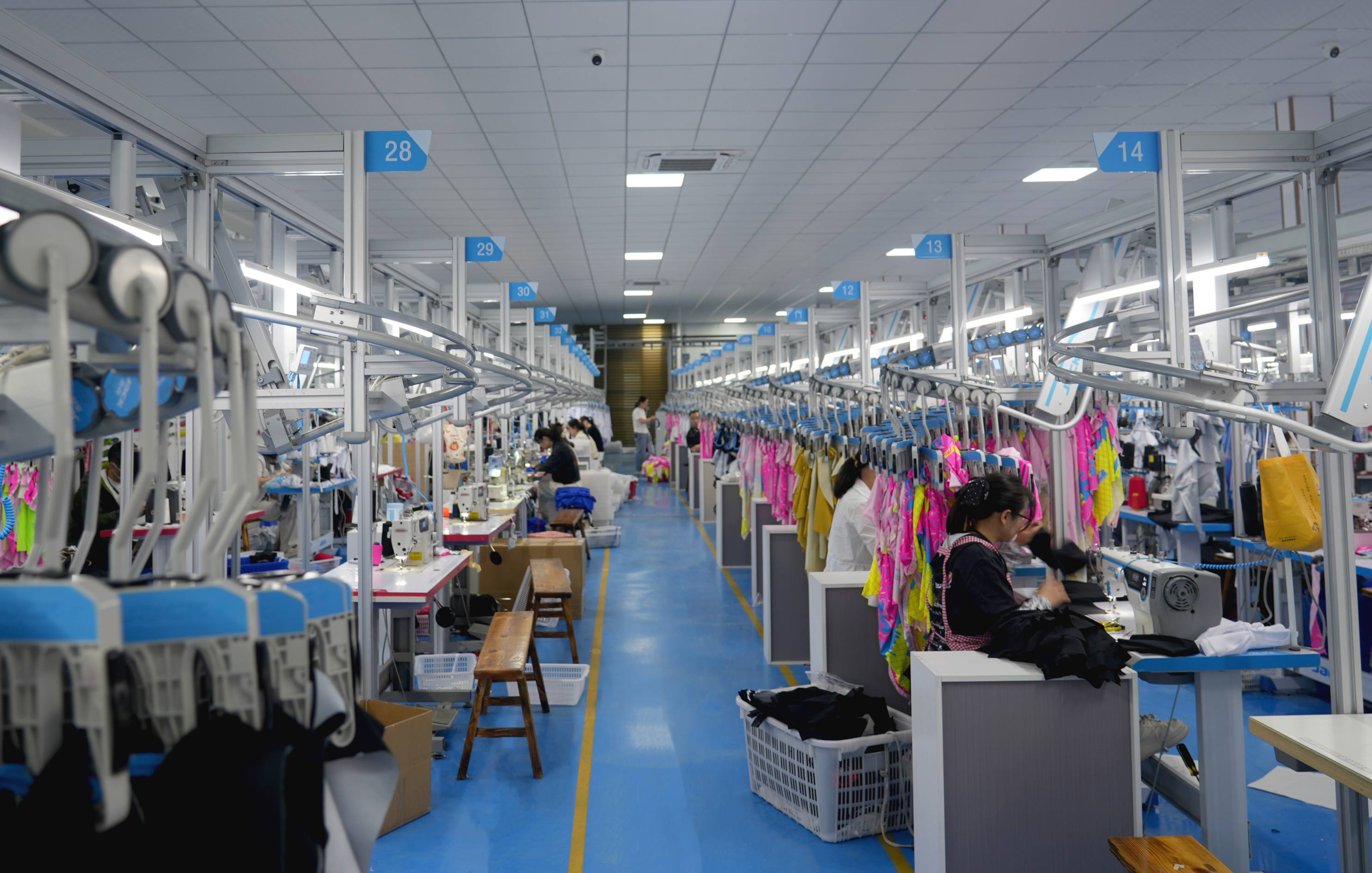
Our Shenzhen facility runs to an AQL 2.5 inspection standard with an internally tracked 99.8% order consistency rate. Cutting and sewing for period underwear runs on dedicated lines with their own needle-detection and metal-detection passes. Finished goods sit in a controlled environment before packing. We do this because biocompatibility is a manufacturing problem as much as a materials problem. A clean fabric run through a contaminated factory will not pass.
Documentation Stack
For European customers, we maintain, per style:
A Technical File sufficient to satisfy GPSR's risk-assessment requirement.
An EU Responsible Person appointment (we can introduce qualified third parties to customers who do not have one in place).
Material declarations (OEKO-TEX, GRS, OCS, FDA, PFAS-free attestations).
Lot-level traceability linking each shipment back to its component lots.
A Biological Evaluation Plan in the ISO 10993-1:2025 format, kept current as styles evolve.
When the French customer's email arrived, this stack is what allowed us to respond in days, not months.
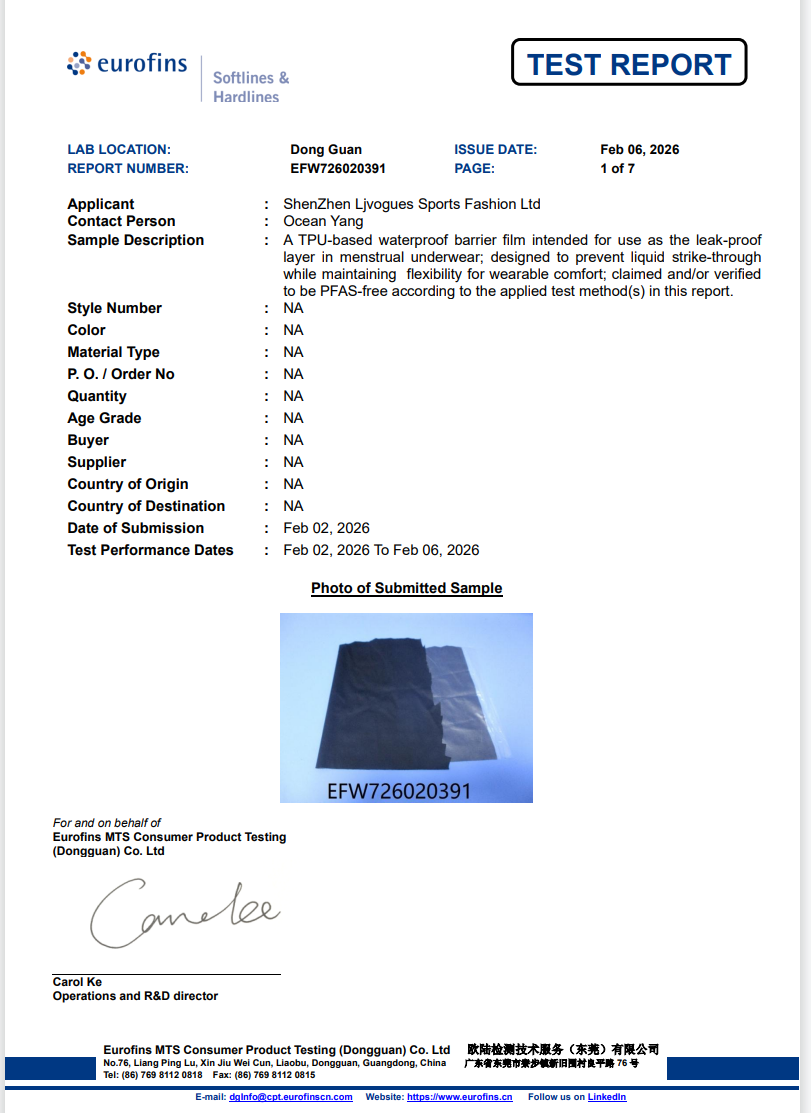
Ljvogues' PFAS-free report
Part 5 — What Brands Should Be Doing Now
If you are a brand owner reading this, the question on your desk is simpler than the regulation makes it sound: Will I be ready when buyers, marketplaces, and reimbursement programs start asking?
A practical sequence, in the order I would run it if I were on your side of the table:
Step 1 — Audit your current dossier this quarter
Pull every certificate you currently rely on. For each, note: what does this prove, and what does it not prove? If your file is OEKO-TEX plus marketing claims, you have a chemicals story but not a biocompatibility story.
Step 2 — Map your exposure to the three triggers
Are you selling, or planning to sell, into the EU under GPSR? (If yes, an EU Responsible Person and risk file are non-negotiable as of December 2024.)
Do you have ambitions in France — direct-to-consumer, retail, or institutional? (If yes, a path to the reimbursement list and a Climate-and-Resilience-aligned OEKO-TEX Class 2 declaration matter.)
Are your buyers asking for ISO 10993 evidence? (If not yet — they will. The first request usually comes from a Tier-1 European retailer or a procurement office.)
Step 3 — Pre-qualify your manufacturer
Ask your factory three direct questions:
Can you produce a documented Biological Evaluation Plan under ISO 10993-1:2025 for our SKUs?
Can you support a 52-wash, 30°C durability and absorbency-retention test under independent lab conditions?
Can you maintain GPSR-grade lot traceability across the styles I sell into Europe?
If the answer to any of the three is "we can try," you have a procurement decision to make.
Step 4 — Budget for the test, not just the product
A full ISO 10993 panel, even scoped down to the risk-relevant parts for period underwear, is not a USD 200 line item. It is a meaningful capital commitment per SKU family, and it will recur. The brands that internalize this cost early will buy themselves a structural advantage.
Step 5 — Tell the story
Once the test is done, the report is also a marketing asset. European consumers — and increasingly American and Australian consumers — are searching for proof, not promises. A brand that can credibly say "independently verified to 20ml, certified to ISO 10993-1, validated through 52 washes" will out-convert a brand that cannot, at a higher price point, every time.
Part 6 — The Quiet Reshaping of the Global Supply Map
What we are seeing, from the manufacturer's seat in Shenzhen, is not a sudden disruption. It is a slow, deliberate redrawing.
Five years ago, the question a European buyer asked was: What is your MOQ and your unit price?
Three years ago, it became: Do you have OEKO-TEX, GRS, and a BSCI audit?
This year, it is: Can you produce a Biological Evaluation Report under ISO 10993-1:2025, and a 52-cycle wash report, and a GPSR-compliant Technical File?
Each step has narrowed the field. Each step has shifted the conversation from price to evidence. And each step has rewarded the manufacturers who decided, years earlier, to invest ahead of the curve.
The factories that will be selling into Europe in 2028 are not, mostly, the factories that were selling into Europe in 2020. The map is being redrawn quietly, one test report at a time.
This is not a tragedy. It is, in fact, what a maturing industry looks like. Period care touches more than 1.8 billion people every month. Treating it with the same evidentiary seriousness we apply to other intimate-contact products is overdue.
I am proud that LJVOGUES is among the first period underwear manufacturers in the world to walk through an ISO 10993-1:2025-aligned evaluation. I am prouder that we did it not because a regulator forced us, but because a customer asked, and our answer was yes, send the samples, we are ready.
Part 7 — What Happens After Day 45
The samples are at the lab. The plan is filed. The clock is running.
When the report lands, we will do three things.
First, we will share the headline results — within the bounds of our customer's confidentiality — with the global buyer community. Because a category does not rise on one factory's test report; it rises on the precedent.
Second, we will fold the protocol into our standard product-development workflow. Every new reusable period underwear SKU that LJVOGUES launches from here will be designed, from the cutting room forward, to clear this bar.
Third, we will help our brand partners — existing and new — build the GPSR, French-reimbursement, and ISO 10993-aligned dossiers they need to compete in Europe. Not as a side service. As core manufacturing.
If you are a brand looking at the European market and wondering whether your current supply base is ready, this is the conversation worth having now. The 45-day window in front of us is small. The 45-month window in front of the industry is not. Whoever uses these months well will own the next decade of the category.

FAQ
Q1: What are the new EU period underwear regulations in 2026?
There is no single "period underwear regulation." Three frameworks are converging: (1) the EU General Product Safety Regulation (GPSR, in force December 13, 2024), which requires risk assessment, an EU Responsible Person, and traceability; (2) France's reusable period product reimbursement program (rolling out autumn 2026) and its "Climate and Resilience" law (provisions in force by August 2026), which reference OEKO-TEX Standard 100 Class 2 and a defined evidence threshold; and (3) the newly published ISO 10993-1:2025 biocompatibility standard, which is increasingly being applied to prolonged-contact textiles.
Q2: What is ISO 10993-1 and why does it apply to period underwear?
ISO 10993-1 is the international standard titled "Biological evaluation of medical devices — Part 1: Evaluation and testing within a risk management process." Its 2025 edition adopts a risk-based lifecycle approach aligned with ISO 14971. Although written for medical devices, its risk-evaluation framework — cytotoxicity, irritation, sensitization, chemical characterization — is now being applied to products like reusable period underwear that contact mucous membranes for prolonged periods.
Q3: What does the 20ml absorbency requirement mean?
It means the garment must be independently verified by an accredited lab to absorb at least 20 millilitres of fluid under standardized test conditions. This shifts the burden of proof from manufacturer declaration to third-party evidence — a meaningful filter for the category.
Q4: Why 52 wash cycles at 30°C?
Fifty-two cycles approximates one year of weekly washing, and 30°C matches the wash temperature recommended by the leading reusable period underwear brands globally. The test measures whether absorbency, dimensional stability, color fastness, and the leak-proof structure all survive a year of normal use.
Q5: What is the difference between OEKO-TEX STANDARD 100 and ISO 10993-1?
OEKO-TEX STANDARD 100 is a chemicals-restriction certification — it confirms what regulated chemicals are not in the textile. ISO 10993-1 is a biological evaluation framework — it asks whether the finished product is biocompatible when in prolonged contact with skin or mucous membranes. They are complementary, not interchangeable. A serious period underwear program needs both.
Q6: How does GPSR change what manufacturers must provide?
GPSR requires every product sold into the EU to have: a designated EU Responsible Person, a written risk assessment, traceability documentation, and a process for incident reporting via the EU Safety Gate. For period underwear, this effectively means manufacturers must keep a Technical File that includes materials, testing, manufacturing controls, and labelling — retrievable on request.
Q7: How long does ISO 10993-1 testing take for period underwear?
A typical scoped panel — cytotoxicity, irritation, sensitization, chemical characterization, combined with absorbency and 52-cycle wash testing — runs approximately 45 days in an accredited European lab. LJVOGUES submitted 12 samples to a 45-day testing window in our first compliance journey.
Q8: Is China updating its biocompatibility standard too?
Yes. The National Medical Products Administration (NMPA) released the draft GB/T 16886.1-2025, the Chinese harmonized counterpart to ISO 10993-1:2025, on August 21, 2025. The international floor is rising in two of the world's largest markets simultaneously.
Q9: Will reusable period underwear be reimbursed in France?
The French government announced a reimbursement program scheduled to begin in autumn 2026, with Sécurité Sociale covering roughly 60% and complementary insurance covering the remainder. To be reimbursed, products must appear on an officially approved list — and listing requires defined evidence of safety and durability.
Q10: What should brand owners do this quarter to prepare?
Five steps: (1) audit your current certification dossier; (2) map your EU and France market exposure to GPSR, the reimbursement program, and ISO 10993; (3) pre-qualify your manufacturer with three direct questions on Biological Evaluation, 52-cycle wash testing, and GPSR lot traceability; (4) budget independently for the testing program — not as a one-time line item but as a recurring capital commitment per SKU family; and (5) turn the resulting evidence into a marketing asset, because European consumers will pay a premium for proof.
Sources
NAMSA — ISO 10993-1:2025: Top 10 Biological Evaluation Essentials in the Update. https://namsa.com/resources/blog/iso-10993-12025top-10-biological-evaluation-essentials-in-the-update/
Greenlight Guru — ISO 10993-1:2025: What Risk-Based Biocompatibility Means for MedTech. https://www.greenlight.guru/blog/iso-10993-12025-what-risk-based-biocompatibility-means-for-medtech
Pure Global — ISO 10993-1:2025 Biological Evaluation of Medical Devices: Edition 6 Update. https://www.pureglobal.com/news/iso-10993-1-2025-biological-evaluation-of-medical-devices-edition-6-update
China Med Device — NMPA Biological Evaluation: GB/T 16886.1-2025 Draft. https://chinameddevice.com/nmpa-biological-evaluation-2/
edgecomply — GPSR for Fashion Brands Webinar. https://edgecomply.com/resources/webinar-gpsr-for-fashion-brands
European Commission — Green Forum — Menstrual Protection Products for Students in Precarious Financial Situations (France case study). https://green-forum.ec.europa.eu/green-business/green-public-procurement/good-practice-library/menstrual-protection-products-students-precarious-financial-situation_en
Hohenstein — Reusable Period Underwear Quality Label / FEMTECHMAS-6513-1:2023. https://www.hohenstein.us/en-us/trust/hohenstein-quality-labels/from-a-z/reusable-period-underwear
Transpire Insight — France Period Panties Market Report. https://www.transpireinsight.com/report/france-period-panties-market
Grand View Research — Period Panties Market Report (Europe revenue share 31.57% in 2025). https://www.grandviewresearch.com/industry-analysis/period-panties-market-report
Written by Ocean Yang, Founder & Head of Production at LJVOGUES. LJVOGUES (Shenzhen Ljvogues Sports Fashion Limited) is a 20-year OEM/ODM manufacturer of reusable period underwear, period swimwear, and incontinence apparel, serving 500+ global brand partners from a Shenzhen facility certified to BSCI, SEDEX, FDA, OEKO-TEX® STANDARD 100, OCS, GRS, ISO 9001, and ISO 14001. Learn more at www.ljvogues.com.