


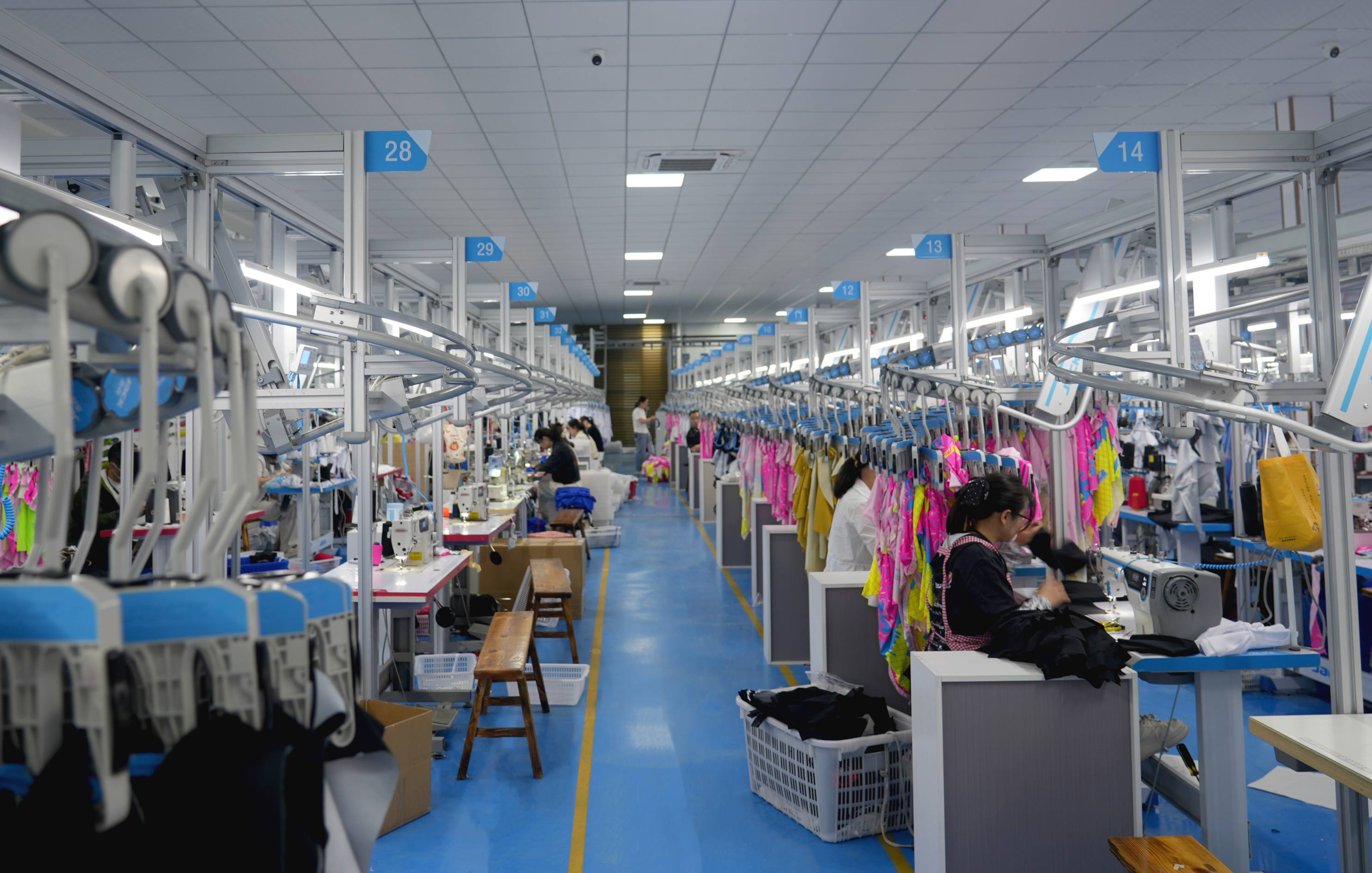

Table of Contents
TL;DR — The Opportunity in One Paragraph
The global menopause economy is on a trajectory toward USD 600 billion (Joanna Strober / Winona Yahoo Finance). 75% of menopausal women experience hot flashes (UCLA Health). 51.6% suffer sleep disorders (Sleep & Breathing meta-analysis, 2023). Up to 63% experience some form of urinary incontinence (Cureus, 2024). And yet — when she opens her underwear drawer at 3 a.m. drenched in sweat, almost nothing in there was designed for her body, her life stage, or her dignity. This is the gap. This article is about why the next generation of premium intimate apparel brands will not be period underwear brands. They will be menopause wear brands — and why the sourcing logic for them is fundamentally different.
Part One — A Letter That Changed How We Think About This Category
Earlier this month, we received an inquiry email at LJVOGUES that we have permission to discuss in anonymized form. A founder — let's call him Bo — wrote to us about a European DTC brand he is building.
He didn't ask about prices first. He didn't ask about MOQs first. He didn't send a tech pack. Instead, he wrote two sentences that made our entire team stop and re-read them three times:
"Our brand focus is not traditional period underwear, but rather: premium comfort-tech underwear and sleepwear for women aged 45+ experiencing menopause symptoms."
"We are looking for a long-term manufacturing partner... we are aiming to build a long-term premium European brand and are currently looking for the right strategic production partner."
That is not the language of someone shopping for a factory. That is the language of someone looking for a co-conspirator.
And he did three things in that email that, in our 20 years of intimate apparel manufacturing, told us this was an inflection point worth paying attention to:
He named the category by what it is — menopause wear — instead of borrowing the language of a neighboring category.
He deliberately distanced himself from period underwear — twice. Not because period underwear is wrong, but because he understood that the consumer he serves does not want to be lumped in with menstruation.
He led with fabric philosophy, not features — TENCEL™ Modal, MicroModal, bamboo viscose, 95/5 modal-elastane. These are not the choices of a price-shopper. These are the choices of a brand that already knows what its products should feel like against the skin.
We have been making intimate apparel for 500+ brands. We have seen every kind of inquiry. Bo's email represents something new — and it is worth unpacking why.
Part Two — The Three Layers of What "Menopause Wear" Really Means
When a brand founder uses a word like "menopause wear," there are three layers operating simultaneously. Most factories only respond to the surface layer. The brands that win in this category will be built by partners who can hold all three layers at once.
Layer 1 — The Functional Layer (What She Needs)
This is the layer most easily quantified, and the one that most product specs focus on:
Symptom | Prevalence in Menopausal Women | Garment Implication |
Hot flashes / vasomotor symptoms | 75% (UCLA Health) | Active cooling, moisture wicking, breathability |
Night sweats | ~75% (overlaps with hot flashes) | Thermal regulation, fast-drying, odor neutralization |
Sleep disorders | 51.6% globally (PMC, 2023) | Soft hand feel, seamless construction, no friction points |
Stress urinary incontinence | 30.8%–63.1% (PubMed 2025; Cureus 2024) | Light leak protection (5–15 ml capacity), discrete construction |
Skin sensitivity / dryness | ~50% (estrogen-related skin atrophy) | Hypoallergenic fibers, low-friction seams, OEKO-TEX skin contact |
Mood / dignity impact | 73% report symptoms disrupt professional life (Femtech Insider) | Premium aesthetics, no "medical" visual cues |
Look closely at that last row. It is not a clinical symptom. It is the symptom-of-symptoms — the cumulative psychological load. And that brings us to Layer 2.

Layer 2 — The Emotional Layer (What She Wants to Feel)
A 47-year-old woman waking at 3:14 a.m. with her hair stuck to her neck, drenched through her T-shirt, with a partner asleep next to her, does not want to feel like a patient. She does not want to feel like a problem being managed. She does not want her sleepwear to whisper "incontinence" to her in the mirror the next morning.
What she wants is to feel like herself — the same woman who, three years ago, didn't think twice about any of this. She wants the fabric against her skin to be a small, quiet act of self-respect.
This is why "premium" in this category does not mean "expensive." It means dignified. And it is why every material decision, every seam placement, every label choice, every packaging detail, has to be made through the question: does this make her feel more like herself, or less?
Period underwear answers a one-week-a-month problem. Menopause wear answers a ten-year identity transition. The two are not interchangeable.
Layer 3 — The Cultural Layer (What She's Pushing Back Against)
For 75 years, the cultural script around menopause has been silence, embarrassment, and medicalization. Hormone replacement was the only "solution." Lifestyle products marketed to menopausal women were typically beige, clinical, and shaped like medical devices.
The women turning 50 in 2026 are different. They are the first generation that came of age post-Title-IX, post-Roe, post the original "Our Bodies, Ourselves." They have spent decades being told their bodies are their own. They are not going to accept beige.
When Bo writes "premium European brand" — what he is really saying is: we are building products that respect this generation's refusal to be invisible. And that is a cultural posture, not a product spec. The factories that win in this category will be the ones that can hold a cultural posture, not just a tech pack.
Part Three — Why This Is a Bigger Opportunity Than Period Underwear
We say this as the manufacturer of period underwear for hundreds of brands: the period underwear category is mature. The growth is still real (21.1% CAGR through 2033 per Grand View Research), but the competitive landscape is crowded — Thinx, Knix, Modibodi, WUKA, Saalt, Proof, The Period Company, Cora, Aisle, Bambody, and 200+ private-label brands behind them.
Menopause wear is something else entirely.
The Macro Numbers
USD 600 billion — projected size of the broader menopause economy by the early 2030s (Joanna Strober, ICMP Founder Winona Yahoo Finance)
USD 10B–25B by 2030 — narrower medical menopause market alone, growing 8–10% annually (PwC)
USD 1.7 billion — private investment deployed into menopause companies between 2020 and 2025, growing ~15% annually (PwC)
~1.3 billion — projected number of women worldwide in menopause or post-menopause by 2030 (WHO data extrapolation)
The Apparel Gap
But here is what is striking. Of that USD 600 billion menopause economy, almost all of the visible market activity is in:
Hormone replacement therapy (Bayer, AbbVie, Pfizer, Theramex — pharma)
Supplements (the dominant treatment segment per Grand View Research)
Telehealth platforms (Midi, Winona, Maven, Evernow)
Wearable cooling devices (necklaces, bracelets — a USD 1.2B sub-segment per Dataintelo)
What is almost entirely absent from this list? Intimate apparel and sleepwear designed for the menopausal woman's body.
There are a small number of serious players — Femography (in partnership with MAS Holdings, with their patented Anti-Flush™ Technology), Cucumber Clothing, Fifty One Apparel, Soak Sleepwear, Nufabrx. Most of these are either small UK/US specialty brands without supply chain depth, or technology-led but limited in fabric range and aesthetic flexibility.
The space for a premium European DTC brand with cinematic brand storytelling, modal-led fabric philosophy, and integrated leak technology — is genuinely open.
Compare this to period underwear, where in 2026 a new brand entering the market has to differentiate against 200+ existing brands. In menopause wear, you are differentiating against fewer than 20 globally recognized brands, none of which has consolidated cultural ownership of the category.
This is what venture capital calls a whitespace. And it is the rarest thing in mature women's apparel.
Part Four — Why Menopause Wear's Sourcing Logic Is Different From Period Underwear's
Now we are in the part of the article that matters most to brand founders considering this category. Because once you understand that menopause wear is not period underwear, you also have to understand that you cannot source it the same way.
Below is what changes when you move from period underwear sourcing to menopause wear sourcing.
Shift 1 — Fabric Philosophy Becomes Identity, Not Spec
In period underwear, the dominant fabric conversation is about absorbency: how many layers, how much ml, what kind of barrier film. Outer fabric is often a commodity decision.
In menopause wear, the outer fabric IS the brand. Bo's email specified 95% TENCEL™ Modal + 5% elastane. That is not a technical specification — that is a brand thesis. He is saying: this product will feel like silk against skin that has lost some of its collagen elasticity. It will breathe like nothing else. It will biodegrade. It will not pill. It will signal premium without shouting.
Sourcing this requires:
Direct relationships with Lenzing AG (the only producer of certified TENCEL™ Modal) or with Lenzing-licensed yarn spinners
MicroModal and Modal Air capability (the premium grades, not commodity modal)
Bamboo viscose in a properly certified form (FSC or OEKO-TEX, not the unverified "bamboo" that turned out to be regular rayon in many earlier brands)
Cooling yarn integration — yarns like Coolmax®, Cooltech, jade-infused fibers, mineral-mineralized cellulosics
At LJVOGUES, we have built TENCEL™ Modal and MicroModal supply chains because our period swimwear and premium underwear lines required them. This was an investment we made before this category existed in its current form. It now positions us specifically for menopause wear partnerships.

Functional Fabrics for Middle-Aged Underwear
Shift 2 — Construction Becomes About Absence, Not Addition
Period underwear is engineered through addition — additional layers, gussets, barrier films, absorbent cores.
Menopause wear is largely engineered through absence:
No friction seams at the inner thigh (estrogen-related skin sensitivity)
No elastic that bites at the waistband (weight redistribution post-45 means waistband fit changes)
No itchy labels (use heat-transfer printing, not woven sew-in)
No synthetic blends that trap heat (the entire heat economy of the garment is reversed — wicking out, not insulating in)
No "medical" aesthetic cues (no clinical white, no obvious gussets, no visible "protection" labeling)
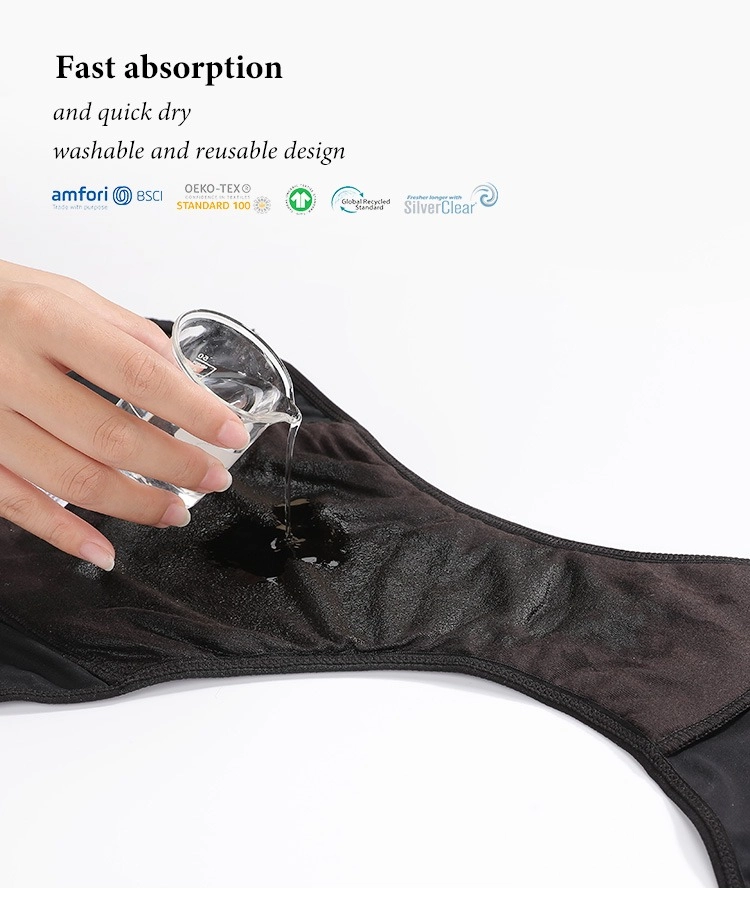
For light bladder leak protection (which Bo specifically mentioned), the construction must achieve 5–15 ml absorbency discretely, with a gusset that is invisible from the outside and imperceptible from the inside. This is a fundamentally different engineering brief than period underwear's 25–50 ml absorbent core.
At LJVOGUES, we have developed a 3-layer light-leak system specifically tuned for this range — using a Selective Absorption Technology adaptation that captures small-volume incontinence events without the bulk profile of menstrual protection. It is the same philosophical lineage as our period underwear technology, but the geometry, weight, and feel are completely different.
Shift 3 — Sizing Logic Expands, Style Vocabulary Shifts
Period underwear is dominated by briefs, bikinis, and boyshorts — the silhouettes a 25-year-old chooses.
Menopause wear has a different silhouette grammar:
High-waist briefs with control panels (without making them shapewear)
Boyshort with longer leg (reduces inner thigh friction)
Sleep tops with built-in light support (not bras, but not nothing)
Sleep shorts and ankle-length sleep pants with no elastic compression points
Lounge pieces that bridge intimate apparel and outerwear (because she's working from home and her sleep bra and her morning bra are increasingly the same thing)
Sizing also has to expand. Body composition changes after 45 — the size run that worked for a 28-year-old brand will fail badly here. We routinely grade XS to 3XL for menopause-focused programs, sometimes XS to 6XL. The fit standards we use are based on the ASTM D5586/D5586M-10 women's body measurement standard for mature figures, not the misses standard.
Shift 4 — Certification Stack Gets More Demanding
For period underwear sourcing, OEKO-TEX STANDARD 100 + PFAS-free is the threshold table stakes.
For premium menopause wear sourcing aimed at European consumers (like Bo's brand), you need:
Certification | Why It Matters Specifically for Menopause Wear |
OEKO-TEX STANDARD 100 Class II | Mandatory — direct skin contact, often worn 8+ hours overnight |
TENCEL™ trademark license | Required to actually call your fabric "TENCEL™" — Lenzing controls this strictly |
EU REACH compliance | Bo's brand is European — full REACH dossier expected |
EU GPSR (General Product Safety Regulation, Dec 2024) | Newly enforced; impacts intimate apparel labeling |
PFAS-free third-party verification | Beyond OEKO-TEX, often requested independently due to Thinx 2023 lawsuit memory |
GOTS (if positioning organic) | For natural-fiber positioning |
Vegan certification | A non-trivial percentage of this consumer base; influences trim/adhesive choices |
BSCI / SEDEX | Required for European retail and major DTC partnerships |
Cradle to Cradle (optional, premium-tier) | Increasingly requested for high-end European DTC |
At LJVOGUES, we hold OEKO-TEX, BSCI, SEDEX, FDA, ISO 9001/14001, GRS, and 100% PFAS-free verification. For TENCEL™ programs, we operate under Lenzing's licensed-manufacturer framework. These are not certifications we acquired for menopause wear specifically — they are the certifications that any premium intimate apparel manufacturer should already hold. The point is that menopause wear requires the full stack, where period underwear can often launch with a partial one.
Shift 5 — MOQ Strategy Inverts
This is the surprising one. In period underwear, brand founders typically try to negotiate MOQs down (because they are testing a crowded market with thin margins).
In menopause wear, the most successful early movers tend to want MOQs segmented but committed — they will commit to 1,000–2,000 units of a tightly curated SKU set rather than spreading 500 units across 8 SKUs. The reason is positioning: menopause wear customers expect a curated, considered collection, not a swatch dump.
A typical first development phase we would recommend for a brand like Bo's:
Product | Suggested First-Phase MOQ | Logic |
Cooling sleep top (modal/elastane) | 800–1,200 units, 4 sizes, 2 colors | Demand validation piece — highest emotional resonance |
Cooling sleep short | 600–1,000 units, 4 sizes, 2 colors | Pairs with top — bundle SKU |
High-waist comfort brief (daily) | 1,000–1,500 units, 5 sizes, 3 colors | Workhorse SKU, repeat-purchase driver |
Ultra-soft daily underwear (no leak) | 800–1,200 units, 5 sizes, 3 colors | Entry SKU — lowest price point |
Light leakproof underwear | 1,000–1,500 units, 5 sizes, 2 colors | Functional differentiator — protects the brand's clinical credibility |
TOTAL | ~5,000–7,000 units | Curated first collection |
This is a different shape than "MOQ 500 across whatever we want." It is the shape of a brand that knows what it wants to stand for.

Customization Process
Part Five — A Note on Why the Word "Period" Is the Wrong Word for This Category
We want to spend one section directly on this — because Bo's deliberate distancing from period underwear is, we think, the most strategically important thing in his email.
There is a generation of consumers between roughly 1955 and 1975 birth years who:
Did not grow up with period underwear as a normalized category (it didn't really mainstream until 2018–2020 with Knix and Thinx)
Have already mostly transitioned out of menstruation (median menopause age is ~51)
Associate "period products" with their younger selves — their daughters, their granddaughters
Resent the perceived patronization of being marketed period-adjacent products at age 50+
Often experience grief about the end of fertility that makes period-related branding emotionally fraught
For this consumer, a brand that says "Period Underwear Now Also For Menopause Light Leaks" is not just off-target — it is actively repellent. It signals that the brand doesn't see her. It conflates her bladder with her womb, her midlife transition with her teenager's first period.
The brands that win here will not be brand extensions of existing period underwear lines. They will be purpose-built menopause wear brands with their own visual language, their own fabric story, their own founders speaking in their own voice.
(This, parenthetically, is also why we believe Bo's specific choice to say "not traditional period underwear" — twice — is a marker of someone who understands the category at a strategic level, not just a product level.)
Part Six — What This Means for LJVOGUES, And What It Means for the Industry
We are putting this article on our blog rather than burying it in a sales conversation for a specific reason. We think the next 36 months are an inflection point in women's intimate apparel, and we want to be transparent about how we are thinking about it.
What We Believe
We believe that by 2030, the menopause wear category will have at least 5 globally recognized premium brands (today there is arguably zero — Femography and a few specialty UK brands are the closest, but none has Knix-level scale and cultural mindshare). We believe these brands will collectively represent USD 2–4 billion in annual revenue. We believe they will primarily originate in Europe and North America, with the most successful ones operating premium DTC models with selective retail (Net-a-Porter, Liberty, Selfridges, Goop).
What We Are Doing
We have spent the past 18 months specifically extending our period underwear and swimwear capabilities into:
Premium cellulosic fabric sourcing — TENCEL™ Modal, MicroModal, bamboo viscose, modal-elastane and modal-cotton blends in 30+ weights and finishes
Cooling yarn integration — Coolmax®, mineral-infused yarns, and proprietary cooling treatments compatible with modal substrates
Light-leak gusset systems — a 3-layer architecture tuned for 5–15 ml capacity rather than 25–50 ml
Sleepwear construction capability — heat-transfer labels, ultrasonic-bonded seams, flatlock construction, tagless waistbands
Smaller-batch high-customization workflows — appropriate for the curated-collection sourcing logic premium menopause wear brands need
We did this initially to serve a small set of early-adopting clients. The Bo-style inquiry told us this is no longer a niche request. It is becoming a movement.
What We Would Tell A Founder Considering This Space
Three pieces of unsolicited advice from a manufacturer's perspective:
Don't try to be everything. The brands that will win this category will be the ones that own a specific slice — the cooling sleep brand, the leak-confidence brand, the dignified-daily-underwear brand. Trying to be all of them dilutes the cultural signal.
Lead with fabric, not features. Customers in this category will pay 30–40% more for the right fabric philosophy than they will pay for an extra feature. If your fabric is right, you can launch with three SKUs and grow. If your fabric is generic, you cannot survive even with twenty.
Choose your sourcing partner the way you would choose a co-founder. The factory that wins this category isn't the one with the lowest quote. It is the one that understands that you are not making period underwear. The one that asks questions about your founder's mother. The one that wants to read your brand book before they price your first sample. (This is also, frankly, the kind of partner LJVOGUES wants. We are not interested in being the lowest bidder for this category — we are interested in being the right partner for a very small number of brands building this future.)
Part Seven — Closing: The Drawer at 3 a.m.
We started this article with a 47-year-old woman waking at 3:14 a.m., hair stuck to her neck. Let us end there.
In the next decade, hundreds of millions of women will go through this transition. They will not stop. They will not be silent about it. They will, increasingly, refuse to accept that the only available solutions are pharmaceutical, beige, or shaped like medical devices.
The intimate apparel industry has, for two centuries, been organized around three life stages of the female body — adolescence, peak fertility, and postpartum. The fourth stage — the perimenopausal and postmenopausal decade — has been almost entirely uncatered to.
This is the largest blank space in women's apparel. The brands that fill it will not do so by making "menopause versions" of existing products. They will do so by re-asking the foundational questions: What should fabric feel like on skin that has changed? What should silhouettes do for a body that has shifted? What should branding sound like to a woman who refuses to be invisible?
At LJVOGUES, we are a manufacturer. We do not build brands — we build the products that brands stand on. But we have been making women's intimate apparel for 20 years, and we know what it sounds like when a category is about to break open.
Menopause wear is about to break open. The founders we want to work with on this are the ones who understand that "not period underwear" is not a disclaimer. It is a thesis statement.
Frequently Asked Questions
Q1: Is "menopause wear" a real category, or is it just a marketing label for period underwear with cooling fabric?
It is a real and distinct category. Menopause wear is built around different consumer psychology (mid-life identity), different functional needs (cooling, light incontinence, sleep quality), different fabric philosophy (cellulosic-led rather than synthetic-led), different silhouettes (high-waist, longer leg, sleep separates), and different cultural positioning (dignified rather than protective). The fact that some adjacent technology (light absorbent gussets) is shared with period underwear does not make them the same category — in the same way that running shoes and orthopedic walking shoes share rubber soles but are different products with different consumers.
Q2: What are the technical fabric specifications for premium menopause wear?
The most common premium specification we see for daily underwear and sleepwear is 95% TENCEL™ Modal + 5% elastane in weights between 140 and 200 GSM. For sleep tops and lounge pieces, 92–95% MicroModal + 5–8% elastane in 160–180 GSM. For cooling-specific pieces, modal can be blended with cooling yarn at 70/25/5 ratios (modal/cooling yarn/elastane). All fabrics should be OEKO-TEX STANDARD 100 Class II certified, REACH-compliant, and PFAS-free verified.
Q3: How much absorbency does light leak protection need?
For menopause-related stress urinary incontinence, the typical event volume is 1–10 ml. Premium light-leak underwear should reliably manage 5–15 ml capacity with no visible bulk. This is fundamentally different from menstrual protection (which typically targets 25–50 ml). The gusset architecture must be three-layer (wicking inner / absorbent middle / breathable barrier) rather than four-layer, and must achieve invisibility from the outside.
Q4: What MOQs are realistic for a first-phase menopause wear launch?
Per-SKU MOQs in the 800–1,500 unit range are realistic with manufacturers experienced in this category. A first collection of 5 SKUs typically requires 5,000–7,000 units committed across the collection. Trying to launch with sub-500 MOQs per SKU usually compromises fabric quality (because premium cellulosic fabrics have minimum yarn order quantities) and is generally not advisable for a brand positioning at the premium tier.
Q5: How long does the development phase take?
For a curated first collection of 5 SKUs with custom fabric specification: ~14–18 weeks from approved tech pack to bulk shipment-ready inventory. This breaks down as approximately 3–4 weeks of fabric development and sampling, 4–6 weeks of fit and counter-sample iteration, 2 weeks of PP sample approval, and 5–7 weeks of bulk production and QC. Brands using existing manufacturer-stock fabrics can compress this to 10–12 weeks total.
Q6: What certifications should a premium European menopause wear brand insist on from its manufacturer?
At minimum: OEKO-TEX STANDARD 100 (Class II for skin contact), full PFAS-free third-party testing, REACH compliance documentation, BSCI or SEDEX social audit, and ISO 9001 quality management. For TENCEL™ programs, the manufacturer must operate under Lenzing's licensed manufacturer framework. For positioning organic or recycled, add GOTS or GRS as relevant. For DTC selling into EU after December 2024, GPSR documentation is now required.
Q7: How does menopause wear's economics differ from period underwear's?
Premium menopause wear typically retails at €25–60 per piece, with COGS targets of €5–10 per piece — meaning gross margins of 70–85%. This is higher than mass-market period underwear (typically 60–70% gross margin) because the consumer has higher willingness-to-pay for emotional resonance and premium fabric. However, customer acquisition costs are higher too because the consumer base is harder to reach via traditional female-health influencer channels.
Q8: Is the European market the right starting point for a menopause wear brand?
For premium positioning, yes — Europe (particularly the UK, Germany, France, and the Nordics) has the strongest cultural readiness for menopause conversation, the strongest regulatory framework (REACH, GPSR), and the most developed premium DTC infrastructure. The US market is also strong but more crowded with adjacent femtech and increasingly fragmented. Asia-Pacific is earlier-stage but accelerating — Japan and Australia particularly. China is an emerging interesting market as cultural taboos around menopause begin to shift.
Q9: What is LJVOGUES's specific role in this category?
We are an OEM/ODM manufacturer, not a brand. Our role is to be the production and technical partner for brands building in this space. We bring 20 years of intimate apparel manufacturing expertise, full certification stack (OEKO-TEX, BSCI, SEDEX, FDA, ISO 9001/14001, GRS, PFAS-free), TENCEL™ and premium cellulosic fabric supply chains, light-leak gusset engineering adapted from our period underwear lineage, and the smaller-batch high-customization workflows that premium menopause wear brands need. We typically work with 5–15 menopause wear brand partners at any given time.
Q10: How do I start a conversation with LJVOGUES about a menopause wear program?
We prefer inquiries that lead with brand thesis rather than tech specs. Tell us who your consumer is, what cultural posture your brand will hold, what your fabric philosophy is, and what kind of partner you want us to be. Then we can talk about MOQs, certifications, sampling, and pricing. Reach us through the contact form at www.ljvogues.com — or, like Bo did, just write us a letter that says what you actually want to build.
A Note to Bo, and to Everyone Else Building in This Space
Bo, if you ever read this — thank you for the email. The reason we wrote this article is that your letter made our team articulate something we had been feeling for two years but had not yet said out loud.
To everyone else building or considering building in this category: we are not the only manufacturer who can do this work, but we are one of the manufacturers who wants to do this work. If you are building a brand that takes the menopausal woman seriously — as a customer, as a person, as a generation about to reshape an industry — we would genuinely like to hear from you.
The drawer at 3 a.m. is the most important drawer in intimate apparel right now. Let's build what should be in it.
About the Author
Ocean Yang is the founder of LJVOGUES (Shenzhen Ljvogues Sports Fashion Limited), a women's intimate apparel manufacturer specializing in period underwear, period swimwear, and premium comfort-technology underwear and sleepwear. LJVOGUES has manufactured for 500+ global brands across 50+ countries and holds full OEKO-TEX STANDARD 100, BSCI, SEDEX, FDA, ISO 9001/14001, GRS, and 100% PFAS-free certifications.
For inquiries: www.ljvogues.com
Sources cited:
Grand View Research — Menopause Market Industry Report, 2030 and Period Panties Market Report
UCLA Health — Hot Flashes and More: New Program Helps Patients Through Menopause
Sleep & Breathing meta-analysis — Global Prevalence of Sleep Disorders During Menopause, 2023
Cureus — The Link Between Menopause and Urinary Incontinence, 2024
PubMed — Menopause, Urinary Incontinence Prevalence and Impact, 2025
Femtech Insider — Femography's Intelligent Clothing Range Targets Menopause, 2023
Dataintelo — Menopause Cooling Wearable Market
Yahoo Finance — Emerging Menopause Economy Reaches $600B, 2025