



Table of Contents
TL;DR
A modular absorbent system lets brands build period biker shorts, leakproof leggings, girls' safety shorts, schoolwear shorts, and running split shorts from a single shared gusset architecture. By standardizing capacity tiers (15–50 ml), gusset shapes, and TPU barrier specifications, manufacturers can reduce sampling cycles by 30–50%, consolidate BOM components, and unify compliance documentation across every SKU. This article provides the cross-category specification matrix, SKU planning framework, and manufacturing logic you need to source a full leakproof activewear line efficiently.
Opening: One Inquiry, Five Products, One System
In May 2026, a brand founder reached out to LJVOGUES with a sourcing brief that captured exactly where the leakproof category is headed. The message read, in part: developing a reusable moisture-protection apparel brand focused on women's and girls' activewear and everyday protective products — initial products include period underwear, period biker shorts, girls' safety shorts for school and daily wear, and future leakproof leggings and activewear.
That inquiry was not unusual. It was the third of its kind that month.
What was notable was how the founder framed it: not as five separate product development problems, but as one technical platform she needed help building. She already understood, at least intuitively, that the absorbent gusset system sitting inside a pair of period underwear is essentially the same architecture that should sit inside a pair of period biker shorts, leakproof leggings, or a girl's school uniform safety short. The fabrics and silhouettes change. The underlying absorbent module does not have to.
This is the insight that separates brands that build efficient, scalable leakproof product lines from those that spend 18 months and four factory relationships trying to reinvent the gusset for every new category. This article — the third in LJVOGUES's Leakproof Activewear Trilogy (see The Rise of Leakproof Activewear and Engineering a Period Biker Short) — explains how a modular absorbent architecture works in practice, what the specification differences across five product categories actually look like, and how brands can use this framework to plan an efficient, defensible SKU lineup from day one.
Part 1: Why Modularity Is the B2B Strategic Edge
The global activewear market is projected to reach USD 720.25 billion by 2034 at an 8.57% CAGR. Within that market, leakproof function is transitioning from a novelty feature to a baseline expectation for a growing segment of female consumers. Brands entering this space face a straightforward dilemma: how do you build a broad enough product assortment to be taken seriously at retail, while keeping development costs, inventory exposure, and supplier complexity at a level that makes sense for a pre-Series A company?
The answer is modular design.
In manufacturing terms, modularity means designing a set of standardized building blocks — in this case, absorbent gusset assemblies — that can be configured and deployed across multiple end products without requiring a new engineering effort for each. The concept is well-established in hard goods manufacturing. Modular product architecture allows companies to expand product portfolios while reducing the number of unique components, tooling requirements, and process variations — outcomes that translate directly to cost and speed advantages in textile manufacturing.
For a leakproof activewear brand, modularity delivers three specific advantages:
Capital efficiency. When the same absorbent core module — same fabric stack, same TPU barrier, same stitching specification — runs across multiple product categories, you consolidate raw material purchasing. Instead of maintaining separate supplier relationships for the absorbent layer in your biker short versus your legging, you source once and allocate. Inventory risk drops proportionally.
SKU flexibility. A modular system lets you launch a minimum viable product in one category, validate the market, and expand to adjacent categories without rebuilding your supply chain. The gusset specification is already proven. Only the outer shell changes.
Brand narrative coherence. Consumers and retail buyers increasingly ask about the technology behind leakproof claims. A brand that can say "the same four-layer absorbent system appears in our biker shorts, our leggings, and our girls' range — engineered to the same absorption and wash-cycle standards across every product" is telling a more credible, more memorable story than one that sources piecemeal from multiple factories with different technical approaches.

ljvogues menstrual panties
Part 2: The LJVOGUES Modular Absorbent Architecture
The modular system at LJVOGUES is built around three configurable variables that can be mixed and matched to produce a gusset specification for virtually any activewear application.
Variable 1: Absorption capacity tier
LJVOGUES manufactures absorbent gussets across five standard capacity tiers:
Tier | Absorption Capacity | Typical Application |
Light | 15 ml | Safety shorts, liner-only products |
Moderate | 20 ml | Everyday leggings, light-flow days |
Standard | 30 ml | Period leggings, schoolwear shorts |
Heavy | 40 ml | Period biker shorts, high-activity use |
Maximum | 50 ml | Overnight/postpartum-adjacent activewear |
For reference, Knix period leggings absorb the equivalent of 1–3 regular tampons (approximately 10–30 ml), and Thinx Active Leggings hold approximately 30 ml. LJVOGUES's five-tier system covers this competitive range and extends above it for higher-demand applications.
Variable 2: Gusset shape
Three standardized shapes accommodate different garment silhouettes and activity profiles:
Contour panel — curved cut optimized for compression shorts and biker-style silhouettes; wraps the central gusset zone and extends toward the rear panel
Flat panel — rectangular gusset for leggings and more relaxed-fit bottoms; easier to integrate into stretch seam construction
Split-panel — two separate absorbent zones joined at the center seam, used in running split shorts and garments where a single-piece gusset would restrict movement
Variable 3: TPU barrier thickness
Two barrier specifications serve different end-use requirements:
Standard TPU (0.018 mm) — sufficient for moderate-activity products where breathability is the priority; used in leggings, schoolwear shorts, and safety shorts
Performance TPU (0.025 mm) — heavier barrier for high-motion, high-perspiration environments where lateral leakage risk increases; used in biker shorts and split running shorts
These three variables — five capacity tiers × three gusset shapes × two TPU thicknesses — generate 30 possible base configurations before any outer fabric specification is considered. In practice, most brand SKU matrices draw from six to ten of these configurations, which means the component library is shared, sourced in quantity, and available without lead-time penalties for new product development.
The four-layer construction of each gusset module remains consistent across all configurations: moisture-wicking inner layer (typically 95% polyester/5% spandex or bamboo jersey), absorption core (multi-layer microfibre), TPU waterproof barrier, and outer shell fabric. Industry-standard reusable life for absorbent gusset systems is approximately 50 wash cycles at the absorbent function level — a benchmark LJVOGUES validates through accelerated wash testing on every new gusset configuration.

ljvogues menstrual underwear absorbent structure
Part 3: Five Product Categories, One Core Technology
Category 1: Period Biker Shorts
Market context: The cycling wear market is valued at USD 8.70 billion in 2026 and forecast to reach USD 12.90 billion by 2033, with apparel accounting for 72.4% of segment revenue. Biker-style compression shorts have crossed from cycling into mainstream fitness and fashion — and they represent the highest-engineering-difficulty application in the leakproof activewear category.
Why they are technically demanding: High-compression fabric (typically 80% nylon/20% spandex) exerts significant lateral pressure on the gusset zone during wear. That pressure must not squeeze absorbed fluid back toward the garment surface — a failure mode that does not exist in low-compression period underwear. As detailed in Article 15, the solution is a combination of performance TPU barrier specification, channeling microstructure in the absorbent core, and gusset-to-shell attachment via bonded seam rather than stitched seam.
Specification summary:
Absorption capacity: 25–35 ml (Heavy tier)
Gusset shape: Contour panel, extended rear coverage
TPU specification: 0.025 mm Performance
Outer fabric: 80% nylon / 20% spandex, 200–280 gsm
Construction: Flatlock with bonded gusset perimeter
Seam finish: 4-needle 6-thread flatlock stitching
Wash standard: 50-cycle validated

Category 2: Leakproof Leggings
Market context: Full-length leggings are the highest-volume category in women's activewear by unit count. The sports and fitness wear segment reached USD 75.21 billion in 2025 and is growing at 5.5% CAGR. Leakproof leggings occupy the overlap between daily wear and moderate-intensity training — which means the specification must balance absorbency with all-day comfort.
Key engineering consideration: Leggings are worn for 8–12 hours. Moisture saturation against skin for that duration is a dermatological concern. The inner layer must wick aggressively and dry between absorption events. Bamboo jersey or a 95% polyester/5% spandex wicking knit is standard. The flat panel gusset shape integrates cleanly into the center-front and center-back seam lines.
Specification summary:
Absorption capacity: 20–30 ml (Moderate to Standard tier)
Gusset shape: Flat panel, central concentration with rear extension
TPU specification: 0.018 mm Standard
Outer fabric: 78–82% nylon or polyester / 18–22% spandex, 200–240 gsm
Construction: Flatlock throughout, gusset stitched into seam
Sizes available: XS–4XL (LJVOGUES extended sizing to 8XL on request)
Wash standard: 50-cycle validated
Category 3: Girls' Safety Shorts Under School Uniform
Market context: The global school uniform market is valued at USD 29.98 billion in 2025. Within this market, a growing and underdiscussed product need has emerged: coverage shorts worn by girls underneath school dresses and skirts to prevent incidental exposure during active play.
The social demand evidence is clear. A 2024 thread in the r/UKParenting community on Reddit generated 78 comments from parents discussing the practical necessity of coverage shorts for girls on school playgrounds — with multiple parents citing that their daughters independently requested them for comfort during climbing, cartwheels, and playground equipment use. Parents noted that standard underwear is insufficiently protective during high-activity play, and that coverage shorts provided both physical comfort and confidence for active girls.
This is not a niche or novelty product. It is a functional gap in the girls' uniform accessory market that sits adjacent to leakproof technology: brands can offer pure coverage shorts (no absorbent layer, just a comfortable barrier garment) alongside light-absorption variants (15 ml, for incidental moisture protection) within the same SKU matrix.
Key engineering considerations: This category prioritizes softness, breathability, and fit security above absorbent performance. The garment must be appropriate for children aged 4–14 (XXS through XL sizing), machine washable at high temperature, and free of any materials that could cause skin irritation. Bamboo jersey or OEKO-TEX certified combed cotton is the preferred inner layer. The absorbent module is Light tier (15 ml) or omitted entirely for coverage-only variants.
Specification summary:
Absorption capacity: 5–15 ml (Light tier) or zero (coverage-only)
Gusset shape: Flat panel, narrow width appropriate for child sizing
TPU specification: 0.018 mm Standard (absorbent variants only)
Outer fabric: 95% organic cotton or bamboo / 5% spandex; or OEKO-TEX certified cotton blend
Sizing: XXS–XL (child sizing scale)
Construction: Flatlock; no exposed seam allowances against skin
Wash standard: 60°C machine wash compatible; 50-cycle validated for absorbent variants
Compliance priority: OEKO-TEX STANDARD 100 certification mandatory; PFAS-free materials required
Category 4: Period Schoolwear Shorts
Market context: This category serves adolescent girls aged 11–18 who wear school uniforms and need reliable period protection during the school day. The product sits between period underwear (too intimate for school PE changing rooms) and adult activewear (incorrect sizing and fit proportions for developing bodies). It is an underserved category with significant demand among the growing female student-athlete population — the NCAA reported a 5% increase in female student-athletes between 2020–21 and 2021–22, a trend that extends into secondary school sport participation.
Key engineering considerations: The outer aesthetic must be school-appropriate — solid-color, low-profile, not visually distinctive as a period product. Absorption must be sufficient for a 6–8 hour school day (15–25 ml). The garment must withstand institutional laundering and maintain absorbent function through repeated wash cycles. Durability in stitching and fabric is a higher priority here than in adult performance activewear.
Specification summary:
Absorption capacity: 15–25 ml (Light to Standard tier)
Gusset shape: Flat panel with rear extension
TPU specification: 0.018 mm Standard
Outer fabric: 80% nylon or polyester / 20% spandex, 220–260 gsm; plain finish, school-compatible colorways
Sizing: XS–XL (junior/adolescent sizing scale)
Construction: Flatlock; reinforced seam allowances for durability
Wash standard: 40–60°C machine wash; 50-cycle validated
Category 5: Running Split Shorts
Market context: The outdoor running segment is among the fastest-growing subsegments within activewear, driven by post-pandemic participation growth in recreational running globally. Split-hem running shorts represent the performance end of the women's running apparel segment — a category where weight, breathability, and freedom of movement are the dominant purchase criteria.
Key engineering considerations: Running split shorts present a specific design challenge: the split-hem construction that gives the garment its freedom-of-movement benefit also limits the gusset zone to a relatively narrow central channel. The split-panel gusset shape is required, with each absorbent zone positioned to function independently. Outer fabric must carry a Durable Water Repellent (DWR) finish to manage sweat saturation on the outer shell without adding weight. Total garment weight is a purchase-decision factor for performance runners.
Specification summary:
Absorption capacity: 15–25 ml (Light to Standard tier)
Gusset shape: Split-panel, dual-zone absorbent placement
TPU specification: 0.025 mm Performance (high perspiration environment)
Outer fabric: 88% recycled polyester / 12% spandex, 120–150 gsm; DWR finish applied
Construction: Bonded seam at gusset perimeter to minimize stitching bulk; flatlock elsewhere
Sizes: XS–4XL
Wash standard: Cold machine wash; 50-cycle validated; DWR reapplication recommended at wash cycle 25

Part 4: Cross-Category Specification Matrix
Specification | Period Biker Shorts | Leakproof Leggings | Girls' Safety Shorts | Period Schoolwear Shorts | Running Split Shorts |
Absorption capacity | 25–35 ml | 20–30 ml | 0–15 ml | 15–25 ml | 15–25 ml |
Gusset shape | Contour panel | Flat panel | Flat panel (narrow) | Flat panel + rear extension | Split-panel dual zone |
TPU barrier | 0.025 mm Performance | 0.018 mm Standard | 0.018 mm Standard | 0.018 mm Standard | 0.025 mm Performance |
Outer fabric | 80% nylon / 20% spandex, 200–280 gsm | 78–82% nylon or polyester / 18–22% spandex, 200–240 gsm | 95% bamboo or cotton / 5% spandex | 80% nylon or polyester / 20% spandex, 220–260 gsm | 88% recycled polyester / 12% spandex, 120–150 gsm |
DWR finish | Optional | No | No | No | Yes |
Construction method | Flatlock + bonded gusset | Flatlock throughout | Flatlock, no exposed seams | Flatlock, reinforced seams | Bonded gusset + flatlock |
Wash standard | 50 cycles at 40°C | 50 cycles at 40°C | 50 cycles at 60°C | 50 cycles at 40–60°C | 50 cycles cold |
Sizing range | XS–4XL | XS–4XL (8XL available) | XXS–XL (child) | XS–XL (junior) | XS–4XL |
Target price tier (wholesale) | USD 18–28/unit | USD 16–24/unit | USD 8–14/unit | USD 12–18/unit | USD 14–22/unit |
Typical MOQ | 300 units/colorway | 300 units/colorway | 300 units/size run | 300 units/size run | 300 units/colorway |
Key certification requirement | OEKO-TEX, PFAS-free | OEKO-TEX, PFAS-free | OEKO-TEX STANDARD 100 mandatory | OEKO-TEX STANDARD 100 | OEKO-TEX, PFAS-free |
Primary sourcing challenge | Compression + barrier integration | Long-wear moisture management | Child safety compliance | Institutional wash durability | Weight vs. absorption balance |
Part 5: SKU Planning Framework for a Leakproof Activewear Brand
The most common mistake brands make when entering the leakproof activewear category is launching too many SKUs simultaneously. A five-category brand with three colorways, four sizes, and two absorption levels per category has 120 SKUs before it has validated a single market. This is not a sourcing guide for 120-SKU launches.
The framework below helps brands identify their minimum viable product (MVP) entry point and build out rationally from there.
Dimension 1: Age segment
Segment | Categories | Notes |
Girls (4–12) | Safety Shorts | Lowest absorbent complexity; highest OEKO-TEX compliance priority |
Teens (12–18) | Schoolwear Shorts, Period Biker Shorts | School-appropriate aesthetics; moderate absorbency |
Adults (18+) | Biker Shorts, Leggings, Running Splits | Full performance spec; broadest size run |
Dimension 2: Activity intensity
Intensity level | Recommended gusset tier | Product categories |
Low (daily wear, school) | Light (15 ml) or Standard (30 ml) | Safety Shorts, Schoolwear Shorts, Leggings |
Moderate (gym, yoga) | Standard (30 ml) | Leggings, Biker Shorts |
High (cycling, running) | Heavy to Maximum (40–50 ml) | Period Biker Shorts, Running Splits |
Dimension 3: Flow level targeting
Flow level | Capacity spec | Core product |
Light/spotting | 15–20 ml | Safety Shorts, Running Splits |
Regular | 25–30 ml | Schoolwear Shorts, Leggings |
Heavy | 35–50 ml | Period Biker Shorts |
MVP entry recommendation by brand type:
Brand type | Recommended first category | Rationale |
Women's wellness brand | Leakproof Leggings | Largest addressable adult market; proven demand signals |
Youth/schoolwear brand | Girls' Safety Shorts + Schoolwear Shorts | Underserved segment; lower technical complexity; school-year seasonality |
Performance/sport brand | Period Biker Shorts | Technical differentiation; premium price point; strong PR hook |
Multisegment family brand | Safety Shorts + Leggings (dual launch) | Covers two age groups from one gusset architecture |
The critical SKU planning principle is: launch one category, two colorways, one size run (XS–XL or XS–XXL). Prove the market. Then extend by adding sizes, then colorways, then adjacent categories — in that order. Extending sizes within a proven category is lower risk than opening a new category with an unproven customer base.
Part 6: Manufacturing Implications — Why Modularity Reduces Cost and Risk
I am sometimes asked why a brand would invest in establishing a modular absorbent system with a single manufacturing partner rather than sourcing each product category separately from specialists. The answer is straightforward: the economies of shared components and unified process knowledge compound at every stage of product development and production.
Shared component inventory. When the absorbent inner layer, TPU barrier film, and absorbent core construction are standardized across a product range, the manufacturer maintains a single inventory position for those materials. There is no minimum order quantity renegotiation when a brand adds a new category — the components are already in stock. This is particularly significant for TPU film, where minimum purchase quantities from film manufacturers typically start at several thousand linear meters. A brand sourcing from one modular-system manufacturer benefits from that purchasing scale even at relatively low per-style volumes.
Shared BOM structure. A modular product architecture reduces the number of unique part numbers, simplifies BOM maintenance, and enables cost modeling to be reused across new SKUs rather than rebuilt from scratch. In textile manufacturing, this means that when a brand wants to add running split shorts to an existing legging program, the gusset assembly specification already exists — only the outer shell and gusset shape variant need to be confirmed and tested.
Shorter sampling cycles. Industry experience suggests that modular product development reduces sampling lead times by 30–50% compared to fully bespoke development for each category. When the absorbent core construction is validated and in production, proto sampling for a new category focuses on fit, shell fabric integration, and colorway — not on revalidating the absorbent system from scratch.
Unified testing protocol. Every LJVOGUES absorbent gusset module — regardless of the garment category it is integrated into — is tested against the same core parameters: absorption capacity (measured volumetrically), leakage resistance under dynamic lateral pressure, wash-cycle durability (50-cycle standard), and TPU barrier integrity. When a new category is added using an existing module specification, the absorbent system does not require retesting — only the garment-level fit and function tests are new.
Unified compliance documentation. PFAS-free certification, OEKO-TEX STANDARD 100 status, and regulatory compliance documentation apply to materials and manufacturing processes — not to individual garment styles. A brand working with LJVOGUES's modular system can present a single compliance package to retail buyers covering all product categories rather than assembling separate documentation per style.

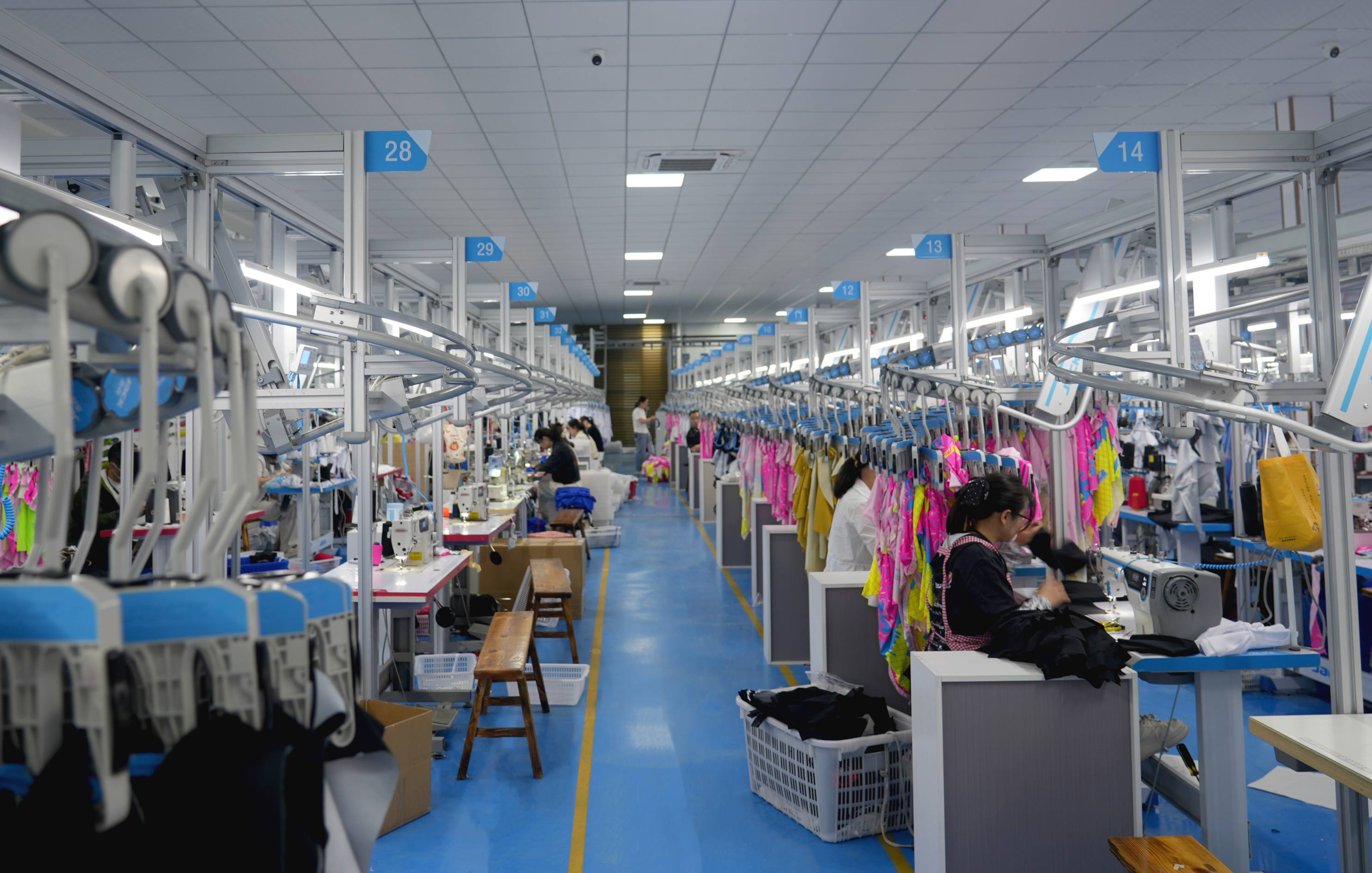
Workers at ljvogues' workshop are working.
Part 7: How LJVOGUES Supports Modular Brand Development
At LJVOGUES, we have been manufacturing period-protection products for over 20 years. The shift from period underwear into activewear categories — biker shorts, leggings, schoolwear, running apparel — is one we have been executing with brand partners since well before the category term "leakproof activewear" entered common use. Our modular absorbent system was not designed as a marketing position; it emerged from the practical necessity of serving brands that wanted to expand across categories without rebuilding their supply chain every time.
OEM and ODM pathways. We support both. OEM brands bring their own designs, tech packs, and fabric specifications; our role is manufacturing to those specifications using our certified materials and processes. ODM brands work with our design and engineering team to develop products from brief — we provide standardized tech packs for each of the five categories described in this article, which significantly reduces the time from concept to production-ready sample.
Tech pack framework. Our standard tech packs for leakproof activewear categories include garment construction drawings, gusset assembly specification, BOM with material callouts, stitching specification, and size grading tables. For ODM clients, these packs serve as a starting point that can be modified to meet brand-specific design requirements. For OEM clients, they serve as a technical reference that helps align the client's own tech pack with our manufacturing capabilities.
MOQ flexibility through modular sourcing. Our standard MOQ is 300 units per colorway. For brands launching across multiple categories simultaneously, we offer combined MOQ structures where the shared gusset component inventory counts toward volume thresholds across all styles. This means a brand launching leggings, biker shorts, and safety shorts in a single development cycle can reach preferential pricing tiers more efficiently than it could sourcing each category from a different factory.
Certifications applicable across all categories:
BSCI and SEDEX (social compliance, manufacturing)
OEKO-TEX STANDARD 100 (materials — applicable to all fabric and trim components)
100% PFAS-free across all TPU barrier and DWR applications
ISO 9001 (quality management) and ISO 14001 (environmental management)
GRS (Global Recycled Standard) — available for recycled polyester outer fabric options
OCS (Organic Content Standard) — available for organic cotton and bamboo variants
AQL 2.5 quality inspection standard on all outgoing orders
For brands targeting the EU market, our compliance documentation package is pre-structured to support REACH regulation requirements and textile labeling standards. For brands targeting the US market, our FDA-registered facility status and PFAS-free material certification address the growing state-level PFAS restrictions on consumer textiles.
Our 8,000 m² facility in Shenzhen operates with a 99.8% order consistency rate — a metric we track quarterly and make available to brand partners as part of our supplier transparency commitment.
To explore how a modular absorbent system can be adapted to your specific product lineup, visit LJVOGUES.com or contact our B2B sourcing team directly for a category-by-category technical brief.
FAQ: Modular Absorbent Systems for Leakproof Activewear
Q1: Can I mix and match absorption tiers across products in the same order?
Yes. Because LJVOGUES's absorbent modules are standardized building blocks, a single production order can include period biker shorts at the 35 ml tier and safety shorts at the 15 ml tier. The outer garment construction changes; the module library is shared. MOQ applies per style, not per tier.
Q2: What is the minimum order quantity for a brand launching across two categories simultaneously?
Standard MOQ is 300 units per colorway per style. For multi-category development programs, contact our sourcing team to discuss combined MOQ structures. Brands launching three or more styles in a single development cycle typically qualify for consolidated inventory pricing on shared gusset components.
Q3: How does PFAS-free TPU compare to conventional PUL in barrier performance?
PFAS-free thermally bonded TPU provides equivalent or superior barrier performance to PFAS-containing PUL while eliminating the chemical persistence risk. Our 0.025 mm Performance TPU spec achieves full waterproof barrier integrity under dynamic pressure testing — the same conditions that replicate high-compression activewear wear. The absence of PFAS does not represent a performance compromise in any category we manufacture.
Q4: Is OEKO-TEX STANDARD 100 certification sufficient for the girls' safety shorts category?
OEKO-TEX STANDARD 100 certifies that materials are free from harmful substances at levels defined for the relevant product class. For products worn by children (Class I), the certification covers a more stringent substance list than adult garment classes. LJVOGUES's standard materials meet Class I requirements. For brands targeting EU markets with children's products, we also recommend reviewing REACH regulation compliance documentation, which our team provides as standard for children's category programs.
Q5: How long does sampling take for a new category if I am already working with LJVOGUES on an existing product?
For brands using an existing LJVOGUES gusset module specification, proto sampling for a new category typically takes 2–3 weeks rather than the 4–6 weeks required for a fully new gusset development. The absorbent system is already validated; only the outer shell integration and fit confirmation samples are new. Fit approval and production-ready sample can follow within 4–6 weeks of proto approval.
Q6: What wash care instructions should I communicate to end consumers for leakproof activewear?
Standard recommendation across all five categories: machine wash cold or warm (30–40°C), gentle cycle, no fabric softener (softener coats the absorbent fibres and reduces wicking capacity), tumble dry low or line dry. The 50-cycle durability standard LJVOGUES validates assumes this wash protocol. For the girls' safety shorts category, 60°C machine wash compatibility is built into the specification to accommodate school laundry practices.
Q7: Can the running split short specification include sustainable materials?
Yes. The outer shell can be specified in GRS-certified recycled polyester at no additional lead-time penalty, as LJVOGUES holds GRS certification and maintains recycled polyester fabric in our standard material library. The DWR finish we use is also PFAS-free — a PFC-free DWR chemistry that meets the bluesign and OEKO-TEX Chemical Management requirements.
Q8: How does modular development affect my tech pack requirements?
For ODM clients, LJVOGUES provides standard tech pack templates for each of the five categories, pre-populated with the modular gusset specification. You provide design direction on outer shell, colorways, and branding elements. For OEM clients, we review your existing tech pack and flag any areas where your specification diverges from our validated module parameters — a process that typically takes 3–5 business days and identifies alignment or modification needs before sampling begins.
Sources
Fortune Business Insights — Global Activewear Market Size, Share & Industry Analysis, USD 345.79B (2025) → USD 720.25B (2034), 8.57% CAGR. https://www.fortunebusinessinsights.com/activewear-market-107923
Coherent Market Insights — Cycling Wear Market Size, USD 8.70B (2026) → USD 12.90B (2033), 5.8% CAGR. https://www.coherentmarketinsights.com/market-insight/cycling-wear-market-1636
The Business Research Company — Sports and Fitness Wears Global Market Report, USD 75.21B (2025), 5.5% CAGR. https://www.thebusinessresearchcompany.com/report/sports-and-fitness-wears-global-market-report
UniformMarket — School Uniform Statistics, USD 29.98B (2025). https://www.uniformmarket.com/statistics/school-uniform-statistics
Female Engineering — Period Panties: 5 Things You Need to Know (50-cycle wash durability standard). https://www.femaleengineering-official.com/sk/articles/period-panties-5-things-you-need-to-know?hl=en
CNHAVING — Period Underwear Technology & Materials: A Buyer's Guide to Absorbency, Fabrics, and Leak-Proofing (Knix, Thinx Active, Dear Kate absorption benchmarks). https://cnhaving.com/period-underwear-technology-materials-a-buyers-guide-to-absorbency-fabrics-leak-proofing/
Choi Design — Designing Modular Products: Flexibility, Repairability, and User Empowerment (modular manufacturing efficiency principles). https://choidesign.com/designing-modular-products-flexibility-repairability-and-user-empowerment/
Reddit r/UKParenting — "Primary school 'advising' girls to wear shorts under dresses" (2024 thread, 78 comments; cited as social demand evidence for girls' safety shorts category). https://www.reddit.com/r/UKParenting/comments/1cyxl0q/primary_school_advising_girls_to_wear_shorts/
LJVOGUES — Period Underwear Product Page. https://www.ljvogues.com/
About the Author
Ocean Yang is the Founder and Head of Production at Shenzhen Ljvogues Sports Fashion Limited (LJVOGUES). With over 20 years of OEM and ODM manufacturing experience and 500+ global brand partners, Ocean leads product engineering across period underwear, period swimwear, and leakproof activewear categories. LJVOGUES holds BSCI, SEDEX, OEKO-TEX STANDARD 100, OCS, GRS, and ISO 9001/14001 certifications and operates 100% PFAS-free across all production lines.