



Table of Contents
TL;DR: Period underwear QC runs across 3 stages — Pre-Production Inspection (PPI), During Production Inspection (DPI), and Pre-Shipment Inspection (PSI). Apply AQL 2.5 as your standard for major defects on intimate apparel. Absorbency performance must be independently tested, not self-reported by the factory. Third-party inspection for any order above $10,000 is non-negotiable.
Why QC Matters More in Period Underwear Than in Regular Apparel
A missed stitch on a standard pair of underwear is a cosmetic nuisance. A missed stitch on the gusset of period underwear can result in leakage, a ruined pair of trousers, and a social media post that reaches 50,000 people before you can issue a replacement.
Period underwear carries an implicit performance promise: that it will hold fluid under real-world conditions, without leaking, without discomfort, and without degrading after repeated washing. When that promise fails, the damage is not just one returned unit — it is the collapse of customer trust in your brand.
Bureau Veritas, one of the world's leading testing laboratories, has developed proprietary absorbency test methods specifically for period and leakproof underwear to address the gap between factory-stated performance and real-world outcomes. Their testing framework covers moisture management performance, breathability, quick-dry claims, and PFAS compliance — areas where self-certification by factories is insufficient.
For B2B buyers, this translates to a simple rule: absorbency claims must be independently verified, not accepted on the factory's word. An order of 2,000 units that tests at 60% of the stated absorbency capacity is not a minor deviation — it is a product liability issue.
The quality control framework in this guide is designed to catch defects before they leave the factory, not after they land in your warehouse or your customers' hands.

QC worker inspect the waistband dimensions.
The 3-Stage QC Framework
Professional buyers treat QC as a continuous process, not a single end-of-line check. The industry standard is a three-stage framework built around key production milestones.
Pre-Production Inspection (PPI)
Timing: Before cutting begins, after materials arrive at the factory.
The PPI is your first line of defence. Its purpose is to verify that the materials going into your order match the specifications you approved during sampling. At this stage, catching a problem costs nothing. After cutting has begun, rework costs money. After sewing, it costs far more.
PPI checklist items:
Confirm fabric rolls match the approved swatch (Pantone reference, weight, hand feel)
Verify GSM (grams per square meter) with lab measurement — acceptable tolerance is ±5% of spec
Review lab test certificates for the absorbent core laminate
Confirm PFAS-free certification is current and covers the specific fabric batch in production
Re-approve any revised samples if material substitutions were made since the last approval
Inspect trims: elastic, thread, labels, packaging materials
If the factory cannot produce lab test certificates for the absorbent core at this stage, halt production. Proceed only when documentation is in hand.

Workers inspect the fabric.
During Production Inspection (DPI)
Timing: When 20–30% of the order is complete and packed.
The DPI catches systemic production errors early enough to correct them without discarding the entire run. Inspecting 20–30% completion means the factory has established its production rhythm — so any patterns in stitching quality, seam consistency, or sizing deviation are already visible.
DPI checkpoint focus areas:
Stitch density and evenness across production units (compare to approved sample)
Gusset construction and absorbent layer placement accuracy
Size labelling consistency (a mislabelled M for an L at this stage can be corrected; post-packing, it requires individual re-inspection)
Early absorbency spot-check: select 3–5 units at random and perform a static pour test
Colour consistency across the current production batch vs. the approved swatch
A DPI finding does not automatically mean a failed order — it gives you the opportunity to issue a corrective action request (CAR) and re-inspect the corrected production before completion.
Pre-Shipment Inspection (PSI)
Timing: When 100% of production is complete and at least 80% is packed.
The PSI is the final checkpoint before goods leave the factory. This is the most critical stage and the one that determines whether the shipment is released or held. PSI should always be conducted by a third-party inspection company on orders above $10,000.
PSI scope:
Full AQL-based random sampling of finished, packed units
Visual inspection, measurement check, and absorbency spot-test
Carton count verification against packing list
Barcode and UPC scannability check
Review of all documentation: test certificates, compliance declarations, packing list accuracy
The PSI results in a written report with photographs. That report is your legal and commercial protection if a dispute arises after shipment.
AQL Standards Explained
AQL stands for Acceptable Quality Level — the maximum percentage of defective units in a lot that is considered acceptable. Under ISO 2859-1 (also published as ANSI/ASQ Z1.4), AQL defines both the sample size you must inspect and the maximum allowable defects within that sample.
For intimate apparel — including period underwear — the industry standard AQL levels are:
Defect Category | AQL Level | Meaning |
Critical | 0 | Zero tolerance — any one critical defect fails the lot |
Major | 2.5 | Up to 2.5% major defects acceptable |
Minor | 4.0 | Up to 4.0% minor defects acceptable |
Sample size in practice:
For a lot of 1,000 units under General Inspection Level II:
Code letter J applies
Sample size: 80 pieces
Accept point for Major (AQL 2.5): 5 defects
Accept point for Minor (AQL 4.0): 7 defects
Reject point for Major: 6 or more defects
Reject point for Minor: 8 or more defects
This means: out of 80 units randomly selected from a 1,000-piece lot, if 6 or more show major defects, the entire lot is rejected under AQL 2.5.
How to specify AQL in your purchase contract:
Include the following clause verbatim in your purchase order or supplier agreement:
"Final product inspection will be conducted per ISO 2859-1, General Inspection Level II. Acceptable Quality Level: 0 for Critical defects, 2.5 for Major defects, 4.0 for Minor defects. Buyer reserves the right to conduct or commission third-party inspection at any time during production. Factory shall provide unrestricted access for inspection purposes."
This language gives you legal standing to reject non-conforming shipments and withhold payment.

AQL Input Form
The Master QC Checklist for Period Underwear
This checklist covers all six inspection categories. Use it as the basis for your inspection protocol with your factory, your in-house team, or your third-party inspection provider.
A. Material Verification
Fabric matches approved swatch — confirm Pantone colour reference and hand feel
GSM measurement falls within spec ±5% (weigh a 10cm × 10cm sample and calculate)
Absorbent core lab test certificates present and current (issued within 12 months)
PFAS-free certificate verified — must cover the specific fabric batch number in production, not a generic brand certificate
Elastics and trims match approved spec (width, stretch recovery, colour)
Thread colour and weight match approval
Why this matters: Fabric substitutions are the most common cause of absorbency underperformance. If the factory switches to a lower GSM absorbent layer without notification — to manage cost overruns — the product will not meet its stated capacity. Material verification at PPI and again at PSI closes this gap.
B. Construction Quality
Stitch density (SPI — stitches per inch) measured at 10–12 SPI for main seams
Seam strength tested: minimum 5 lbs (approximately 2.3 kg) pull force on gusset seams
Gusset attachment: no loose ends, no gaps at corner joins
No skipped stitches anywhere on the garment
No broken threads — check the full perimeter of each unit inspected
Elastic placement consistent: centred in waistband, not twisted, correct tension
Leg opening elastic tension uniform — test by stretching to body measurement and releasing
Hem finishing: flat, no rolling, no exposed raw edges
Inspector note: SPI verification requires a loupe or magnifier. Count stitches over a 1-inch span on the gusset seam, which takes the highest stress in use. Fewer than 10 SPI is a major defect on period underwear.
C. Absorbency Performance Testing
Full laboratory testing is conducted pre-production and on pre-shipment samples. During inspection, spot-testing gives a directional read.
Static absorbency test: Saturate a sample unit and measure total fluid absorbed (ml). Compare to stated capacity. Acceptable variance: ±10% of spec.
Dynamic leak test: Simulate wear movement (bend, sit, walk motion) after saturation — check for fluid migration to outer layer
Re-wet test: After saturation, apply light pressure to the inner layer with white absorbent paper. The paper should show no significant moisture transfer. If significant transfer occurs, the inner layer is not adequately wicking — this is a functional defect.
5-wash performance retention: This test is conducted on pre-production samples. Wash 5× per care label instructions. Re-test absorbency after wash 5. Performance should retain ≥90% of original capacity.
For formal certification of absorbency claims — particularly for retail buyers who require it — commission Bureau Veritas or Intertek to conduct full performance testing against your spec sheet.

LJVOGUES-period-underwear-absorption-capacity-testing
D. Dimensional Accuracy
Size grade measurements match tech pack specification — use a tape measure on laid-flat garments
Size grade tolerance: ±0.5 inch (approximately ±1.3 cm) on all key measurements
Waistband stretch test: stretch to maximum and confirm it returns to within 0.5 inch of original measurement (elastic recovery test)
Leg opening measurements match spec at unstretched position
Front rise and back rise within tolerance
Gusset length and width within spec — critical for coverage function
Typical measurement points for period underwear tech pack: waist relaxed, waist stretched, hip, front rise, back rise, thigh, leg opening, gusset length, gusset width.

Workers inspect the accuracy of dimensional tolerances.
E. Visual and Aesthetic
Colour uniformity across all units in the inspection sample — compare directly against approved colour swatch
No fabric defects visible: no snags, holes, pulls, stains, or shading within a single piece
Batch-to-batch colour consistency — if the order spans multiple production batches, compare across them
Print or embroidery quality (if applicable): sharp edges, correct Pantone match, no bleeding, no puckering
Label placement: centred, flat, correctly positioned per approved sample
Label legibility: all text readable, no ink smear, no label distortion
Shading — where different units in the same size appear different colours — is a major defect if visible side by side in retail display. Check for this by laying 5 units of the same colour flat next to each other.
F. Packaging and Labelling
Care label present and accurate: wash temperature, dry method, iron instruction, bleach instruction
Country of origin label present: "Made in China" (or applicable) — mandatory for most import markets
Size label on garment matches the size label on the polybag or hang tag
Polybag quality: correct thickness (typically 0.04–0.06mm), no sharp edges, self-sealing if specified
Box/retail packaging quality: no damage, print quality matches approved artwork
Barcode and UPC scannability: scan every unit in the sample with a barcode reader — a 100% scan pass rate is required
Carton labels accurate: style, colour, size, quantity, PO number match packing list
Barcode failures are a common cause of retail chargebacks. Confirm scannability during PSI, not on arrival at the distribution centre.

Critical vs Major vs Minor Defects — How to Classify
Defect Classification | Definition | Period Underwear Examples |
Critical | Renders the product unsafe or unfit for use; regulatory violation | PFAS contamination detected; needle fragments in finished garment; mould or contamination on absorbent layer; hazardous chemical residue above regulatory limit |
Major | Likely to cause customer complaint, return, or functional failure | Gusset seam failure under pull test; absorbency below 80% of stated capacity; wrong size label on garment; significant colour deviation from approved standard; re-wet failure; broken elastic |
Minor | Does not affect function; unlikely to cause return but below ideal standard | Slight thread trim missed; label placement 3mm off centre; minor print density variation; polybag slightly misaligned |
Key principle: Classify conservatively. When in doubt between Major and Critical, treat it as Critical. When in doubt between Minor and Major, treat it as Major. The cost of a field failure in period underwear — customer embarrassment, social media exposure, potential health claim — far exceeds the cost of reworking a borderline lot.
Third-Party Inspection Services
For any order above $10,000 in FOB value, third-party pre-shipment inspection is standard practice. Below that threshold, the cost-benefit can be marginal for simple reorder programmes with a trusted supplier; for new factories or new product categories, use third-party inspection regardless of order value.
What third-party inspectors provide:
Independent sampling per your specified AQL
Photographic documentation of all defects found
Dimensional measurements against your tech pack
Barcode scan results
Written pass/fail report typically delivered within 24 hours
Cost:
Provider | Indicative Cost (China) | Turnaround | Notes |
$300–600/man-day | 24–72 hours | Enterprise-tier; widely accepted by major retailers | |
$300–500/man-day | 24–48 hours | Strong in textile and absorbency testing | |
$300–500/man-day | 24–48 hours | Global network; widely accepted | |
From $309/man-day | Same-day report | Strong platform analytics; 48-hour deployment | |
AQF | From $298/man-day | 24–48 hours | EU compliance focus |
Most inspections for a single factory visit covering one shipment lot require one man-day. For very large orders (5,000+ units), two man-days may be required depending on AQL sample size.
What the report delivers: A PDF report with pass/fail verdict, defect photos, measurement data, carton count, and inspector sign-off. This report travels with your commercial documents and is required evidence in any supplier dispute or insurance claim.
How to Handle a Failed Inspection
A failed PSI is not the end of the process — it is the beginning of a negotiation. You have four options:
1. Sort and rework
The factory screens 100% of the production lot to remove defective units. Identified defectives are reworked (re-stitched, relabelled, or replaced). A re-inspection is then conducted on the reworked lot. Re-inspection is charged at standard man-day rates and is payable by the factory under most supplier agreements.
2. Re-inspection only
If the failed inspection result was marginal (just above the AQL reject point), some buyers request a re-inspection of the same lot after a sorting pass. If the defect rate was structural (systematic seam failure, widespread size mislabelling), sorting alone is unlikely to resolve it.
3. Price discount negotiation
For minor defect overruns — where the product is functional but aesthetically below spec — a price discount per defective unit is sometimes accepted by buyers rather than delaying shipment. Calculate the discount as: (defective unit rate × FOB unit cost × total order quantity). Only accept this option where the defects are genuinely minor and do not affect performance.
4. Refusal of goods
If critical defects are found, or if a major defect AQL failure involves functional failure (absorbency, safety), refuse the shipment. Do not accept delivery. Your purchase order should specify that payment is conditional on passing PSI — structure your payment terms (T/T 30% deposit, 70% against passed PSI) accordingly.
Documentation rule: Whatever option you choose, document every step. Photograph defects. Keep inspection reports. Keep all written communication with the factory. This paper trail is the foundation of any chargeback, insurance claim, or legal dispute.
How LJVOGUES Manages In-House QC
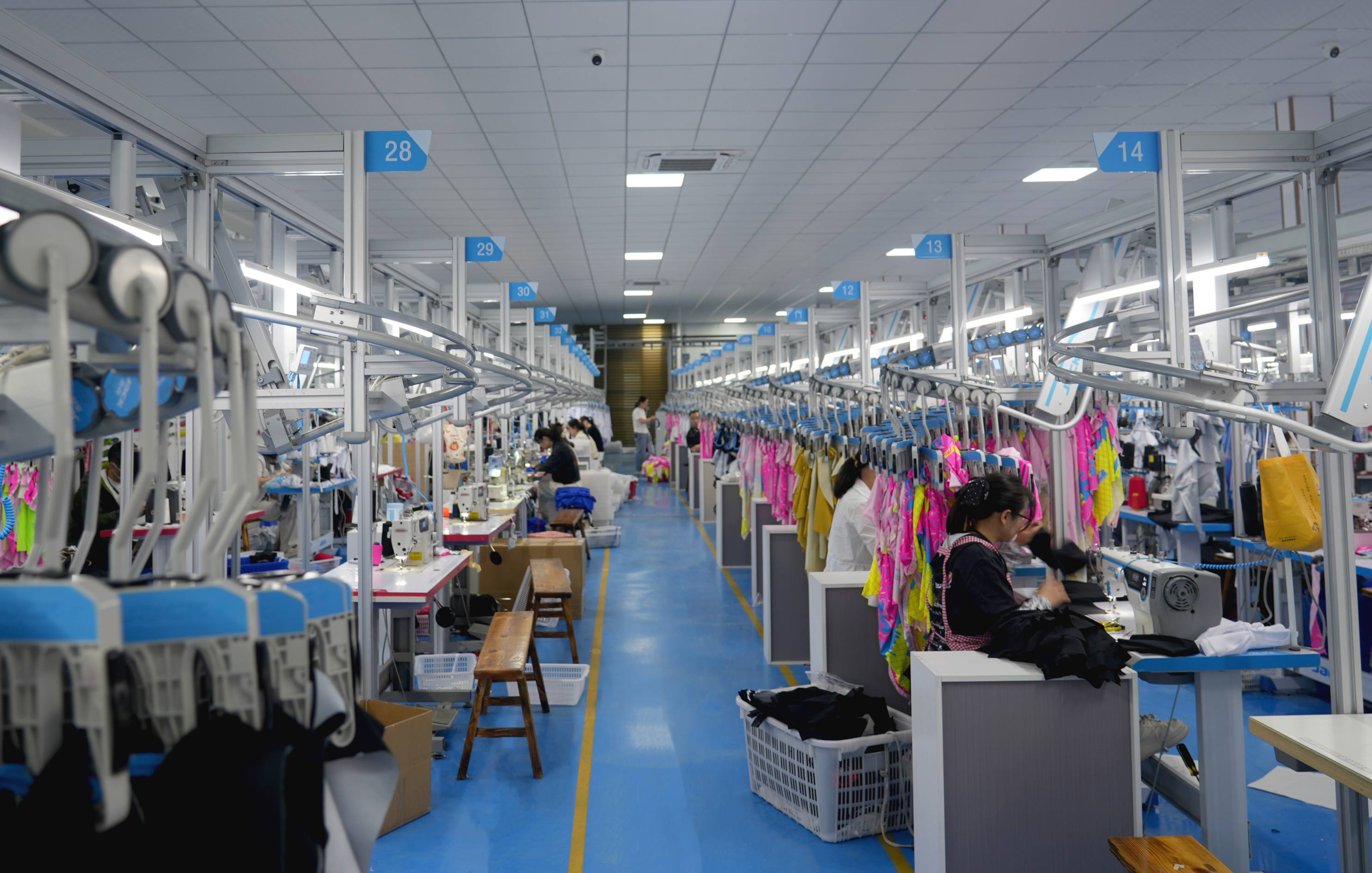
At LJVOGUES, our QC system operates across four internal checkpoints before any shipment leaves our 8,000 m² Shenzhen facility.
"We do not wait for a buyer's third-party inspector to tell us there's a problem — by the time they arrive, we have already run our own four-stage check. We welcome third-party PSI because we know what they're going to find. Our internal QC team reviews materials on arrival, checks construction at 25% production completion, runs a full AQL sample at end-of-line, and then signs off on the packing verification. The third-party inspector is the buyer's second opinion, and we have no issue with that."
— Ocean Yang, Founder, LJVOGUES
LJVOGUES 4-Checkpoint QC System:
Checkpoint | Timing | Responsible | Focus |
CP1 — Incoming Materials | Before cutting | QC Manager | Fabric GSM, PFAS cert, colour vs. swatch, absorbent core documentation |
CP2 — In-Line Production | 20–25% complete | Line Supervisor + QC | SPI, seam strength, gusset integrity, label accuracy |
CP3 — End-of-Line AQL | 100% production complete | QC Team | AQL 2.5 sampling, absorbency spot-test, dimensional measurements |
CP4 — Packing Verification | Carton packing | QC + Shipping | Barcode scan, carton count vs. packing list, label accuracy |
All QC findings are documented in writing. Any lot that fails CP3 AQL enters a mandatory sort-and-rework cycle before CP4 begins. Rework records are retained for a minimum of 12 months and are available to buyers on request.
For orders requiring absorbency certification — particularly buyers supplying UK retailers, US chains, or medical/pharmacy channels — LJVOGUES coordinates third-party lab testing through Bureau Veritas or equivalent accredited laboratories as part of the standard OEM service.
Factory Audit: Beyond Product QC
A product QC inspection verifies the finished goods. A factory audit verifies the system that produces them — management practices, worker conditions, environmental compliance, and process controls.
For buyers who are establishing a long-term supplier relationship, or who are supplying major retailers (who typically require factory audit reports), a social compliance or quality management system audit is a separate process from PSI.
Key differences:
Product QC (PSI) | Factory Audit | |
What's checked | Finished goods quality | Factory management system |
Who conducts it | Inspection company | Audit company (SGS, Bureau Veritas, BSCI) |
Duration | 1 man-day | 1–2 days |
Output | Pass/fail inspection report | Audit certificate (BSCI, SEDEX, ISO 9001) |
Frequency | Every shipment | Annually |
LJVOGUES holds current BSCI, SEDEX, and ISO 9001 certifications. Audit reports are available to qualified buyers upon signing an NDA.
Frequently Asked Questions
Q1: What AQL should I use for period underwear?
Use AQL 0 for critical defects (safety, contamination, PFAS), AQL 2.5 for major defects (functional failures, wrong labelling, seam failures), and AQL 4.0 for minor defects (cosmetic issues that do not affect function). These are the standard levels for intimate apparel and are specified in ISO 2859-1. Write these levels into your purchase order contract before production begins.
Q2: Can I trust the factory's own QC reports?
No — not as your only quality verification. A factory's own QC report is an internal document. It reflects what the factory's staff found and chose to report. Third-party inspection provides independent sampling with no conflict of interest. Use the factory's QC report as a supporting document, not as a substitute for independent PSI.
Q3: How much do third-party inspections cost in China?
Typical rates in China range from $298 to $600 per man-day depending on the provider. SGS and Bureau Veritas sit at the higher end; QIMA starts from $309/man-day; AQF from $298/man-day. Most single-factory PSIs require one man-day. Budget $350–500 as a planning figure for standard orders.
Q4: What if the factory refuses third-party inspection access?
Factory refusal of third-party inspection access is a serious red flag. A factory with nothing to hide welcomes independent inspection. If a factory refuses, withhold the final payment balance and do not allow shipment. Add unrestricted inspection access as a mandatory clause in your supplier agreement before placing orders. [internal link: Article 12 — 10 Red Flags When Sourcing Period Underwear]
Q5: How do I test period underwear absorbency during a factory inspection?
For spot-testing during a pre-shipment inspection, select 5 random units from the inspection sample. Pour a measured quantity of water (equal to the product's stated capacity in ml) onto the inner layer of the gusset. Wait 2 minutes. Press white absorbent paper against the inner layer. If significant moisture transfers to the paper, the re-wet performance has failed. For formal absorbency certification, commission Bureau Veritas or Intertek to conduct a full static absorbency and moisture management test.
Q6: What is the difference between a pre-shipment inspection and a final random inspection?
These terms are used interchangeably in most sourcing contexts. Both refer to an AQL-based random sampling inspection conducted when 100% of production is complete and 80% or more is packed. Some inspection companies use "final random inspection" (FRI) as their internal terminology; the process and scope are equivalent to PSI.
Q7: How many defects are allowed in a lot of 1,000 units under AQL 2.5?
Under General Inspection Level II, a lot of 1,000 units requires a sample of 80 pieces. Under AQL 2.5 for major defects, the acceptance point is 5 defects — meaning if 5 or fewer major defects are found in the 80-piece sample, the lot passes. If 6 or more major defects are found, the lot is rejected. For critical defects, the acceptance number is 0.
Q8: Should I specify size grade tolerances in the tech pack?
Yes — always. The industry standard tolerance for intimate apparel is ±0.5 inch (±1.3 cm) on all key measurements. If you do not specify tolerances in the tech pack or purchase order, you have no contractual basis to reject an order for dimensional non-conformance. Include measurement tolerances explicitly in both your tech pack and your supplier agreement.
Q9: What happens to production lots that fail PSI?
You have four options: full sort-and-rework followed by re-inspection; re-inspection of the existing lot after sorting; price discount negotiation for minor defect overruns; or outright refusal of goods. For critical or major defect failures, sort-and-rework or refusal are the appropriate responses. Always document the outcome in writing and retain the original inspection report regardless of the resolution path chosen.
Q10: How do I know if a factory has genuine certifications versus forged documents?
Verify certifications directly through the certifying body's online database. OEKO-TEX certifications can be verified at oeko-tex.com/certificate-checker. BSCI and SEDEX memberships can be verified directly with those organisations. ISO 9001 certificates should include an accreditation body reference number which can be independently confirmed. Do not accept PDF copies alone — always verify the certificate number through the issuing body's portal.
Work With a Factory That Documents Everything
QC protocol is only as strong as the factory enforcing it. Documentation — test certificates, inspection records, rework logs, packing verification sign-offs — is what separates a professional manufacturing partner from a factory that relies on buyers not checking.
At LJVOGUES, every order above 300 pieces includes a full QC documentation package: incoming material certificates, in-line inspection records, end-of-line AQL report, and packing verification sign-off. Third-party PSI is welcomed and can be coordinated through your preferred inspection company or through our preferred partners.
If you are building a period underwear line and want to review our QC documentation standards before placing a first order, contact the LJVOGUES sourcing team at www.ljvogues.com to request a sample documentation package alongside your first sample quote.