



Table of Contents
TL;DR — 10 Red Flags at a Glance
A factory posing as a manufacturer, missing or unverifiable certifications, prices 30%+ below market, demands for 100% upfront payment, no period underwear specialisation, evasive communication, refusal of factory visits or third-party inspections, stolen or stock photos, no written contract, and zero online footprint are the ten most reliable warning signs that a period underwear supplier cannot be trusted. Identifying even two or three of these signals simultaneously should put any sourcing relationship on hold.
Why Due Diligence Matters
Every year, period underwear brands — from early-stage DTC founders to established importers — lose between $20,000 and $200,000 to unreliable factories. The losses take multiple forms: outright fraud where a deposit is paid and the supplier disappears; substandard bulk production that cannot be sold; missed ship windows that cost retail shelf space; and in the worst cases, product recalls triggered by undisclosed chemical content in materials.
The reputational damage is frequently worse than the financial loss. A recall tied to PFAS-contaminated fabric, for example, can permanently damage consumer trust in a brand that spent years building its position. In a market growing at a 21.1% CAGR through 2033, the stakes for getting your factory decision right are high and rising.
The root cause of most sourcing disasters is not bad luck. It is avoidable due diligence failure. Buyers who skip factory verification steps because a supplier seems professional over email, offers a compelling price, or shows an impressive website end up learning the same lesson the hard way. The ten warning signs below are drawn from 20+ years of observing how sourcing relationships break down. They are operational signals, not gut feelings.
The 10 Critical Red Flags
Red Flag #1 — Trading Company Posing as a Factory
The signal: The supplier uses language like "our factory" and "our production team" but cannot produce a verifiable facility address, business registration showing a manufacturing scope, or live video of a production floor.
Why it matters: Trading companies sit between the buyer and the actual manufacturer. They add a margin — typically 15–30% on top of ex-factory cost — while holding no production authority. When quality issues arise, they have no power to enforce corrections at the mill. When delays happen, they have no visibility into the production queue. You are effectively paying a premium for a relationship that reduces your control and your recourse.
A legitimate factory will have a registered business licence explicitly listing "manufacturing" or "production" in its business scope (经营范围). It will have an employee headcount consistent with its claimed capacity, utility bills showing industrial power consumption, and a verifiable address on Chinese business registration databases such as National Enterprise Credit Information Publicity System.
How to verify:
Request a live video factory tour via WeChat or Zoom — not a pre-recorded promotional video
Ask for the business licence (营业执照) in full; confirm the business scope includes manufacturing
Request the factory's power supply contract — a genuine 8,000 m² production facility will have commercial/industrial electricity capacity, not residential
Cross-check the registered address on Google Maps satellite view

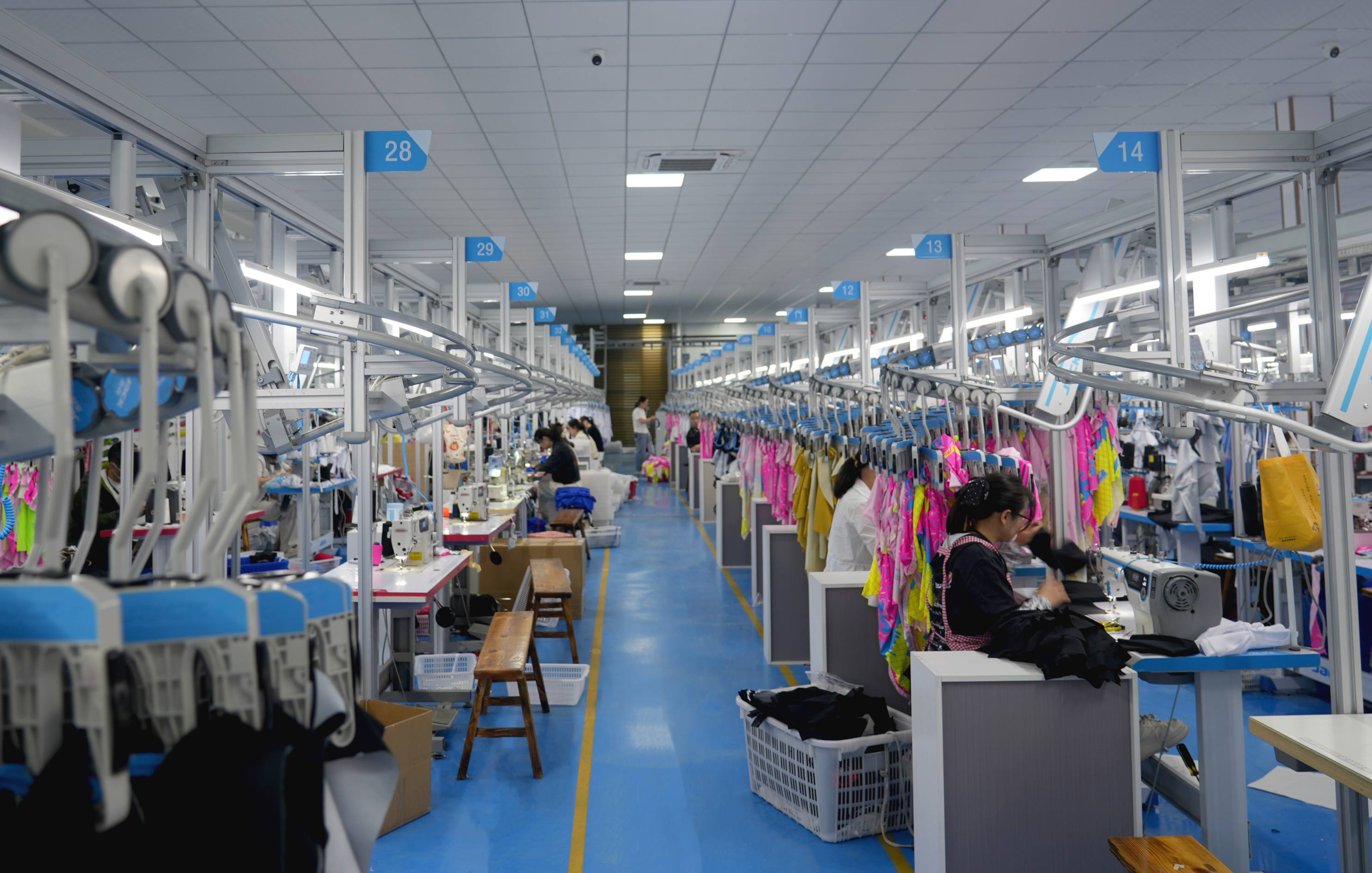
Ljvogues-Factory Interior
Red Flag #2 — No Verifiable Certifications
The signal: The supplier claims "ISO certified," "OEKO-TEX certified," or "GOTS certified" but provides only logo images, PDF copies with no certificate numbers, or documents with obviously inconsistent fonts.
Why it matters: Period underwear sits directly against skin for hours. Your retail buyers and end consumers are increasingly informed about chemical safety. Certifications like OEKO-TEX® STANDARD 100 carry specific certificate numbers and are publicly searchable — they are not logos you can copy from a website. A factory that fabricates certification claims will fabricate quality claims too.
Counterfeit certification documents are more common than most buyers assume. They are straightforward to produce, look plausible in a PDF, and are rarely challenged by buyers who do not know how to verify them.
How to verify:
Check OEKO-TEX certificate numbers on the official OEKO-TEX label checker at label.oeko-tex.com
Check GOTS claims on the GOTS public database
For ISO 9001/14001, ask for the certificate issuing body name (e.g. Bureau Veritas, SGS, TÜV) and verify on the certifying body's own portal
BSCI and SEDEX reports can be shared directly from the audit platform; ask for login access to the shared report rather than a PDF copy
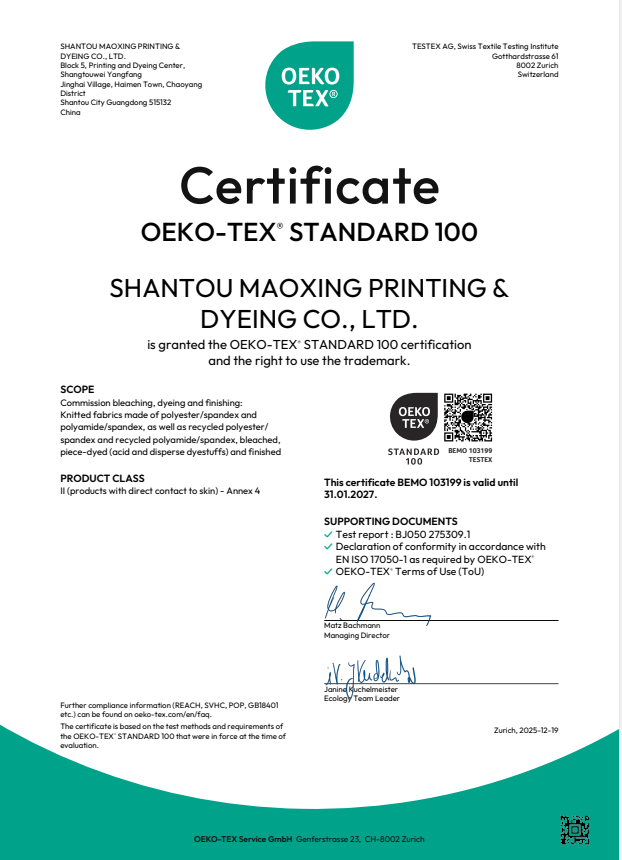
OEKO-TEX dyeing certificate provided by the upstream factory
Red Flag #3 — Unusually Low Prices
The signal: A factory quotes you ex-factory prices 30% or more below the range you have received from other suppliers. The quote may also be suspiciously fast — sent within an hour of your inquiry, without any technical questions about your spec.
Why it matters: Period underwear is not a commodity product. It requires a 4-layer absorbent construction, specialised lamination, and proprietary fabric blends. The ex-factory cost for a well-made period brief runs $3–12 per piece depending on absorbency, fabric quality, certification status, and order volume. A quote significantly below this range either reflects a stripped-down construction that will fail in absorbency testing, undisclosed substandard materials, or a deliberate loss-leader designed to capture a deposit before issues emerge.
Hidden costs are also common: once you have committed, the factory introduces sample fees, tooling fees, mould fees for custom hardware, or "rush surcharges" that erode the apparent saving.
How to verify:
Collect 3–5 factory quotes before evaluating any single offer; outliers become immediately visible
Ask for a cost breakdown by component (fabric, absorbent core, sewing labour, trims, packaging) — a confident factory will share this
Request confirmation of the absorbent core specification included in the quote; a vague answer ("standard quality") is a secondary red flag

Menstrual Panties with Multi-Layered Gusset
Red Flag #4 — Pressure to Pay 100% Upfront
The signal: The factory insists on full payment before production begins, frames it as "factory policy," and declines to negotiate payment structure.
Why it matters: The standard payment structure in legitimate Chinese manufacturing for a new buyer relationship is 30% T/T deposit before production + 70% T/T balance before shipment (or against bill of lading copy for established relationships). 100% upfront payment removes all financial leverage from the buyer. Once your funds are transferred, you have no mechanism to enforce production quality, delivery dates, or compliance with your tech pack.
This is the most direct path to the "disappearing factory" scam pattern described later in this article.
How to verify:
Insist on T/T 30/70 as a non-negotiable condition before proceeding
For a first order with an unfamiliar factory, use Alibaba Trade Assurance — it holds funds in escrow and releases them only on confirmed shipment
For higher-value orders ($50K+), explore a Letter of Credit (LC) with your bank — this provides documentary conditions that must be met before payment is released
Never wire funds to a personal bank account or a Hong Kong account presented as the "factory's export account"
Red Flag #5 — No Period Underwear Specialisation
The signal: The factory's primary product range is standard cotton briefs, shapewear, or fashion lingerie. Period underwear capability is presented as an add-on or "we can make anything" service.
Why it matters: Period underwear is not a standard intimate apparel product. Effective construction requires specific equipment — ultrasonic bonding for the absorbent core layers, precision lamination to bond the leak-proof barrier without compromising breathability, and tested seam construction that prevents lateral leakage. A general underwear factory that has never produced period underwear at scale will not have this equipment and will not have the engineering knowledge to troubleshoot absorbency failures.
The consequences are predictable: prototypes pass basic tests, bulk production underperforms, and the factory has no process documentation to diagnose why.
How to verify:
Ask to see existing production samples from other period underwear brand clients — not samples made specifically for your inquiry
Request reference clients (brand names or contact details for at least two buyers of period underwear they have produced)
Ask specifically: "What ultrasonic bonding equipment do you use for absorbent core assembly?" — a genuine factory answers precisely; a non-specialist deflects
Red Flag #6 — Vague or Evasive Communication
The signal: Response times consistently exceed 48 hours, answers to technical questions are generic ("no problem, we can do it"), there is only one English-speaking contact who cannot answer engineering-level questions, and the supplier declines to put you in contact with their production or technical team.
Why it matters: The sourcing relationship depends on precise technical communication. Your tech pack will contain absorbency specifications, AQL tolerance levels, fabric weight requirements, stitch density standards, and packaging instructions. If your only contact is a salesperson who cannot discuss these details, that information is not reaching the people making your product.
Evasive communication at the inquiry stage predicts evasive communication during production — the point at which problems actually need to be resolved.
How to verify:
Request a video call with a factory engineer or merchandiser (not the salesperson)
Ask a specific technical question: "What is your standard AQL level for absorbency testing, and which test method do you use — gravimetric or capacity?" A confident factory answers specifically
Assess whether the person you're speaking with has actually read your tech pack before the call

Red Flag #7 — Won't Allow Factory Visit or Third-Party Inspection
The signal: The factory declines a buyer site visit, citing "confidentiality," "client privacy," or "factory security." It also pushes back on pre-shipment inspection (PSI) by third-party agencies.
Why it matters: Legitimate factories welcome visitors. Factory visits are a standard part of the OEM/ODM process, particularly for orders over $20,000 or at the start of a new client relationship. Third-party pre-shipment inspection by agencies such as SGS, QIMA, or Bureau Veritas is a recognised industry practice — it protects the factory's reputation as much as the buyer's investment.
A factory that refuses inspection has something to hide. The most common reason is that the stated factory is not where your goods will actually be produced.
How to verify:
Announce a planned factory visit as part of your RFQ process — treat a refusal as disqualifying
Include a third-party PSI clause in your manufacturing agreement; the right to inspect should be written in, not requested informally
For remote buyers, book a QIMA or SGS audit as a standalone verification before committing to a first production order
Red Flag #8 — Inconsistent or Stolen Photos
The signal: The factory's website, Alibaba listing, or sales materials feature production floor photos that appear on multiple different company websites. The images are stock photos, overly polished renders, or were taken in a facility that does not match the claimed location or scale.
Why it matters: A factory that lacks real photos of its own production floor almost certainly does not have one. Photo theft among trading companies presenting as manufacturers is widespread. The same facility images sometimes appear on 10–15 different "factory" profiles simultaneously.
How to verify:
Run reverse image searches (Google Images, TinEye) on 3–5 of the factory's production photos
Ask the supplier to send a photo of the production floor with today's date on a piece of paper or a current newspaper headline visible — a live request that cannot be satisfied with stock images
Request a live, unscripted video call showing the floor in real time; ask them to walk to the sewing section and show you the machines running
Red Flag #9 — No Written Contract or Vague Tech Pack Acceptance
The signal: The supplier wants to proceed based on a rough brief — "just send the design and samples, we'll figure it out." There is resistance to signing a formal manufacturing agreement and no structured process for locking technical specifications in writing.
Why it matters: Without a signed manufacturing agreement tied to a locked tech pack, you have no enforceable recourse when the bulk production diverges from the approved sample. "We'll figure it out" is a phrase that almost always means "we will do what is expedient when we have your deposit." Every quality dispute that ends badly for the buyer traces back to an absence of documented, mutually signed specifications.
How to verify:
Insist on a signed manufacturing agreement before sample production begins; it should cover spec tolerances, AQL levels, delivery dates, and remediation terms for out-of-spec production
The tech pack should be formally approved and co-signed — any changes should require written amendment
If a factory refuses to sign basic documentation, walk away
[internal link: Article 9 — Sampling & Prototyping Period Underwear: Timeline & Costs]
Red Flag #10 — Bad Reviews or No Online Footprint
The signal: The company's website was registered within the past 12–18 months. There is no LinkedIn company page, no Canton Fair exhibition history, no verifiable client references, and no presence on industry B2B platforms. Alternatively, there are negative reviews on Trustpilot, Reddit sourcing forums, or Alibaba.
Why it matters: Established manufacturers accumulate a verifiable digital footprint over time: trade show participation, industry directory listings, client testimonials that can be followed up, and platform rating histories. A factory with no footprint is either brand new (and therefore unproven for your production) or deliberately operating without traceable history.
How to verify:
Check Alibaba or Made-in-China.com registration year and response rate metrics
Search the company name on LinkedIn; a legitimate 8,000 m² factory will have staff profiles, past employees, and a company page
Search the company name alongside "review," "scam," or "complaint" in English and Chinese (use Google Translate for Chinese search terms)
Ask whether they have exhibited at the Canton Fair; request their booth number and edition year and verify at Canton Fair official records
Bonus Red Flags
Beyond the ten primary signals, flag any supplier who exhibits the following:
Refuses to disclose subcontracting: Your order may end up at a third factory with no quality controls, no certifications, and no accountability.
Claims "everything is possible" without asking questions: A factory that does not interrogate your specs does not understand your specs. A specialist manufacturer will push back on technically unrealistic requirements.
Refuses to sign an NDA: Protecting your design files and proprietary tech pack is non-negotiable. NDA refusal suggests either legal naivety or an intent to use your designs.
Will not provide MSDS (Material Safety Data Sheet) for materials: For period underwear sold into the EU, US, or UK, material safety documentation is a compliance requirement. A factory that cannot supply MSDS either does not know what is in its materials or is concealing it.
The Due Diligence Checklist Before Signing
Before committing to any manufacturing agreement, complete each of the following verifications:
Confirm business licence shows manufacturing scope
Verify registered business address against satellite imagery and public records
Conduct a live video tour of the production facility
Confirm employee headcount aligns with claimed production capacity
Verify OEKO-TEX certificate number on label.oeko-tex.com
Verify ISO certificate via issuing body's portal
Request BSCI/SEDEX audit report directly from the platform (not PDF copy)
Collect minimum three comparable factory quotes to assess price reasonableness
Obtain a cost breakdown by component for the quoted product
Request period underwear samples from at least two existing brand clients
Conduct a video call with an engineer or technical merchandiser (not only a salesperson)
Confirm payment terms of 30/70 T/T or Letter of Credit before proceeding
Book a SGS, QIMA, or Bureau Veritas factory audit prior to first order
Review Alibaba/Made-in-China registration year and platform ratings
Sign a manufacturing agreement and locked tech pack before sample production begins
Real-World Scam Patterns
Understanding how fraud actually unfolds helps buyers recognise early warning signs.
Pattern A — Bait and Switch: The factory invests genuinely in your pre-production sample. The sample is excellent. Bulk production is manufactured from downgraded materials — lower-weight fabric, inferior absorbent core filler, cheaper elastic — that are visually indistinguishable until tested under absorbency or wash durability protocols. This is the most common quality fraud in the industry and is best countered by pre-shipment inspection and locked material specifications with mill certificates.
Pattern B — Disappearing Factory: The factory collects a 50–100% deposit, begins stalling with production updates, and eventually becomes unreachable. This pattern is concentrated among suppliers who were never real factories — they are brokers who intended to pocket the deposit without placing any production. Prevention: use Alibaba Trade Assurance or a Letter of Credit; never wire funds to personal accounts.
Pattern C — Trust-Built Quality Decline: The first two or three orders are executed at high quality. Prices may even be slightly below market. On the third or fourth order — once the buyer is locked in psychologically and operationally — quality degrades significantly. By this point, many buyers absorb the bad order rather than restart the sourcing process. Prevention: conduct PSI on every order regardless of relationship history; write quality standards into the standing agreement.
Pattern D — Counterfeit Certification Documents: The supplier provides professionally formatted PDF copies of OEKO-TEX, ISO, or GOTS certificates. The certificate numbers either do not exist in the certifying body's database or belong to a different company entirely. Prevention: verify every certificate number directly with the issuing body before finalising any supplier agreement.
How to Protect Yourself Financially
Supplier verification reduces the probability of fraud. Financial structure reduces the cost when things go wrong.
Letter of Credit (LC): A documentary LC requires the seller to present specific shipping and compliance documents before the issuing bank releases payment. It is the most robust protection for orders above $30,000 and provides bank-level enforcement of delivery conditions. Your bank's trade finance department can structure this.
Alibaba Trade Assurance: For suppliers found on Alibaba, Trade Assurance holds your payment in escrow and releases it only after confirmed shipment. Dispute resolution is handled by Alibaba. It is most practical for orders under $50,000 and provides meaningful recourse for non-delivery and quality disputes.
Escrow services: Third-party escrow (Escrow.com and similar platforms) can be used for suppliers outside Alibaba's ecosystem. Both parties agree to conditions upfront; funds are released only when conditions are met.
Phased payment tied to milestones: Structure payment releases against verifiable production milestones — fabric approval, cut panel inspection, pre-shipment inspection sign-off. Each milestone payment is small enough that you retain financial leverage throughout the production cycle.
Red-line rule — personal Hong Kong accounts: If a supplier requests wire transfer to a personal bank account or to a Hong Kong account presented as their "overseas trading account," treat this as an immediate disqualifier. Legitimate Chinese manufacturers operate through corporate accounts in mainland China. Personal account payment requests are strongly associated with fraud.
Recovery Options If You Are Already Affected
If fraud has already occurred, the following channels offer varying degrees of recourse:
PayPal / credit card dispute: If payment was made via PayPal or a credit card, initiate a dispute immediately. PayPal's buyer protection and credit card chargeback mechanisms are most effective when invoked within 180 days of payment.
Alibaba dispute resolution: If the transaction was conducted through Alibaba Trade Assurance, file a formal dispute through the platform. Alibaba's dispute team has investigative authority over suppliers on its platform.
China Council for the Promotion of International Trade (CCPIT): The CCPIT provides commercial dispute mediation and can assist with cross-border trade disputes. This route is appropriate for larger disputes where mediation may produce a negotiated settlement.
Local Chinese law firms: For disputes exceeding $20,000 with documented evidence (contract, payment records, communications), engaging a Chinese commercial law firm in Shenzhen, Guangzhou, or Shanghai is a realistic path. Enforcement of judgements against registered Chinese companies is possible, though time-consuming.
Practical note: The most effective "recovery" is prevention. The cost of a $500 third-party factory audit is trivial relative to the cost of recovering a fraudulent $50,000 order.
Why LJVOGUES Welcomes Every Verification
"We have been manufacturing period underwear for over 20 years, and in that time I have seen every form of supplier fraud described in this article. That experience is exactly why LJVOGUES operates with a full open-door policy. We routinely host buyer visits at our 8,000 m² Shenzhen facility, we welcome SGS, Bureau Veritas, and Intertek inspections on every order, and every one of our certifications — OEKO-TEX STANDARD 100, BSCI, SEDEX, ISO 9001, ISO 14001, FDA, GRS — is published publicly with verifiable certificate numbers. Trust is not something we ask buyers to assume. It is something we earn through documentation and transparency, one order at a time."
— Ocean Yang, Founder, LJVOGUES (Shenzhen Ljvogues Sports Fashion Limited)
At LJVOGUES, we treat factory verification as a mutual benefit. A buyer who has thoroughly vetted our facility, our certifications, and our production capabilities is a buyer who has confidence in the relationship from day one. That confidence produces faster approvals, clearer communication, and better product outcomes for both sides.
Our factory verification package for new clients includes:
Verification Item | LJVOGUES Status |
Business licence (manufacturing scope) | Available on request |
Live factory video tour | Scheduled within 5 business days |
On-site buyer visit | Welcome; Shenzhen, year-round |
Third-party audit (SGS / BV / Intertek) | Welcome; contractually accommodated |
OEKO-TEX certificate (public) | Certificate number publicly listed |
ISO 9001 / 14001 certificate | Available on request |
BSCI / SEDEX report access | Shared directly via platform |
PFAS-free verification | Test reports available |
Reference clients | Available subject to client consent |

Frequently Asked Questions
Q1: How do I verify a Chinese factory is a real manufacturer and not a trading company?
Request the business licence and confirm the business scope includes "manufacturing" . Cross-check the registered address on China's National Enterprise Credit Information Publicity System (gsxt.gov.cn). Ask for a live video of the production floor showing active machinery and a workforce. A trading company cannot fabricate a factory floor on demand.
Q2: What if the factory passed all verification checks but bulk quality is still bad?
Supplier verification reduces fraud risk but does not eliminate production quality risk. The additional protection layer is a contracted pre-shipment inspection (PSI) with AQL 2.5 tolerance, conducted by an independent agency such as QIMA or SGS, before the balance payment is released. If the PSI fails, you retain financial leverage to require remediation before goods ship.
Q3: Is sourcing through Alibaba safer than sourcing directly?
Alibaba provides transparency tools (supplier years on platform, transaction volume, response rate) and Trade Assurance payment protection that direct sourcing does not. However, Alibaba verification does not confirm production capability. The 10 red flags in this article apply equally to Alibaba suppliers. Use Trade Assurance for financial protection and conduct independent factory verification regardless of Alibaba's supplier badges.
Q4: Should I work with a sourcing agent instead of dealing with factories directly?
A reputable sourcing agent with verifiable China-side presence can accelerate factory vetting and manage quality control on your behalf — particularly valuable if you cannot visit China. However, sourcing agents add a layer of cost and create their own principal-agent problem: confirm the agent's fee structure upfront and ensure they are not receiving kickbacks from the factory. Request that the agent attends the factory inspection in person, not by proxy.
Q5: What is the safest payment method for a first order?
Alibaba Trade Assurance for Alibaba-sourced suppliers; a Letter of Credit for off-platform suppliers with order values above $20,000–$30,000. Both methods hold payment conditionally against delivery performance. Wire transfer (T/T) to a new supplier's corporate account with a 30/70 structure is standard but provides less recourse than escrow-based mechanisms.
Q6: How do I know if a certification document is fake?
Do not rely on PDFs. Every major certification body operates a public database: OEKO-TEX at label.oeko-tex.com, GOTS at global-standard.org. Enter the certificate number from the document and confirm it resolves to the correct company name and scope. If the certificate number does not appear, or resolves to a different entity, the document is not authentic.
Q7: What red flags apply specifically to period underwear vs. general apparel sourcing?
Period underwear has three additional risk layers beyond general apparel: (1) absorbent core fabrication requires specific equipment that most general factories do not have; (2) material chemical safety is a regulatory and consumer safety issue, not just a quality preference — PFAS contamination in particular has triggered regulatory action in the EU and US; (3) absorbency claims are measurable and will be tested by serious buyers and retailers. A factory without period-specific production experience and OEKO-TEX or equivalent certification introduces all three risks simultaneously.
Q8: Should I ask for a factory audit even for a small first order?
Yes. The cost of a QIMA or SGS factory audit ($300–$600 for a standard assessment) is fixed regardless of order value. On a $5,000 first order, that cost is significant as a percentage. On a $50,000 first order, it is negligible. More importantly, the audit findings inform not just the first order but every subsequent order with that supplier. The audit is an investment in the long-term relationship, not a one-time transaction cost.
Ready to Source With Full Transparency?
Sourcing period underwear is a high-stakes decision. The factory you choose determines your product quality, your compliance posture, your delivery reliability, and ultimately your brand reputation in the market.
LJVOGUES has served 500+ global brands across 20+ years of period underwear manufacturing. Our facility, certifications, and production team are available for verification at any stage of your sourcing process — before you commit to a sample, before you place a first order, or before you transition from your current supplier.
To request a factory verification package, schedule a video call with our team, or discuss your OEM/ODM requirements, visit www.ljvogues.com or contact us directly.
External references: OEKO-TEX Label Checker | Alibaba Trade Assurance | CCPIT Commercial Dispute Services | GOTS Certified Entities Database