



Table of Contents
TL;DR: The period biker short is the most technically demanding leakproof garment to manufacture. It requires simultaneous engineering of high-compression fabric (80–85% nylon / 15–20% spandex), a multi-layer absorbent gusset (3–5 layers with fluid-channeling structures), a thin TPU barrier laminate that survives 50+ wash cycles, and flatlock construction that maintains structural integrity under dynamic stretch. This article breaks down the four engineering pillars, five common failure modes, testing protocols every brand should demand, and a 12-point specification checklist for sampling.
Why the Period Biker Short Matters Now
In May 2022, PUMA and Modibodi launched the first period activewear underwear collaboration — a range of leak-proof biker shorts and leggings combining PUMA's compression engineering with Modibodi's absorbent technology. By October 2022, the pair had extended the collaboration to a full period activewear collection — including cycle shorts with patent-pending Activewear Technology — targeting the estimated 50% of girls who experience discomfort from disposable menstrual products during sport.
The timing was not accidental. The cycling wear market alone is valued at USD 8.70 billion in 2026, projected to reach USD 12.90 billion by 2033 at a 5.8% CAGR, with apparel accounting for 72.4% of that market. Knix's period leggings absorb the equivalent of 1–3 regular tampons (approximately 10–30ml), while Thinx Active leggings target approximately 3 tampons (~30ml) of capacity. The consumer appetite exists. The supply-side challenge is manufacturing a garment that can deliver on those claims.
From my 20 years at the production bench, I can say without qualification: the period biker short is the hardest leakproof garment category to manufacture correctly. The compression requirement works directly against the absorption requirement. The sweat environment challenges TPU stability. Dynamic cycling motion — pedaling, sprinting, standing on the saddle — stresses every seam and layer simultaneously. Most factories that produce period underwear competently cannot produce a period biker short that survives real activity.
This article is the manufacturer's technical blueprint. It is intended for brand owners and product developers who are either entering this category or who want to ask sharper questions of their manufacturing partners.

PUMA's compression engineering with Modibodi's absorbent technology
Part 1: Why the Biker Short Is the Hardest Period Garment to Engineer
Period underwear is a solved engineering problem at this point. The standard 3–4 layer gusset, TPU laminate, and cotton or microfiber outer shell are well-understood. The period biker short introduces three physical conflicts that period underwear does not face.
The compression-absorption conflict. A performance biker short requires graduated compression — typically 15–25 mmHg in the thigh zone — to reduce muscle oscillation and support blood flow during cycling. Compression is generated by fabric tension: the fabric is cut undersized and stretches across the body. That tension is also compressive force on the gusset. Absorbent materials work by creating capillary spaces that hold fluid. Constant compression collapses those capillary spaces. If the absorbent core is too thick or too loose, compression force squeezes fluid back toward the surface — exactly the failure mode consumers report as "the fluid just sat there instead of being absorbed." The engineering solution is thin, dense absorbent layers rather than thick, lofted layers. This counterintuitively means the gusset needs to be thinner than in standard period underwear, not thicker, while still achieving the same volumetric capacity.
Sweat-environment TPU stability. During cycling, the gusset area routinely reaches 35–38°C with high humidity from sweat. Standard solvent-laminated PUL can soften under sustained thermal and moisture load, causing delamination at the edges. Thermally bonded TPU — where the film is heat-pressed rather than adhesive-bonded — maintains structural integrity under these conditions without chemical off-gassing. The challenge is that thinner TPU films (which are required for breathability in activewear) are more susceptible to edge-seal failure than the heavier films used in period underwear.
Dynamic gusset instability. In a standard pair of underwear, the gusset is relatively static. In a biker short, the wearer goes through hip flexion angles of 90–120 degrees during the pedal stroke. The gusset is pulled forward, backward, and laterally with each pedal revolution. Without proper anchoring — typically diagonal stitching at the gusset corners and a reinforced center seam — the multi-layer absorbent panel shifts within the garment. A shifted gusset loses coverage precisely in the zones where coverage is most critical.

Part 2: The Four Engineering Pillars
Pillar 1: Compression Fabric Selection
The outer shell of a period biker short determines the garment's compression level, moisture management, durability, and aesthetic. For this application, the optimal base fabric is a nylon-spandex blend in the 80–85% nylon / 15–20% spandex ratio, knitted at 200–230 gsm for the thigh and seat panels.
Why nylon over polyester for this category? Nylon-spandex blends achieve a recovery rate of 95–98%, versus 90–95% for polyester-spandex. In a compression garment worn for 2–4 hours of continuous activity, that recovery differential matters: polyester-spandex begins to show compression creep (gradual pressure loss) faster under sustained stretch. Nylon is also inherently softer against skin — relevant for a garment in direct contact with the inner thigh during cycling.
Fabric weight is a critical specification. At below 180 gsm, the fabric lacks the density to generate meaningful compression. Above 260 gsm, the garment becomes thermally uncomfortable during sustained aerobic activity. For period biker shorts targeting the 15–35ml absorbency range, 200–230 gsm is the workable window.
Recovery rate testing should be conducted on wet samples, not dry. The outer shell is in a wet environment during use — sweat-saturated fabric behaves differently than dry fabric. Brands that only test dry recovery will be surprised by in-use performance.

Pillar 2: Absorbent Gusset Architecture
The absorbent gusset is the functional core of the garment. For a period biker short, the gusset architecture departs from standard period underwear design in three ways.
Thin-layer stacking, not thick-layer construction. The industry-standard gusset uses 3–5 layers, each serving a distinct function: moisture-wicking topsheet, primary absorbent, secondary absorbent or distribution layer, and TPU barrier. For a biker short, each individual layer must be thinner — target total gusset thickness under 4mm in the compressed state — while maintaining the same aggregate absorbency. This is achieved through denser microfiber construction and through precise layering sequence rather than thicker individual components.
Fluid-channeling structures. In a standard period garment, fluid migrates by capillary action through the absorbent mass. Under compression and during movement, passive capillary migration is insufficient. High-performing period biker shorts incorporate channeling structures — directional stitching lines or quilted patterns within the absorbent panel — that guide fluid from the point of contact toward the center of the gusset where absorbent density is highest, and away from the edges where leakage risk is highest. These channels must be engineered to remain functional under 80–90% stretch, which is the operational stretch range of the gusset during cycling.
Coverage geometry: toward-back extension and center concentration. Absorbent placement should be highest concentration in the central gusset zone, with strategic extension toward the back. For a cycling application, anterior coverage is less critical than posterior and lateral coverage — the seated position shifts fluid toward the back and toward the legs. The gusset should extend at minimum 15cm from front to back, with the high-density zone centered 6–8cm anterior from the rear seam.

ljvogues uses a thin-layer stacking structure
Pillar 3: TPU Barrier Lamination
The TPU barrier is the third layer from the outside, sitting between the absorbent layers and the outer shell. Its function is to prevent absorbed fluid from migrating outward.
Thermally bonded TPU vs. solvent-laminated PUL. Thermally bonded TPU — where the film is heat-fused to the backing fabric using controlled temperature and pressure — produces a bond without chemical solvents. The result is a softer hand, better breathability (measured in MVTR: moisture vapor transmission rate), and cleaner environmental credentials. Solvent-laminated PUL uses adhesive chemistry to bond the film, which can reduce breathability and may introduce residual chemical concerns. For period activewear, thermally bonded TPU is the technically superior choice, and it aligns with OEKO-TEX and PFAS-free certification requirements.
Film thickness and breathability balance. Thicker TPU films (>30 microns) are more robust against delamination but reduce breathability significantly. Thinner films (15–20 microns) maintain adequate MVTR but are more susceptible to edge-seal failure. The practical window for period biker short applications is 18–25 microns, with edge-reinforcement compensating for the reduced film thickness.
Edge heat-sealing. The perimeter of the TPU laminate must be heat-sealed, not just stitched. Stitching through the TPU film creates needle holes that become fluid pathways. Thermal edge bonding fuses the film to the surrounding fabric without penetrating the barrier. This step is one of the most common points of quality variation between factories.
Pillar 4: Construction Method
The choice of construction method affects seam comfort, seam strength under stretch, fluid management at seam lines, and production cost.
Construction Method | Stretch Tolerance | Seam Profile | Leakage Risk at Seam | Recommended Use Case |
Seamless (circular knit) | Very high | No external seam | Lowest | Premium minimalist shorts, no gusset seam required |
Bonded (heat-welded) | High | No external seam | Very low | Mid-tier to premium, requires bonding equipment |
4-Needle 6-Thread Flatlock | High | Flat, bilateral | Low (with sealed gusset) | Performance-grade, highest durability under wash |
2-Needle Overlock | Moderate | Raised, one-sided | Moderate | Budget construction, not recommended for period activewear |
The 4-Needle 6-Thread Flatlock stitch is the industry reference for performance activewear seam construction. Its flat, bilateral profile eliminates the raised seam ridges that cause chafing under compression. The stitch structure — four needle threads interlocking with six looper threads — distributes tensile load across the full seam width, allowing the seam to stretch alongside the fabric without stress concentration. This construction is the standard for the LJVOGUES period biker short program and is specified in every production tech pack.

Part 3: Absorbency Capacity Tiers by Activity
A single absorbency level does not serve the full spectrum of activities a period biker short is worn for. Brands entering this category should plan an SKU architecture that maps absorbency to activity intensity.
The following matrix is based on documented brand benchmarks — Knix's 1–3 tampon capacity, Thinx Active's ~30ml target — and the physiological reality that high-intensity exercise increases menstrual flow rate through increased intra-abdominal pressure and core activation.
Activity Profile | Intensity | Recommended Capacity | Gusset Thickness | Compression Level | Notes |
Yoga / Low-intensity | Low | 5–10ml | 2.5–3mm | 15 mmHg | Minimal sweat; TPU breathability less critical |
Daily commute cycling | Moderate | 10–15ml | 3–3.5mm | 18–20 mmHg | Seated position; back-extension coverage priority |
Running (30–60 min) | Moderate-high | 15–25ml | 3.5–4mm | 20–22 mmHg | Dynamic hip movement; channeling structures essential |
Cycling / Boxing / HIIT | High | 25–35ml | 3.5–4mm | 20–25 mmHg | Maximum sweat; TPU thermal stability critical |
Most brands launching into this category start with two SKUs: a moderate capacity (10–15ml) for everyday and commute use, and a high capacity (25–35ml) for performance sport. A three-tier range (light / moderate / performance) is the sustainable long-term architecture.
Part 4: The Hidden Failure Modes
Understanding failure modes before sampling prevents expensive iteration cycles. These are the five most common failure modes our engineering team encounters when auditing competitor products or reviewing failed samples.
1. Edge leakage at the gusset perimeter. This is the most common failure and is almost always a TPU edge-sealing issue. The TPU film is correctly laminated across the center but fails to seal at the gusset edge where the barrier layer meets the outer shell. Under load, fluid migrates along the edge channel. Solution: thermal edge bonding with a minimum 6mm sealed overlap, verified by pressurized dye testing.
2. Wet-state compression failure. A gusset that absorbs fluid correctly when dry collapses under compression when saturated, squeezing absorbed fluid back toward the surface. This occurs when absorbent layers are too lofted (high air content) rather than dense. Solution: specify absorbent materials with a compression recovery of >85% after 10ml saturation load, tested at 80% fabric extension.
3. TPU delamination after washing. Thermally bonded TPU can delaminate if wash temperatures exceed the film's bonding threshold, or if the bonding was done at insufficient temperature during production. The industry minimum durability standard is 50 wash cycles maintaining absorbent function. EU compliance standards require 52-wash verification at 30°C. Delamination typically appears at wash cycles 20–35 when bonding is substandard. Solution: verify bonding temperature log during production; conduct accelerated wash testing to 30 cycles before approving bulk.
4. Seam-line reverse absorption. Conventional stitching through the absorbent layers creates a fluid pathway along the thread channel. In a garment under dynamic stretch, this pathway can become a siphon — drawing absorbed fluid from the gusset back toward the surface seam and then to the outer shell. Solution: use flatlock construction that does not penetrate the TPU barrier layer, and ensure the TPU heat seal overlaps any seam intersection by at least 8mm.
5. Absorbent core migration. Under repeated wash and wear cycles, the absorbent layers can shift within the gusset panel, particularly if the channeling stitching is insufficient. A shifted core leaves coverage gaps in critical zones. Solution: specify quilting stitch density at minimum 4 rows per centimeter across the gusset, using thread that maintains elasticity under 80% stretch; verify core position after 10-wash accelerated aging.
Part 5: Testing Protocols Every Brand Should Demand
Before approving any period biker short sample, these protocols should be contractually required from your manufacturing partner:
Wet-state stretch testing. The gusset is loaded with 20ml of test fluid, then the garment is stretched to 80% of rated extension and held for 10 minutes. No fluid migration outside the gusset perimeter is acceptable. This test should be documented with photographic evidence.
52-wash durability cycle. Required under EU compliance standards. The garment is machine-washed 52 times at 30°C using standard detergent, then absorbency is re-measured. The garment must retain rated capacity within 10% of original specification. (For full EU regulatory context, see our article on EU Period Underwear Compliance Standards covering ISO 10993-1 biocompatibility, PFAS testing, and labeling requirements.)
Dynamic leak wear test. A human-motion wear test with the garment loaded to half of rated capacity, with the wearer completing a standardized 30-minute cycling protocol. No external fluid transfer to a white backing cloth is acceptable. This test cannot be replicated on a static mannequin — the channeling and compression interaction is only visible under real movement.
ISO 10993-1 biocompatibility screening. For brands targeting regulated markets, particularly the EU, biocompatibility screening of all materials in direct skin contact — including the topsheet, absorbent layers, and any antimicrobial treatments — should be conducted per ISO 10993-1 guidelines. This is particularly relevant for intimate-contact garments where mucosal skin exposure is a consideration.
20ml absorbency verification. The minimum absorbency claim verification for EU market compliance is 20ml. This should be independently measured using the EDANA WSP 10.1 gravimetric method or equivalent, with results documented on letterhead from a qualified third-party lab (Bureau Veritas, SGS, Intertek, or equivalent).
Part 6: LJVOGUES's Production Approach for Period Biker Shorts
At LJVOGUES, our period biker short program is built on the same engineering foundations that have made our period underwear the choice of 500+ global brand partners. The biker short category required us to extend and adapt that foundation in four specific ways.
4-Layer Leak-Proof Protection, compressed-format. Our standard 4-Layer system — moisture-wicking topsheet, primary absorbent, secondary distribution layer, TPU barrier — is re-engineered for the biker short format. Each layer is thinner and denser than in our underwear constructions, with the aggregate compressed thickness held below 4mm to avoid disrupting compression performance.
Selective Absorption Technology for zone-specific density. Our Selective Absorption Technology allows us to vary absorbent density within a single gusset panel — higher concentration in the posterior zone for cycling applications, graduated density toward the edges to prevent edge saturation. This is a more technically demanding construction than uniform-density gussets and requires precise layer placement in production, which is managed through custom cutting templates and pre-positioned layer kits.
DWR on the outer shell. The outer shell fabric receives a Durable Water Repellent treatment. This is distinct from the TPU barrier's function: DWR prevents external moisture (rain, water bottle splash) from saturating the outer shell fabric and adding weight, while the TPU barrier prevents internal fluid from passing outward. Both are necessary for a complete leakproof system in an outdoor cycling application.
4-Needle 6-Thread Flatlock Stitching throughout. Every seam in our period biker short — waistband attachment, inseam, gusset perimeter — is sewn with 4-Needle 6-Thread Flatlock. This is a non-negotiable production standard for this category. No overlocked seams are present in the gusset zone.
AQL 2.5 Quality Control. Every production lot is inspected at AQL 2.5 — the same standard used by major international performance apparel brands. Our 99.8% order consistency rate reflects the investment in inspection infrastructure at our 8,000m² Shenzhen facility.
Certifications applicable to this category: OEKO-TEX STANDARD 100, BSCI, SEDEX, ISO 9001, ISO 14001, 100% PFAS-free. Our garments are lead-free and phthalate-free, with third-party verification available for all claims.
Absorption capacity range for the biker short program: 15ml–50ml, configurable by tier. For brands seeking a manufacturing partner with the full technical stack — compression fabric engineering, TPU lamination, 4-Needle Flatlock, certified testing — we welcome inquiry through ljvogues.com.

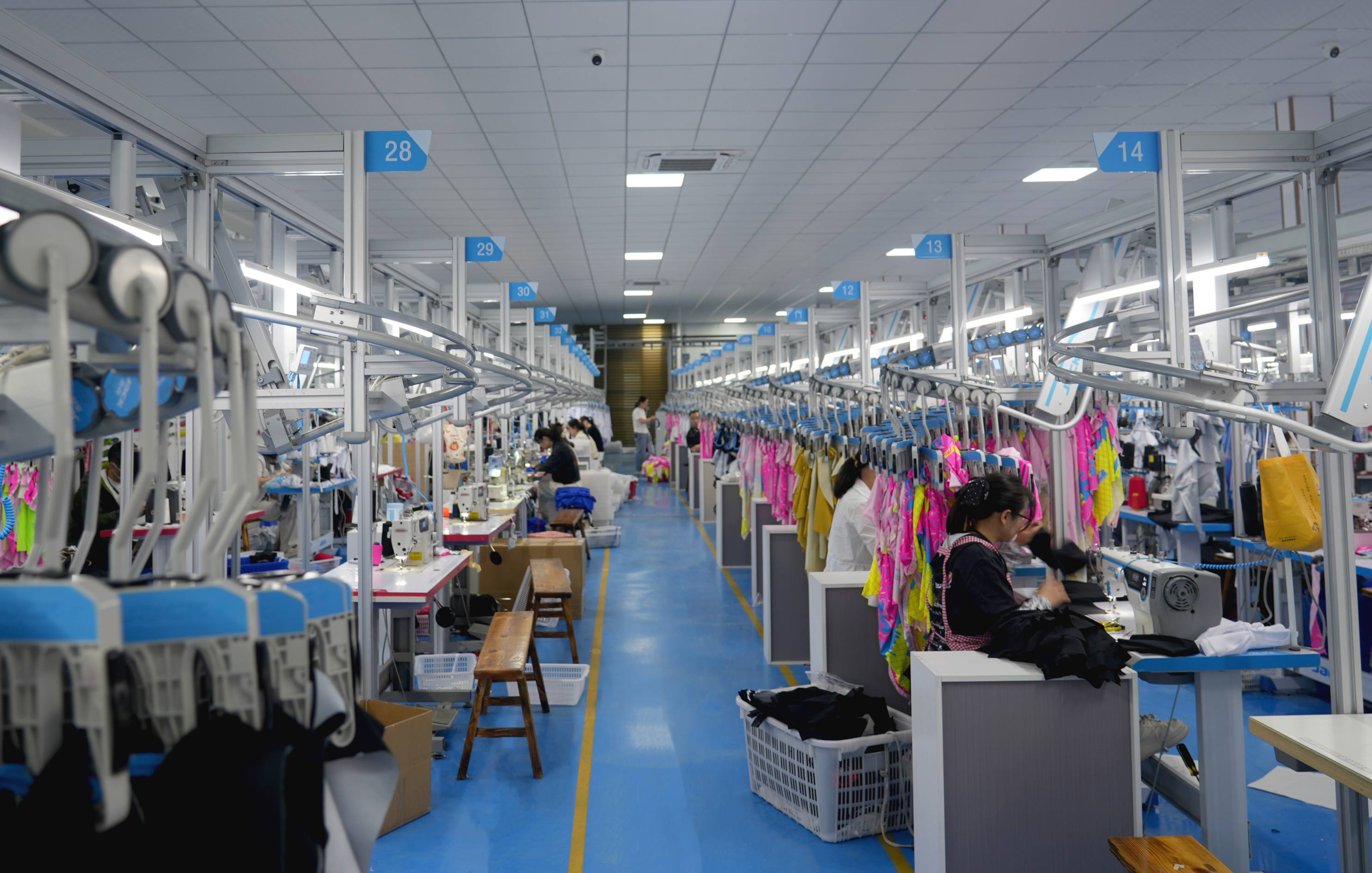
ljvogues' factory production line
Part 7: A Brand Owner's Specification Checklist Before Sampling
The following 12-point checklist should be completed and sent to your manufacturing partner before any sample is cut. Factories that cannot answer these questions clearly are not equipped to produce this category at standard.
# | Specification Item | Why It Matters | What to Specify |
1 | Outer shell fabric composition | Determines compression level and recovery | Nylon/spandex ratio; target 80/20 to 85/15 |
2 | Outer shell fabric weight (gsm) | Affects compression and thermal comfort | 200–230 gsm for performance biker short |
3 | Outer shell wet recovery rate | Performance under sweat conditions | Minimum 93% at 80% extension, wet state |
4 | Gusset layer count and material | Core absorbency architecture | 3–5 layers; specify each layer material |
5 | Gusset compressed thickness | Compression-absorption compatibility | Maximum 4mm at 70% fabric extension |
6 | Absorbency capacity (ml) | Rated performance claim | Specify per-SKU target; verify by EDANA WSP 10.1 |
7 | Channeling structure specification | Fluid management under movement | Pattern, stitch density, stretch tolerance |
8 | TPU film specification | Barrier durability | Thermally bonded; 18–25 micron film thickness |
9 | Edge sealing method | Leak prevention at perimeter | Thermal bonding; minimum 6mm sealed overlap |
10 | Seam construction type | Comfort and structural integrity | 4-Needle 6-Thread Flatlock throughout gusset zone |
11 | Wash durability requirement | Product lifespan | 52-wash retention at minimum 90% of rated capacity |
12 | Certification requirements | Market access and compliance | Specify: OEKO-TEX, PFAS-free, ISO 10993-1 (if EU) |
Factories that manufacture standard activewear often present biker short samples that pass dry-state inspection but fail wet-state testing in the first wash cycle. This checklist is designed to surface those capability gaps before sampling investment is made.
Frequently Asked Questions
Q: What is the minimum absorbency a period biker short should offer to be market-viable?
A: For most markets, 15ml (approximately 1–2 regular tampons equivalent) is the minimum viable product. The EU regulatory framework requires manufacturers to verify 20ml absorbency. For an active sport application like cycling or running, 25–35ml is the range that meaningfully differentiates a period-specific product from a standard biker short with light backup protection.
Q: Can I use the same gusset construction I use in my period underwear for a biker short?
A: Almost certainly not without modification. Period underwear gussets are typically designed for a non-compression environment. When placed inside a compression biker short, the same construction will experience lateral force that collapses capillary spaces and displaces the absorbent core. The gusset must be re-engineered specifically for the compression context — thinner layers, denser construction, and additional anchoring stitching.
Q: How many wash cycles should a period biker short maintain its absorbency?
A: The industry-standard durability benchmark is 50 wash cycles. EU compliance standards require 52-wash verification at 30°C. Brands should specify this requirement explicitly in their tech pack and request wash-test documentation from any qualified factory before approving bulk production.
Q: Is seamless construction better than flatlock stitching for period biker shorts?
A: Seamless construction (circular knit) eliminates external seam lines and reduces chafe risk, which is ideal for premium positioning. However, integrating a multi-layer absorbent gusset into a seamless construction is technically demanding and limits absorbency architecture flexibility. For most brands entering this category, 4-Needle 6-Thread Flatlock with a bonded gusset perimeter is the more reliable production path, offering comparable comfort with greater gusset engineering flexibility.
Q: What is the difference between TPU and PUL lamination for this application?
A: Both create a fluid barrier layer. PUL (polyurethane laminate) produced through solvent lamination typically uses chemical adhesives and results in a stiffer, less breathable material. Thermally bonded TPU uses heat and pressure without chemical solvents — the result is softer, more breathable, and cleaner from a chemical-content perspective. For intimate-contact activewear, thermally bonded TPU is the technically and regulatory-preferred specification.
Q: What activity level should I design my first period biker short for?
A: Design for your most demanding use case first. A 25ml short with full channeling, flatlock construction, and thermal edge sealing can be positioned down for lighter activity with a different colorway or price point. A 10ml short designed for yoga cannot be repositioned for cycling. Start with performance-grade engineering.
Q: How does DWR treatment interact with the leakproof system?
A: DWR (Durable Water Repellent) is applied to the outer shell fabric and functions externally — repelling rain, sweat from adjacent clothing, or water. It does not affect the internal leakproof system (TPU barrier, absorbent layers). DWR is a supplementary protection layer for outdoor applications, not a substitute for TPU lamination.
Q: What is the minimum order quantity (MOQ) for a period biker short program, and how does that compare to period underwear?
A: Period biker short MOQs are typically higher than standard period underwear due to the specialized fabric sourcing and gusset construction complexity. At LJVOGUES, we work with brand partners to structure reasonable entry quantities for new category launches. Contact our team at ljvogues.com to discuss program structure.
Sources
PUMA SE Newsroom — "Keep Your Head in the Game: PUMA and Modibodi Introduce Period Pep Talks" (October 2022): https://about.puma.com/en/newsroom/news/keep-your-head-game-puma-and-modibodir-introduce-period-pep-talks-designed-keep-women
Coherent Market Insights — Cycling Wear Market Size, Trends & Forecast (2026–2033): https://www.coherentmarketinsights.com/market-insight/cycling-wear-market-1636
CNHAVING — "Period Underwear Technology & Materials: A Buyer's Guide to Absorbency, Fabrics, Leak-Proofing": https://cnhaving.com/period-underwear-technology-materials-a-buyers-guide-to-absorbency-fabrics-leak-proofing/
Sino Finetex Textile Technology — "How to Source Nylon-Spandex Blends for High-Compression Wear": https://sinofinetex.com/how-to-source-nylon-spandex-blends-for-high-compression-wear/
Wooter — "Best Fabrics for Stretch and Recovery": https://wooter.com/articles/best-fabrics-stretch-recovery/
Female Engineering — "How Does Period-Proof Underwear Work?": https://www.femaleengineering-official.com/articles/how-period-underwear-works?hl=en
ISO — ISO 10993-1:2018, Biological Evaluation of Medical Devices — Part 1: https://www.iso.org/standard/68936.html
IDentity Custom Clothing — "Flatlock Stitches Explained: Functionality Meets Decoration": https://idcustomapparel.com/flatlock-stitches-functionality-meets-decoration/
Global Market Insights — Period Panties Market Size & Share, Statistics Report 2034: https://www.gminsights.com/industry-analysis/period-panties-market
Asan Cup — "Top 5 Features for Period Underwear": https://asancup.com/blogs/blogs/top-5-features-for-period-underwear
About the Author
Ocean Yang is the Founder and Head of Production at LJVOGUES (Shenzhen Ljvogues Sports Fashion Limited), a period-proof underwear and activewear manufacturer with 20+ years of OEM/ODM experience and 500+ global brand partners. LJVOGUES operates an 8,000m² facility in Shenzhen and holds certifications including BSCI, SEDEX, FDA, OEKO-TEX STANDARD 100, OCS, GRS, ISO 9001, and ISO 14001. All LJVOGUES products are 100% PFAS-free. Ocean writes the LJVOGUES B2B Sourcing Guide from the production floor, not from a marketing brief.