


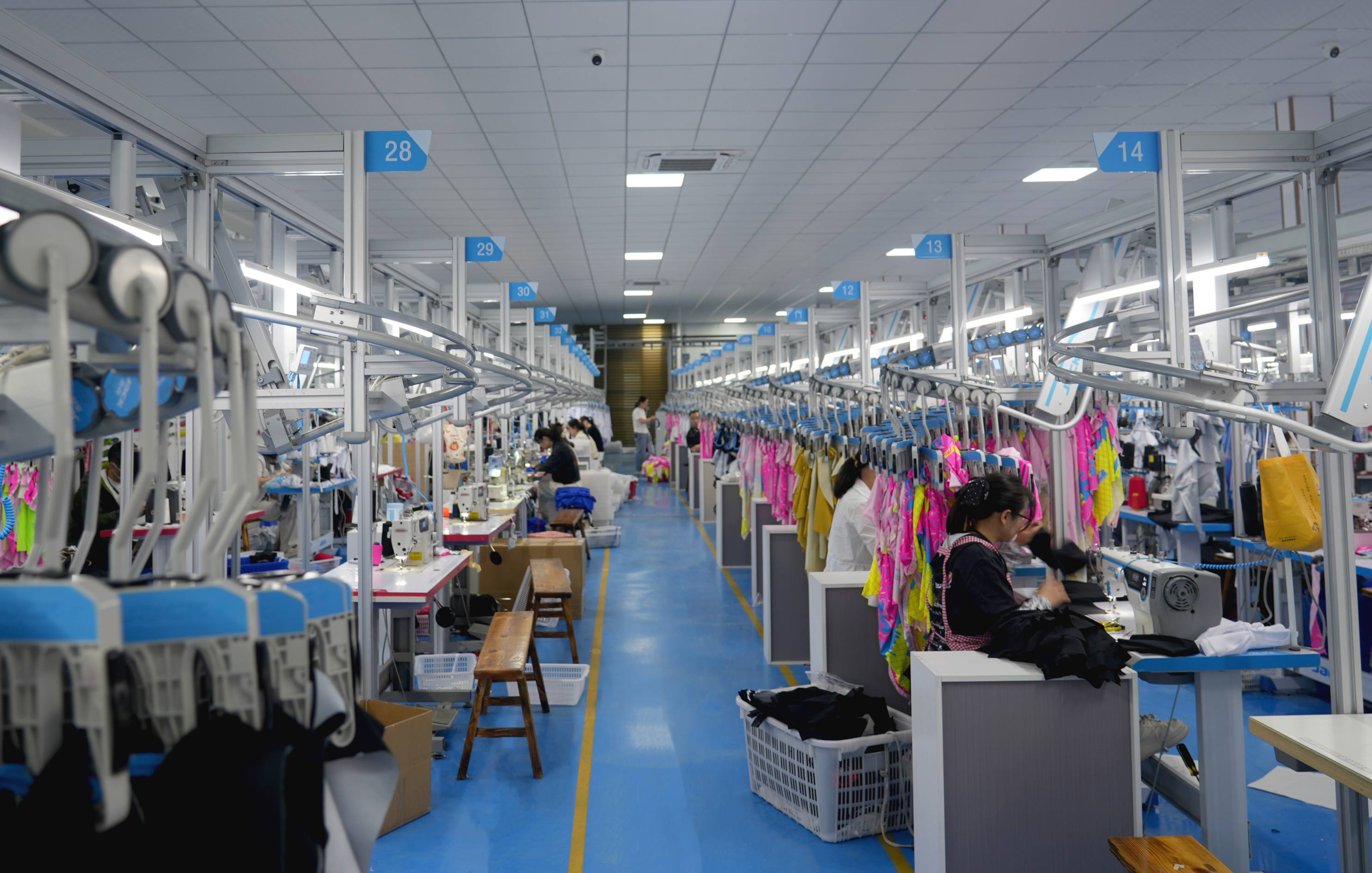

Table of Contents
TL;DR
Period swimwear for teens uses a 4-layer waterproof lining that absorbs menstrual flow inside the suit — no tampons, no pads, no stress. The right pair handles light to moderate flow for 4–6 hours in the water. Choose chlorine-resistant fabric, a snug waist-and-leg seal, and PFAS-free, OEKO-TEX-certified materials for developing bodies. Buy 2–3 pairs before the summer season and size up if she is between sizes.
The Evening Before Camp
Your daughter is sitting on her bedroom floor surrounded by balled-up T-shirts, a water bottle, and a tube of sunscreen. Summer camp starts tomorrow. She is 12, it is her first time away from home for a week, and her period arrived this morning — two days ahead of schedule.
She is not ready for tampons. She has tried exactly once, did not like it, and you are not going to push the issue. Pads are not an option in a lake. So she is already mentally deciding she will sit on the dock.
This is the exact moment period swimwear was designed for.
I am Ocean Yang, founder of LJVOGUES and a manufacturer who has spent more than 20 years engineering absorbent activewear. I am also a parent. The first time I understood the full emotional weight of this product category was not in a factory test — it was hearing a story like this one, from a mother who emailed us asking why her daughter's period swimsuit had leaked at the waist during a pool party. She had bought the right product. She had bought the wrong size.
This guide exists to make sure that does not happen to your daughter. We will cover how period swimwear works, how to choose it, how to size it correctly, and — just as importantly — how to talk to her about it without making the whole conversation more awkward than it needs to be.
Part 1: Why This Question Matters Now
Teen Swimmers Are in the Water All Summer
According to the Aspen Institute's State of Play report, swimming is consistently among the top three youth sports by participation in the United States. Swim class is a requirement in many school districts. Summer camps list "daily swim" as a standard activity. Family beach trips peak between June and August. For girls aged 10 to 17, the overlap between the swimming season and menstruation is not occasional — it is near-constant.
The average girl gets her first period between 12 and 13, though onset as early as 10 and as late as 16 is entirely normal. Once periods begin, they rarely align with schedules. A pool party does not check the calendar. Neither does a weeklong kayaking camp.

Teen Swimmers Are in the Water All Summer
Why Tampons Are Not the Obvious Answer for Teens
For many parents, the first instinct is "she can just use a tampon." For many girls, that instinct does not match reality. Research from the American College of Obstetricians and Gynecologists consistently shows that adolescents face a significant psychological barrier to tampon use — discomfort with internal insertion, fear of toxic shock syndrome (however overstated), and simple unfamiliarity. In practice, a meaningful proportion of teens who could use tampons choose not to.
Period swimwear removes the insertion question entirely. She puts it on like any other swimsuit. There is nothing to manage inside her body. That simplicity is, for many families, the entire value proposition.
The Market Confirms Growing Demand
The period panties and period swimwear market is not a niche trend. Period panties alone are growing at a CAGR of 20.5%, driven in part by demand from younger consumers and their parents seeking reusable, chemical-free alternatives to disposable products. The broader swimwear market is on track from USD 22.95 billion in 2025 to USD 34.12 billion by 2034, with period-specific styles claiming a fast-growing slice of that.
Part 2: What Period Swimwear Is (And What It Isn't)
The 4-Layer System, Explained Simply
Period swimwear works because of a multi-layer construction built into the gusset — the lined section that sits closest to her body. The four layers each perform a specific function:
Inner moisture-wicking layer — pulls fluid away from skin to prevent that "wet" feeling. In quality garments, this layer uses a soft bamboo or cotton-based knit that is gentle on sensitive teen skin.
Absorbent core — captures and holds menstrual fluid. The capacity of this layer determines whether the suit is rated for light, moderate, or heavier flow. Most teen-focused suits are designed for light to moderate flow (roughly 10–25 ml, equivalent to 1–2.5 regular tampons).
Leak-proof barrier — a thin, thermally bonded TPU (thermoplastic polyurethane) film that prevents absorbed fluid from migrating outward. At LJVOGUES, our engineering team uses TPU bonding at 18–25 microns — thin enough to prevent the gusset from feeling stiff or bulky, while maintaining a complete seal.
Water-resistant outer layer — made from polyester or polyester-PBT blend treated with DWR (Durable Water Repellent). This is the layer that prevents pool water from entering the suit and reaching the absorbent core.

Water-Resistant Is Not the Same as Waterproof
This distinction matters enormously and is worth saying clearly: period swimwear is water-resistant, not waterproof. The outer DWR treatment repels water under normal swimming conditions — meaning the absorbent core stays dry and functional. It does not form an impenetrable seal. Extended submersion, diving, or high-pressure water jets can eventually allow some external water in.
Ruby Love, whose teen line is one of the most widely reviewed in the category, explains this well on their education page: the suit is designed to absorb internal flow while resisting external water ingress — not to perform under extreme aquatic conditions.
For 95% of real teen use cases — pool party, swim class, lake camp, family beach day — the water-resistant outer layer performs exactly as needed.

ljvogues water-repellent menstrual underwear
How It Differs from Period Underwear
Period underwear and period swimwear share the same core layering concept, but they are engineered for different environments. Standard period underwear for teens is not designed for submersion. Its outer fabric is typically a soft cotton or modal that absorbs external moisture rather than repelling it — which means it would absorb pool water in addition to menstrual flow and become saturated quickly.
Period swimwear uses chlorine-resistant polyester or polyester-PBT as the outer shell. This does two things: it repels external water, and it survives repeated chlorine exposure without degrading. Research on chlorine-resistant swimwear fabrics shows that polyester-PBT blends last 5–10 times longer in chlorinated water than standard nylon/spandex constructions.
Do not substitute period underwear for period swimwear. They are different products for different environments.
Part 3: The 6-Point Checklist for Choosing Teen Period Swimwear
When I talk to parents who have had a leaking experience, the cause nearly always comes back to one of these six factors. Use this checklist before you add anything to your cart.
# | Factor | What to Look For | Red Flag |
1 | Flow capacity match | Light (10–15 ml / ~1 tampon) for school swim; moderate (15–25 ml / ~2–2.5 tampons) for camp or all-day use | "Good for up to 1 tampon" on a heavy flow day is inadequate |
2 | Fit and seal | Snug waist band and leg openings that lie flat without digging in; no gaps when she moves | Loose leg openings = water ingress channel; too tight = discomfort and rolling |
3 | Lining fabric | Bamboo or cotton inner layer for sensitive teen skin; OEKO-TEX STANDARD 100 certification | Synthetic-only inner with no certification; no mention of skin-safe testing |
4 | Discreet style | Looks identical to a standard swimsuit from the outside; no visible thickness in the gusset area | Obvious padding or bulk in the seat area will make her self-conscious |
5 | Chlorine-tolerant outer | Polyester or polyester-PBT outer; DWR treatment stated in product specs | "Nylon/spandex" construction will degrade faster in pool water |
6 | Care instructions | Machine washable; cold water wash; hang dry; no tumble dry required | "Hand wash only" is a dealbreaker for a teen managing laundry at camp |
On Safety: Why PFAS-Free and OEKO-TEX Matter More for Teens
Developing bodies absorb chemical exposures differently than adult bodies. PFAS (per- and polyfluoroalkyl substances) — sometimes called "forever chemicals" — have historically been used in water-repellent fabric treatments. A 2023 analysis by MAMAVATION found detectable levels of PFAS in some period underwear products. For swimwear worn by adolescents in direct contact with developing skin, this is not an acceptable risk.
LJVOGUES products are 100% PFAS-free, verified by third-party testing, and carry OEKO-TEX STANDARD 100 certification — which screens for over 100 harmful substances including heavy metals, formaldehyde, and pesticides. When evaluating any brand, look explicitly for these two markers: PFAS-free stated and independently verified, and OEKO-TEX STANDARD 100 on the label or product page.
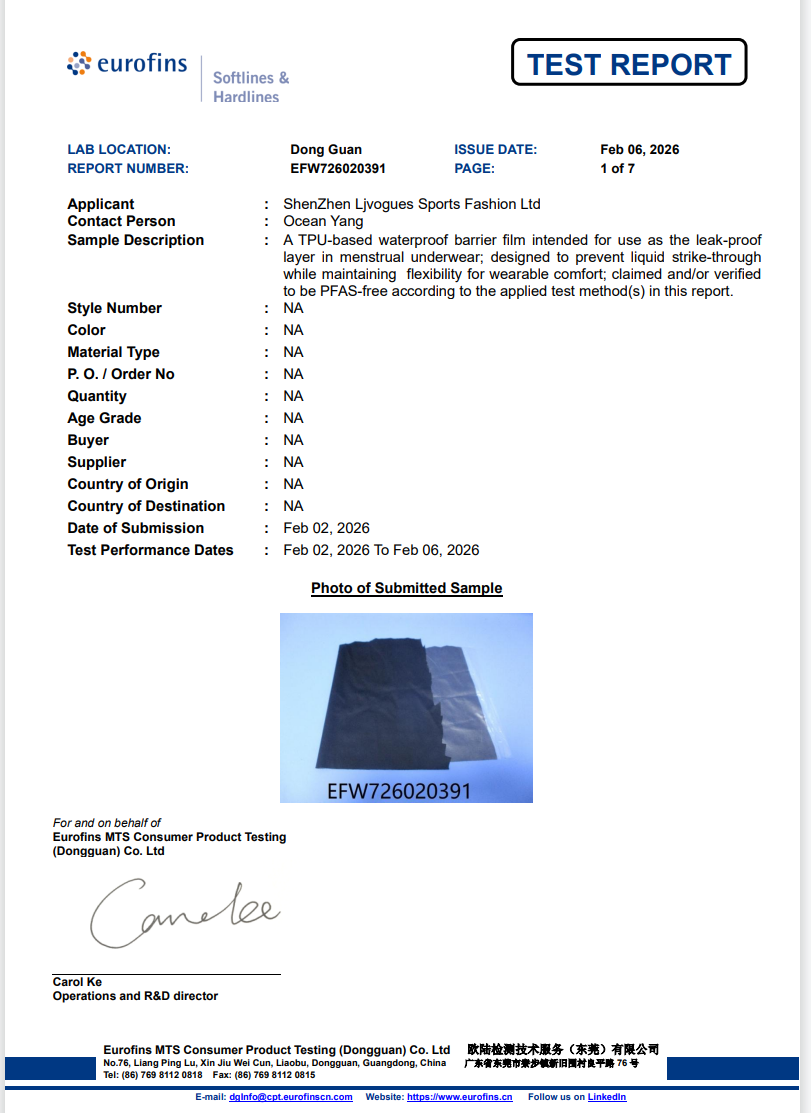
Ljvogues' PFAS-FREE report
Part 4: Sizing — The #1 Reason Teen Period Swimwear Leaks
In my experience reviewing customer returns and complaints over 20 years of manufacturing, fit failure is the most common cause of period swimwear leaking — not a defective product. The suit did not fail. The size was wrong.
Why Teen Sizing Is Especially Tricky
Teens are in a period of rapid body change. A 13-year-old's measurements in April may not match her measurements in July. Hip width, waist circumference, and thigh girth can change meaningfully within a single season. Most teen period swimwear is sized like standard youth swimwear — by height and weight range or by age bracket — but the critical measurement for a leak-free seal is the leg opening circumference and hip width, not age or height.

The Seal Principle
The leg openings and waistband of period swimwear need to form a continuous seal against her skin. Think of it like a gasket: it needs to be snug enough to lie flat without gaps, but not so tight that it rolls, folds, or creates pressure marks.
Common seal failures:
Too loose at the leg openings: Pool water or fluid can travel in or out along the thigh gap.
Too tight at the waist: The waistband folds outward, breaking the horizontal seal.
Wrong hip-to-waist ratio: Standard sizing assumes a proportional relationship between hip and waist that many teens do not have yet.
Sizing Recommendations
Measure first, do not guess by age. Use a soft measuring tape. Measure the fullest part of her hips and the circumference of each thigh at the upper leg. Cross-reference both against the brand's size chart.
When between sizes, size up. A slightly larger suit can be adjusted with a knot tie on bikini bottoms; a too-small suit cannot expand and will gap at the leg seam.
Test at home before camp. Have her wear the suit in a shallow bathtub filled with a few inches of water. Move around — sit, stand, squat. If water enters the lining, the fit is wrong.
Reassess each season. Teen bodies change fast. A suit that fit perfectly last August may not fit this June.
Check the leg openings specifically. Slide two fingers under the leg band while she is standing. If you cannot fit two fingers, it may be too tight. If the leg band lifts away from her skin, it is too loose.
Part 5: Starting the Conversation — How to Talk to Your Daughter
This is the section many parents skip. Do not skip it.
Period swimwear is a practical product, but introducing it to your daughter for the first time is a communication moment. How you frame it will determine whether she reaches for it confidently at camp or leaves it in the bag because "it felt weird to wear."
The Underlying Fear She May Not Say Out Loud
Many teen girls quietly carry one fear above all others related to periods in public: "Will everyone know?" Not "will it hurt," not "will it work" — but "will her friends see it, will there be a stain, will someone notice something."
Period swimwear directly addresses this fear, but only if she understands how it works. If you hand her the suit without context, she may assume it is somehow visible, or that she has to explain herself, or that wearing it means something is wrong with her.
A 5-Step Talking Framework
Step 1: Pick a low-pressure moment. Not while she is stressed, not five minutes before a swim event. A car ride or a quiet evening at home works well. The side-by-side posture of a car ride reduces the eye-contact intensity of a difficult conversation.
Step 2: Lead with her experience, not the product. Start with "I know your period sometimes shows up when you're supposed to swim" rather than "I bought you something." She needs to know you understand the problem before she can hear the solution.
Step 3: Explain what it is and what it is not. Briefly explain the 4-layer system: it absorbs flow inside, it looks exactly like a normal swimsuit from the outside, and nobody — not her friends, not the lifeguard, not her swim coach — will know she is wearing it. This is the answer to her actual fear.
Step 4: Let her choose. Give her the option. "I got a couple of options to try — want to look at them together?" Teens who feel agency over their period management tools use them. Teens who feel managed or embarrassed do not.
Step 5: Practice at home first. Before any public swim event, suggest she try it in a bath or the backyard pool. Confidence comes from knowing it works, not from being told it works.
What Not to Say
Do not use language that frames the period as something to hide, fix, or overcome. "So you won't have to worry about accidents" is more effective than "so nothing embarrassing will happen." The difference is subtle but meaningful for a teenager.
I have heard from mothers who told us that their daughters, once introduced to period swimwear without pressure, went on to request it before every summer event. The product is not hard to love — the introduction is everything.
Part 6: Real Scenarios — Pool Party, Sleepaway Camp, Swim Class, Beach Trip
Most period swimwear conversations happen in the context of one of four specific scenarios. Here is what each one actually requires.
Scenario | Key Considerations | What to Pack |
Pool Party (3–5 hours) | Social setting; she wants to look like friends; typically light to moderate flow | 1 period swimsuit (moderate capacity); 1 change of clothes; small zip bag for wet suit; 1 spare pair of period underwear in bag |
Sleepaway Camp (1 week) | Multiple swim sessions; no parent on site; needs to manage laundry herself | 2–3 period swimsuits; travel-size mesh laundry bag; cold-water detergent packets; written care reminder card; spare period underwear for non-swim days |
Swim Class (school/club) | Regular chlorine exposure; coach and classmates present; she may not disclose to teacher | 1–2 chlorine-resistant period swimsuits rotated; follow Swim England guidance (see below); spare suit in locker |
Beach / Family Trip | Saltwater + sun exposure; longer wear time possible; sand can disrupt leg seal | Moderate-to-heavy capacity suit; rinse immediately after ocean; DWR outer essential for sand/salt resistance; backup period underwear for evenings |

Swim Class
On Swim Team and Swim Class: The Swim England Precedent
In 2023, Swim England updated its period wear guidance to explicitly allow period swimwear and period underwear during official events and training — a significant policy shift that followed years of advocacy from athletes and parents. The rule also clarified that a swimmer may wear one additional layer (a period swimsuit bottom) under or over a standard competition suit, provided it does not give a performance advantage.
This means: yes, your daughter can wear period swimwear at swim team practice and at meets. She does not need a note from a doctor. She does not need to explain herself to her coach. This is now formal, written policy.
The Emergency Period Kit for Teens
For any overnight or away event, put together a small emergency kit:
1 spare period swimsuit (in a sealed zip bag)
2 pairs of period underwear (for non-water days or evenings)
Mini laundry detergent or a few Tru Earth eco-strips
Compact mesh bag for drying
A simple written note: "Cold water wash, hang dry, no fabric softener"
Keep it in a small waterproof pouch. It should fit inside her regular bag without obvious announcement.
Part 7: Care, Replacement, and Building Her Confidence
Care Instructions
Period swimwear lasts significantly longer when cared for correctly. The most common cause of early failure is heat — tumble drying, hot machine cycles, or leaving the suit in a hot car — which degrades the TPU leak-proof barrier.
Standard care protocol:
Rinse in cold water immediately after use (removes chlorine, salt, and surface residue)
Machine wash on cold, gentle cycle
Use a mild, fragrance-free detergent — no fabric softener (softener coats the absorbent layer and reduces capacity)
Hang dry only — never tumble dry, never iron
Store flat or loosely rolled, not compressed under other items
When to Replace
The absorbent gusset has a finite lifespan. Industry standard is approximately 50 washes after which the absorbent layer begins to lose capacity and the TPU barrier may start to delaminate. At average teen use — roughly twice per week during a 12-week summer, plus occasional school-year use — one suit might reach 50 washes in 18–24 months.
Signs it is time to replace:
The gusset feels thinner than it used to
It takes longer to dry
She notices increased leaking even with a correct fit
The leg bands have stretched and no longer seal properly
How Many Should She Own?
For a summer-active teen: 2–3 suits minimum. One suit will not survive a week of daily swimming if it needs to air-dry overnight. Two suits allow rotation. Three suits provides a comfortable buffer for laundry delays, travel, or unexpected double-swim days.
The Bigger Picture: Building Independent Period Management
The goal is not just leak protection. It is equipping her to manage her period on her own terms. Period swimwear is a meaningful piece of that, because it eliminates the need to ask an adult for help, find a bathroom, or disrupt a water activity.
Over time, teens who manage their periods confidently — who have the right tools and understand how they work — report significantly less period-related anxiety in social situations. That is the real outcome worth investing in.

Frequently Asked Questions
At what age can my daughter wear period swimwear?
There is no minimum age. Period swimwear is appropriate from the first period onward, regardless of whether that is at 10, 11, 12, or later. Unlike tampons, it requires no internal use and no anatomical readiness. For girls who have just started menstruating and are not yet managing flow independently, period swimwear may actually be the easiest first product to introduce because it requires no technique — she puts it on like any swimsuit. Ruby Love and Knix both offer styles sized for pre-teen and early teen bodies.
Can she wear period swimwear at swim team practice?
Yes. Swim England's 2023 period wear policy update explicitly permits period wear during training and competitive events. She does not need to disclose her reason to her coach or team. For competition, check whether an additional layer over her racing suit is permitted under her specific federation's rules — Swim England allows it, and many other national bodies have followed with similar guidance.
Will her friends notice anything?
No — assuming the suit fits correctly. Quality period swimwear is engineered to look identical to a standard swimsuit from every external angle. The absorbent gusset is designed to remain thin and flat when dry, and does not swell when wet because the water-resistant outer layer prevents pool water from reaching the absorbent core. The only scenario in which something might be visible is if the suit is ill-fitting and the gusset shifts — which is another reason correct sizing matters.
How do I size it correctly?
Measure her hip circumference (at the fullest point) and upper thigh circumference (at the widest point where the leg opening will sit). Cross-reference both measurements against the brand's specific size chart — do not use age or height alone. If she falls between two sizes, size up. Have her test the suit in a shallow bath at home before any public swim event: sit, stand, squat, and check that the leg bands lie flat against the skin without gaps.
Does she need a backup tampon or pad?
Not necessarily — but it depends on her flow and the duration of the activity. For light to moderate flow over 4–6 hours, a correctly fitted period swimsuit with appropriate capacity is designed to work independently. For heavier flow days, or for activities longer than 6 hours, pairing with a light tampon is a reasonable precaution. If she is not comfortable with tampons, bring a spare suit instead.
Can she sleep in it overnight at camp?
Period swimwear is not designed for overnight use. The gusset is engineered for aquatic environments — it is thinner and the absorption design prioritizes water resistance over high overnight capacity. For overnight use at camp, she should switch to period underwear, which has a deeper absorbent core optimized for lying-down positions and longer wear. Our teen period underwear guide covers overnight options in detail.
What if she has a heavy flow day?
First, understand that most period swimwear is designed for light to moderate flow — roughly equivalent to 1–2.5 regular tampons, or 10–25 ml. If her heaviest days exceed this, options include: (1) choosing a higher-capacity suit (some brands, including LJVOGUES, offer moderate-to-heavy capacity styles rated up to 50 ml); (2) pairing the swimsuit with a light tampon for the first few hours; or (3) scheduling longer water activities for lighter flow days when possible. Modibodi's teen swimwear line and Knix teen both offer options in higher capacity ratings.
How many period swimsuits should I buy?
The practical minimum for a summer-active teen is two. One suit requires same-day washing and overnight drying — which is realistic at home but impractical at camp or during travel. Two suits allow proper rotation. Three suits is the ideal for anyone attending a week-long swim camp, taking regular swim classes, or living in a climate where "summer" means daily water access from June through August. Given the 50-wash lifespan and a retail price point of $40–$80 per suit, three suits over two summers represents a highly cost-effective alternative to two summers of disposable products.
Sources
Swim England — Period Wear Guidance Updated (2023): https://www.swimming.org/sport/period-wear-guidance-changed/
Market.us — Period Panties Market Report (CAGR 20.5%): https://market.us/report/period-panties-market/
Fortune Business Insights — Swimwear Market Size, USD 22.95B (2025): https://www.fortunebusinessinsights.com/swimwear-market-103877
Ruby Love — Teen Period Swimwear & How It Works: https://rubylove.io/pages/how-it-works
Ruby Love — Teen Period Swimwear Collection: https://rubylove.io/collections/period-swimwear
Knix — Teen Period Swimwear & Underwear: https://knix.com/collections/teen
Modibodi — Teen Swimwear Collection: https://www.modibodi.com/collections/teens
Swimwear Galore — Chlorine-Resistant Swimwear, 5–10x Lifespan: https://swimweargalore.com/en-us/blogs/the-swim-report/chlorine-resistant-swimwear-why-its-worth-the-investment
MAMAVATION — PFAS in Period Underwear Testing (2023): https://www.mamavation.com/
Grand View Research — Swimwear Market, USD 23.1B (2023) → USD 36.15B (2030): https://www.grandviewresearch.com/industry-analysis/swimwear-market
Good Housekeeping — Best Period Swimwear Review (2026): https://www.goodhousekeeping.com/clothing/swimsuit-reviews/g42576046/best-period-swimwear/
American College of Obstetricians and Gynecologists — Teen Menstrual Health: https://www.acog.org/
Aspen Institute — State of Play Youth Sports Report: https://www.aspenprojectplay.org/state-of-play
Reddit r/Parenting — "Period swimwear for my daughter's swim camp" (July 2025): https://www.reddit.com/r/Parenting/
Reddit r/Mommit — "Has anyone tried period swimwear for their teen?" (2025): https://www.reddit.com/r/Mommit/
LJVOGUES — Period Swimwear Product Page: https://www.ljvogues.com/
LJVOGUES — Period Swimwear Explained (A1 Pillar Article): https://www.ljvogues.com/blog/experience/period-swimwear-explained-how-it-works
LJVOGUES — Teen Period Underwear First Period Guide: https://www.ljvogues.com/experience/teen-period-underwear-first-period-guide
LJVOGUES — How to Source Period Swimwear (B1 B2B Guide): https://www.ljvogues.com/blog/b2b-sourcing-guide/how-to-source-period-swimwear
Internal Links Used in This Article
Period Swimwear Explained: How It Works, When to Wear It, and What Real Swimmers Should Know — A1 Pillar (deep technical reference)
Your Daughter's First Period: A Complete Parent's Guide to Teen Period Underwear — Experience article on teen period underwear
How to Source Period Swimwear: A B2B Manufacturer's Guide for 2026 Brands — B1 Sourcing Guide (for parent-entrepreneurs)
LJVOGUES Period Swimwear — Main site and product pages
About the Author
Ocean Yang is the founder of Shenzhen Ljvogues Sports Fashion Limited (LJVOGUES), a premier period-proof swimwear and underwear manufacturer with 20+ years of OEM/ODM experience and 500+ global brand partners. Ocean oversees product engineering, material science selection, and quality assurance across all product lines.
LJVOGUES products are verified to the following standards relevant to teen safety:
OEKO-TEX STANDARD 100 — screens for 100+ harmful substances including formaldehyde, heavy metals, and pesticides
100% PFAS-free — third-party tested; no "forever chemical" fabric treatments
Lead-free and phthalate-free — critical for adolescent skin contact
BSCI and SEDEX social compliance audits
ISO 9001 / ISO 14001 quality and environmental management systems
AQL 2.5 quality control standard; 99.8% order consistency rate
"Every product we engineer for teens goes through a separate safety review. The absorbent lining, the TPU barrier, the outer shell — they are all third-party tested before we sign off on any teen SKU. When a 12-year-old is wearing something against her skin for four hours in a pool, the certification is not a formality. It is the point."
— Ocean Yang, Founder, LJVOGUES
For sourcing inquiries or B2B manufacturing partnerships, visit ljvogues.com or explore our B2B Period Swimwear Sourcing Guide.