



Table of Contents
TL;DR
Period swimwear MOQ typically ranges from 50–100 units for entry-level Alibaba suppliers up to 500+ for large-volume OEM programs; most credible private-label factories start at 100–300 units per style.
Total unit cost runs $10–$50 ex-factory depending on fabric tier, absorbent core specification, and order volume; the 4-layer functional build adds $3–$6 over a standard swimwear bottom.
A realistic production cycle runs 4–12 weeks end-to-end: 7–14 days sampling, 5–7 days pre-production approval, 20–45 days bulk manufacturing, plus 1–6 weeks shipping.
Hidden costs — pattern fees, certification testing, dyeing minimums, and air freight premiums — routinely add 15–25% on top of the quoted ex-factory price.
Lock your specifications before leaving the sample stage; cost overruns almost always trace back to spec changes after production begins.
2026 US tariff volatility on China-origin apparel and CNY/USD movements justify building a 10–15% budget buffer into any new program.
LJVOGUES supports 100–300 unit MOQs with mixed-color flexibility for qualified new brands — without the per-unit penalty common at smaller runs.
Part 1: Period Swimwear MOQ — Industry Ranges Explained
The global swimwear market is valued at USD 22.95 billion in 2025 and projected to reach USD 34.12 billion by 2034 at a 5.08% CAGR. Within that base, period care is tracking an estimated 8.8% annual growth rate, and period swimwear sits at the intersection of both curves. That growth profile has attracted a broad mix of manufacturers — which means period swimwear MOQ ranges are wider than in almost any other functional apparel category.
Understanding what drives those ranges is more useful than a single number. MOQ is a function of three variables: fabric roll minimums, absorbent core lamination batch economics, and production setup amortisation. For period swimwear specifically, the 4-layer functional crotch panel introduces an additional lamination step that does not exist in standard swimwear manufacturing. That step has a practical batch floor — typically 100–150 pieces — below which the setup cost makes production uneconomical at market pricing.
"We get inquiries every month from brands asking whether we can do 20 or 30 pieces of a custom period bikini bottom. I always explain the same thing: the lamination press for the absorbent core has a minimum run of around 100 metres of material before the economics make sense. That is not a business decision — it is a manufacturing reality. The brands that understand this from the start plan better and waste less time." — Ocean Yang, Founder, LJVOGUES
The table below maps MOQ tiers to supplier type, typical brand stage, and what level of customisation is realistic at each level.
Table 1: Period Swimwear MOQ Tiers by Supplier Type
MOQ Tier | Supplier Type | Typical Brand Stage | Customisation Level | Cost Impact |
50–100 units | Alibaba entry-level / stock-fabric traders | Pre-launch testing; proof-of-concept | Limited — stock designs, generic labels only | Highest per-unit cost; likely trading company, not factory direct |
80–150 units | Small private-label factories | Early-stage DTC launch | Moderate — label, basic colorway | Premium per-unit; suitable for market validation at low capital risk |
100–300 units | Mid-tier OEM factories (main LJVOGUES range) | Seed-funded or bootstrapped brand launch | Good — custom color, label, waistband, capacity tier selection | Viable for serious brand launch; absorbent core lamination batch economics achieved |
200–500 units | Larger OEM / full-custom manufacturers | Growth-stage brands, second collection | Full OEM — custom tech pack, fabric development, multi-style | Meaningful unit cost reduction; custom fabrics become viable |
500+ units | Mass-production factories; retail program suppliers | Established brands, wholesale programs | Complete ODM/OEM customisation | Best unit economics; priority production scheduling |
The most important distinction in this table is between 50–100 unit offers from trading companies and genuine factory MOQs. Sino Finetex's sourcing guide for custom bikinis from China confirms that verified OEM factories typically set MOQs at 100–300 units, while Alibaba-listed basics start at 50–100 — reflecting stock-fabric production rather than custom builds. A sub-100 unit quote at factory-direct pricing almost always means a trading company is involved, which removes your direct visibility into manufacturing quality and compliance documentation.
For a complete framework for evaluating period swimwear manufacturers at any MOQ level, see our B2B Sourcing Guide :How to Source Period Swimwear. For the technical background on why period swimwear requires specialised manufacturing versus standard swimwear, see our Period Swimwear Explained pillar guide.

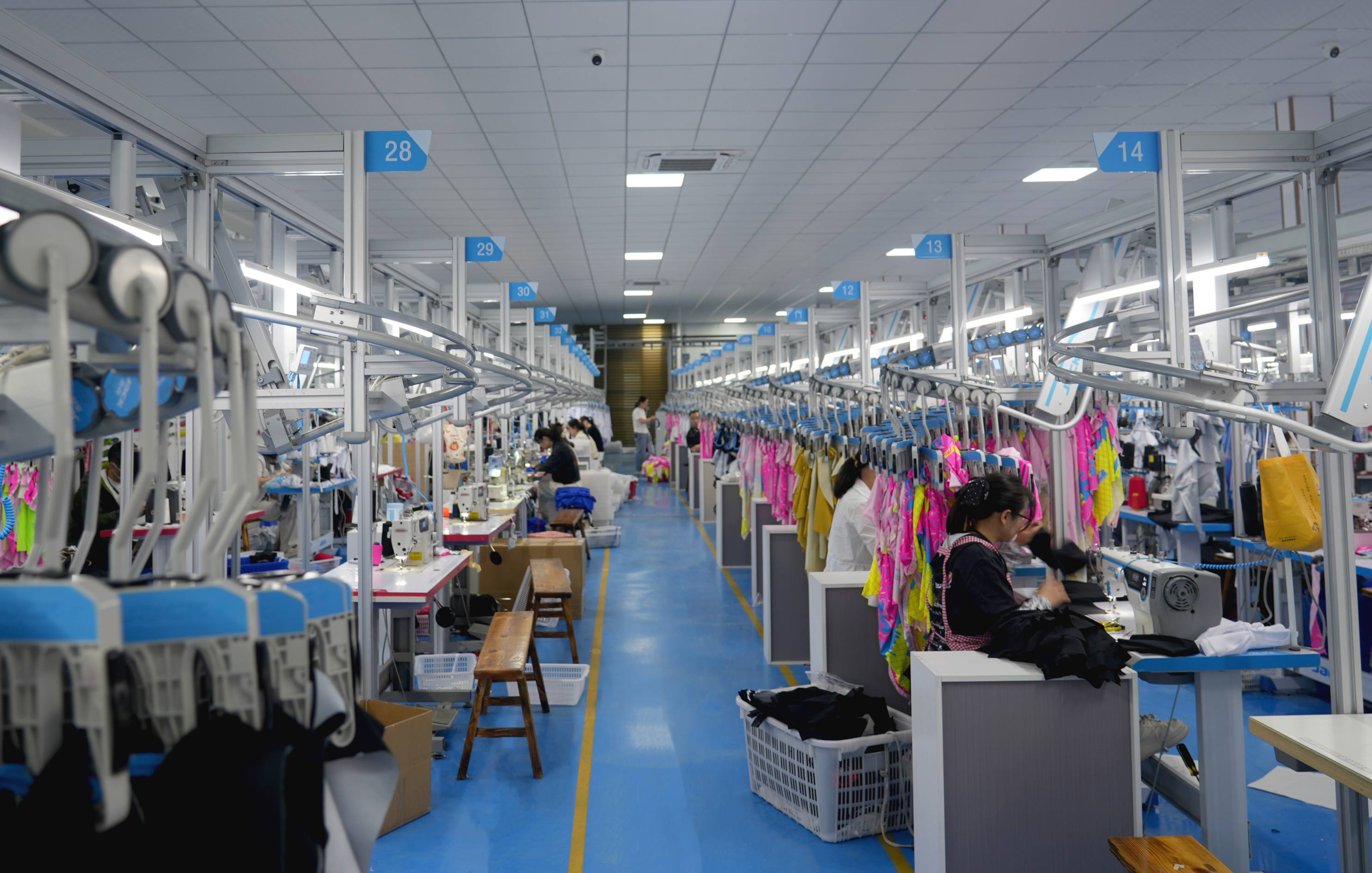
ljvogues's sewing process assembly line
Part 2: Period Swimwear Cost Breakdown — Full Unit Economics
The total cost to manufacture swimwear ranges from $10 to $50 per piece ex-factory, according to industry data for 2025–2026. Period swimwear lands at the upper end of that range for most functional builds — the 4-layer absorbent crotch panel adds $3–$6 per unit over a standard swimwear bottom in materials alone, before the additional labour for lamination and flatlock stitching.
The table below breaks down every cost component for a 4-layer period bikini bottom at a mid-volume run (300–500 units), FOB Shenzhen. These figures are consistent with publicly available swimwear cost data from Modaknits and internal production benchmarks.
Table 2: Period Swimwear Unit Cost Breakdown (FOB Shenzhen, 300–500 Unit Run)
Component | Specification | Cost Range (USD/unit) | % of Total (Mid) | Key Cost Drivers |
Outer fabric | Nylon-spandex ($5–10/yd), polyester-spandex ($4–8/yd), recycled nylon ECONYL® ($15–30/yd) | $1.80 – $4.50 | 28–35% | Fabric type, chlorine-resistance requirement, recycled content premium |
Absorbent core (4-layer) | TPU thermal bonding + wicking layer + absorbent batting + distribution layer; capacity 15–50ml | $1.50 – $4.00 | 18–22% | Capacity tier (15ml vs 50ml = ~$2 difference); PFAS-free TPU adds ~$0.15/unit |
Trims and elastics | Waistband elastic, leg elastic, labels, hang tags | $1.00 – $2.50 | 8–12% | Custom branded vs commodity; woven label adds $0.20–0.40/unit |
Pattern making and grading | Pattern: $100–500/design (amortised over run); grading: $50–200 | $0.30 – $1.80 | 5–8% | New vs adapted pattern; number of sizes in run; higher for small runs |
Labor — Asia (Shenzhen) | Cutting, lamination, flatlock stitching, finishing | $5.00 – $10.00 | 30–38% | Complexity of flatlock seam work; number of absorbent zones; seamless vs sewn gusset |
Labor — US/EU comparison | Same construction, domestic production | $15.00 – $30.00 | — | Included for comparison only; not typical for volume sourcing |
Packaging | Standard poly bag to branded retail box | $1.00 – $3.50 | 5–10% | Generic poly bag ($0.15–0.40) vs custom print box ($1.50–3.50) |
Factory overhead and margin | Typically 15–20% of component + labour cost | $1.00 – $3.00 | 8–12% | Higher at low MOQ; lower at 500+ units |
Sample stage (pre-production) | $20–50/sample; 2–3 rounds typical | $40 – $150 total | Not per unit — amortised | Credited against bulk order at some factories including LJVOGUES |
Total ex-factory (FOB Shenzhen) | 300–500 unit run, 4-layer period bikini bottom | $12.00 – $30.00 | 100% | Volume, fabric tier, and construction complexity are primary levers |
Key observations from this breakdown:
The absorbent core is the single most technically differentiated cost item. A 15ml light-capacity core costs approximately $1.50 per unit in materials; a 50ml heavy-capacity core with PFAS-free TPU bonding runs $3.50–4.00. That $2–2.50 spread is legitimate — it reflects real differences in material weight, lamination time, and quality assurance testing.
Labor is the largest single line item. At 300–500 units on a Shenzhen production floor, the 4-needle 6-thread flatlock stitching required at waistband and leg openings — the structural elements that create the seal preventing external water ingress — adds meaningfully to labour cost versus a standard swimwear bottom. This is a quality investment, not a cost to eliminate.
Packaging has a disproportionate impact. The swing from a $0.25 generic poly bag to a $2.50 custom retail-ready box is a $2.25 per-unit difference — more than the cost of the TPU barrier layer. New brands should use stock packaging formats for the first run and upgrade once sell-through is proven.
"When I review a cost breakdown with a new brand client, the first thing I look at is whether the absorbent core cost is plausible. A quote that shows a 50ml 4-layer core at $0.80 per unit is either a 2-layer product being misrepresented, or the TPU has been laminated with solvent adhesive instead of thermal bonding — which means it will delaminate in the wash. The cost structure tells you a lot about what is actually being built." — Ocean Yang, Founder, LJVOGUES
At scale, unit economics shift materially. At 200–500 units, expect ex-factory pricing of $15–25 for a well-built 4-layer period bikini bottom. At 1,000+ units with stock fabrics and optimised construction, $12–18 is achievable. For EU compliance context on the material specifications that drive these costs — particularly PFAS-free TPU and ISO 10993-1 biocompatibility requirements — see our EU Compliance and ISO 10993-1 article.

Ljvogues's Absorption Core
Part 3: Period Swimwear Lead Times — Week-by-Week Timeline
Understanding lead time is as important as understanding unit cost. The most common sourcing mistake — across every brand archetype we work with at LJVOGUES — is underestimating how long the journey from initial brief to goods-in-warehouse actually takes.
Sino Finetex's bikini sourcing guide provides a clear breakdown of the standard production cycle: sampling 7–14 days, pre-production approval 5–7 days, bulk manufacturing 20–45 days, and shipping 1–6 weeks — giving a total of 4–12 weeks from brief confirmation to goods arrival. ExploreTex confirms that expert sample makers typically require 7 to 14 days to create a physical prototype once the tech pack and raw materials are finalised, with complex custom-dyed fabrics extending that to 3–4 weeks.
For period swimwear specifically, add one variable: if a custom outer fabric colorway requires a new dye run, add 10–15 days to the fabric procurement phase before sampling begins.
Table 3: Period Swimwear Production Timeline (Week-by-Week)
Week | Stage | Activity | Duration | Notes |
Week 1 | Brief and material confirmation | Tech pack review, fabric selection, absorbent core spec sign-off | 2–5 days | Using stock fabrics saves 10–15 days vs custom dye run |
Weeks 1–2 | Sampling | Initial prototype construction; TPU lamination; flatlock stitching; first physical sample | 7–14 days | Complex construction (3 capacity tiers, custom colorways) may reach 14 days |
Week 2–3 | Sample review and revision | Brand reviews prototype; fit, function, absorption, seal testing; revision round(s) | 5–10 days per round | Budget 1–2 revision rounds; each adds 7–10 days |
Week 3–4 | Pre-production approval | PP sample sign-off; purchase order issuance; deposit payment | 5–7 days | Lead time clock starts from PO confirmation + deposit received |
Weeks 4–9 | Bulk manufacturing | Fabric cutting, lamination batch run, sewing, QC inline inspection, finishing, packing | 20–45 days | 300–500 units: 20–30 days; 1,000+ units: 30–45 days |
Weeks 9–15 | Shipping and customs | Sea freight (25–35 days) or air freight (5–7 days); customs clearance | 1–6 weeks | Sea LCL: cost-effective from 500 units; air: premium rate, use for urgent launches |
Total | Brief to warehouse | From brief confirmation to goods in destination warehouse | 4–12 weeks | Lower end with stock fabrics + air freight; upper end with custom fabrics + sea freight |
"Brands planning a summer launch consistently underestimate the timeline. If you want inventory for May or June, your PO needs to be confirmed by late January at the latest — and that means samples approved in December. The brands that launch on time are the ones who started the conversation in October." — Ocean Yang, Founder, LJVOGUES
One important note on where lead time begins: the clock starts at purchase order confirmation with deposit received, not at the date of first inquiry, not at sample approval. Factories allocate production capacity upon PO + deposit. Any brand that plans lead time from the date of first email will arrive at the shipping window late.

Part 4: LJVOGUES Flexible MOQ — What It Means for New Brands
Most mid-tier OEM factories in China quote 300–500 units per style as their minimum for custom period swimwear production. LJVOGUES supports production from 100–300 units per style for qualified new brand partners, with mixed-color and mixed-style flexibility at the total order level.
The reason this is possible — and why it is not a gimmick — is structural. LJVOGUES operates a vertically integrated 8,000m² facility in Shenzhen with in-house absorbent core lamination. When the lamination press is not outsourced to a third party with its own batch minimums, the production floor can absorb smaller runs without the surcharges that appear when a factory has to negotiate small batches with external lamination partners.
For brands launching a 2-style core range — a bikini bottom and a one-piece, for example — in two colorways each, a 100–150 unit per-style MOQ means a total first order of 400–600 pieces. That is a manageable capital commitment for a seed-funded brand, and it provides enough inventory to test the market meaningfully before committing to a larger second run.
LJVOGUES holds BSCI, SEDEX, FDA, OEKO-TEX STANDARD 100, OCS, GRS, and ISO 9001/14001 certifications, and operates a 100% PFAS-free production process verified by third-party laboratory analysis — certifications that are increasingly required by EU and North American retail buyers and that take 18–24 months for a new brand to acquire independently.
For brands already sourcing leakproof activewear or period underwear — and looking to extend into swimwear — the Absorbent System Across Activewear article explains how a modular absorbent core architecture allows brands to extend a swim SKU without redesigning the functional system from scratch.

Part 5: Hidden Costs and Negotiation Points
The ex-factory price quoted in the first RFQ response is not the number that determines whether your launch is profitable. The following cost categories are real, commonly underestimated, and consistently appear in post-launch cost reviews.
Pattern making and tooling fees ($100–$800 per design)
For a brand using its own tech pack and custom fit block, pattern making runs $100–500 per style. Grading across a full size run (XS–4XL) adds $50–200. These are one-time fees per design, amortised across the production run — but at 100 units, they add $0.75–$7.00 per unit in amortised cost. At 500 units, the same fees add $0.30–$2.00 per unit. This is one concrete reason why slightly larger first orders meaningfully improve unit economics.
Custom dyeing minimums ($150–$600 per colorway)
Custom-dyed outer fabrics require a minimum dye lot from the mill — typically 100–300 metres per color. If your design requires a proprietary colorway and your order cannot absorb the full dye lot, you either pay for unused fabric or choose from the factory's stocked palette. Stocked colors eliminate this cost entirely and are the practical choice for a first production run.
Certification testing ($300–$2,500 per test category)
Even when sourcing from a certified factory, retail buyers increasingly require independent third-party test results under your brand's name. PFAS panel testing runs $300–$400; absorption and wash durability testing $400–$500; chlorine soak and colorfastness testing $300–$500; biocompatibility screening $600–$900. Budget $1,500–$2,500 for a comprehensive first-run test suite, or $500–$800 if you scope to PFAS-free and basic durability only.
Air freight vs sea freight premium
For a 300-unit order (~15kg, 0.2 CBM), air freight to the US West Coast runs $0.80–$1.20 per unit; sea LCL freight runs $0.25–$0.50 per unit. The difference — roughly $0.50–$0.75 per unit — sounds small, but on a 300-unit order that is $150–$225 in additional cost. For time-sensitive launches (chasing a summer window), air freight is often unavoidable; for planned second orders, sea freight should be the default.
Third-party QC inspection ($300–$500 per visit)
A pre-shipment inspection from SGS, Bureau Veritas, or Intertek runs $300–$500 per man-day. On a 300–500 unit order this is a significant proportional cost — but it is significantly cheaper than a quality failure that generates a 15–20% return rate on your first cohort of customers. Build it in.
"I tell every new brand the same thing: your budget should include testing, inspection, and a freight contingency from day one — not as a post-launch discovery. The brands that come back to me after a first run with unexpected costs are almost always the ones who planned for ex-factory only. The brands that manage their margin well from launch are the ones who built the full landed-cost picture before placing the PO." — Ocean Yang, Founder, LJVOGUES
Negotiation points that actually move the number
The most effective cost levers available to a brand placing a first order are: (1) using the factory's stocked fabric palette — eliminates dye-lot costs and often reduces lead time; (2) accepting stock packaging for the first run — saves $1.50–$3.00 per unit; (3) concentrating the order on 2–3 styles and 2 colorways rather than spreading across a wider range — keeps total order value high enough to justify the factory's setup cost. Price negotiation on ex-factory per-unit cost is rarely effective at sub-500-unit volumes; structural choices about what you are ordering have far more impact than asking for a lower rate.

ljvogues's sewing process assembly line
Part 6: Avoiding Cost Overruns
Cost overruns in swimwear and period care manufacturing are predictable — they cluster around three failure points. Understanding these points lets you build sourcing practices that prevent them rather than respond to them.
Lock specifications at the sample stage
The most expensive change in any production cycle is a specification change after bulk production has begun. Changing the waistband elastic from 3cm to 4cm after cutting has started means re-cutting material and re-running the lamination batch. At 300 units, a mid-production spec change can add $500–$1,500 in rework cost and 7–14 days of delay. The discipline to sign off completely on the golden sample — construction, materials, dimensions, colorway, and all trims — before approving production is the single most cost-effective action a brand can take.
AQL inspection terms in the purchase order
AQL 2.5 is the industry standard for functional intimate apparel and means that a statistically valid sample of the production run is inspected, with a maximum acceptable defect rate of 2.5%. Brands that issue POs without specifying an AQL standard have no contractual basis for rejecting a non-conforming shipment. Write AQL 2.5 into every PO. For period swimwear specifically, confirm that inspection includes functional testing of the seal and absorption capacity — not just visual inspection of the outer garment.
Third-party QC before shipment
Factory self-inspection is not a substitute for independent QC. A third-party inspector from a firm such as SGS, Bureau Veritas, or Intertek will catch dimensional inconsistencies, seam defects, incorrect absorbent core placement, and packaging errors before the shipment leaves the factory. At 300–500 units, one inspection visit costs $300–$500 — roughly 1–2% of the order value. The cost of a failed first run in returns, replacements, and reputational damage is orders of magnitude higher.
"In twenty-plus years of manufacturing, the cost overruns that have damaged brands most are not the ones caused by bad factory partners — those are easy to see in advance. The ones that hurt are the ones where a brand approved a sample, changed a trim specification three weeks into production because their designer wanted something slightly different, and then needed to rework 40% of the cut pieces. Lock the spec. Trust the golden sample. That is where cost discipline lives." — Ocean Yang, Founder, LJVOGUES
For detailed quality control frameworks applicable to period care manufacturing, the LJVOGUES B2B Sourcing Guide library covers AQL methodology, pre-shipment inspection checklists, and third-party QC engagement in Articles 10 and 12.
Part 7: 2026 Tariff and FX Considerations
Any brand sourcing from China for the US market is navigating a tariff environment that has been genuinely volatile over the last eighteen months. The current position as of mid-2026 is that additional IEEPA-based duties on China were struck down by the Supreme Court in February 2026, with a 10% global tariff under Section 122 remaining in effect through July 2026. Existing Section 301 duties — ranging 0–20% depending on product category — continue to apply. The Yale Budget Lab puts the pre-substitution average effective US tariff rate at 11.8% as of April 2026, up from historical norms.
For women's swimwear from China specifically, the baseline HTS duty rate has historically sat at 11.9–27.7% depending on the specific HTS code (6112 for swimwear), on top of which any applicable Section 301 surcharges apply. With the tariff landscape still subject to potential policy changes — including new Section 301 investigations into 16 economies launched in March 2026 with outcomes expected by late July — brands placing production orders in Q3 2026 for Q1–Q2 2027 delivery face genuine duty cost uncertainty.
Practical budget guidance:
Build a 10–15% budget buffer on top of your fully-landed cost estimate to absorb potential tariff changes between PO issuance and goods arrival. For brands sourcing at volumes where air freight is a viable alternative to sea (typically under 500 units), factor in the per-unit freight cost difference when modeling scenarios.
On the FX side, CNY has been relatively stable against USD in early-to-mid 2026, but any brand denominating production costs in RMB should plan for a ±5–8% annual movement range. Most Shenzhen factories quote in USD, which shifts the FX exposure to the factory — but USD/EUR and USD/GBP movements remain relevant for brands whose revenue is in euros or sterling. A 5% unfavorable FX move on a $20,000 first order is a $1,000 unbudgeted cost.
Diversification considerations for future orders
While China remains the dominant production base for period swimwear — with over 70% of global bikini production capacity concentrated in China — brands building for scale should investigate Vietnam, Bangladesh, and Cambodia as alternative manufacturing bases for future runs, particularly given the active Section 301 investigations that could affect relative duty rates across those markets. Vietnam-based factories with swimwear capability are at an earlier stage of period-care manufacturing maturity, but the gap is closing.
For regulatory compliance cost context — particularly the EU GPSR-driven documentation requirements that add to the cost structure of any EU-destined SKU — see the EU Compliance and ISO 10993-1 article in this sourcing guide library.
Frequently Asked Questions (FAQ)
Q1: What is the minimum order quantity for period swimwear from a real factory?
The practical MOQ floor from a genuine OEM factory — one with in-house absorbent core lamination and verified chlorine-resistant fabric sourcing — is 100–150 units per style. Below that threshold, the lamination batch economics break down and you are almost certainly working with a trading company, not a factory. For a well-funded brand launch, 200–300 units per style is the range that gives you reasonable per-unit costs, genuine customisation options, and a direct factory relationship.
Q2: How much does it cost to manufacture a period swimwear piece?
At a 300–500 unit run with a full 4-layer absorbent build (polyester-spandex outer, TPU thermal bonding, 30ml capacity), expect $15–25 ex-factory from a qualified Shenzhen manufacturer. At 1,000+ units, $12–18 is achievable with stock fabrics and optimised packaging. The 4-layer functional build adds $3–6 per unit over a standard swimwear bottom, which is a direct reflection of the additional material and lamination labour.
Q3: How long does period swimwear take to manufacture from brief to delivery?
A realistic total timeline is 8–14 weeks from brief confirmation to goods-in-warehouse: 7–14 days sampling, 5–7 days pre-production approval, 20–45 days bulk production, plus 5–35 days shipping depending on mode. If you are using stock fabrics and air freight, you can compress toward 4–6 weeks. If you are developing a custom colorway and shipping by sea, plan for 10–14 weeks minimum.
Q4: What are the hidden costs brands miss when budgeting for period swimwear?
The four most commonly underestimated costs are: (1) pattern making and grading fees ($150–700 total, amortised over the run); (2) third-party certification testing ($500–$2,500 for a reasonable test scope); (3) pre-shipment QC inspection ($300–500); and (4) tariff and freight variability — particularly relevant in 2026 given ongoing US trade policy uncertainty. Budget these explicitly before finalising your landed cost estimate.
Q5: Can I mix styles and colors within an MOQ to reach the minimum?
This depends on the factory's structure. Some apply MOQ at the per-style level; others apply it at the total order level. At LJVOGUES, new brand partners can mix colorways within a style run — for example, 100 units of a bikini bottom in navy and 100 units in black counts as a 200-unit order for that style. Mixing completely different styles (bikini bottom plus one-piece) toward a total order minimum is also negotiable for brands placing their first order, subject to each style having sufficient quantity to run the lamination batch efficiently.
Q6: What is the cost difference between sea and air freight for period swimwear?
For a 300-unit order (approximately 15kg, 0.2 CBM), air freight from Shenzhen to the US runs approximately $0.80–$1.20 per unit; sea LCL runs $0.25–$0.50 per unit. The difference is $0.30–$0.70 per unit — or $90–$210 on the total order. For a summer launch where timing is critical, air freight is often the right decision. For a planned second order with a 10–12 week runway, sea freight is almost always the better choice.
Q7: Do I need to pay for sampling separately from production?
Yes, at most factories. Pre-production samples are charged separately — typically $20–50 per sample per style, with 2–3 revision rounds common before approval. Total sampling cost for a 2–3 style range runs $120–$450. At LJVOGUES, sample costs are credited against your first bulk production order above 300 units, which effectively reduces the net cost of sampling for brands that proceed to production.
Q8: How does the period swimwear MOQ compare to period underwear MOQ?
Period swimwear MOQs are broadly comparable to period underwear at the same construction complexity level — both require 4-layer functional builds and dedicated lamination runs. The main difference is the chlorine-resistant outer fabric, which introduces an additional material specification that fewer factories carry in stock. Brands that already source period underwear from a factory should confirm that factory has active swimwear-grade fabric inventory and chlorine soak test documentation before assuming the same MOQ applies. For a complete comparison of the manufacturing differences, see B2B Sourcing Guide .
Sources
Fortune Business Insights — Global Swimwear Market Size, Share & Industry Analysis — Market valuation USD 22.95B (2025), USD 34.12B (2034), 5.08% CAGR
Market.us — Period Panties Market Report — Period care CAGR 20.5%; broader period products ~8.8% annual growth
Modaknits — How Much Does It Cost to Make Swimwear? — Swimwear manufacturing costs $10–$50/piece; fabric cost ranges by type; labor cost comparison Asia vs US/EU
Sino Finetex — How to Source Custom Bikinis from China — MOQ ranges by supplier tier; production timeline stages; China's 70%+ share of global bikini production
ExploreTex — Sample Makers Guide — Sampling lead times 7–14 days standard; 3–4 weeks for custom dyed/milled fabrics; standard 2–3 sample rounds
Grand View Research — Swimwear Market Size, Share & Trends Analysis — Alternative market forecast USD 23.1B (2023) to USD 36.15B (2030), 6.8% CAGR
Nichesources — Top Private Label Swimwear & Lingerie Manufacturers (MOQ data) — MOQ structure across supplier categories; private label options
MakeMine — Guide to Tariffs on Clothing From China (2026) — 2026 tariff timeline for China-origin apparel; Section 301, Section 122, IEEPA rulings
Yale Budget Lab — State of US Tariffs: April 8, 2026 — Average effective US tariff rate 11.8% as of April 2026; clothing among hardest-hit categories
OEKO-TEX STANDARD 100 — Official Certification Information — Certification requirements for functional intimate apparel
EU General Product Safety Regulation (GPSR) — EUR-Lex — GPSR compliance requirements effective December 2024 for EU market products
LJVOGUES B2B Sourcing Guide — How to Source Period Swimwear — Manufacturer evaluation framework, testing protocols, 7-criteria scorecard
LJVOGUES — EU Compliance and ISO 10993-1 for Period Products — GPSR technical file requirements, ISO 10993-1 biocompatibility framework
LJVOGUES — Period Swimwear Explained (Consumer Pillar) — How period swimwear works; technology overview for brand education resources
About the Author
Ocean Yang
Founder, Shenzhen Ljvogues Sports Fashion Limited
With 20+ years in intimate apparel manufacturing and 500+ global brand partnerships, Ocean leads LJVOGUES' 8,000m² Shenzhen facility producing certified period swimwear, period underwear, and leakproof activewear for international brands. The team holds BSCI, SEDEX, FDA, OEKO-TEX STANDARD 100, OCS, GRS, ISO 9001/14001 certifications and is 100% PFAS-free.
LJVOGUES Certifications: OEKO-TEX STANDARD 100 | BSCI | SEDEX | FDA | ISO 9001 | ISO 14001 | OCS | GRS | 100% PFAS-Free | AQL 2.5 | 99.8% Order Consistency
Connect: ljvogues.com | Email Ocean's team for OEM/ODM inquiries.