


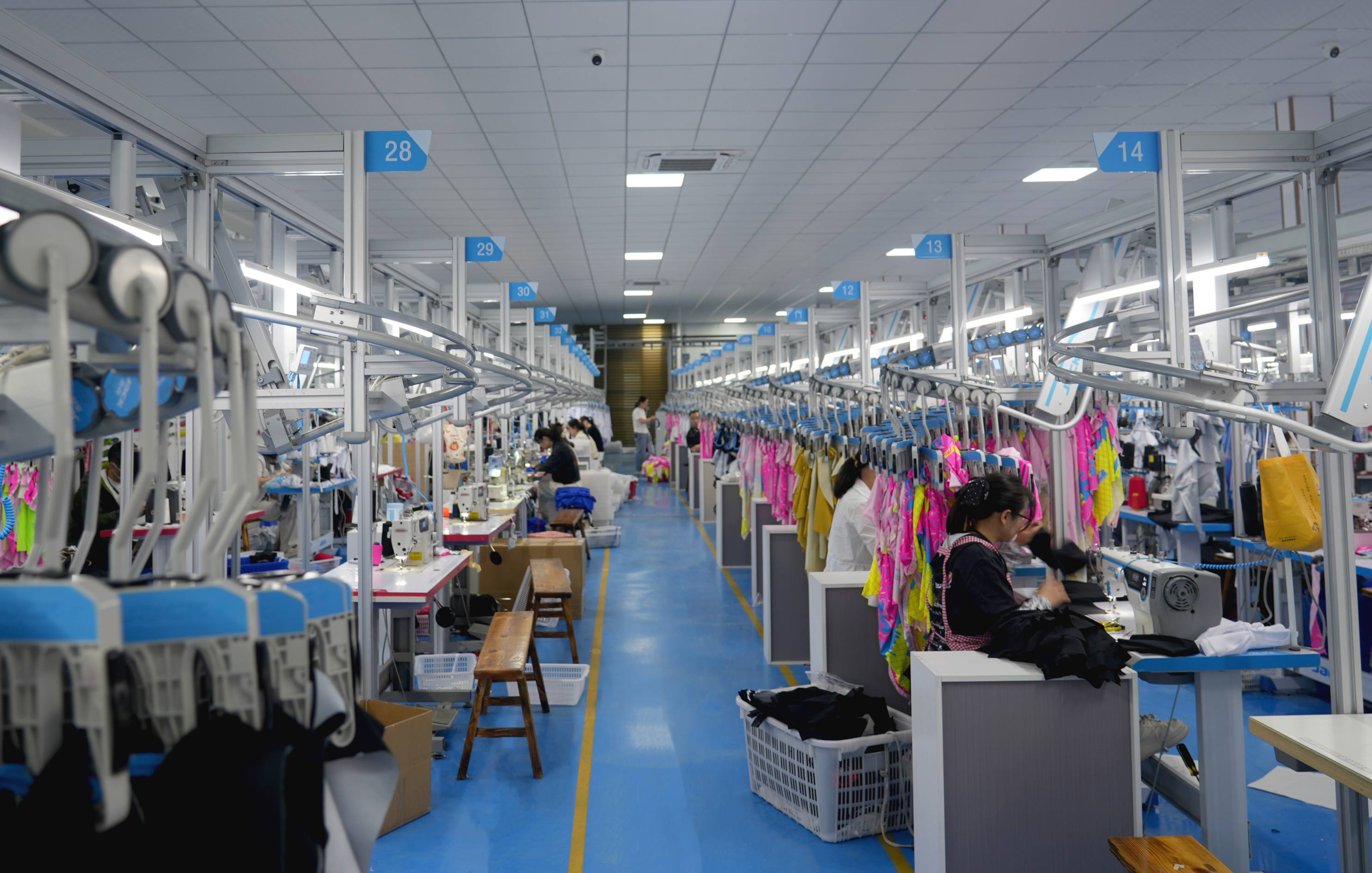

We now hold both GOTS and OEKO-TEX Standard 100 certifications. GOTS covers our organic cotton categories — most directly our reusable period underwear development — under License Number GOTS-BVCN9928. OEKO-TEX Standard 100 Class I covers our period underwear product line under Certificate No. 26.HCN.12213, tested by Hohenstein Labs, valid through July 31, 2027. They are not the same certification measuring the same thing twice — they check different parts of the process, and I want to lay out exactly what each one covers, where they overlap, and where they don't.
I already wrote a longer piece on the GOTS certification itself, what it took and what it means for organic cotton sourcing specifically. This one is different. This is about having two certificates on file at the same time and what that actually adds up to for a buyer trying to evaluate us. I'm not going to compare our paperwork to anyone else's — I don't know what other factories have on file and it's not really my business to guess. I can tell you what we have, what each document says, and how the two relate to each other.
What GOTS Represents
GOTS certifies the organic origin of the raw fiber plus environmental, chemical, and social compliance standards across the whole production process — not just a check on the finished product.
The Global Organic Textile Standard is built around traceability. It starts at the raw material — organic cotton, in our case — and requires that organic status to be verifiable back through every processing stage, not just claimed on a spec sheet. On top of that fiber traceability, GOTS sets environmental standards for wet processing, dyeing, and finishing, maintains its own restricted substance list separate from general textile regulations, and includes social compliance criteria for labor practices at the certified facility.
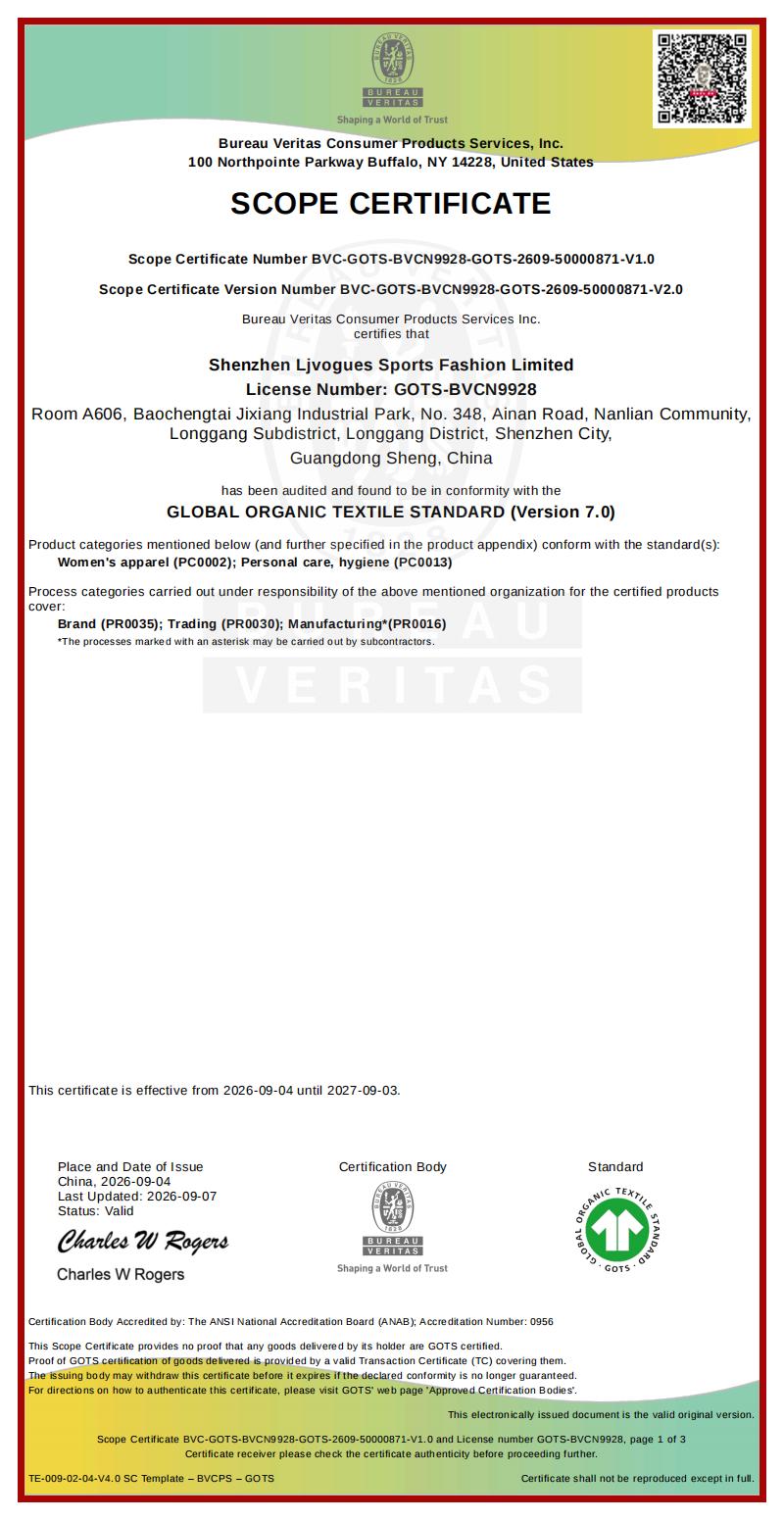
Our GOTS certificate — License Number GOTS-BVCN9928, Scope Certificate Number BVC-GOTS-BVCN9928-GOTS-2609-50000871-V1.0 — was issued by Bureau Veritas Consumer Products Services, Inc., accredited by the ANSI National Accreditation Board (ANAB) under Accreditation Number 0956. It's valid from September 4, 2026 through September 3, 2027, and it covers our Brand, Trading, and Manufacturing process categories for products built on 100% organic cotton. In practice, that scope lines up with our reusable period underwear development — that's the direction where organic cotton sourcing is the most relevant right now.
That scope detail matters for this article specifically: GOTS is tied to the organic cotton category. It doesn't extend to fabric constructions that aren't built on certified organic cotton, regardless of what else those products might have going for them.
What OEKO-TEX Standard 100 Represents
OEKO-TEX Standard 100 tests the finished product for harmful substances against defined limits — it's a lab test on what comes off the line, not a standard applied to raw material origin.
Where GOTS starts at the fiber source and follows the process forward, OEKO-TEX starts at the other end. It takes the finished product — or components of it — and tests them in an accredited lab against limit values for substances that shouldn't be there: things like restricted dyes, heavy metals, formaldehyde, and other substances with defined thresholds. It doesn't ask where the fiber came from or what standard the dye house was held to. It asks: does the finished item test clean against these specific limits.
Our OEKO-TEX Standard 100 Class I certification, Certificate No. 26.HCN.12213, was tested by Hohenstein Labs in Germany and is valid through July 31, 2027. Class I is the strictest of the OEKO-TEX product classes, reserved for items intended for babies and infants, which sets a tighter bar than the general consumer product classes above it. This certification covers our period underwear product line.
Notice that the word "line" there is doing real work. OEKO-TEX Standard 100 in our case is scoped to period underwear as a product line — not to organic cotton specifically, and not to every category we manufacture.

Where the Two Overlap — And Where They Don't
These two certifications cover different scopes that aren't identical: GOTS applies to our organic cotton categories, OEKO-TEX Standard 100 applies to our period underwear line, and holding both doesn't mean every product carries both certifications.
This is the part I want to be direct about, because it would be easy to let two certificate logos sitting next to each other imply more than either one actually says. Here's the honest picture:
GOTS scope: organic cotton categories, specifically our organic cotton reusable period underwear development, under Brand/Trading/Manufacturing process categories.
OEKO-TEX Standard 100 Class I scope: our period underwear product line, tested for harmful substances at the Class I threshold.
Where reusable period underwear is made from organic cotton, both certifications can speak to that product — one to the fiber and process, one to the finished-item safety test. But the two scopes were built to answer different questions, and they were not designed to blanket the same list of SKUs. A GOTS certificate doesn't tell you a product passed a harmful-substance test. An OEKO-TEX certificate doesn't tell you anything about whether the fiber was organic or how the processing chain was managed. Holding both means we have documentation on two separate fronts — it does not mean every item in our catalog is covered twice over, and it doesn't mean these are two versions of the same statement.
If a buyer wants to know whether a specific product carries one, both, or neither certification, that's a scope question worth asking directly rather than assuming from the fact that we hold two certificates in general.
Why This Distinction Matters When You're Sourcing
A certification is only useful to a buyer if you know exactly what it covers — a certificate number without a defined scope is just a name on a page.
I've written before about how to test a new manufacturer before committing real production volume to them, and the same logic applies here. The value of a certification isn't the logo. It's the fact that you can ask for the certificate number, the issuing body, the scope, and the expiration date, and check all four against something real. "We use safe, sustainable materials" is a sentence anyone can put on a website. "GOTS-BVCN9928, issued by Bureau Veritas, covering organic cotton categories through September 2027" is something you can verify.
This connects to something I've said about reading quotes carefully too: the number on a page doesn't tell you much until you know what's actually included in it. A certification works the same way. Two suppliers can both say "we're certified," and that sentence alone tells you almost nothing until you ask which standard, which scope, which certificate number, and which expiration date back it up. That's not a knock on anyone — it's just how verification has to work if it's going to mean anything.
So when you're comparing us, or comparing any supplier, on certifications, the useful questions are specific ones: What standard is this certificate for? What product categories or lines does the scope cover? Who issued it, and are they accredited by a recognized body? When does it expire? If a supplier can answer all four without hesitation, you're looking at something real. If the answer is vague, that's worth noting too.
GOTS vs. OEKO-TEX Standard 100 at a Glance
GOTS | OEKO-TEX Standard 100 | |
What it certifies | Organic fiber origin and traceability, plus environmental, chemical, and social compliance standards across the production process | Harmful substances in the finished product, tested against defined limit values |
What it does NOT certify | Finished-product substance residue testing | Fiber origin, organic status, or processing-chain standards |
Certification/testing body | Bureau Veritas Consumer Products Services, Inc. (accredited by ANAB, Accreditation No. 0956) | Hohenstein Labs |
Product scope for Ljvogues | Organic cotton categories — reusable period underwear development | Period underwear product line |
Certificate/License number | GOTS-BVCN9928 (Scope Certificate: BVC-GOTS-BVCN9928-GOTS-2609-50000871-V1.0) | 26.HCN.12213 |
Valid through | September 3, 2027 | July 31, 2027 |
What This Means If You're Evaluating Us
Holding both certifications means a buyer can ask to see two separate, independently issued documents covering two separate questions — a fiber-and-process standard and a finished-product safety test — instead of taking one general statement on faith.
I'll put it plainly: this isn't a claim that our whole catalog is double-certified. It's two pieces of paperwork, each with a defined scope, each checkable against a certificate number, each issued by a different body asking a different question. If you're sourcing organic cotton period underwear, both certifications are relevant to that specific product. If you're sourcing something outside either scope, neither one applies, and I'd rather tell you that upfront than let a general announcement create an assumption I can't back up.
What I'd actually suggest: ask us for the scope documents, not just the certificate numbers. Check the GOTS scope certificate against what GOTS publishes for verifying certification bodies. Ask what product categories sit inside the OEKO-TEX Class I scope versus outside it. That's a two-minute conversation on our end, and it's the same standard I'd want from any supplier I was buying from.
FAQ
Does holding both GOTS and OEKO-TEX certification mean all of Ljvogues' products are certified?
No. GOTS covers our organic cotton categories, most directly reusable period underwear development. OEKO-TEX Standard 100 Class I covers our period underwear product line. The two scopes are not identical and don't automatically extend to every product we manufacture. Ask about a specific style if you need to know whether it falls inside either scope.
What's the actual difference between GOTS and OEKO-TEX Standard 100?
GOTS certifies the organic origin of the raw fiber and sets environmental, chemical, and social compliance standards through the whole production process. OEKO-TEX Standard 100 tests the finished product for harmful substances against defined limits. One looks at where the material came from and how it was processed; the other tests what the finished item contains.
Can a product be OEKO-TEX certified without being GOTS certified, or vice versa?
Yes. OEKO-TEX Standard 100 doesn't require organic fiber content — a non-organic fabric can pass the substance test on its own. GOTS doesn't test finished-product substance residues at all — its entire scope starts with organic fiber and process standards. A product can carry one, both, or neither depending on its materials and what's been tested or audited.
How do I verify these certificates are real?
For GOTS, check the Scope Certificate Number (BVC-GOTS-BVCN9928-GOTS-2609-50000871-V1.0) and License Number (GOTS-BVCN9928) using the verification guidance GOTS publishes on its own site. For OEKO-TEX, Certificate No. 26.HCN.12213 was issued by Hohenstein Labs and can be checked through OEKO-TEX's certificate verification tools. I'd encourage any buyer to check both directly rather than relying on our word.
When do these certifications expire?
The GOTS certificate is valid from September 4, 2026 through September 3, 2027. The OEKO-TEX Standard 100 Class I certificate is valid through July 31, 2027. Both are time-bound, not permanent, so it's worth checking current status rather than referencing either indefinitely.
If you want to see either certificate directly, or talk through which scope applies to what you're sourcing, reach out and I'll walk you through it.
— Ocean Yang
Founder & CEO, Shenzhen Ljvogues Sports Fashion Limited
Email: info@ljvogues.com
WhatsApp: +86-199-2880-2613
Website: ljvogues.com