The disposable period underwear market in the United States is growing fast — projected to be part of a category approaching $1 billion globally within the next decade. But walk into any drugstore and look at the shelf: every disposable period underwear product looks the same. White. Maybe light pink. Occasionally gray. Nobody is making them in skin tones. In this project, we worked with a US-based startup founder who saw that gap clearly and wanted to build a brand around it — disposable period underwear in a full range of skin-tone colorways, from light ivory to deep brown, with clean materials and US market compliance built in from day one.
The Client
Our client was a founder based in the United States, building a new disposable period underwear brand with a differentiated market position: skin-tone inclusivity . The concept was simple and powerful — if nude-shade bras and underwear have become a mainstream expectation in intimate apparel, why is disposable period underwear still stuck in clinical white?
The founder had done thorough market research and identified that no major US disposable period underwear brand was executing a genuine skin-tone range. This was not a cosmetic preference — it was a commercial opportunity. For consumers who wear light-colored clothing, work in visible environments, or simply want their period protection to feel as considered as the rest of their wardrobe, color matters.
The brand was at the early sampling stage. No existing products, no established supply chain. The founder needed a manufacturing partner who could execute custom colorways at reasonable per-shade MOQs, provide material safety documentation for the US market, and support a structured first-order launch.
The project was discussed under a confidential OEM framework.
What the Client Was Looking For
The inquiry was exceptionally well-structured. The founder organized their requirements across four areas — a level of preparation that immediately signaled a serious buyer.
Color customization:
A custom skin-tone fabric range covering at least 5–6 shades from light ivory to deep brown
Clarity on whether the outer fabric layer would be dyed or printed (and which method produced better color consistency)
Reasonable MOQ per individual colorway — the founder understood that 6 colorways would multiply MOQ pressure and needed a workable structure
Sample or photographic references of previous custom color work
Product specifications:
Multiple absorbency levels: light, moderate/heavy, and overnight
Clear absorbency capacity data in milliliters per level
Material certifications: OEKO-TEX Standard 100, PFAS-free documentation, and FDA compliance for absorbent hygiene products sold in the US
Exploration of biodegradable or compostable outer layer options for future sustainability positioning
Minimums and pricing:
MOQ per SKU broken down by color × size × absorbency level
Sample costs and whether they could be credited toward bulk
Standard payment terms and lead time from approved sample to delivery
US compliance and shipping:
FDA requirements for absorbent hygiene products
Third-party test reports for skin safety and absorbency performance
Experience shipping to the US market or working with US import/logistics partners
The Concerns We Heard Before Starting
"Can you actually produce 5–6 custom skin-tone colorways without astronomical MOQs?"
This was the make-or-break question. The founder's entire brand concept depended on a multi-shade range. If the per-colorway MOQ was 50,000 units, the launch was financially impossible for a startup. If it was 3,000–5,000 per colorway, the math worked. The founder needed a transparent conversation about where the realistic threshold sat.
"Is the outer layer dyed or printed — and does it matter?"
The founder understood that color consistency across a skin-tone range is critical. A shade that shifts between production batches destroys the brand's credibility. They wanted to know which coloring method — fabric dyeing versus printing — would deliver the most consistent, wash-stable (or in this case, wear-stable), and visually accurate result for skin-tone shades.
"Can you prove the materials are PFAS-free?"
PFAS contamination in period products has become a high-profile issue in the US market. The founder was building a brand around trust and transparency, and needed verifiable third-party documentation — not just a supplier's verbal assurance — that the absorbent core, leak-proof layer, and adhesive materials contained no intentionally added PFAS. This was both a consumer safety commitment and a regulatory risk mitigation strategy.
"Do your products meet FDA requirements?"
In the United States, disposable absorbent hygiene products fall under FDA regulatory oversight. The founder needed confidence that we could provide the documentation, testing, and labeling support necessary for compliant US market entry.
"Is a biodegradable outer layer actually possible at this stage?"
The founder was thinking ahead. While the initial launch would prioritize market entry, they wanted to understand whether a compostable or biodegradable outer fabric was technically feasible for a future product iteration — and what the trade-offs would be in terms of cost, performance, and certification.
How We Worked Through It
We structured this project across two parallel workstreams: product development (color, construction, absorbency) and market readiness (compliance, documentation, packaging, logistics).
Phase 1 — Custom Skin-Tone Color Development
Color matching for skin tones is far more demanding than standard color work. In a typical disposable period underwear order, the color is white or a single fashion shade. A skin-tone range requires 5–6 distinct shades that must each look natural, consistent, and accurate — and any visible inconsistency between batches will be immediately obvious to the end consumer.
Our approach:
Method: we recommended fabric dyeing over printing for the outer non-woven layer. Dyeing produces a more natural, through-color result with better batch-to-batch consistency. Printing can create surface-level color that may appear uneven on non-woven textures, especially in subtle skin-tone shades where the eye is highly sensitive to variation.
Shade development: we created a 6-shade Pantone-referenced skin-tone palette — Light Ivory, Light Beige, Medium Sand, Warm Caramel, Rich Umber, and Deep Brown — with each shade matched to a Pantone TPX reference for reproducible color control across production runs.
Lab dips: we produced lab dip samples for each shade on the actual production non-woven fabric, so the founder could evaluate color accuracy on the real material, not on a different substrate.
MOQ per colorway: we structured the MOQ to make the multi-shade launch feasible for a startup — setting a per-colorway minimum that allowed the founder to produce all 6 shades within a total first-order volume that was commercially realistic without requiring venture-capital-level inventory investment.
Phase 2 — Disposable Product Construction
Disposable period underwear construction is fundamentally different from reusable. The product is a non-woven garment with a built-in absorbent core, designed for single-use wear and disposal. We engineered the product using a structure optimized for comfort, fit, and protection :
Outer layer: a soft, breathable non-woven fabric (custom-dyed in the skin-tone shade) — providing the garment's external appearance, breathability, and structural shape
Absorbent core: a multi-layer SAP (superabsorbent polymer) and fluff pulp core — the ratio and weight of SAP to fluff pulp determines absorbency capacity, and was calibrated differently for each absorbency tier:
Light flow: designed for approximately 50–80ml capacity — suitable for light days, spotting, and backup protection
Heavy flow: approximately 120–180ml — suitable for moderate-to-heavy menstrual days and regular daytime use
Overnight: approximately 200–280ml — extended capacity with a longer absorbent zone for overnight wear and full coverage during sleep positions
Acquisition/distribution layer: a layer between the skin-facing surface and the absorbent core that rapidly spreads fluid across the core to prevent pooling and improve absorption speed
Leak-proof back sheet: a breathable PE (polyethylene) film that prevents liquid pass-through while allowing air circulation to reduce heat and moisture buildup
Skin-facing top sheet: a soft, hydrophilic non-woven that wicks fluid away from the skin surface — selected for a cotton-like hand feel to maximize comfort during wear
Elastic waist and leg: soft stretch elastic integrated into the waist and leg openings for a secure, underwear-like fit without dig-in or pressure marks
Phase 3 — PFAS-Free Material Verification
Given the increasing regulatory scrutiny and consumer awareness around PFAS in intimate hygiene products, we implemented a multi-layer verification approach:
All materials in direct or indirect skin contact were sourced from suppliers who provide PFAS-free declarations
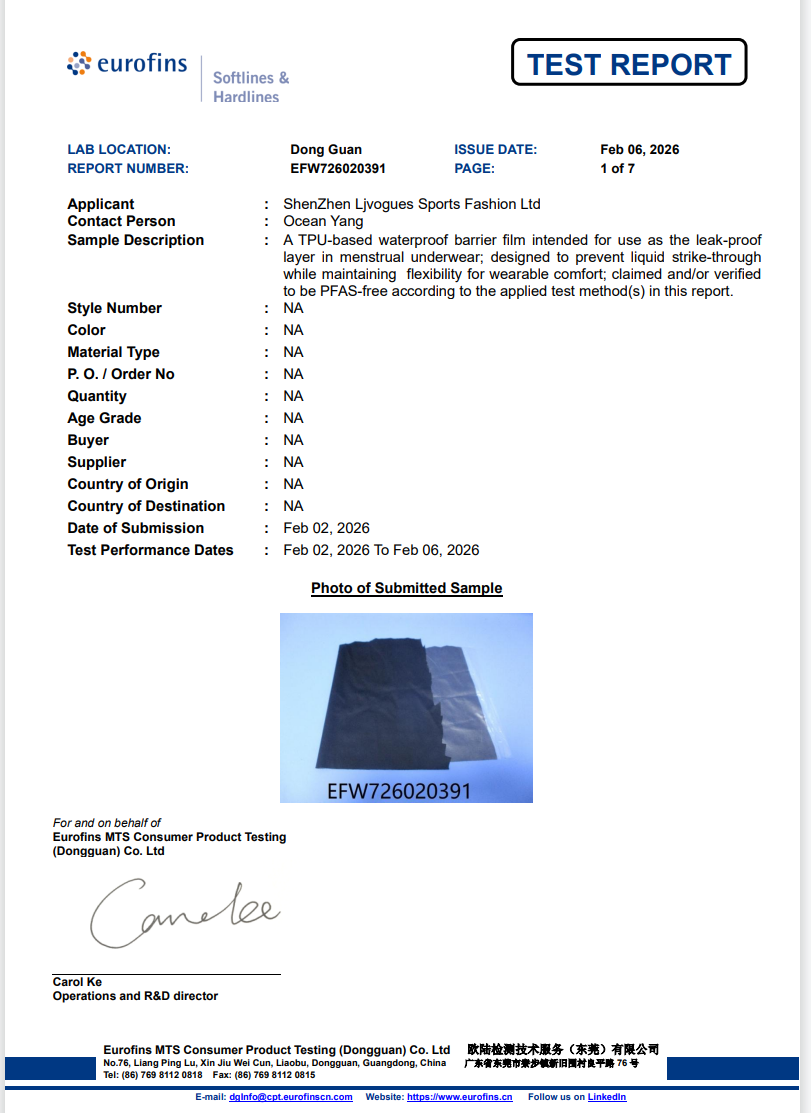
We arranged third-party laboratory testing for Total Organic Fluorine (TOF) on finished product samples — testing to the stringent threshold of below 20 ppm, consistent with Intertek's PFAS-Free certification standard
Test results were documented in a formal report suitable for the founder's product claims, Amazon listing compliance, and any future regulatory inquiries
Additionally, we confirmed OEKO-TEX Standard 100 certification on all skin-contact materials, providing a second layer of chemical safety assurance
Phase 4 — FDA and US Compliance Preparation
Disposable absorbent hygiene products sold in the US require attention to FDA regulatory requirements. We supported the founder with:
Product classification documentation confirming the product's regulatory category
Third-party absorbency performance testing: standardized testing to quantify actual absorbent capacity per level, absorption speed, and rewet performance
Skin safety testing: dermatological compatibility testing on finished product samples
Labeling guidance: recommended content for US-market packaging including material composition, absorbency level designation, disposal instructions, and any required regulatory statements
All documentation compiled into a compliance file the founder could provide to retail partners, Amazon, or any US regulatory inquiry
Phase 5 — Biodegradable Outer Layer Feasibility
The founder asked about biodegradable/compostable options for a future iteration. We provided a transparent assessment:
Feasible today: biodegradable non-woven outer layers (PLA-based or plant-fiber-based) exist and can be custom-dyed in skin-tone shades, though with slightly narrower color gamut and higher cost (approximately 15–25% premium over standard non-woven)
Trade-offs: biodegradable non-wovens currently have slightly lower tensile strength and different drape behavior — acceptable for most consumers, but requiring separate sample evaluation
Certification: true "compostable" claims require industrial composting certification (e.g., EN 13432 or ASTM D6400), which applies to the non-woven layer only — the SAP core and PE back sheet are not compostable in current formulations
Recommendation: launch with standard non-woven for Phase 1 (proven performance, lower cost, faster timeline), and develop biodegradable samples in parallel for a Phase 2 "eco" line once the core brand is established
Phase 6 — MOQ Structure and First-Order Planning
We worked with the founder to build a launch plan that made the 6-colorway concept feasible:
For Phase 1 launch, we recommended a focused structure: 6 colorways × 1 absorbency level (heavy — the highest-volume, most universal use case) × 3 sizes (M/L/XL) = 18 SKUs
This reduced the total first-order volume to a startup-manageable level while still delivering the full skin-tone range that defined the brand
Light and overnight absorbency levels were deferred to Phase 2, informed by Phase 1 sales data
Multi-pack packaging: 4-pack and 8-pack options designed for both e-commerce and potential retail shelf placement
Phase 7 — Packaging and Logistics
Packaging was designed for dual-channel readiness:
Individual wrap: each unit in a discreet, sealed pouch (standard for disposable hygiene products)
Multi-pack outer: a printed cardboard sleeve or bag with the skin-tone shade clearly visible — allowing the consumer to identify their shade at a glance
Labeling: bilingual English/Spanish product information, US-compliant material disclosures, absorbency level indicator, disposal instructions, and the brand's PFAS-free claim supported by test documentation
Export documentation: prepared for the founder's US-based 3PL, including commercial invoice, packing list, and any required customs documentation for absorbent hygiene product importation
Production and Delivery
The first-order plan was structured for a focused, skin-tone-led market entry:
1 absorbency level (heavy flow) for Phase 1
6 custom skin-tone colorways
3 sizes per colorway (M/L/XL)
18 total SKUs
4-pack and 8-pack multi-pack formats
PFAS-free and OEKO-TEX certified materials
FDA-ready compliance documentation
Export-ready for US 3PL intake
Production followed a workflow specific to disposable hygiene products: raw material inspection (non-woven, SAP, fluff pulp, elastic), converting line setup with colorway-specific changeover protocols, in-line quality checks (absorbency spot tests, elastic tension, seal integrity), and final inspection before packing .
The Result
The founder moved from a concept deck to a market-ready product with a genuine competitive differentiator — something no other US disposable period underwear brand was offering.
6 skin-tone colorways produced with Pantone-matched consistency — the brand's core differentiator was manufacturable and reproducible
PFAS-free verified to <20 ppm TOF — the founder could make this claim confidently on packaging and product listings, backed by third-party documentation
FDA compliance file prepared — all testing, documentation, and labeling guidance assembled for US market entry
Absorbency validated through third-party testing — each level had documented ml capacity, giving the founder credible data for product claims
First-order volume manageable for a startup — the focused Phase 1 structure kept inventory investment realistic while delivering the full 6-shade range
Phase 2 roadmap clear — light and overnight absorbency levels, biodegradable material iteration, and expanded size range all mapped and ready for development once Phase 1 data is in
For a startup entering a growing category, the most powerful launch advantage is not being cheapest or biggest — it is being the only brand doing something the customer has been waiting for.
What Other Buyers Can Take from This Project
Color is a product feature, not just a packaging decision.
In intimate hygiene — a category worn against the skin and sometimes visible through clothing — color is functional. Skin-tone matching is not a luxury; for many consumers, it is a basic expectation that no one has met in the disposable period category.
Verify PFAS-free status with third-party testing, not supplier declarations.
Supplier self-declarations are a starting point, not proof. For the US market, where PFAS awareness is high and regulatory action is increasing, invest in independent laboratory testing to a recognized threshold (20 ppm TOF) and keep the documentation ready for any inquiry.
Do not launch 72 SKUs when 18 will answer your questions.
If you have 6 colorways, 3 absorbency levels, and 4 sizes, the math says 72 SKUs. The reality says: pick the single highest-volume absorbency level, cut one size from the first run, and launch with 18. You will learn which colors sell, which sizes move, and whether the category works — without drowning in inventory.
Think about compliance before you think about marketing.
FDA documentation, skin safety testing, absorbency performance data, PFAS-free certification — these are not afterthoughts you handle before launch week. They are workstreams that run in parallel with product development from day one. A product that cannot prove its claims is a liability, not an asset.
Looking for a Confidential OEM Partner for Disposable or Reusable Period Underwear?
At Ljvogues, we manufacture both disposable and reusable period underwear and period swimwear, supporting brands from concept through compliance, custom color development, and market-ready production. Whether you need a skin-tone disposable range for the US market or a reusable collection for European retail, we bring the product engineering, material sourcing, and documentation discipline to get it right.
Ocean Yang bridges the gap between textile science and brand success. As the founder of Ljvogues, he leverages 10+ years of expertise in manufacturing high-performance period underwear and swimwear. Dedicated to transparency and safety, Ocean empowers B2B buyers to source verified, compliant, and innovative functional apparel from Shenzhen to the world.
Ljvogues is a Shenzhen-based manufacturer of high-performance menstrual and incontinence apparel. Empowering 500+ brands across 100+ countries since 2015 — with PFAS-free verified production, REACH/SVHC compliance, and ISO 9001 & 14001 certified precision.

 English
 العربية
 Français
 Русский
 Español
 Português
 Deutsch
 italiano
 日本語
日本語 한국어
한국어 Nederlands
 Tiếng Việt
 ไทย
ไทย Polski
 Türkçe
 ພາສາລາວ
 ភាសាខ្មែរ
 Bahasa Melayu
 Filipino
 Bahasa Indonesia
 magyar
 Română
 Čeština
 Српски
 हिन्दी
 فارسی
فارسی Svenska
 українська
 Ελληνικά
 Suomi
Suomi Հայերեն
 עברית
עברית Latine
 Dansk
Dansk Gaeilge
 Eesti keel
 Oʻzbekcha
 Azərbaycan dili
 Беларуская мова
 Български
 ქართული
 Lietuvių




 Ocean Yang


