
Views: 0 Author: Ocean Yang Publish Time: 2026-03-12 Origin: Ljvogues


Table of Contents
When a DTC underwear brand already has loyal customers who trust its fit, fabric, and comfort — adding period underwear is not about starting over. It is about extending what already works into a functional category without breaking the connection. In this project, we partnered with a US-based DTC underwear brand to do exactly that: build a period underwear line that felt like a natural next chapter, not a separate product experiment.
Our client was a US-based direct-to-consumer underwear brand with an established customer base and a clearly defined product identity . The brand had built its reputation on everyday comfort, clean design, and reliable fit — and had developed strong brand loyalty as a result.
The team saw period underwear as a logical next step. Their existing customers were already asking for it. But the concern was clear: if the new product felt too different — too thick, too stiff, too "functional" — it could actually damage the trust they had built with their core audience.
The project was managed under a confidential OEM framework. All brand-specific information, sourcing details, and product specs remain private.
The brief was not "build us a period underwear line." It was "help us extend our existing underwear into a period-proof version without losing what makes it ours."
Period underwear styles that preserved the brand's existing fit silhouette and design language
Absorbent protection for light to moderate flow, suitable for all-day wear
A product feel that stayed close to everyday underwear — no bulk, no stiffness, no "diaper" sensation
A controlled launch scope: limited styles, manageable SKUs, realistic first-order quantities
Custom branding: labels, packaging, and product presentation consistent with the existing line
A development timeline that moved efficiently without cutting corners on fit refinement
The client was very specific: the period underwear had to pass what they internally called "the drawer test" — if a customer pulled it out of a drawer alongside regular underwear, it should feel like part of the same family.

"Will our customers recognize this as our product?"
Brand continuity was the primary anxiety. The client had spent years building a specific product identity — the weight of the fabric, the way the waistband sits, the cut of the leg opening. They needed assurance that adding an absorbent layer would not fundamentally change that experience.
"How much bulk does the absorbent layer actually add?"
The client's existing underwear was lightweight and minimal. Their customer base chose the brand specifically because it did not feel over-engineered. Any noticeable increase in thickness — especially in the gusset area — was a dealbreaker.
"Can we test this without over-committing?"
As a DTC brand, the client managed its own inventory. There was no retail partner absorbing excess stock. Every unit ordered had to be sellable. The team wanted a first-order structure that let them validate the category before scaling.
"How fast can we move from sample to shelf?"
The client had an internal launch calendar tied to email campaigns, content production, and website updates. Development delays would cascade into marketing delays.
We treated this as a product extension project, not a new product development project. That distinction shaped every decision.
Phase 1 — Mapping the Existing Product DNA
Before designing anything new, we studied the client's current underwear range in detail. They sent us their best-selling styles with fit notes, fabric specs, and customer feedback highlights. We documented the key attributes that defined their product identity:
Waistband width and tension
Leg opening cut and elastic feel
Rise height and back coverage
Fabric weight, stretch, and hand feel
Overall construction approach (bonded vs. stitched seams, raw-cut vs. finished edges)
This became our design constraint framework. Every development choice for the period underwear had to stay within these parameters or justify the deviation.
Phase 2 — Selecting Extension-Ready Silhouettes
Not every underwear style translates well into period underwear. We worked with the client to identify which of their existing silhouettes offered the best foundation for functional adaptation — considering gusset width, body coverage, and construction compatibility. We narrowed it down to two core silhouettes: a mid-rise bikini and a high-rise brief, both strong sellers in their existing range .
Phase 3 — Engineering the Absorbent Layer Within Brand Parameters
This was the critical technical phase. We needed to integrate our multi-layer absorbent panel system while staying within the thickness and weight tolerances the client defined. Our approach:
Top wicking layer: a micro-mesh with a soft brushed finish to match the client's existing fabric hand feel
Absorbent core: a slim-profile core calibrated for light-to-moderate absorption — enough for all-day confidence without the volume of a heavy-flow build
Leak-proof membrane: a breathable waterproof barrier thin enough to avoid adding perceptible stiffness
Inner lining: matched to the client's existing gusset lining for visual and tactile consistency
We produced cross-section samples so the client's team could physically compare the period version against their standard underwear — measuring the actual thickness differential in millimeters. The final construction added less than 1.5mm to the gusset area.

Phase 4 — Sample Development and Refinement
First samples were produced and shipped with a detailed specification sheet for side-by-side comparison against the client's existing products. The client's feedback was thorough and focused on:
Fit consistency — ensuring the period version did not ride differently, bunch, or shift compared to the standard version of the same silhouette
Waistband and leg opening feel — maintaining identical elastic tension and edge finish
Gusset transition zones — smoothing the points where the absorbent panel meets the standard fabric to eliminate any visible ridge or step
Fabric hand feel — confirming that the outer fabric and inner lining felt cohesive with the rest of the brand's range
Wash durability — verifying that absorbency, shape, and softness held up through repeated home laundering
We went through two revision rounds. The first addressed fit and panel integration; the second fine-tuned transition-zone flatness and confirmed final elastic tension. Each round was documented with a side-by-side revision log.

Phase 5 — Branding and Packaging Alignment
The client needed the period underwear to integrate seamlessly into their existing packaging system. We matched their label format, replicated their care label layout with US-compliant FTC content, and produced packaging that was visually consistent with their current line — with a subtle product descriptor differentiating the period styles.
Phase 6 — Pre-Production Lock and First Bulk
Final pre-production review covered: confirmed size grading (XS–XL, US standard), color-matched fabric approval against Pantone references, label placement verification, fold-and-pack method confirmation, and carton packing specs aligned with the client's fulfillment workflow. This step eliminated ambiguity before the production floor started cutting.
The first order was structured for controlled market testing:
2 core silhouettes (mid-rise bikini + high-rise brief)
5 sizes per style (XS–XL), weighted toward S/M/L based on the client's existing sales data
3 colorways drawn from the brand's neutral palette
Packaging matched to the brand's existing fulfillment format
Production followed our standard QC-integrated workflow with additional checkpoints specific to this project: gusset thickness measurement at cutting, absorbent panel alignment verification during sewing, and a final fit check on graded size samples before packing .
Delivery was completed on schedule, aligned with the client's planned product launch and supporting content calendar.
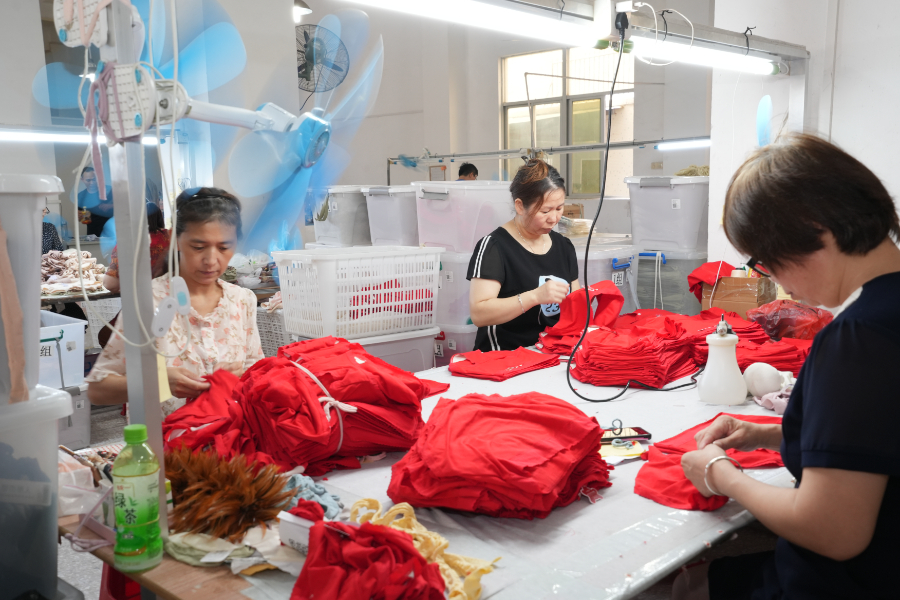
The client launched period underwear as a line extension — not as a side experiment — and the product felt like it belonged.
Brand continuity preserved — existing customers experienced the new product as a familiar upgrade, not a foreign addition
"Drawer test" passed — the period underwear was visually and tactilely consistent with the brand's standard range
First-order risk managed — limited styles, practical quantities, and focused SKU count kept inventory exposure low
Reorder pathway established — the client now has locked specs, approved patterns, and validated construction for future expansion into additional silhouettes, absorbency levels, or seasonal colorways
For a DTC brand, the real measure of success is not just launching a new product — it is launching one that strengthens the existing relationship with customers rather than confusing it.

Start from your existing product identity, not from zero.
If your brand already has a defined fit, fabric, and design language, the smartest path into period underwear is to extend those attributes — not to design a completely separate product that happens to share your logo.
Measure the thickness differential in millimeters, not in marketing language.
Your customers will feel the difference between regular underwear and period underwear the moment they put it on. The closer you can get that gap to zero, the higher your repeat purchase rate will be.
Use your existing sales data to plan your first order.
Your size ratio, color mix, and style selection should be informed by what you already know about your customer — not by generic industry assumptions.
Treat the launch as a test, not a commitment.
A focused first order with two to three styles gives you real market data. A sprawling launch with eight styles gives you warehousing problems.
At Ljvogues, we work with DTC brands, retail buyers, and emerging labels to develop period underwear and period swimwear that meet real commercial standards. Whether you are extending an existing line or building from scratch, we focus on product clarity, brand consistency, confidential cooperation, and structured development that respects your timeline.
Request a Sample · Email: info@ljvogues.com · WhatsApp: +86-19928802613
 Ocean Yang


