Building leak-proof function into running shorts is a fundamentally different engineering problem from building it into underwear. In underwear, the garment sits close to the body and barely moves. In running shorts, everything moves — the fabric shifts, the legs stride, the body bounces, and sweat mixes with everything else happening in the gusset area. If the liner cannot keep up with all of that, it fails. In this project, we worked with a women's activewear startup to develop leak-proof running shorts and skirts with built-in functional liners — products designed to handle both menstrual flow and light bladder leaks without compromising the athletic performance the wearer expects.
The Client
Our client was an early-stage founder building a women's activewear brand with a specific mission: create running apparel that eliminates the anxiety of leaking during exercise . The concept was born from a real problem — women who run, train, or exercise during their period or who experience light bladder leaks during high-impact movement currently face a choice between wearing a pad inside their shorts (uncomfortable, shifts during movement, visible lines) or hoping for the best.
The client wanted a third option: running shorts and skirts with a built-in leak-proof liner that was thin enough to feel like regular activewear, secure enough to stay in place during a 10K run, and absorbent enough to handle light-to-moderate flow without anxiety.
The brand was pre-launch. No existing products, no sales history, no established supply chain. This meant the development process needed to be realistic about early-stage constraints — particularly around MOQ, sampling investment, and the pace of iteration.
The project was discussed under a confidential OEM framework.
What the Client Was Looking For
This was not a standard period underwear brief adapted for sportswear. The client had thought carefully about the product concept and arrived with specific, technically informed requirements:
Two core silhouettes: a running short (mid-thigh, relaxed athletic fit) and a running skirt (skort format with built-in liner short underneath)
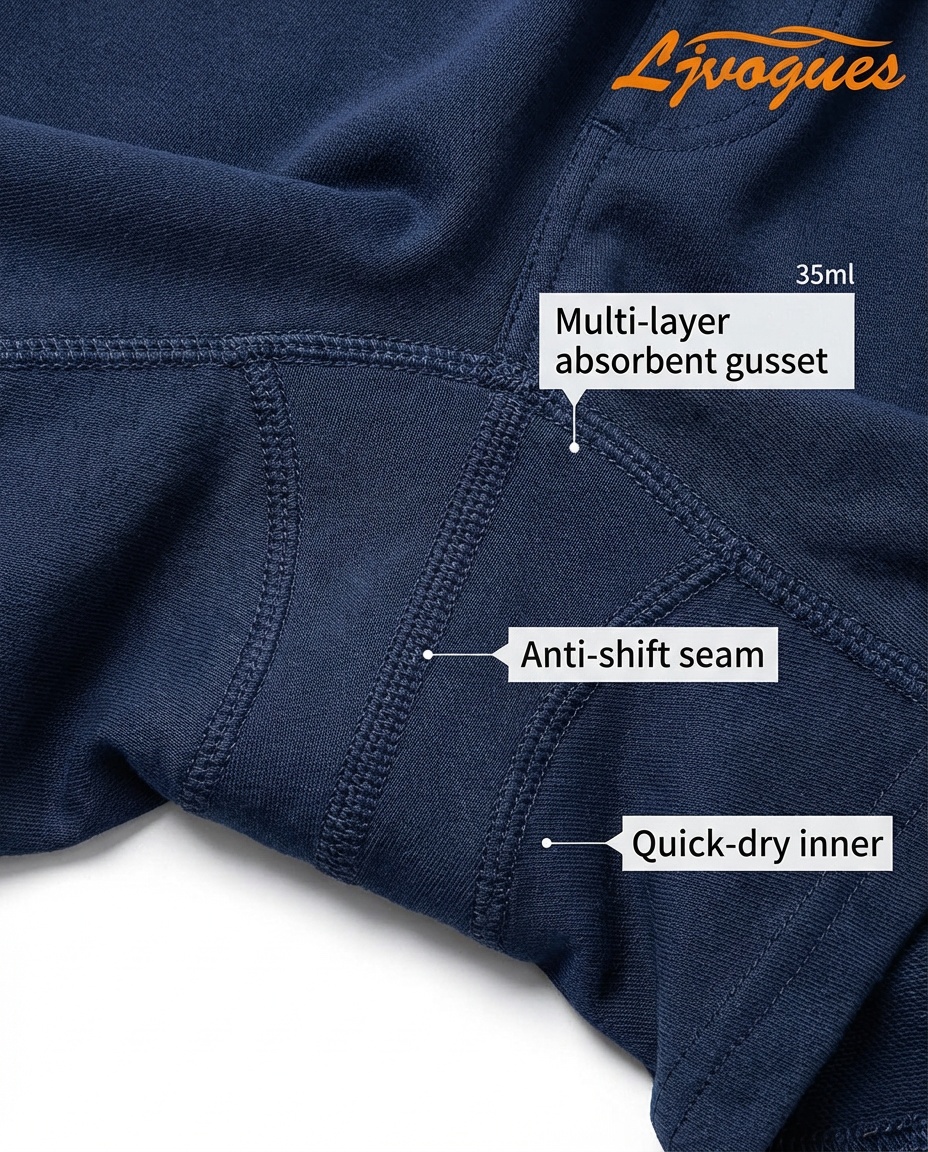
Built-in liner: a 3-layer leak-proof liner integrated into the inner brief, covering both menstrual protection and light bladder leak use cases
Liner feel: as thin as possible while still providing meaningful protection — the client explicitly did not want the product to feel like "underwear with shorts over it"
Motion stability: the liner had to stay in place during running, jumping, lunging, and lateral movement without bunching, shifting, or riding up
Target absorbency: enough for light-to-moderate menstrual flow or light bladder leaks (the client wanted to understand the realistic milliliter range achievable at activewear thinness)
MOQ: approximately 50–150 units for initial market testing
Custom sampling: the client needed samples built to their proposed construction, not generic off-the-shelf products
The Concerns We Heard Before Starting
The client asked some of the most technically precise questions we have received from a startup buyer. Every one of them was directly relevant to whether the product would actually work in real athletic use.
"How many milliliters of absorbency can I get without making the liner feel thick?"
This is the central trade-off in leak-proof activewear. In period underwear, a moderate-flow panel might absorb 15–20ml and sit at 2–3mm thickness — acceptable when the garment is underwear. In running shorts, that same thickness creates a perceptible bulk that the wearer feels with every stride. The client understood this tension and wanted a transparent conversation about where the realistic performance envelope sat.
"How do you prevent side leakage during running?"
Side leakage is the number-one failure mode in leak-proof activewear. During running, the legs move laterally relative to the gusset, the fabric shifts, and fluid can migrate to the edges of the absorbent zone. A liner that works perfectly while standing can fail completely during a sprint. The client specifically asked how we would address this — not with marketing language, but with construction solutions.
"Will the liner stay breathable during exercise?"
Running generates significant body heat and sweat in the groin area. Adding a multi-layer liner with a waterproof membrane on top of that raises a legitimate concern: will the product become a sweat trap? For an activewear product, breathability is not a nice-to-have — it is a functional requirement.
"Can you actually support a 50–150 unit first order?"
The client was honest about their stage. They did not have funding for 3,000 units of an unproven concept. They needed a manufacturing partner who would take a small test order seriously and support the iteration process that early-stage product development requires.
How We Worked Through It
We structured this project as a technical product development engagement, not a standard production order. The goal of the first phase was not to produce bulk — it was to prove the concept worked in motion.
Phase 1 — Mapping the Athletic Use Case
Before touching any materials, we mapped the specific physical demands the product would face:
Impact forces: running generates repetitive vertical impact — the liner must resist compression cycling without losing absorbent capacity or shifting position
Lateral movement: the inner thighs move against the gusset with every stride — the liner edges must resist being pushed sideways by friction
Sweat load: the groin area during running can produce 2–5x more perspiration than at rest — the liner's wicking layer must handle sweat and menstrual fluid simultaneously without becoming saturated by sweat alone
Body temperature: core temperature during running rises significantly — the leak-proof membrane must remain breathable enough to allow vapor transmission, or the wearer will experience uncomfortable heat buildup
Duration: a typical run or training session lasts 30–90 minutes — the liner needs to perform across that entire window, not just the first 10 minutes
This use-case map became the engineering specification that every material and construction decision was tested against.
Phase 2 — Liner Architecture for Activewear
The client proposed a 3-layer system. We refined it into an activewear-specific build that prioritized thinness, breathability, and motion stability over maximum absorbency :
Layer 1 — Dual-function wicking surface: a high-performance moisture-transport mesh designed to wick both sweat and menstrual fluid away from the skin surface. In activewear, this layer has to work harder than in underwear because it is managing two fluid types simultaneously. We selected a mesh with a faster capillary transfer rate than our standard period underwear wicking layer.
Layer 2 — Slim absorbent core: a compressed-fiber core calibrated for the activewear use case. Rather than targeting maximum milliliter capacity, we optimized for a balance: enough absorption for light-to-moderate flow across a 60–90 minute activity window, at the thinnest possible profile. We were transparent with the client about the realistic range — at activewear-appropriate thinness (under 2mm total panel), the absorbent capacity sits in the 8–15ml range depending on core density. This covers light menstrual flow, spotting, and light bladder leaks effectively. For heavier flow days, we recommended the product be positioned as a backup layer alongside a menstrual cup or disc, rather than as standalone heavy-flow protection.
Layer 3 — Breathable waterproof membrane: we tested three membrane options and selected the one with the highest moisture vapor transmission rate (MVTR). In activewear, the membrane needs to block liquid from passing through while allowing sweat vapor to escape. A low-MVTR membrane would trap heat and moisture, creating a sauna effect that makes the product unwearable during exercise.
Phase 3 — Solving Side Leakage for Running
This was the most engineering-intensive part of the project. Side leakage during running is a multi-factor problem, and solving it requires addressing construction, fit, and placement together — not just adding more absorbent material.
Our approach:
Wider coverage zone: the absorbent panel was designed wider than a typical period underwear gusset — extending further toward the inner thigh crease on both sides to account for the lateral leg movement during running
Contoured panel shape: rather than a rectangular panel, we developed a front-narrow, center-wide, back-tapered shape that matched the natural contact zone between the body and the liner during running gait
Bonded edge sealing: the edges of the leak-proof membrane were bonded (not stitched) to the liner fabric, creating a sealed perimeter that prevents fluid migration to the panel edges — stitching creates needle holes that can become leak paths under pressure
Liner fit tension: the built-in brief was engineered with slightly higher elastic tension than a standard running short liner — enough to keep the absorbent zone in firm contact with the body during movement, but not so much that it felt restrictive or created dig-in
We explained to the client that side leakage prevention is ultimately a fit problem as much as a materials problem. The best liner in the world will leak sideways if the brief does not hold it against the body consistently during motion.
Phase 4 — Outer Shell Development
The outer running short and skirt were developed as performance activewear, independent of the liner function:
Fabric: a lightweight polyester/spandex blend (88/12) with 4-way stretch, moisture-wicking finish, and UPF 30+ — standard performance spec for running apparel
Running short: mid-thigh length, relaxed athletic fit, elastic waistband with internal drawcord, side split hem for stride freedom
Running skirt: A-line skort format with the same built-in liner brief, knee-length skirt overlay with stretch panel for movement
Both silhouettes were designed so the outer layer looked and functioned as standard athletic apparel. The leak-proof function was entirely invisible — hidden inside the built-in brief.
Phase 5 — Sample Development and Motion Testing
We produced development samples for both silhouettes and shipped them to the client for evaluation. The client's testing protocol included:
Motion testing: running, lunging, squatting, lateral shuffles — evaluating liner stability, panel shift, and comfort during sustained movement
Moisture simulation: testing absorbent response with controlled fluid application during movement (the client used industry-standard testing methods to simulate real-world use)
Breathability assessment: wearing the product during a 45-minute treadmill session and evaluating heat buildup versus a standard running short without a liner
Feedback from the first sample round:
Liner stability during running was rated "good" — minor adjustment needed to brief leg elastic to improve contact on the left side during right-foot push-off (asymmetric movement pattern)
Absorbent panel coverage was confirmed as adequate for the intended use case
Breathability was rated "acceptable" — the client noted the liner area was slightly warmer than a non-functional short, but not uncomfortable. We discussed potential improvements for the next iteration using a higher-airflow membrane
Outer shell fit and appearance received positive feedback — "looks like a regular running short, which is exactly the point"
One revision round was completed to address the brief elastic adjustment and a minor change to the panel edge finishing for improved flatness
.
Phase 6 — MOQ and Launch Planning
With the sample validated, we worked with the client to structure a realistic first-order plan:
1 core silhouette for Phase 1 (running short — the simpler construction, lower risk for a first production run)
50–150 units depending on the client's final testing confidence and available budget
2 sizes initially (M and L — covering the broadest initial test demographic)
1 colorway (black — universal, forgiving, lowest production complexity)
Basic private-label: heat transfer label inside, branded hangtag outside
Simple individual polybag packaging suitable for e-commerce fulfillment
We were transparent: at 50–150 units, the per-unit cost would be higher than at scale. But for a product that has never been market-tested, this was the right investment level. The client was paying for validated learning, not volume efficiency.
Production and Delivery
At the time of this case study, the project had progressed through feasibility evaluation, liner engineering, sample development, and motion testing, with a first production order being planned around:
1 running short silhouette with integrated leak-proof liner
Target volume of 50–150 units
Size focus on M and L
Black colorway
Private-label branding
E-commerce-ready packaging
The development framework established during this project — liner architecture, side-leakage solutions, motion-tested fit, and breathability benchmarks — provides the client with a fully documented product specification that can scale directly into larger production volumes once market validation is complete .
The Result
This project gave the client something more valuable than a finished product — it gave them a validated product architecture and a clear development path.
Liner engineering resolved — a 3-layer activewear-specific build that balances thinness, breathability, and realistic absorbency for the running use case
Side leakage addressed through design, not just materials — contoured panel shape, bonded edge sealing, and calibrated brief tension working together as a system
Absorbency expectations grounded in reality — the client understands the realistic performance envelope at activewear thinness and can position the product honestly to consumers
Motion-tested sample validated — the product has been evaluated during actual running, not just on a flat table
Low-MOQ launch plan structured — a focused, affordable first order designed to generate real customer feedback
Scalable specification documented — every material, construction detail, and measurement is locked in a spec sheet ready for volume production when the time comes
For an early-stage activewear brand, the most important milestone is not a large first order — it is knowing the product actually works when someone runs in it.
What Other Buyers Can Take from This Project
Leak-proof activewear is not period underwear in disguise.
The movement dynamics, sweat loads, breathability requirements, and fit tolerances are fundamentally different. Do not assume a period underwear supplier can automatically build a functional running short. Ask specifically about activewear experience and motion-tested development.
Be honest about the thinness-absorbency trade-off.
At activewear-appropriate liner thickness (under 2mm), you will not achieve heavy-flow standalone protection. That is physics, not a manufacturing limitation. Position the product for what it realistically does — light-to-moderate protection and backup confidence — and your customers will trust you more than if you overpromise.
Side leakage is a design problem, not just a materials problem.
Panel width, panel shape, edge sealing method, and liner-to-body contact tension all matter more than simply making the absorbent area bigger. Work with a manufacturer who can discuss these factors specifically, not generically.
A 50-unit test order can be the smartest money you spend.
For an unproven concept in a specialized category, a small, focused test order with real customer feedback is worth more than a 3,000-unit guess. Find a manufacturing partner who respects that logic.
Test in motion, not on a mannequin.
If your product is designed for running, your sample evaluation must include running. Static fit checks will not reveal the problems that matter most — liner shift, side leakage, heat buildup, and brief-to-body contact loss.
Looking for a Confidential OEM Partner for Leak-Proof Activewear, Period Underwear, or Period Swimwear?
At Ljvogues, we develop leak-proof functional apparel across categories — from period underwear and period swimwear to performance activewear with integrated protection. Whether you are an early-stage founder testing a concept or an established brand extending into functional sportswear, we bring the liner engineering, motion-aware construction, and flexible MOQ support to help you build a product that works when it matters most.
Request a Development Sample · Email: info@ljvogues.com · WhatsApp: +86-19928802613
Ocean Yang bridges the gap between textile science and brand success. As the founder of Ljvogues, he leverages 10+ years of expertise in manufacturing high-performance period underwear and swimwear. Dedicated to transparency and safety, Ocean empowers B2B buyers to source verified, compliant, and innovative functional apparel from Shenzhen to the world.
Ljvogues is a Shenzhen-based manufacturer of high-performance menstrual and incontinence apparel. Empowering 500+ brands across 100+ countries since 2015 — with PFAS-free verified production, REACH/SVHC compliance, and ISO 9001 & 14001 certified precision.

 English
 العربية
 Français
 Русский
 Español
 Português
 Deutsch
 italiano
 日本語
日本語 한국어
한국어 Nederlands
 Tiếng Việt
 ไทย
ไทย Polski
 Türkçe
 ພາສາລາວ
 ភាសាខ្មែរ
 Bahasa Melayu
 Filipino
 Bahasa Indonesia
 magyar
 Română
 Čeština
 Српски
 हिन्दी
 فارسی
فارسی Svenska
 українська
 Ελληνικά
 Suomi
Suomi Հայերեն
 עברית
עברית Latine
 Dansk
Dansk Gaeilge
 Eesti keel
 Oʻzbekcha
 Azərbaycan dili
 Беларуская мова
 Български
 ქართული
 Lietuvių




 Ocean Yang


