



Table of Contents
Last week I received an inquiry from a German brand that included a line I hadn't seen before in a sourcing brief:
"Sport-focused products — e.g. shorts or long leggings with thin-layer absorbent solutions."
Not period underwear. Not basic briefs. Leak-proof activewear — shorts and full-length leggings with integrated absorbent technology so invisible that no one in the gym, the yoga studio, or the trail could ever tell.
This isn't a niche request anymore. It's the next frontier.
Modibodi already sells Recycled Active 7/8 Leggings with built-in Modifier Technology that holds up to 2–3 tampons (approximately 20ml). WUKA offers period leggings rated for medium flow, with styles absorbing up to 60ml depending on the design. Saalt launched a Leakproof Teen Sport Short targeting the adolescent active market. Even Adidas entered the space with Techfit Period-Proof Tights.
Good Housekeeping's 2026 Lab testing confirmed that the best period shorts now "offer excellent protection while looking like a typical pair of sleep shorts" — passing both leak and aesthetic tests simultaneously.
The brands asking about this category aren't chasing a trend. They're reading the data: the period underwear market is projected to grow at 17% CAGR through 2036, and the fastest-growing sub-segment is activewear integration — products that eliminate the need to layer period underwear under workout clothes.
So how do you actually build one?
Why Activewear Is Harder Than Underwear
Let me be direct about the engineering challenge, because this is where most development projects stall.
Period underwear has a relatively forgiving construction envelope. The garment is loose enough (or stretchy enough) to hide a 3mm absorbent core without visible bulk. The waistband and leg openings can be designed with enough structure to anchor the gusset in place. And the consumer expects the product to look like underwear — not like a fashion statement.
Leak-proof leggings and shorts change every one of those parameters:
1. Thickness tolerance drops to near zero. A legging is skin-tight. Every millimetre of added bulk in the gusset zone is visible — as a ridge, a shadow, or an asymmetry in the silhouette. If your absorbent core is 3mm (standard for period underwear), it will show. The target for activewear-integrated absorbency is <1.5mm — ideally closer to 1mm.
2. The garment moves more. During a squat, a lunge, or a running stride, leggings stretch, compress, and shift across the body in ways that underwear doesn't. The absorbent zone must stay in contact with the body through all of this movement — no bunching, no folding, no migration toward the inner thigh.
3. Moisture comes from two directions. In period underwear, the primary moisture source is menstrual fluid from above. In activewear, you're simultaneously managing menstrual fluid and heavy exercise sweat — two different fluids with different viscosities, at different entry points, at different rates. The absorbent architecture must handle both without becoming saturated or feeling wet.
4. Aesthetics are non-negotiable. Women's Health magazine's testing criteria for period leggings explicitly evaluates whether the product looks like "regular activewear at first glance" with "no obvious bulk or padding". If a fitness instructor can spot your absorbent core from across the studio, the product fails — regardless of how well it performs.

The Architecture: How to Engineer an Invisible Absorbent Zone
Based on our development work and the engineering principles validated by the leading brands in this space, here's the construction approach that works:
Layer 1: Performance Outer Shell
The legging or short body fabric must be indistinguishable from any premium activewear fabric. This means:
High-compression nylon/spandex blend (typically 75–80% nylon / 20–25% spandex) for body-hugging fit and shape retention
Moisture-wicking finish across the entire garment — not just the gusset zone
Four-way stretch with high recovery so the garment snaps back after every movement
Opacity testing: the fabric must pass a squat test for opacity. Many legging fabrics become semi-transparent when stretched over the glutes — and if there's an absorbent pad visible underneath, the product is dead on arrival
Layer 2: Ultra-Thin Absorbent Core
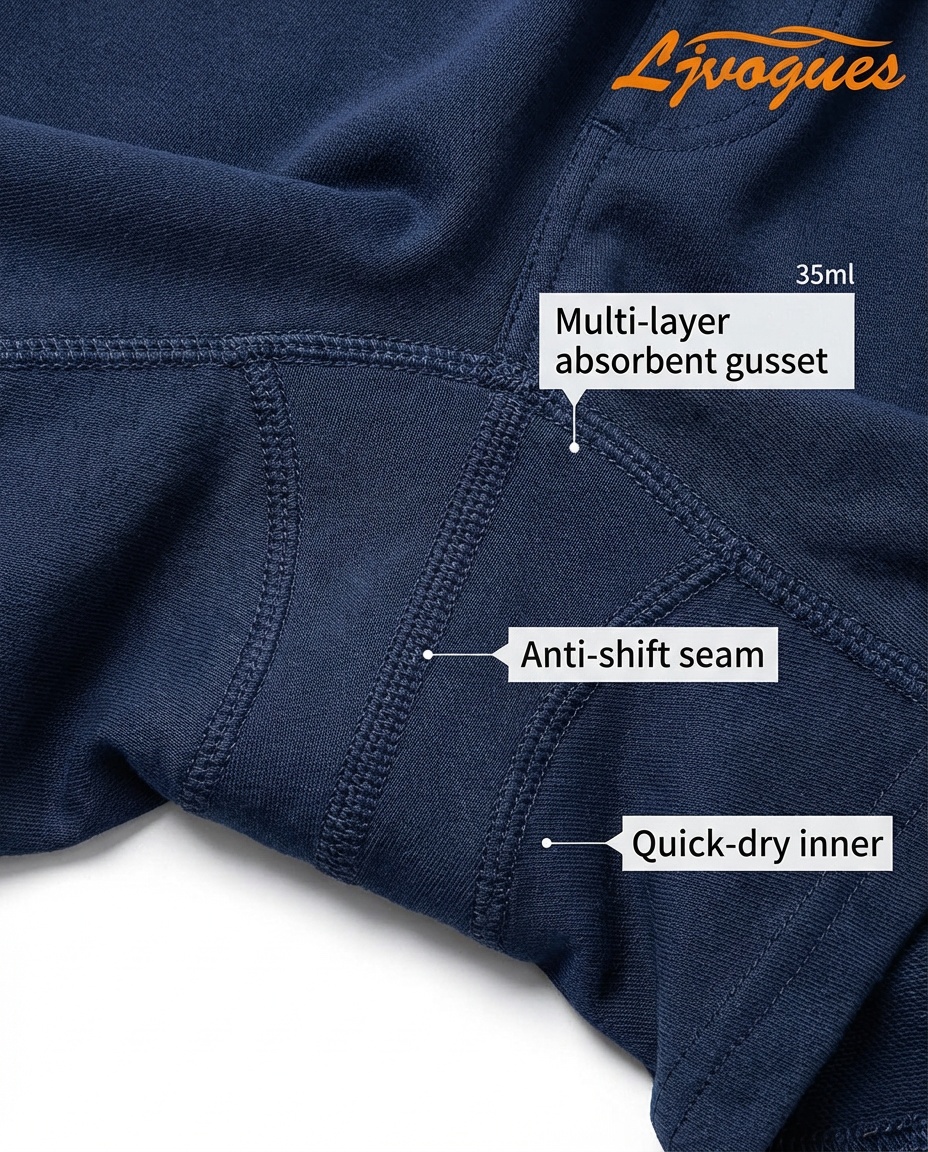
This is the critical engineering challenge. The core must deliver meaningful absorbency (15–30ml depending on the product positioning) at a total stack thickness of under 1.5mm.
How do you achieve this?
Super-fine microfiber terry at optimised GSM — denser weave, thinner profile, faster wicking
Graduated absorbency zones: the core doesn't need to be uniform. Concentrate the highest absorbency in the center-front (where flow is heaviest) and taper toward the edges. This reduces average thickness while maintaining peak performance where it matters
Compression bonding: the absorbent layers are mechanically compressed and thermally bonded to prevent lofting (expanding back to their uncompressed thickness during wear or after washing)
Modern ultrasonic bonding technology — like ANDRITZ's neXbond process — uses high-frequency ultrasonic energy to create glueless, soft, durable bonds that maintain their integrity through hundreds of wash cycles. This is the kind of precision manufacturing that makes sub-1.5mm cores possible at scale.
Layer 3: Breathable Waterproof Barrier
The TPU (thermoplastic polyurethane) membrane must be:
PFAS-free — non-negotiable for EU markets and increasingly for all markets
Breathable — allowing water vapour to pass through while blocking liquid. This is critical in activewear because the wearer is generating significant perspiration; a non-breathable barrier turns the gusset into a sauna
Ultra-thin — the barrier adds to total stack thickness, so every micron matters. Modern TPU membranes can be as thin as 15–20 microns while maintaining full waterproof integrity
Layer 4: Skin-Contact Lining
The innermost layer — the one touching the vulva — must be:
Soft, non-irritating, and quick-wicking
Seamlessly integrated with the outer legging fabric so there's no visible "pad edge" at the transition point
Ideally extending beyond the absorbent zone to create a gradual, invisible transition rather than an abrupt edge
-
Three Product Tiers for Brand Development
Not every brand needs to launch a full activewear line on day one. Here's a phased approach:
Tier 1: Sport Shorts (Easiest Entry Point)
Sport shorts have more construction tolerance than leggings. The looser fit hides the absorbent core more easily, and the shorter length means less fabric engineering.
Target specs:
Absorbent core: 15–20ml capacity, <2mm thickness
Inseam: 3–5 inches
Look: Indistinguishable from standard running shorts or sleep shorts
Target retail: $28–38
Good Housekeeping's 2026 Lab testing confirmed that the best-performing period shorts achieved full leak protection while looking exactly like "a typical pair of sleep shorts". This is the benchmark.
Best for: Brands entering the activewear category for the first time. Lower development complexity, lower MOQ risk, and a clear consumer use case (running, gym, sleep).

Tier 2: Bike Shorts / Mid-Length
Bike shorts (5–8 inch inseam) are the middle ground — tighter than sport shorts but less demanding than full leggings. They've become a mainstream streetwear silhouette, which means consumers are already comfortable wearing them outside the gym.
Target specs:
Absorbent core: 15–25ml capacity, <1.5mm thickness
Compression fit with wide waistband
Look: Athleisure-ready, wearable as standalone bottoms
Target retail: $32–42
Best for: Brands targeting the athleisure/lifestyle market, not just pure sport. Think: "the shorts she wears to brunch after yoga."

Tier 3: Full-Length Leggings (Most Demanding)
Full-length leggings are the ultimate engineering challenge — and the ultimate brand statement. If you can make a leak-proof legging that genuinely looks and performs like a premium yoga pant, you've proven your technology at the highest level.
Target specs:
Absorbent core: 20–30ml capacity, <1.5mm thickness (ideally <1mm)
Full-length, high-waist, second-skin fit
Opacity-tested under maximum stretch
No visible panty line from the integrated absorbent zone
Target retail: $45–65
WUKA prices their period leggings at £36.99 (≈$47). Modibodi's active leggings retail at A$80–100 (≈$52–65). This is a premium category with premium margins — but only if the product genuinely delivers invisible protection.
Best for: Established brands with proven period underwear lines looking to expand into activewear as a category extension.

The Product Line Play: Underwear → Shorts → Leggings
For brands developing a sport-focused absorbent collection, I recommend a sequential launch strategy:
Phase | Product | Timeline | Purpose |
Phase 1 | Sport shorts (2–3 styles) | Months 1–3 | Prove the technology in the easiest form factor |
Phase 2 | Bike shorts (1–2 styles) | Months 4–6 | Bridge to tighter-fit products, test athleisure positioning |
Phase 3 | Full leggings (1–2 styles) | Months 7–10 | Premium flagship, highest margin, strongest brand signal |
Each phase builds on the manufacturing learning of the previous one. The absorbent core engineering for shorts informs the tighter tolerances needed for leggings. The consumer feedback from shorts validates (or adjusts) the absorbency and comfort specs before you commit to the more complex legging development.
Manufacturing Considerations for Brands
A few practical notes for B2B buyers evaluating this category:
1. Your underwear factory may not be your leggings factory. Legging manufacturing requires different equipment (flat-bed knitting or warp knitting for the shell fabric, specialized cutting for compression panels, bonded waistband construction). Make sure your manufacturing partner has activewear production capability, not just underwear capability.
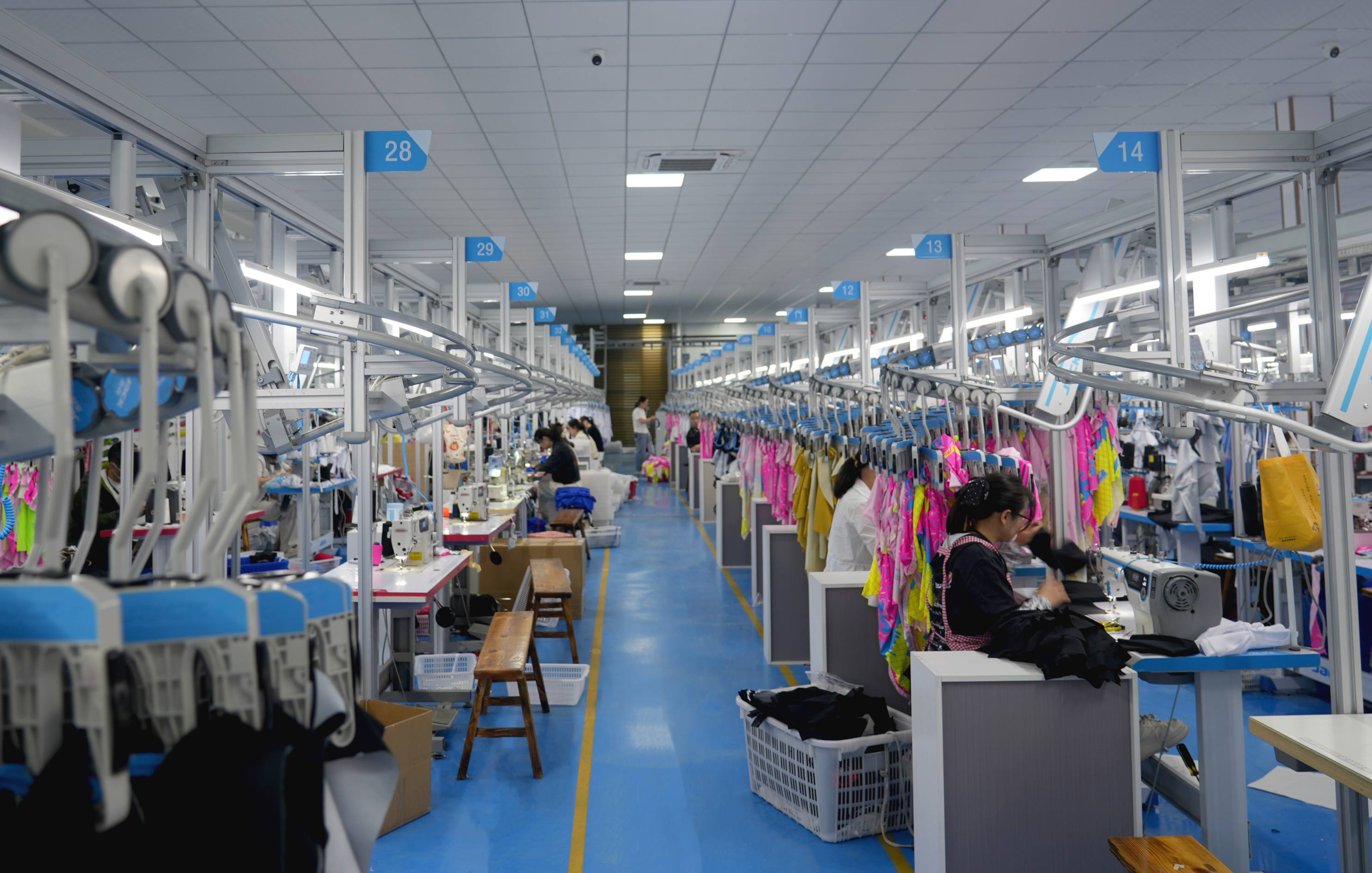
At Ljvogues, we manufacture both categories on the same production floor — which means the absorbent core technology is identical, but the outer garment construction draws on our activewear sewing lines. This continuity is critical for maintaining absorbent performance across product types.
2. Size grading is more complex. A legging must fit precisely across a wider range of body geometries than underwear. Absorbent zone placement must be graded proportionally — a size XS and a size 3XL need different core positions relative to the inseam and rise. Get this wrong, and the core sits in the wrong place for larger or smaller bodies.
3. Wash durability standards are higher. Consumers wash activewear in warm/hot water more frequently than underwear. Your absorbent core and TPU barrier must maintain integrity through aggressive wash cycles. We test to 100+ washes as standard, but for activewear we recommend 150+ wash validation.
4. EU compliance applies to the entire garment. If you're selling in Europe, your REACH/SVHC compliance must cover not just the absorbent zone but the entire legging — including the outer shell, waistband, and any decorative elements. Our Eurofins testing covers every component individually.
Developing leak-proof activewear? We can prototype sport shorts, bike shorts, and full leggings with our ultra-thin (<1.5mm) absorbent technology. Send us your activewear brief and we'll ship development samples within 30 days.
