



Table of Contents
Last week we received an inquiry from a European textile sourcing and brand development agency. They were launching a premium reusable absorbent underwear line for a major retail client — targeting bladder leak protection, not period care — and they needed to move fast.
The brief was sharp. No fluff. Five requirements in five bullet points.
But three of those requirements stopped me in my tracks — not because they were surprising, but because they articulated something I've been feeling in this industry for two years, and no client had ever said it this clearly:
Ultra-thin absorbent core: less than 2mm, with 30ml+ retention.
Aesthetic finish: seamless bonding or premium lingerie quality.
No "medical" look. Period.
Within a week of back-and-forth on technical specs, we reached an agreement. Samples are now in production. The client's internal team is already planning SKUs and purchase volumes.
But I want to talk about why those three requirements matter — not just for this one order, but for every brand developing absorbent underwear in 2026, whether it's for bladder leaks, periods, or postpartum recovery.

The Market Context: $8.3 Billion by 2032
Let's zoom out for a moment.
The global reusable incontinence products market is valued at approximately $5.8 billion in 2025 and is projected to reach $8.3 billion by 2032, growing at a 5.2% CAGR. The broader incontinence underwear segment is growing even faster — at a projected 12.6% CAGR from 2026 to 2033. And the reusable segment specifically is expected to double from $2.1 billion in 2025 to $4.2 billion by 2035.
What's driving this growth isn't just demographics (though an ageing population helps). It's a fundamental shift in what consumers expect from functional underwear. They no longer accept the trade-off between "it works" and "it looks terrible." They want both. And the brands that deliver both are capturing disproportionate market share.
Even industry giants are responding. TENA launched its Stylish™ line explicitly "designed to look and feel like real underwear" — with cottony-soft stretch fabric, body-hugging fit, and fashion prints by lingerie designer Ceri Williams. Wirecutter's 2026 testing of reusable incontinence underwear now evaluates aesthetics alongside absorbency as a core review criterion.
The message from the market is unmistakable: functional underwear that looks functional is dead.
Requirement #1: Ultra-Thin (<2mm) with Real Absorbency (30ml+)
This is the engineering challenge that separates serious manufacturers from everyone else.
Most consumers — and many brands — assume there's an unavoidable trade-off: more absorbency = more bulk. If you want 30ml of retention, you need a thick pad. If you want thin, you sacrifice protection.
That assumption is wrong. But making it wrong requires specific manufacturing capability.
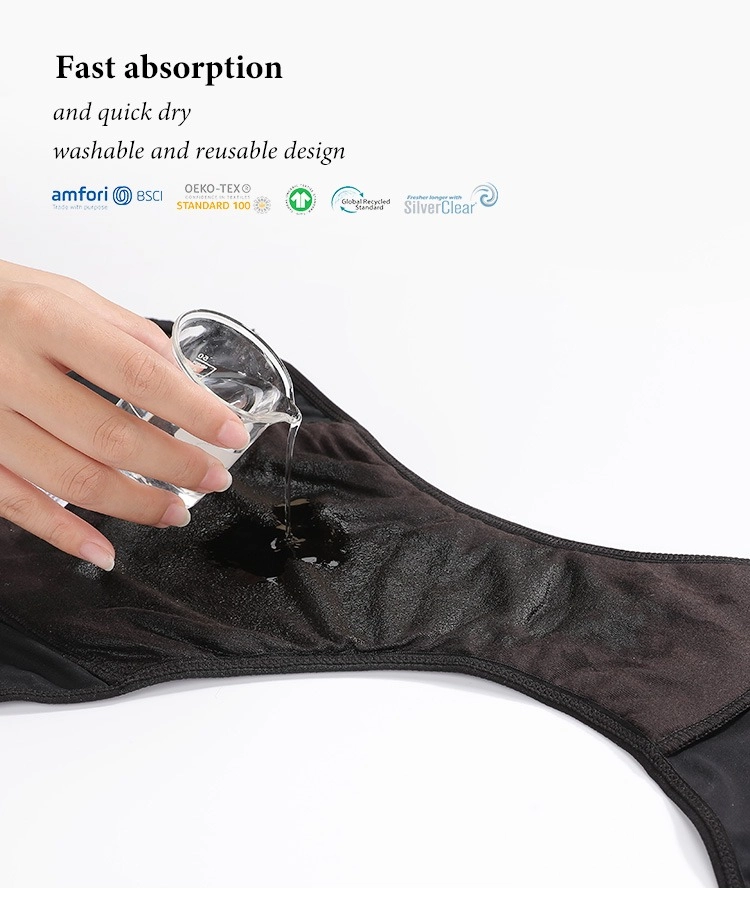
At Ljvogues, our proprietary compression technology produces absorbent cores at less than 2mm total thickness while maintaining retention levels from 10ml (ultra-light daily liners) all the way to 50ml+ (heavy overnight protection). The key is the combination of:
Super-absorbent microfiber terry with optimised GSM (grams per square metre) for the target absorbency level
High-density compression that packs maximum absorption capacity into minimum volume
Layered architecture where each layer has a specific job: wicking, absorbing, distributing, and blocking
The 30ml threshold our European client specified is significant. It's enough to handle moderate bladder leaks (the "sneeze, laugh, exercise" moments that affect an estimated 1 in 3 women at some point in their lives), and it's enough for moderate-flow period days. At under 2mm, the wearer genuinely cannot feel the absorbent core through the fabric — it's invisible both visually and tactilely.
For brands: this is where your spec sheet becomes your competitive moat. If your factory can't deliver 30ml at <2mm, your product will either be too bulky (and consumers will reject it as "diaper-like") or too thin (and consumers will experience leaks and never repurchase). There is no middle ground.
Requirement #2: Aesthetics — Seamless, Bonded, Lingerie-Grade
This requirement is about understanding what category you're actually competing in.
Most absorbent underwear brands think they're competing against other absorbent underwear brands. They're not. They're competing against the consumer's favourite regular underwear. The pair she reaches for every morning without thinking. The one that fits perfectly, feels beautiful, and makes her feel like herself.
The moment your absorbent underwear looks or feels like a "product" instead of "underwear," you've lost. She'll wear it reluctantly on bad days and switch back to her favourite pair the moment she can. That's not brand loyalty. That's grudging tolerance.
Our European client specified two construction approaches:
Seamless bonding (no-sew construction): Using ultrasonic or heat-bonding technology to join fabric panels without traditional stitching. This eliminates visible seam ridges, reduces bulk at join points, and creates a smooth, lingerie-like surface that's invisible under fitted clothing. It also removes potential irritation points — critical for a product worn during vulnerable moments.
Premium lingerie finishing: Lace trims, refined elastic encasement, delicate edge finishes, and colour palettes that belong in a lingerie drawer, not a pharmacy aisle. Details like bonded waistbands (no exposed elastic), laser-cut leg openings, and matte fabric surfaces that look and drape like high-end basics.
The economic logic is compelling. When you manufacture absorbent underwear that looks like premium lingerie, you can price it like premium lingerie — at $30-45 retail, rather than $18-22. The consumer pays more, but she also wears it more often, recommends it more freely, and feels less stigma about the purchase. That's a better business for everyone.
Requirement #3: "No Medical Look" — The Most Important Line in the Brief
This is the requirement that deserves the most attention, because it represents a philosophical shift in how functional underwear should be designed.
What does "medical look" mean? It means:
White or beige colour that signals "clinical" rather than "chosen"
Visible padding that creates an obvious bulge or diaper-like silhouette
Utilitarian elastic — thick, exposed, functional-looking waistbands and leg openings
Plastic-feeling materials — crinkly barriers, stiff absorbent pads, synthetic surfaces that scream "medical device"
Packaging that looks like it belongs in a pharmacy, not a boutique
Every one of these signals tells the consumer the same thing: "You have a problem, and this product manages your problem." It positions the wearer as a patient, not a person.
The brands that are winning in 2026 have flipped this narrative entirely. Thinx, Knix, and Modibodi didn't just make better absorbent underwear — they made underwear that happens to be absorbent. The functional technology is invisible. The design language is aspirational. The consumer buys it because she wants it, not because she needs it.
This distinction — want vs. need — is the single most important positioning decision in functional underwear. Products bought out of need have low loyalty, high price sensitivity, and high shame association. Products bought out of want have high loyalty, premium pricing power, and organic word-of-mouth.
Our European client understood this instinctively. Their brief didn't say "make it look nice." It said "no medical look" — a prohibition, not a preference. They were telling us: if the product reminds anyone of a hospital, we've failed.

What This Means for Brand Owners: A Design Philosophy
Based on this client engagement and our broader experience manufacturing for European, US, and Middle Eastern markets, here's the design philosophy I recommend for any brand developing absorbent underwear in 2026:
The "Drawer Test"
Before approving any prototype, ask yourself: "If this were sitting in a drawer next to her favourite everyday underwear, would it look like it belongs there?"
If the answer is no — if it looks like a separate category of garment, if it stands out as "the medical one" — go back to development.
The "First-Touch Test"
Hand the prototype to someone who doesn't know what it is. Don't tell them it's absorbent. Don't tell them it's for bladder leaks or periods. Just hand it to them and ask: "What do you think this is?"
If they say "underwear" — you've succeeded.
If they say "some kind of pad" or "is this medical?" — you haven't.
The "Instagram Test"
Could a consumer post a flat-lay of this product on Instagram without feeling self-conscious? Not because she needs to — but because the product is genuinely beautiful enough that she'd want to.
Brands like Knix and Thinx pass this test. Most traditional incontinence products don't. The gap between those two realities is where your margin lives.
The Male Market: An Untapped Opportunity
One detail from our European client's brief that deserves its own section: they requested men's boxer-style development alongside the women's line.
This is forward-thinking. Male bladder leak underwear is one of the most underserved segments in the market. The vast majority of reusable absorbent underwear brands focus exclusively on women. Men who experience post-prostate-surgery incontinence, age-related bladder weakness, or stress incontinence during exercise have almost no premium reusable options.
The design challenge is different:
Absorbent zone geometry: Men's leaks concentrate in a different area than women's, requiring a front-weighted gusset design rather than a center-weighted one
Boxer construction: The loose-fit boxer brief silhouette must integrate an absorbent core without adding visible bulk in the front panel
Aesthetic expectations: Men's underwear design language is more restrained — the goal is "indistinguishable from a normal boxer brief," not "lingerie-beautiful"
For brands willing to develop a male SKU alongside their female line, the competitive whitespace is enormous. There are very few premium reusable options for men, which means early movers can establish category leadership with relatively low marketing spend.

From Inquiry to Production in One Week
Let me close with the timeline of this engagement, because I think it illustrates something important about how the B2B relationship should work in functional underwear:
Day | What Happened |
Day 1 | Client inquiry received — clear brief with 5 core requirements |
Day 2 | Our team responded with technical capabilities, existing sample availability, and MOQ structure |
Day 3–4 | Back-and-forth on absorbent core specs, fabric options, compliance certifications |
Day 5 | Video call to align on prototype scope, colourways, and size range |
Day 7 | Agreement reached. Sample production initiated. |
Seven days from first email to confirmed prototype order. No weeks of back-and-forth on NDAs. No endless sample rounds. No "let me check with my factory" delays.
This speed was possible because:
We already had the technology. Our <2mm / 30ml+ absorbent core is a proven, production-ready platform. We didn't need to R&D from scratch.
We had counter-samples ready. White-label samples that demonstrate our absorbent technology were available for immediate shipment — the client could evaluate our capability before committing to custom development.
We understood the brief. When a client says "no medical look," we don't need three rounds of mood boards to understand what they mean. We've been building lingerie-grade functional underwear for years.
For brands with immediate launch timelines — and in 2026, most serious brands have immediate timelines — the ability to move from inquiry to prototype in days, not months, is a competitive advantage in itself.
What We Can Do for You
If you're developing a reusable absorbent underwear line — whether for bladder leaks, periods, postpartum, or multi-functional positioning — here's what Ljvogues brings to the table:
Ultra-thin absorbent cores (<2mm) with customisable retention from 10ml to 50ml+
Seamless bonding and premium lingerie finishing — no visible stitching, no medical aesthetic
PFAS-free waterproof barriers — independently tested and certified
REACH/SVHC compliance — full Eurofins testing against the latest 253-substance SVHC list
Men's and women's development — boxer briefs, hipsters, briefs, high-waist styles
Counter-samples available for immediate shipment — evaluate our technology before committing to custom development
Custom ODM prototypes in 30–40 days from confirmed specs
The market is moving fast. Consumers are done choosing between "it works" and "it's beautiful." They want both. And the brands that deliver both first will own this category for years.
Ready to see what ultra-thin, lingerie-grade absorbent underwear actually looks and feels like? Request our B2B sample kit — we'll ship counter-samples within 48 hours so you can evaluate our technology hands-on.
Ocean Yang is the CEO of Ljvogues, a Shenzhen-based manufacturer specialising in functional intimate apparel. His factory produces leak-proof underwear for brands across Europe, North America, and the Middle East — engineered to be invisible, beautiful, and nothing like a medical product.