


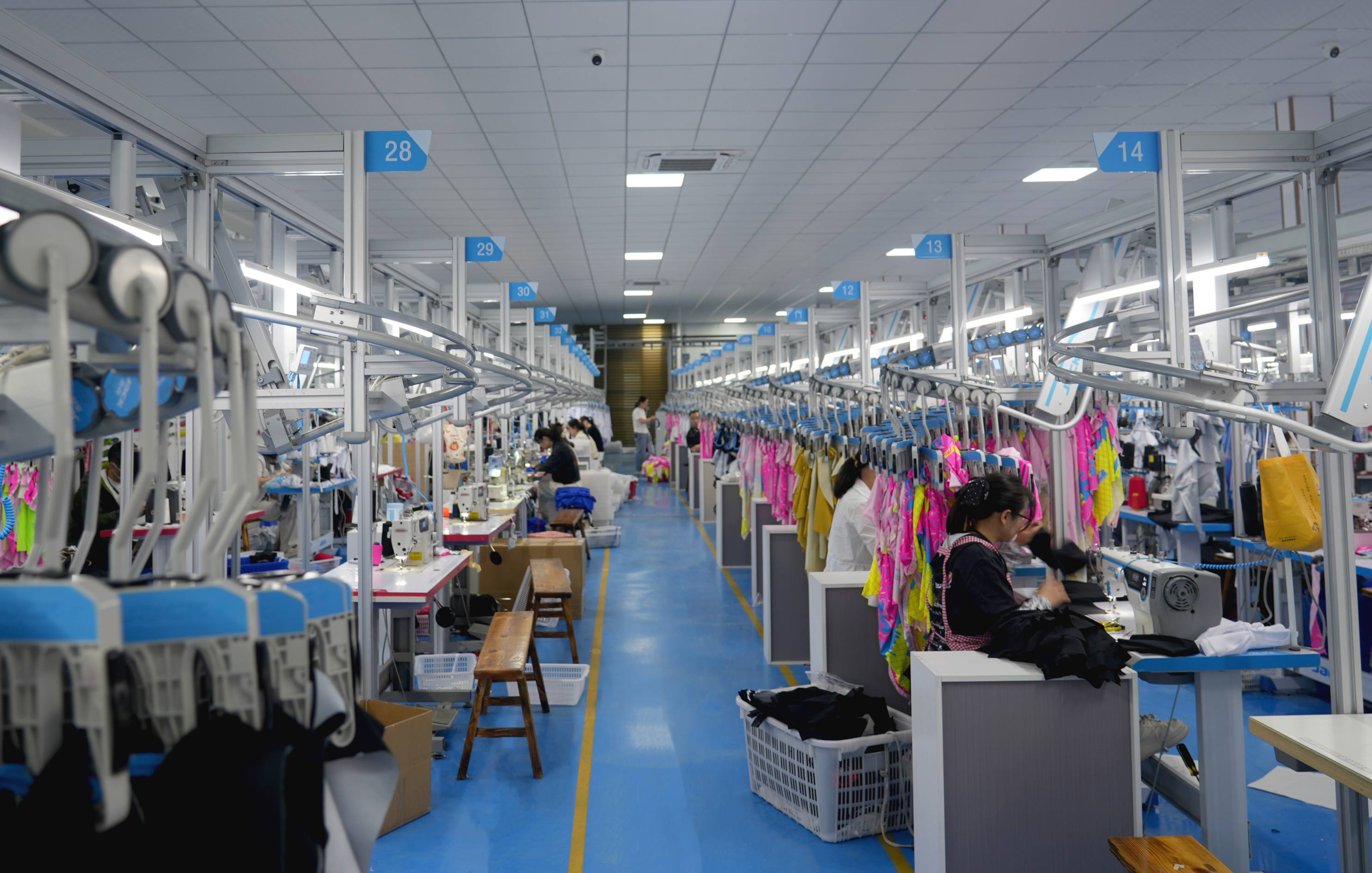

In 11 years of running this factory, the pattern I see most often is this: a new founder comes to us wanting to customize everything — their own fabric, their own cut, their own packaging — and then the first quote comes back and the math doesn't work.
Here's why. Custom fabric means a fabric mill has to run a batch just for you, and every mill has its own minimum order quantity. At 500 or 900 pieces, you can't fill a custom fabric run efficiently — so unit cost goes up, then your retail price goes up or your margin disappears. Either you're uncompetitive against every other brand on Amazon, or you're working for free on your own launch.
This is the trap. It's not obvious until you've seen it happen dozens of times.
We've built a different approach at Ljvogues: get brands launched fast, with real brand identity, at costs that work. What follows is a real example from May 2026 — a private label period underwear brand that came to us wanting to customize everything, launched in 7 days at 500 pieces instead, and came back 60 days later ready to scale.

The Number That Determines Everything Else
If you take one thing from this article, take this: MOQ determines cost, and cost determines whether your brand is viable. Most new period underwear brands don't understand this connection, and it's the single biggest reason first orders fail before they even launch.
Every customization has a minimum attached to it. Fabric mills have minimums, trim suppliers have minimums, packaging printers have minimums. When your order volume sits below those minimums, you either pay a steep premium to get the mill to run a small batch anyway, or you simply can't access that customization at all.
The math is not abstract. A custom fabric run on 900 pieces can cost 40–60% more per unit than the same product built on stock fabric already running at scale. That difference doesn't disappear — it shows up directly in your retail price, or it eats your margin. Most brands don't find this out until they've already committed emotionally to a custom direction and the quote lands.
The counterintuitive truth I try to get every new brand to understand: the right level of customization for your first order is not "as much as possible." It's as much as your volume can actually support without wrecking your unit economics. For most first orders in the 300–1,000 piece range, that means stock fabric with branded finishing — your label, your packaging, your identity — and saving the full custom build for when your volume can carry it.
Illustrative only — actual figures vary by style and fabric:
Order Size | Custom Fabric | Stock Fabric + Branded Finishing |
300–500 pcs | Unit cost premium: high; MOQ barrier: likely | Unit cost: competitive; MOQ barrier: none |
1,000–3,000 pcs | Unit cost premium: moderate; MOQ barrier: possible | Unit cost: competitive; MOQ barrier: none |
5,000+ pcs | Custom fabric becomes viable | Both options work |
A Real Example — US Brand, May 2026
In May 2026, a US brand reached out through our website, ljvogues.com. Their brief: three styles, 900 pieces, custom fabric, their own label, their own pouch. It was a good brief — they'd clearly thought about their brand. But when we sat down with the numbers together, the custom fabric on 900 pieces didn't work. The unit cost would have priced them out of the US market before they'd sold a single pair, and their biggest stated concern going in was capital risk — which made this exact mismatch the worst possible outcome for them.
We didn't just tell them their plan wouldn't work — we did the work to fix it.
Our sales team looked at their brand as a whole: DTC, US-focused with some EU interest, still building awareness, needing speed more than a fully bespoke product on day one. We recommended three styles we already sell successfully on Amazon — products already validated in their target market, with known quality and known lead times, so there was zero development risk inside their first order.
We moved their brand identity out of the fabric and into the finishing instead: a custom woven label carrying their logo, and a branded PU waterproof pouch for every unit. That's still a genuine private label period underwear product — every touchpoint their customer sees and touches carries their brand. We also recommended cutting the order to 500 pieces instead of 900, to bring their capital exposure down on a first run with no sales history behind it.
They accepted the revised plan. We produced, labelled, packaged, and shipped 500 pieces in 7 days. They paid in full before we started.
Then, on July 13 — less than 60 days later — they came back. 900 pieces this time. Expanded style range. Paid in full, in one payment. No negotiation.
That reorder tells me everything I need to know. They launched. They sold. They had real data instead of guesses. They came back with confidence, not questions. That's exactly what a right-sized first order is supposed to do — not the end goal, but the proof point that lets you bet bigger with confidence.

How We Think About Customization — and How New Brands Should Too
I break this into two phases, and I say this to every brand that calls us, whether they end up ordering from us or not.
Phase 1 — Launch. Stock styles, branded finishing. The goal is to get to market, generate real sales, and validate demand, while investing minimum capital and moving at maximum speed. This is not the compromise phase — it's the intelligence-gathering phase.
Phase 2 — Scale. Once you have sales data — what styles actually sell, what sizes move, what customers say in reviews — you have the information to customize intelligently. Custom fabric, custom cut, custom construction all make sense now, because the volume you've earned supports the investment.
The brands that skip Phase 1 and go straight to full custom on their first order are making a bet before they have any information. Sometimes it works. Most of the time it doesn't. And when it doesn't, the cost isn't just the money spent — it's 6 to 12 months of your time chasing a product-market fit you never confirmed existed.
The brands that run Phase 1 properly come back to Phase 2 with data, with confidence, and — like the brand in this case — with the volume to actually unlock the custom options they wanted from the very beginning.
What We Can Do — and In What Order
I'd rather explain how the program works than hand you a capabilities list — the order matters as much as the options.
Starting point, for any first order:
50 pieces per color, per size — this is our real MOQ floor, not a promotional number
Stock styles from our collection, Amazon-validated and quality-proven
Custom woven label with your brand logo
Branded packaging — PU waterproof pouch or custom box
7-day production timeline
Step up, once your volume supports it:
Custom colorways on existing stock constructions
Modified cut or silhouette built on proven base patterns
Custom fabric, once your order volume can actually reach the fabric mill's minimum
Full custom ODM:
Original design, original fabric, original construction from the ground up
Requires volume that supports the investment — we'll tell you honestly when you're there
We don't push brands toward full custom because it generates a bigger order for us. We push them toward what will actually work for their stage. A brand that launches successfully and grows comes back — like this one did, twice as large, 60 days later. A brand that over-invests in a first order and struggles usually doesn't come back at all.
The Same Standards, Whatever the Order Size
One thing I want to be clear about: choosing stock styles for a first order is not a compromise on quality or safety. The standards don't move based on order size.
OEKO-TEX Standard 100 Class I — Certificate No. 26.HCN.12213, issued by Hohenstein Laboratories, valid through July 31, 2027. This is the strictest product class in the OEKO-TEX system, the same class used for baby articles. It applies to every style, every order, no exceptions.
PFAS-free, verified by SGS finished garment testing under EPA Method 533, on every single production batch since Q2 2024.
ISO 9001 (Certificate No. 62726Q00153R001) and ISO 14001 (Certificate No. 62726E00103R001).
AQL 2.5 inspection standard with 3-stage quality control on every order.
A 500-piece stock-style order ships with the same certified materials as a 50,000-piece full custom order. That's not a marketing line — it's just how we run this factory.

If You're Building a Period Underwear Brand
If you're where this brand was in May — you have a concept, a market, and a budget, but you're not sure how to structure your first order — talk to us directly. We'll look at your numbers honestly and tell you what will actually work, even if that means telling you your original plan needs to change.
Request a quote: our team will scope a 3-style run for you within 48 hours.
Request a sample: 7-day turnaround, so you can evaluate the product before you commit to volume.
Reach us directly: info@ljvogues.com or WhatsApp +86-199-2880-2613
Frequently Asked Questions
What is Ljvogues' minimum order quantity for private label period underwear?
50 pieces per color per size — our standard floor, not a promotional offer. A typical first private-label run is 300–500 pieces across 2–3 styles. No special arrangement needed.
Can I get my own brand label and packaging without a custom fabric?
Yes — this is how most successful first orders work. We separate brand identity from fabric specification. A custom woven label and branded PU pouch give your customers a fully branded experience, no fabric development required.
How long does a 500-piece private label period underwear order take?
7 days from confirmed order to shipment, for stock-style orders with branded finishing. Custom fabric or full ODM takes longer — we'll give you an honest timeline upfront.
Are Ljvogues' stock styles certified?
All styles carry OEKO-TEX Standard 100 Class I certification (Certificate No. 26.HCN.12213, valid through July 31, 2027, Hohenstein Laboratories). PFAS-free status is verified through SGS finished garment testing under EPA Method 533, on every production batch. Certification doesn't change based on order size.
When does it make sense to move to custom fabric and full ODM?
When your volume can support the fabric mill's minimum without spiking unit cost — for most brands, that's 3,000–5,000-plus pieces per style. We'll tell you when you're at that point and help you make the transition. Your first order is for validation, not for betting everything on a custom build you haven't tested yet.
Ocean Yang is the founder and CEO of Ljvogues, a period underwear manufacturer based in Longgang District, Shenzhen, operating an 8,000m² facility with 14 sewing lines and 200+ employees since May 2015. Ljvogues has produced for 500+ brands across 40+ countries. Contact: info@ljvogues.com / WhatsApp: +86-199-2880-2613.