


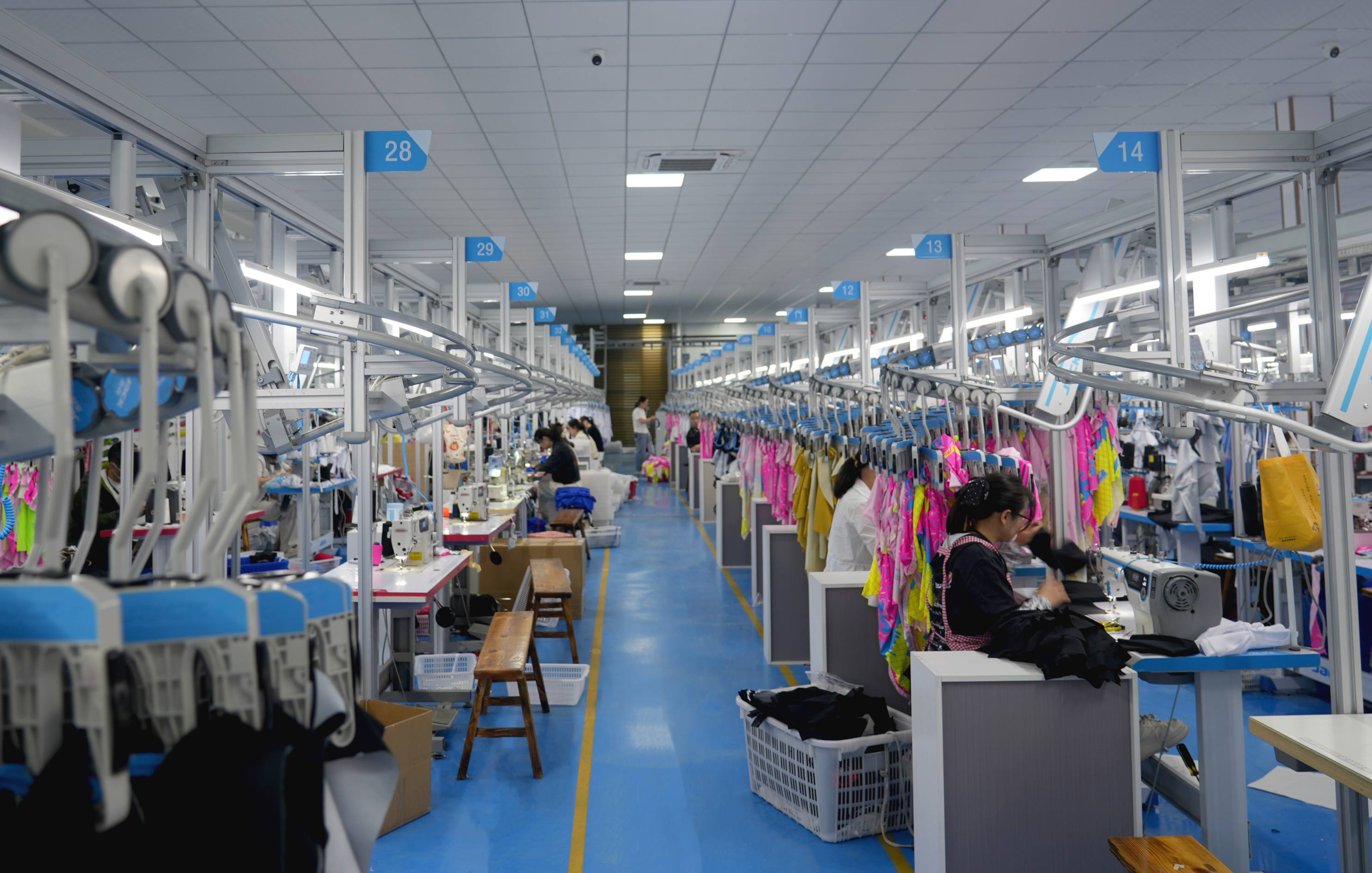

PFAS-free, in the context of period activewear, should mean one specific thing: the finished, sewn garment — not just the raw fabric — has been tested by a named method and found free of intentionally added per- and polyfluoroalkyl substances. Right now, "PFAS-free" gets used to mean at least three different things depending on who's printing it, and almost nobody tells you which one they mean.
Why I'm writing this one
A buyer I'd never spoken with before emailed after finding our LY4291-1 page. Her question was short: "You say PFAS-free testing. Is that a lab report I can actually see, or is that a line on a spec sheet?" I get versions of this question regularly, but hers landed differently, because a few weeks earlier a US activewear brand had gotten written up for pulling a product line after a PFAS test came back positive — a product marketed as "chemical-free" on the strength of a fabric mill's raw-material letter, never a finished-garment test. That story was circulating in buyer group chats, and I suspect that's exactly why her question was so specific.
That's the gap this article exists to close — first for the person wearing the product, then for the person deciding whether to put their brand name on it.
What PFAS actually is, in plain language
PFAS is a family of manufactured chemicals — per- and polyfluoroalkyl substances — built around carbon-fluorine bonds so strong that the compounds barely break down in the environment, which is why they've picked up the nickname "forever chemicals."
That same bond is why PFAS ended up in so many products: it makes materials resist water, oil, and stains extremely well. It's not one chemical — it's a class covering thousands of related compounds, which is part of why "PFAS-free" isn't as simple a claim to verify as it sounds. A test screening for a handful of commonly regulated PFAS compounds isn't the same as one that screens broadly.
Why PFAS shows up in clothing — and sportswear specifically
PFAS ends up in apparel mainly through durable water repellent (DWR) finishes, stain-resistant treatments, and certain performance-fabric coatings — functions that are exactly why activewear has historically used them more than basic apparel.
A few places this shows up in practice: DWR coatings on outer shells and jackets, common on running and outdoor gear; stain- and oil-resistant finishes on fabrics, trims, or printed graphics; moisture-management or "easy-care" treatments, where a fluorinated finish historically helped fabric resist absorbing sweat or oils at the surface; and elastic or bonding processes in technical garments, where fluorinated compounds have shown up as processing aids rather than a marketed feature.
None of this is unique to period activewear — it's a sportswear-and-technical-apparel-wide issue, which is exactly why regulators are now writing rules aimed at apparel broadly, not one product category.
Why a consumer might reasonably care about this in a period product specifically
Period activewear sits against skin for extended periods, over a larger contact area than most everyday apparel — a reasonable basis to ask what's in the fabric, not a medical claim, just a fair question about a garment worn close to the body for hours at a time.
I want to be careful here, because it's easy to either dismiss the concern or overstate it, and neither is honest. This is one of the most common questions I get from both consumers and brand buyers evaluating this category, right alongside absorbency and leak performance. Wanting to avoid unnecessary chemical exposure in a garment worn against sensitive skin for an extended stretch of time is a reasonable preference, not an alarmist one. I'm not attaching a specific health-risk claim to PFAS here — that's not my lane, and doing so without solid evidence would be the kind of overreach I've tried to avoid throughout this series. What I can tell you is that "does this contain PFAS" has moved from a niche question to a mainstream one across the apparel industry — reason enough for regulators to start writing laws about it, which is where this goes next.
The problem with "PFAS-free" as a label today
There is currently no single, universally enforced legal definition or certification mark for "PFAS-free" on a garment — different brands, labs, and even different regulations define and test for it differently, which means the phrase alone tells you almost nothing without a method attached to it.
This trips up more buyers than any other chemical-safety question I get. "PFAS-free" can mean a finished-garment test came back below a detection threshold for a defined list of compounds; a raw-material supplier simply declared their fabric PFAS-free with no finished-product test done; a brand infers PFAS-free status just because it doesn't use DWR or stain-resistant finishes, without testing at all; or a test measured Total Organic Fluorine (a broader screen) rather than specific named compounds. Four different levels of evidence, same three words. My honest advice: ask what was tested — finished garment or raw material — and by what method. If a brand can't answer that specifically, the claim is marketing, not a test result.
Common PFAS uses in apparel vs. relevance to period activewear
Common apparel use of PFAS | Purpose | Relevance to a sport period short like LY4291-1 |
DWR coating on outer shell fabric | Water resistance for rain/outdoor performance | Not a functional need for an indoor/gym/running short not marketed as waterproof outerwear |
Stain-resistant fabric finish | Keeps fabric looking clean longer | Not a stated feature of LY4291-1's construction |
Oil-resistant treatment | Resists oil-based stains | Not applicable to this product's design intent |
TPU leakproof barrier layer | Blocks fluid from passing through the gusset | Different chemistry (thermoplastic polyurethane) from PFAS-based DWR chemistry — not the same material family |
Moisture-wicking surface treatment | Helps fabric pull moisture away from skin | Achievable through fabric structure and finish choices that don't rely on PFAS chemistry |
Elastic/bonding processing aids | Manufacturing-stage aid in some technical fabrics | Not a documented input in LY4291-1's current construction, though we haven't published a full ingredient-level chemical audit for this specific style |
Worth flagging: the TPU barrier layer that makes a gusset leakproof is a different chemical family from PFAS-based DWR treatments. Leakproof and PFAS-free aren't in tension by default — they solve different problems with different materials.
The company-level fact: what Ljvogues actually tests, and how
As a company, Ljvogues tests PFAS-free status at the finished-garment level via SGS testing against EPA Method 533, on every production batch across our period underwear line since Q2 2024 — that's a real, documented, company-wide policy, not a one-off claim made for this article.
EPA Method 533 is a recognized analytical method for detecting a defined list of PFAS compounds, and testing at the finished-garment level — the actual sewn product, not a fabric swatch from a mill — is the more rigorous of the two approaches described above. A raw-material declaration and a finished-garment test are not interchangeable evidence.
Here's where I have to be precise, the same way I've been about absorbency and wash durability throughout this series: that company-wide testing policy covers our period underwear production line and its established batches. Whether LY4291-1 specifically — as an individual SKU — has its own finished-garment PFAS test report on file is something I need to confirm and document separately, not something I'll assume or claim has already happened. Our OEKO-TEX Standard 100 Class I certificate (26.HCN.12213, Hohenstein, valid through July 31, 2027) is the other document I get asked about, and the same precision applies: it covers our period underwear line's core category, and I won't claim it automatically extends to this specific sport short until its scope is confirmed to cover it. "We test for this" as a company is true. "This exact style has been individually certified" is a different, more specific claim — one I won't make without a document that names LY4291-1 directly.
Why this stopped being just a marketing question
New York State and California have both passed laws restricting intentionally added PFAS in new apparel sold in their states, which means a "PFAS-free" claim is no longer only a consumer-trust talking point — it's now something a brand may need to document to stay compliant with actual state law.
New York's PFAS-in-apparel law took effect January 1, 2025, prohibiting the sale of new apparel — a category explicitly including undergarments, leggings, and leisurewear — containing intentionally added PFAS in the state (NY State DEC). Outdoor apparel for severe wet conditions gets a longer runway to 2028, but general apparel, the category period activewear falls into, has been covered since the start of 2025. The law also expects sellers to obtain compliance certifications from manufacturers — not a self-certifying honor system, but a documentation chain a retailer must produce on request.
California's AB 1817 (Safer Clothes and Textiles Act) similarly restricts regulated PFAS in new textile articles starting January 1, 2025, with the allowable threshold tightening further in 2027 (California Legislative Information). Like New York, it requires a manufacturer's certificate of compliance. Other states have introduced comparable proposals, and I'd expect this trend to keep spreading.
This changes the incentive math for brands. Before laws like these existed, a brand's main reason to ask about PFAS was consumer trust and avoiding bad press — real, but deprioritizable when resources were tight. A compliance-certificate requirement removes that option: if you're selling into New York or California and can't produce one on request, that's a regulatory risk now, not just a reputational one — exactly why I expect "what's your PFAS testing, specifically" to become a standard RFQ line item, not a question only the most sophisticated buyers ask.
PFAS regulation timeline: New York vs. California
Jurisdiction | Law | General apparel effective date | Special carve-out | Compliance documentation |
New York | PFAS in Apparel Law (ECL 37-0121) | January 1, 2025 | Outdoor apparel for severe wet conditions phased in by January 1, 2028 | Manufacturer compliance certifications, available to DEC on request |
California | AB 1817 — Safer Clothes and Textiles Act | January 1, 2025 (100 ppm total organic fluorine threshold, tightening to 50 ppm January 1, 2027) | Outdoor apparel for severe wet conditions exempt from the outright ban until January 1, 2028, but must carry a "Made with PFAS chemicals" disclosure if sold before then | Manufacturer certificate of compliance provided to sellers/distributors |
Sources: NY State DEC; California AB 1817 legislative text.
What this means going forward
I'm not turning this into the supplier-audit checklist here — a separate piece will cover report formats, spotting a finished-garment test versus a raw-material declaration, reasonable testing frequency, and reading a certificate's scope. That deserves its own space.
What I want this article to leave you with: PFAS-free needs a method behind it to mean anything, the regulatory ground has shifted from optional to compliance-relevant in at least two major US states, and neither a consumer nor a brand buyer should accept the phrase on its own anymore.
FAQ
Does OEKO-TEX certification automatically mean a product is PFAS-free?
Not automatically — it depends on the specific standard, its testing scope, and what product line and materials the certificate names. Our Standard 100 Class I certificate covers our period underwear line's core category; don't assume any OEKO-TEX certificate extends to a different product without checking its stated scope.
Is a raw-material PFAS declaration from a fabric mill good enough evidence for a brand?
It's useful, but not the same as a finished-garment test. A fabric can be declared PFAS-free at the mill and the finished garment can still pick up fluorinated compounds later, through dyeing, coating, trims, or printing.
Has LY4291-1 specifically been tested and certified PFAS-free?
Our company-wide policy tests finished-garment PFAS-free status via SGS and EPA Method 533 on every batch since Q2 2024. Whether LY4291-1 has its own individual test report on file is something I need to confirm separately — I won't claim that's done without a report naming this specific style.
Do these PFAS laws apply outside New York and California?
Those two states have confirmed apparel-specific laws I can point to directly. Other states have introduced similar proposals, and I'd expect the trend to spread, but I won't name specifics for laws still moving through other legislatures.
Is PFAS in clothing dangerous to wear?
That's a question for toxicologists and regulators, not a factory founder, and I won't make a health-risk claim I can't back up. Avoiding unnecessary chemical exposure in a garment worn against skin for extended periods is a reasonable, common preference — exactly why regulators are now writing rules about it.
If you're evaluating a supplier's PFAS claim
If you're a brand trying to figure out whether a supplier's PFAS-free claim is real evidence or a marketing line, I'd rather walk you through what we test, how, and what's still on our to-confirm list than hand you a reassuring sentence. A detailed supplier-verification checklist is coming in a future article — for now, ask any factory, us included, what was actually tested and by which method before repeating their claim to your own customers.
WhatsApp: +86-199-2880-2613
Email: info@ljvogues.com
LinkedIn: linkedin.com/in/ljvogues-ceo
Product page: https://www.ljvogues.com/2-in-1-sport-period-shorts
— Ocean Yang, Ljvogues
Sources cited in this article
New York State DEC — PFAS in Apparel Law: https://dec.ny.gov/environmental-protection/pollution-prevention/pfas-in-apparel-law
California Legislative Information — AB 1817 (Safer Clothes and Textiles Act): https://leginfo.legislature.ca.gov/faces/billTextClient.xhtml?bill_id=202120220AB1817
Additional background sources from this content series, referenced for context but not directly cited inline in this article: