
Views: 0 Author: Ocean Yang Publish Time: 2026-08-08 Origin: Ljvogues


Sweat, odor, and chafing aren't three separate complaints about sport period underwear — they're one problem wearing three different faces. Sweat and menstrual fluid landing on the same layer make that layer feel wetter and take longer to dry; that trapped moisture is exactly what makes odor more noticeable after a workout; and a fabric that's staying damp against skin is also a fabric that's more likely to rub and irritate the inner thigh. Solve the moisture-and-airflow problem well, and you've made real progress on all three. Ignore it, and each one makes the other two worse.
I spend a fair amount of time reading runner forums and comment sections just to see what real people say when nobody's trying to sell them anything. A few weeks back I went down a rabbit hole in the comments under a running club's Instagram post about training through your period, and the same three complaints kept resurfacing, worded differently by different people but clearly describing the same experience: it gets swampy down there by mile four, it smells different after a hard run than after a normal one, and something keeps rubbing on the inner thigh that never used to. Nobody in that thread was asking about milliliters or fabric composition. They were describing a feeling, and the feeling was "this doesn't breathe."
That stuck with me because sweat, odor, and chafing don't show up in a customer's mind as separate line items — they show up as one bad workout. So I want to treat them that way here instead of splitting them into isolated FAQ answers that pretend they don't talk to each other.
The direct answer: yes, sweat and menstrual fluid can end up on the same absorbent layer during a workout, and that combined moisture load is a real design consideration — not something either fluid type gets a dedicated, separate lane for.
The gusset in a sport period short sits against skin that's also producing sweat, especially in the groin and inner-thigh area where blood flow and friction are both already higher during exercise. There's no membrane inside a typical period-proof gusset that sorts "this drop is sweat" from "this drop is menstrual fluid" and routes them differently. They land on the same surface layer and get pulled toward the same absorbent core.
That matters for a specific reason: a core that's designed and tested against a single fluid type, at a single volume, isn't automatically validated for what happens when two moisture sources hit it at once, at unpredictable rates, during movement. A capacity number like 30ml describes how much the core is designed to hold in total — it doesn't tell you how the core behaves when sweat is arriving continuously from one direction while menstrual fluid arrives intermittently from another. Those are genuinely different stress conditions on the same material.
The practical worry runners describe — "will this feel damp and heavy well before I'm anywhere near a heavy flow day" — is a fair one, and it's really a question about acquisition speed and airflow, not core capacity. A core can have plenty of remaining capacity and still feel wet and heavy on the surface if moisture isn't being pulled away from skin fast enough, or if there's nowhere for that moisture to go once it's absorbed. That surface-wetness feeling is what a person actually experiences mid-run; the number on a spec sheet is not.

The direct answer: sweat and menstrual fluid combined create more favorable conditions for odor-causing bacteria than either fluid alone, mainly because of added moisture and warmth, and no factory I know of — including us — has published independent odor-testing data on a combined-fluid scenario yet.
Odor is fundamentally a bacterial byproduct problem, not a fluid-type problem. Bacteria that cause odor thrive in warm, moist, low-airflow conditions — which describes the inside of a snug gusset during a sweaty run reasonably well regardless of what fluids are present. Add menstrual fluid into that same warm, damp environment and you've added another organic material for bacteria to interact with, on top of the sweat that was already going to create a favorable environment on its own. That's the honest mechanism, and it's the reason odor complaints tend to spike specifically around workouts during a period, rather than being an everyday period-underwear complaint or a sweat-only gym complaint.
In real runner discussions, this comes up repeatedly. Threads on r/XXRunning about wearing period underwear for running include recurring, specific descriptions — people saying the fabric doesn't seem to breathe well, that odor becomes noticeable specifically after a sweaty session rather than during normal daily wear, and that there's a lingering worry about the garment feeling "plasticky" or sealed rather than breathable (Reddit r/XXRunning — Period underwear and running; Reddit r/XXRunning — Period panties for running sweat). I want to be precise about what that evidence is and isn't: these are qualitative, anecdotal accounts from real runners describing their own experience in an open discussion thread, not a controlled study with a sample size or a measurement instrument behind it. I'm not going to dress that up as data it isn't. But when the same handful of descriptions — poor breathability, noticeable post-workout odor, worry about a sealed or plastic feel — keep showing up independently across different people in different threads, that's a genuinely useful signal about what customers are experiencing, even without a lab number attached to it.
What I can tell you honestly about mitigation, without overstating it: breathable outer fabric and a gusset construction that doesn't trap moisture against skin longer than necessary are the structural levers that exist to work against this. What I won't tell you is that any specific antimicrobial finish, treatment, or fast-dry technology is built into LY4291-1, because I don't have that documented yet, and I'm not going to name a treatment or process just because it would sound reassuring.
The direct answer: inner-thigh chafing, added heat from doubled-up layers, a gusset that reads as bulky, and a waistband that slides are four separate mechanical issues that share one root cause — fabric and structure that weren't built to move as a single unit with the body.
Let's take these one at a time, because they're mechanically distinct even though they get lumped together in complaints.
Inner-thigh friction mostly comes down to how many fabric edges are moving against skin and against each other with each stride. A standalone period brief worn under running shorts gives you two leg-opening edges instead of one, and those edges aren't moving in sync because they belong to two separate garments with two separate waistbands. That mismatch is a repeated, low-grade rubbing motion over the course of a run, not a one-time irritation.
Added heat from a two-layer setup is a basic textile fact, not a lab claim: two stacked fabric layers across the crotch and inner thigh trap more warmth than a single engineered layer, especially in an area with limited airflow to begin with. That heat compounds directly with the moisture problem from the sweat-and-menstrual-fluid section above — a warmer, damper microclimate is worse for comfort and worse for odor at the same time.
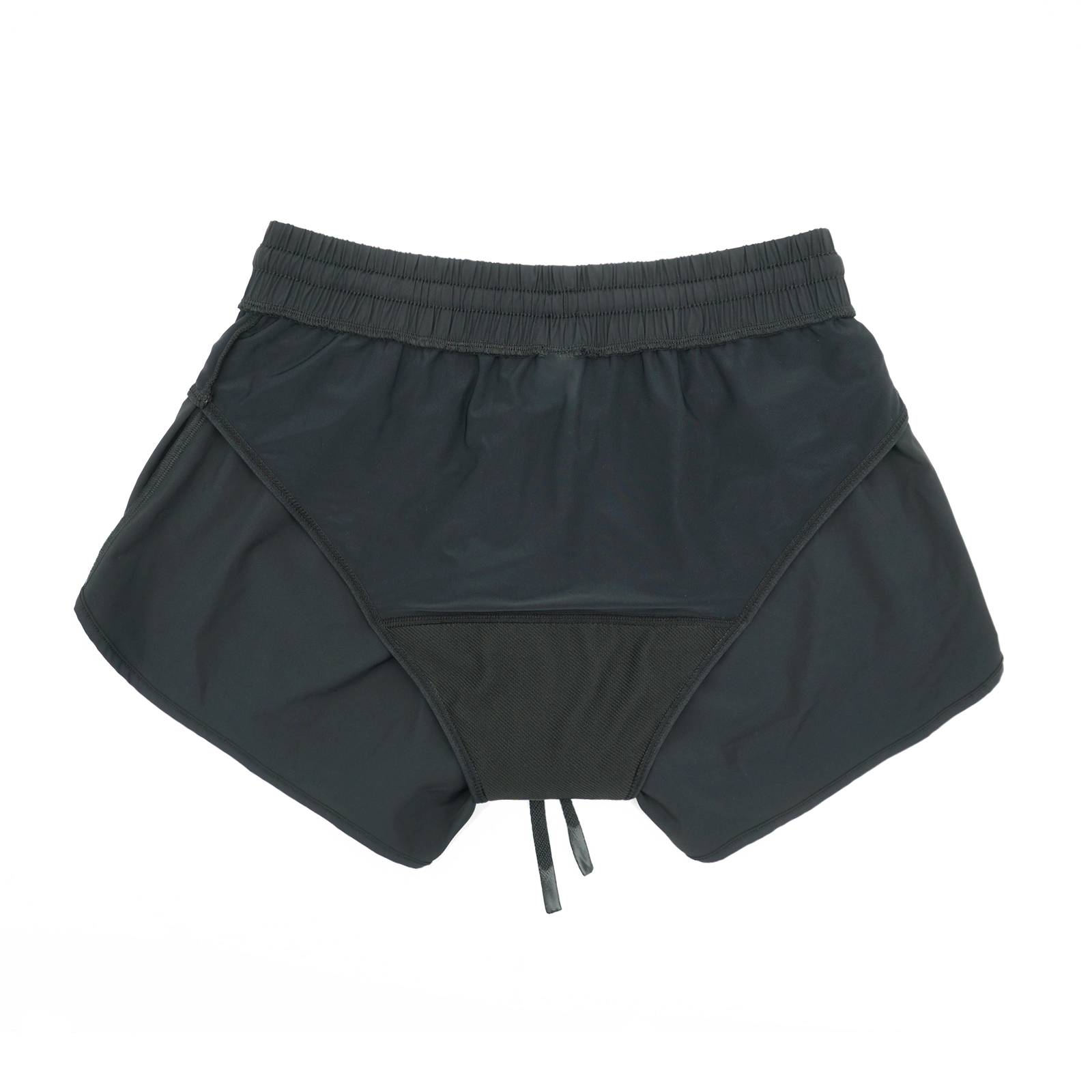
Gusset bulk and visibility happen when an absorbent panel is thick relative to the outer fabric covering it, or when it isn't anchored well enough to lie flat during movement. A gusset that shifts or bunches during a stride is also a gusset that's more likely to create a visible ridge or an odd silhouette, on top of being uncomfortable.
Waistband slippage is its own mechanical issue: a looser outer waistband sitting over a tighter inner waistband gives you two competing bands that don't move together, and the outer one tends to lose the fight over the course of a long run, sliding down as the tighter inner layer holds its position.
The common denominator across all four: separate, independently-moving layers create friction points and gaps that a single engineered garment is structurally positioned to reduce, simply by having one waistband, one leg-opening edge, and a gusset anchored to the shell instead of floating independently against skin. I covered this comparison in more construction detail in an earlier article in this series — the waistband, bulk, and VPL differences between layering and a 2-in-1 build are worth reading in full if chafing and bulk are your main concern.
This table is about mechanism and mitigation direction, not lab-measured performance — nobody in this category, us included, has published independent testing that would let anyone make a verified head-to-head claim on any of these three.
Problem | What actually triggers it | What tends to make it worse | What structurally helps |
Sweat + menstrual fluid on one layer | Both fluids land on the same absorbent core, at different rates and directions | High-intensity or long-duration sessions; a core with slow acquisition speed | Breathable fabric and a core designed with real-world combined-fluid exposure in mind, not just single-fluid capacity |
Post-workout odor | Warm, moist, low-airflow conditions favor odor-causing bacteria; menstrual fluid adds another organic material to that environment | Leaving sweaty gear sealed in a bag for hours; delayed changing after a hard session | Breathable outer fabric, gusset construction that limits trapped moisture, and changing reasonably promptly after activity |
Chafing, bulk, heat, and waistband slip | Multiple independently-moving fabric edges and layers rubbing against each other and against skin | Two-garment layering (brief + separate shorts); a gusset not anchored to the outer shell | Single waistband, one leg-opening edge, and a gusset fixed to the shorts' inner panel so it moves as one unit |
Here's the part that I think gets missed when people treat sweat, odor, and chafing as three items on a checklist: they aren't independent. They amplify each other in a fairly direct chain.
Start with moisture. When sweat and menstrual fluid are both present, the fabric against your skin stays wetter for longer than it would with sweat alone, simply because there's more total fluid volume and it's arriving from two directions instead of one. That extra dampness is precisely the condition that lets odor-causing bacteria do more of what they do — warmth plus moisture plus organic material is the exact environment they favor, and a longer, sweatier training session is already pushing you toward that environment before menstrual fluid ever enters the picture.
Now bring in the mechanical side. A layer that's staying damp longer is also a layer that's more likely to cling, drag slightly against skin, and create the kind of low-grade friction that becomes chafing over a long run — dry fabric generally slides against skin more easily than damp fabric does. So the same moisture that's feeding the odor problem is also feeding the friction problem. And if that damp, clingy layer is one of two independently-moving layers — a brief under separate shorts, say — you've added a second source of friction (two edges instead of one) directly on top of the moisture-driven one.
That's why I think the honest framing isn't "here are three problems" but "here's one underlying condition — trapped moisture and unstable layers — that expresses itself as three different complaints depending on which part of the experience you're paying attention to at the time." A design that reduces trapped moisture and layer instability is working on all three at once, even though no single fix "cures" any one of them independently, because none of them is truly independent to begin with.
I want to be direct about what our factory can and can't claim here, because this is exactly the kind of topic where it would be easy to reach for reassuring words I can't back up.
What I can say: our 8,000-square-meter facility has real fabric-selection and structural-development capability, and when we develop a product like LY4291-1, breathability, fit, and how a two-layer construction manages heat are genuine structural considerations that go into the pattern and fabric decisions — a single anchored gusset instead of a floating one, an outer shell chosen with airflow in mind, a fit that avoids unnecessary doubled fabric across the inner thigh. Those are real design-direction factors, not filler language.
What I won't say: I'm not going to name a specific antimicrobial finish, a moisture-wicking treatment, or a fast-dry fabric technology as being built into LY4291-1, because that level of technical detail on odor-control or drying-speed treatments hasn't been confirmed and documented for this specific style yet. Claiming a named technology I can't verify would break the same honesty standard I've tried to hold to throughout this series — where we've been upfront that dynamic movement testing, post-wash performance testing, and finished-garment PFAS testing are still development-stage items for LY4291-1, not completed records. The same rule applies here: structural capability, yes; specific unconfirmed technical claims, no.
If sweat, odor, and chafing are the three things you personally care most about before trusting any sport period short on a run, that's a completely reasonable place to focus your own testing, too — trial it on a training session first, pay attention to how it feels by mile three or four, and trust your own body's feedback over any spec sheet, ours included.
Does a higher absorbency number (like 30ml) mean less odor risk?
Not directly. Absorbency capacity describes how much fluid the core can hold in total, not how quickly it pulls moisture away from skin or how well the fabric manages airflow — the two things most connected to odor. A high-capacity core with poor airflow can still feel damp and develop odor before it's anywhere near its stated capacity.
Is it normal to feel wetter during a workout on a period than on a non-period training day?
Yes, and it's not necessarily a sign anything is malfunctioning — you have two moisture sources instead of one landing on the same area, which naturally increases the total fluid volume against skin during that specific session compared to a sweat-only workout.
Do two-layer setups always run hotter than a single built-in gusset?
As a basic textile principle, two stacked fabric layers trap more heat than one engineered layer, especially in a low-airflow area like the crotch and inner thigh — that's a structural fact rather than a brand-specific performance claim, and it applies regardless of which two garments are being layered.
Should I change immediately after a sweaty workout, or is it fine to wait?
Changing reasonably promptly after a hard session is a sensible practice specifically because a warm, damp, sealed environment is what favors odor-causing bacteria — leaving sweaty gear in a closed bag for hours is one of the more avoidable ways to make the odor problem worse.
Are chafing complaints usually about the fabric or about how the garment is constructed?
Both matter, but construction tends to be the bigger factor for sport period underwear specifically — the number of independently-moving fabric edges (two layers vs. one) and whether the gusset is anchored to the outer shell typically drive chafing more than fabric choice alone.
2026-08-13 11
LJVOGUES-August-2026-New-Arrivals.pdf
2026-07-17 7
LJVOGUES-Period-Underwear-Collection-2026-LJ-style-title-fixed.pdf
2026-06-15 20
LJVOGUES-June-2026-New-Arrivals.pdf
2026-06-05 14
LJVOGUES-May-2026-New-Arrivals.pdf
2026-04-01 197
Plus Size Bra Collection.pdf
2026-02-04 124
Professional Period Underwear OEMODM Manufacturer Catalog 2026.pdf
2026-02-04 119
Ljvogues Period-Panties-Catalog-In-stocks-2026-1.pdf


