



Whether your brand should develop a private label period running short depends on four things — whether you already have a period-underwear customer base, whether you can accept 6-8+ weeks of development time, whether you're comfortable telling customers the category-wide testing gaps honestly, and whether you're willing to start with a small validation order instead of betting big on a new SKU. If those four boxes check out, this is a category worth entering. If they don't yet, it's worth waiting.
I've had this exact conversation with brands more times this year than in the previous three combined.

Why I'm writing this one
Back in the spring, a founder of a US-based activewear brand emailed me after finding our LY4291-1 product page. She wasn't asking for a quote yet — she was asking whether she should ask for one. Her brand already sold running shorts and a small compression line, no period-care products at all. Her exact line to me was: "I keep seeing WUKA and Knix doing well with this, but I don't know if that means there's room for us too, or if we'd just be a smaller brand throwing money at a trend."
That's a different question from "what's your MOQ," and it deserves a different kind of answer. Most of what gets written about this category is either pure hype ("massive untapped market!") or pure spec sheet ("here's our fabric blend"). Nobody sits down and says: here's what's genuinely working in your favor, here's what could bite you, and here's how to tell which situation you're in. That's what this article is for.
Why this category is worth taking seriously
The strongest evidence for this category isn't a market-size number — it's how often athletes say their period has already cost them a training session or a competition. Federation University's 2025 study of adolescent athletes found that 91.5% of girls worried about leaking or staining their sportswear, and 62.8% had already skipped a training session because of their period, with 33.3% missing a competition entirely (Federation University). That's not a soft "nice to have" signal. That's a participation problem that's costing girls and women actual training time, and it tells you the demand isn't manufactured by marketing — it's already there, unmet, in your target customer's actual life.
Now let me be honest about the market-size side of this, because I think most of what's published about "period underwear market size" right now is not trustworthy, and I'd rather tell you that directly than repeat a number that sounds impressive.
I looked at several market research reports while preparing this article, and the estimates for the "period panties" or "period underwear" market vary enormously — from roughly

1 billion, with projected annual growth rates anywhere from 12% to over 40%, depending on which firm you read. That spread is too wide to be describing the same market with any precision, and a lot of the sites publishing these numbers read like content stitched together to rank for a keyword, not primary research. I'm not going to pretend that problem doesn't exist just because a bigger number would make a better pitch for this article.
The most conservative, methodologically transparent figure I found is from Grand View Research: they size the global period panties market at USD 157.03 million in 2025, projected to reach USD 183.61 million in 2026, growing at a CAGR of 21.1% from 2026 to 2033 to reach USD 700.18 million by 2033 (Grand View Research).
I need to be clear about what that number is and isn't. This is the estimate for the overall period panties/period underwear market — everyday briefs, not a dedicated sport or activewear sub-segment. I looked for a figure specific to "period sportswear" as its own tracked category and couldn't find one from a source I'd consider reliable enough to print. If you find a report claiming to size the sport sub-segment specifically, read its methodology before building a business case on it — in my experience those numbers are often back-calculated guesses dressed up as research.
The honest takeaway: this is a real, growing category by the most conservative estimate available, sport period wear is very likely a growing slice of it given how often athletes describe this exact problem, but nobody — including me — has a credible number for how big that slice is today. If a supplier or a report tells you otherwise with confidence, ask where the number comes from.

The four risks nobody puts in the pitch deck
Everything above is the case for this category. Here's the case for slowing down before you commit, because a decision this size deserves both sides on the table.
Every brand entering this category — including established players — is working without a shared, independent way to prove a dynamic no-leak claim, which means your biggest risk isn't us, it's the whole category's maturity level. This isn't a Ljvogues-specific gap. WUKA, Modibodi, Knix, and every other brand selling period sports shorts today (WUKA, Modibodi, Knix) is operating without a standardized, third-party dynamic leak-testing protocol — the kind of thing that exists for diaper absorbency (ASTM/ISO methods) but doesn't exist yet for period activewear tested during running, squatting, or jumping motion. Every brand in this space, including the ones with bigger name recognition, is making the same trade-off: describing what the product is designed to do, while being upfront that "designed to" and "independently verified under motion" aren't the same claim yet. Enter this category and you inherit that same communication challenge with your customers — better to know that going in than find out after your first round of reviews.
A period running short takes meaningfully longer to develop than a standard period brief, and any timeline that skips real wear testing is a timeline I wouldn't trust. A basic period brief is largely a gusset-and-fabric problem. A sport short adds pattern engineering for range of motion, a gusset that has to stay mechanically anchored to the outer shell through a stride cycle, and — critically — real activity testing, not just a flat lab sample. That means more sampling rounds, and actual runners or trainees wearing prototypes through real sessions before you sign off, not just a fit model standing still in a mirror. Budget for a longer runway than a typical apparel SKU.
WUKA, Modibodi, and Knix already have real customer trust in this specific sub-category, so "we made one too" isn't a strategy. These brands have spent years building recognition specifically around leakproof activewear, and a new entrant competing purely on "we also have a period running short" without a clear point of difference is competing on the hardest possible terms. The brands that do well here tend to win on something specific: price point, deeper size-range customization, a specific sport or age group (school/teen sports is one example nobody has fully owned yet), a regional market where none of the big three have strong distribution, or an existing loyal audience you can cross-sell into. Know your answer to "why you and not them" before you place a sample order.
Demand forecasting for a brand-new category is genuinely harder than for a product line you already sell, and an overconfident first order is the most common way brands lose money on a launch like this. You don't have historical sell-through data for this specific product type yet, which means your first order size is a guess dressed up as a forecast. The practical fix: place a deliberately small first production run sized to test real market response — enough to learn from actual sell-through across your core sizes and 1-2 colorways — before committing to a bigger reorder. It's slower, but it's a much cheaper way to be wrong.
Four risks vs. what I'd actually do about each
Risk | What it means | What to do about it |
No industry-wide dynamic leak-testing standard | Every brand, including WUKA/Modibodi/Knix, states designed performance, not independently verified dynamic performance | Write claims as "designed to," not "proven to," and explain that honestly to customers |
Longer development cycle than standard period underwear | More pattern iterations plus real wear testing, not just flat-sample review | Plan for a longer runway; don't compress wear-testing to hit a launch date |
Established competitors already have category trust | "We built one too" isn't a differentiator against years of brand recognition | Decide your wedge — price, size range, sport/age niche, or region — before sampling |
Demand forecasting risk on a brand-new SKU | No internal sales history means your first order size is a guess | Start with a small validation order, then scale on real sell-through |
The development process, briefly
This article is about the decision, not the operating manual, so I'll keep this part short.
MOQ tiers vary by customization level — a standard colorway order carries a lower minimum than a full custom development with your own color palette, logo placement, and packaging. Ask for the specific tier breakdown before assuming one number applies to your project.
Sample development typically runs in rounds — an initial proto sample, at least one revision round after fit/construction feedback, and a pre-production sample before bulk. Real wear testing adds time on top of standard sampling, which is part of why this category runs longer than a typical apparel add-on.
Customizable elements include colorways, logo placement, packaging, and size-range adjustments across our standard XXS–3XL grading, all handled through OEM/ODM development.
If you want the detailed mechanics of how the 2-in-1 gusset construction actually differs from layering a regular period brief under shorts, I covered that in full in an earlier article in this series rather than repeating it here.
A quick self-check before you commit
If you're checking most of these boxes, you're in reasonable shape to move forward; if you're checking almost none, it's not a "no," it's a "not yet."
Question | Why it matters |
Do you already have a period-underwear or intimates customer base, even a small one? | Easier to extend trust from an existing category than build a new audience and new product credibility from zero at once |
Can you accept a development timeline in the 6-8+ week range, possibly longer with wear-testing rounds? | A standard-apparel launch calendar will blow through this category's real timeline |
Are you comfortable explaining a category-wide testing limitation to customers honestly, instead of overstating performance? | Rounding a "designed to" claim up to "proven" is a real risk with this product type |
Have you identified a specific differentiation angle beyond "we have one too"? | Price, size range, sport/age niche, or region — pick one before you sample |
Are you willing to start with a small validation order instead of a full-scale first run? | Overordering on unproven demand is the most avoidable mistake brands make entering a new category |
Do you have a plan for who owns product-safety and testing documentation on your side? | Know what a supplier's company-level certifications cover — and don't — for this specific SKU |
Where LY4291-1 stands today — stated plainly
I'd rather repeat this clearly here than let a reader assume more than what's actually documented.
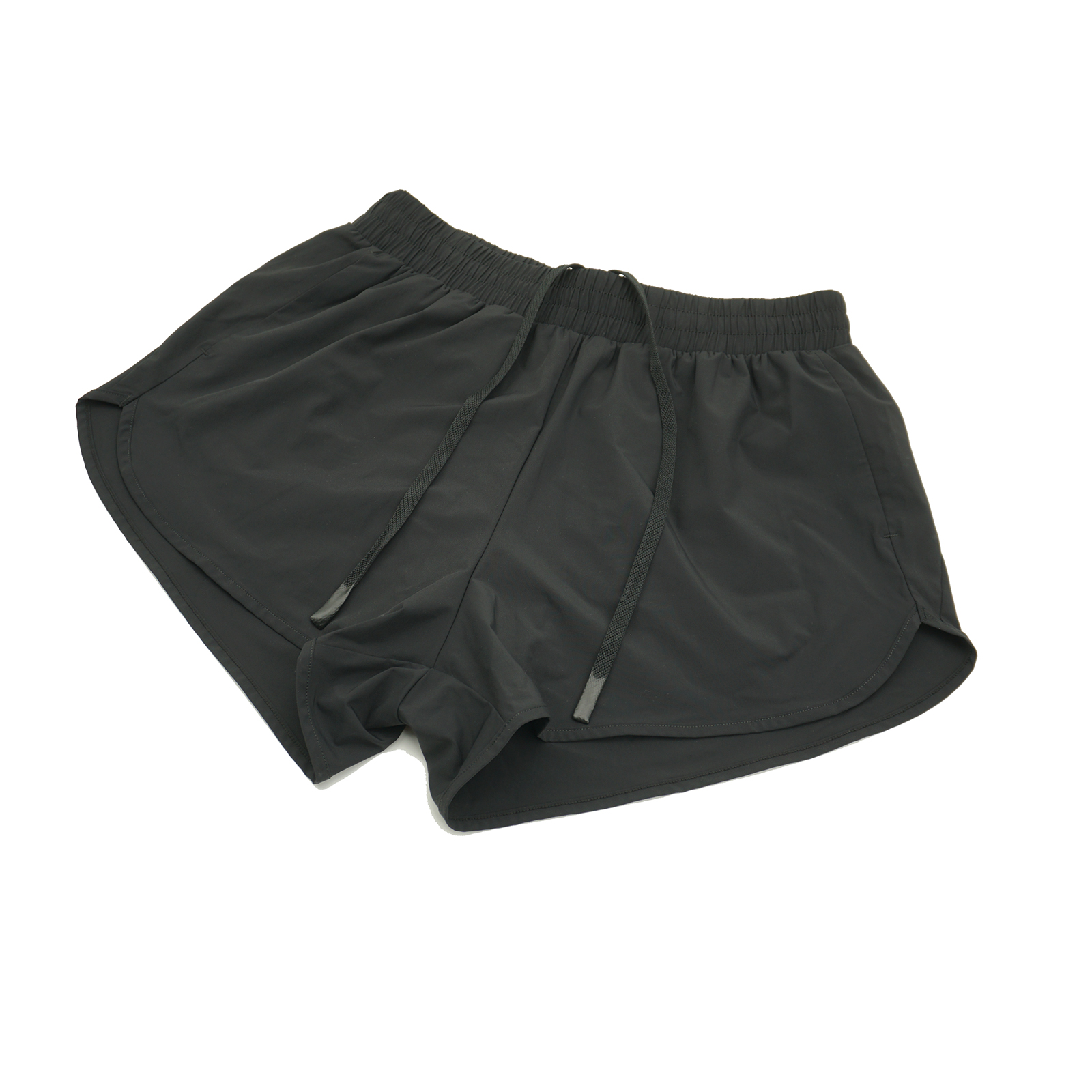
LY4291-1 is a relaxed-fit 2-in-1 sport short with a fixed, built-in leakproof gusset, made from an 88% nylon / 12% spandex outer shell, sized XXS–3XL, with a drawstring waistband, dual side pockets, and reflective detailing. It's open to OEM/ODM development across colorways, logo placement, packaging, and size-range adjustments. Full product details are on the LY4291-1 product page.
30ml is our internal development target capacity, not a third-party laboratory-verified maximum — I explained the methodology gap behind that distinction in detail in an earlier article in this series, and the short version is that no one in this category has published dynamic leak-testing data yet, us included.
On chemical safety: as a company, we test PFAS-free status at the finished-garment level via SGS testing against EPA Method 533, on every batch since Q2 2024 across our production — that's real, company-wide policy. LY4291-1 as a standalone style still needs its own finished-garment chemical test on file before I'd call that fully documented for this specific product. Our OEKO-TEX Standard 100 Class I certificate (26.HCN.12213, Hohenstein, valid through July 31, 2027) covers our period underwear line — I won't claim it automatically extends to this sport short until we've confirmed the certificate's scope covers it.
What we haven't completed yet: dynamic movement leak testing, combined sweat-plus-menstrual-fluid absorbency data, post-wash performance data at 5 and 20 cycles, and wear trials across a representative range of body types and sport types. This is our current development specification, not a finished performance record — and I'd rather tell you that directly than have you find out later.
If you're seriously weighing this category
If you've read through the four risks above and you're still interested — not despite them, but with a clear-eyed view of them — that's exactly the kind of buyer I want to talk to. I'd rather spend an hour walking you through what's tested, what isn't, realistic timelines, and MOQ by customization tier than have you find any of that out after you've already committed to a launch date.
WhatsApp: +86-199-2880-2613
Email: info@ljvogues.com
LinkedIn: linkedin.com/in/ljvogues-ceo
Product page: https://www.ljvogues.com/2-in-1-sport-period-shorts
— Ocean Yang, Ljvogues
Sources cited in this article
Federation University — Menstruation driving girls out of sport (2025): https://www.federation.edu.au/about/news/media-release/new-study-reveals-menstruation-is-quietly-driving-girls-out-of-sport/
Grand View Research — Period Panties Market Report: https://www.grandviewresearch.com/industry-analysis/period-panties-market-report
WUKA Period Sports Shorts: https://wukawear.com/products/wuka-period-sports-shorts
Modibodi Period Running Short: https://us.modibodi.com/products/running-short-moderate-black
Knix Pursuit Leakproof Training Short: https://knix.com/products/pursuit-leakproof-training-short