
Views: 0 Author: Ocean Yang Publish Time: 2026-08-10 Origin: Ljvogues


Most sport period underwear returns trace back to two pattern decisions made before a single unit ever ships: gusset coverage that's mismatched to how the body actually moves, and a size grading logic borrowed from regular underwear that doesn't hold up once you're scaling a leakproof panel across XXS to 3XL. Rise height and inseam length matter too, but they're secondary — gusset coverage and grading are where most of the damage happens.
A brand's ops manager sent me their return-reason export a few months back, printed out and highlighted in three colors, because she'd been staring at it for a week without finding the pattern. Two hundred-some returns, almost all tagged "doesn't fit" or "not as expected." No size cluster jumped out, no obvious defect — just a flat, frustrating spread across sizes and colors. She asked me straight: "Is this a sizing problem, a quality problem, or are people just picky?" My answer was that it's probably not any one size failing — it's the gusset and grading logic underneath the whole range, and that kind of problem doesn't show up cleanly in a return-reason dropdown. It shows up as noise that looks like nothing.

I covered testing methodology in an earlier article in this series — absorbency claims, dynamic leak testing, wash durability, chemical safety. This one is different. It's not about whether the product leaks under lab conditions; it's about whether the pattern itself was built to fit the range of bodies it's sold to. You can pass every test in that testing article and still generate returns if the gusset or the grading is wrong, because fit and performance are two separate failure modes that get lumped into the same one-word customer complaint.
I'll also be upfront about this article's boundaries. I'm not handing you LY4291-1's size chart or a return-rate percentage — we haven't published multi-size return statistics for this style, and I won't invent a number just to make a table look authoritative. What I can walk through is the general pattern logic our team checks on every sport period style we grade, regardless of which specific measurements end up on a spec sheet.
A gusset that's cut too short leaves the sides and back exposed exactly where leaks actually start; a gusset cut too long creates a bulky panel that shifts, bunches, or rides during movement — and both failure modes get reported by the customer as some version of "it didn't fit right," not as a coverage measurement.
This splits into two failure directions, and brands tend to over-correct toward one and walk straight into the other.
Coverage that's too short usually shows up at the side edges and the back rise — the zones where fluid moves under motion rather than sitting still under gravity. A gusset patterned for a static, seated posture can look adequate on a flat table and still fall short mid-stride, because running and squatting change how the body compresses and how fluid travels relative to that panel. Side leakage and back-of-garment staining are the two most common consumer descriptions of under-coverage, and neither mentions the word "gusset" — they just say the product leaked.
Coverage that's too long or too wide creates a different problem: bulk. An oversized absorbent panel relative to the outer fabric reads as a visible ridge, creates a thicker seam line across the inner thigh, and is more likely to bunch or fold during a stride instead of lying flat. Customers describing this tend to say the product felt "bulky," "rode up," or "moved around" — again, no mention of coverage dimensions, just a discomfort description that could just as easily be blamed on fabric or sizing.
Here's the part that matters for development: coverage isn't a length-and-width spec you pick once and lock in. It has to be validated against how the body's crotch geometry and stride mechanics actually behave, not just measured against a flat pattern piece. In our own development process, when we're validating gusset coverage on a new sport period style, we check it across a seated posture, a standing posture, and a mid-stride or squat position on a fit model — because a coverage line that looks generous on a flat table can end up too narrow the moment someone's legs are in motion, and a line that looks tight on paper can turn out fine once you see how the surrounding fabric compresses around it. That check doesn't require exotic equipment. It requires deciding to do it before cutting a production pattern, instead of assuming a coverage dimension that worked for a different garment will transfer cleanly to this one.
Standard underwear grading assumes waist, hip, and thigh measurements scale up and down together in roughly fixed proportions across a size run — but gusset coverage relative to body size, and thigh circumference relative to hip circumference, don't move in that same straight line, which is exactly why a sport period short graded like a regular brief tends to under-perform at the size extremes.
Regular underwear grading is fairly forgiving. If the waistband and leg openings are close enough, the garment still functions — a slightly loose or snug everyday brief isn't a functional failure, just a comfort preference. A sport period short doesn't get that same forgiveness, because the gusset has a specific job: sit against the body in the right place, stay anchored to the outer shell through movement, and hold its containment geometry regardless of size. That's a much narrower tolerance than "does the waistband feel okay."
The proportional relationships that make simple linear grading risky for this category:
Thigh circumference doesn't scale at the same rate as waist or hip circumference. Two people one size apart at the waist aren't reliably one "size step" apart at the thigh — body shape distribution varies enough that a linear scale-up can leave a larger-size thigh opening too loose (chafing, gusset drift) or a smaller-size thigh opening too tight (pressure, discomfort), independent of whether the waist and hip fit correctly.
Gusset coverage as a proportion of total garment area shifts across the size range, even when absolute gusset dimensions stay fixed. A panel that covers a comfortable proportion of the crotch area on a smaller frame can cover proportionally less on a larger frame if dimensions aren't re-evaluated at each step — and a panel sized generously for a larger frame can feel oversized on a smaller one.
Rise and gusset placement interact differently at size extremes. At the smallest and largest ends of a range like XXS–3XL, small proportional shifts in torso length and hip depth can move the gusset's front-to-back placement, a fit issue a middle-size sample often won't reveal at all.
This is why, when our factory grades a sport period style across a wide range, we treat the gusset panel and the thigh opening as their own validation checkpoints at each size step — not just a proportional scale-up from the sample size — because a sample size passing fit review tells you almost nothing about whether the smallest and largest sizes will behave the same way. Scaling a mid-range sample by a fixed percentage is a common shortcut, and it's exactly the one that produces returns concentrated at the size extremes without ever showing up as a "sizing" complaint, because the customer just says it didn't fit and moves on.
Rise and inseam deserve a place in this conversation, but they're not where most of the return volume originates, so I'll keep this tight.
Rise height — how high the waistband sits — affects how much of the lower back and hip the outer shell covers, and whether the waistband rolls or folds down during movement. A rise that's too low for the garment's intended activity level increases the odds of slipping during a run or squat, which compounds a gusset positioning issue rather than causing one on its own. A rise matched to the activity level generally stays put through a training session without constant adjustment.
Inseam length mostly affects inner-thigh friction. A shorter inseam reduces fabric-on-skin contact at the leg opening but covers less of the upper thigh. A longer inseam covers more thigh but adds more hem and seam contact with each stride — a common chafing contributor over a longer session. Neither is universally better; it's a trade-off that should match the intended sport and session length.
Both interact with gusset coverage and grading rather than existing in isolation — a well-graded gusset paired with a poorly matched rise can still produce a return, which is part of why fit needs evaluating as a system, not four separate checkboxes.
This table is the one I'd hand a product manager who's staring at a return-reason export and not finding a pattern in it — because the pattern usually isn't in that export at all.
Fit problem | What the consumer typically says (return/review language) | What a brand should verify before launch |
Gusset coverage too short (sides/back) | "Leaked," "didn't work," "leaked from the side" | Check coverage under a mid-stride or squat posture, not just flat/seated — confirm side and back rise coverage against actual movement, not a static pattern piece |
Gusset coverage too long/wide | "Bulky," "rode up," "felt like I was wearing a diaper," "bunched up" | Compare panel dimensions against outer fabric proportions at each size; check for visible ridging and folding during a stride test |
Linear grading applied across size range | "Didn't fit like my usual size," "loose in one area, tight in another," complaints clustered at smallest/largest sizes | Validate thigh circumference and gusset-to-body proportion independently at each size step, not just at the sample size |
Thigh opening too tight or too loose at size extremes | "Digs in," "rides up on my thighs," "gaps at the leg" | Fit-test dedicated samples at the smallest, middle, and largest sizes in the range — not just the sample size — with real bodies, not only a fit model |
Rise too low for activity level | "Waistband kept rolling down," "had to keep adjusting it" | Match rise height to intended activity level; test waistband stability through a full training session, not just standing still |
Inseam mismatched to use case | "Chafed on my inner thigh," or conversely, "didn't feel covered enough" | Set inseam length deliberately based on target sport and session length, and validate with wear testing rather than defaulting to a standard shorts inseam |
Return-reason data is almost never granular enough to tell you whether a return was caused by gusset coverage, grading, rise, or inseam — a customer writes "didn't fit" or "not as described," and that single phrase can be hiding four completely different pattern problems, which is exactly why a brand can't afford to treat an empty or vague return-reason field as good news.
This is the core problem the ops manager I mentioned earlier ran into. Her return dashboard wasn't lying to her — it just wasn't built to capture the information that would let her diagnose a pattern issue. Most return workflows offer a generic dropdown — "didn't fit," "changed my mind," "wrong color" — and call it done. None of those distinguish between "the gusset leaked because coverage was too short" and "I sized up because your grading runs small at the hip." Both land in the same vague bucket, and aggregate return-reason data reads as noise, not a diagnosis.
That's exactly why fit validation has to happen before launch, not after the return data comes in. Waiting for return patterns to reveal a gusset or grading problem means you've already shipped a meaningful volume of product with the flaw baked in, and by the time the signal is clear enough to act on, you've absorbed the returns, the bad reviews, and the reorder hesitation that comes with them. A proactive fit test — real bodies across a genuine size spread, evaluated in motion, not standing in front of a mirror — catches what a return-reason dropdown never will.
This connects directly to a point I made in an earlier piece in this series about layering versus a 2-in-1 build: a gusset that's mechanically anchored to the outer shell removes one whole category of movement-related fit failure, but it doesn't remove the need to grade that gusset correctly across every size in the range. Anchoring the gusset solves how it moves with the body at any given size. Grading solves whether it's positioned correctly for that specific body in the first place. Both have to be right.
If you're sourcing this category, ask your factory directly whether gusset coverage and thigh-opening fit were validated independently at multiple size points, or whether the whole range was scaled proportionally from one sample size. The answer to that question tells you more about your future return rate than any spec sheet number will.
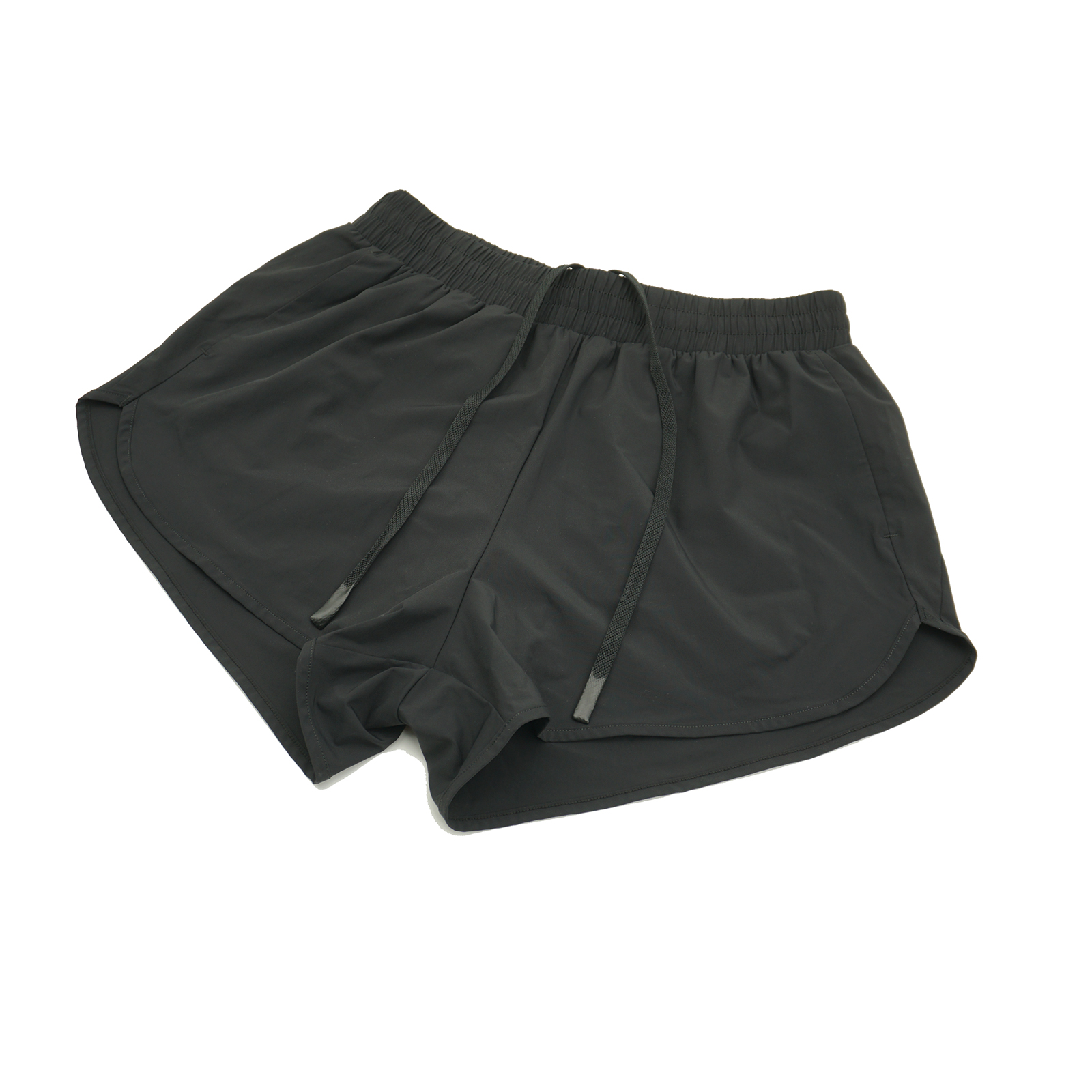
I'd rather be direct about scope than let this section imply more than what's documented. LY4291-1 is our relaxed-fit 2-in-1 sport short with a fixed, built-in leakproof gusset, an 88% nylon / 12% spandex outer shell, sized XXS–3XL, with a drawstring waistband, dual side pockets, and reflective detailing. The drawstring waistband gives some adjustability at the waist specifically, which helps with rise-related fit variance without requiring a size change.
What I won't do here is hand you a size-by-size measurement chart or a return-rate figure for this style — we haven't published multi-size return statistics for LY4291-1, and a number without that data behind it would be the exact unearned confidence I've tried to avoid throughout this series. What I can tell you is that gusset coverage and thigh-opening fit across a size range like ours are checkpoints our team treats as non-negotiable during grading review — the general validation approach described here is the one we apply, regardless of which specific numbers end up on any given style's spec sheet.
Fit problems are the hardest category of return to diagnose after the fact and the easiest to prevent before launch, which is exactly backwards from how most brands allocate their testing budget. If you're developing a sport period short and want to talk through how gusset coverage and grading should be validated for your specific size range and target sport, I'd rather walk through that with you directly than have you find the gap in your return data six months from now.
WhatsApp: +86-199-2880-2613
Email: info@ljvogues.com
LinkedIn: linkedin.com/in/ljvogues-ceo
Product page: https://www.ljvogues.com/2-in-1-sport-period-shorts
— Ocean Yang, Ljvogues
This article draws on general apparel pattern-grading and fit-development principles and Ljvogues' own manufacturing experience rather than third-party statistical sources. No external data sources are cited inline. For related evidence on category demand and testing standards referenced elsewhere in this series, see:
Federation University — Menstruation driving girls out of sport (2025): https://www.federation.edu.au/about/news/media-release/new-study-reveals-menstruation-is-quietly-driving-girls-out-of-sport/
New York State DEC — PFAS in Apparel Law: https://dec.ny.gov/environmental-protection/pollution-prevention/pfas-in-apparel-law
2026-08-13 11
LJVOGUES-August-2026-New-Arrivals.pdf
2026-07-17 7
LJVOGUES-Period-Underwear-Collection-2026-LJ-style-title-fixed.pdf
2026-06-15 20
LJVOGUES-June-2026-New-Arrivals.pdf
2026-06-05 14
LJVOGUES-May-2026-New-Arrivals.pdf
2026-04-01 197
Plus Size Bra Collection.pdf
2026-02-04 124
Professional Period Underwear OEMODM Manufacturer Catalog 2026.pdf
2026-02-04 119
Ljvogues Period-Panties-Catalog-In-stocks-2026-1.pdf


