




A private label period underwear brief should move in this order: define the product levers that shape the sample, including fabric, absorbency level, silhouette, size range, color or print, branding touchpoints, and performance add-ons; state absorbency and leakage language as test requirements rather than finished marketing promises; and check destination-market textile labels before packaging is locked.
Start with the brief elements that control the sample
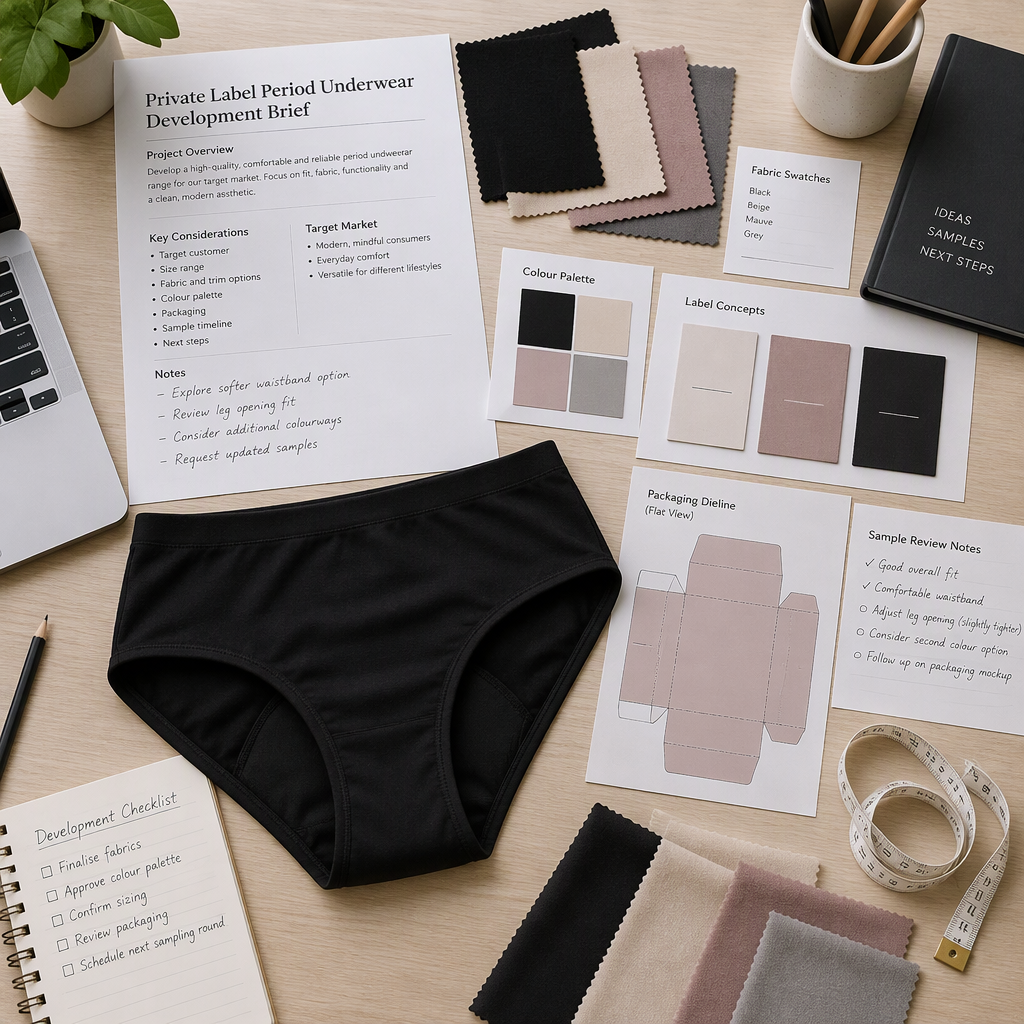
Before requesting a private label period underwear sample, define the construction choices that the supplier must interpret: material direction, absorbency target, leakage-control intent, style, grading, branding placement, and any performance add-ons.
| Brief field | What the buyer should specify | Why it matters at sample stage |
|---|---|---|
| Fabric direction | Main fabric preference, hand feel, stretch expectation, and lining concept. | Fabric decisions affect comfort, fit, wash review, and how the sample is judged. |
| Absorbency level | Intended use case and the claim type the brand wants to support later. | The sample request should not become a public absorbency promise until testing supports it. |
| Silhouette and size range | Brief, bikini, boyshort, teen, sport, swim, maternity, or other style direction where relevant. | Pattern and grading choices decide whether the sample can be assessed on the target wearer group. |
| Branding touchpoints | Waistband, label, hangtag, packaging, print, and color direction. | Brand artwork must be reviewed together with legal label space and care information. |
Set absorbency and leakage claims as evidence requirements
Write absorbency and leak-protection goals as performance requirements to be tested, not as guaranteed consumer-facing claims in the first sample brief.
For claim planning, the Hohenstein period underwear quality label page describes criteria that include absorbency according to FEMTECHMAS-6513-1:2023 and fit, and it describes maximum absorption capacity before leakage for reusable absorbent underwear. Treat this as an example of testing dimensions, not proof that any supplier or style has achieved a result.
Do not convert a sample request into exact milliliter, leakproof, overnight, medical, or certification language unless the brand has test files for the same material, construction, size range, and intended use conditions.
In the brief, separate three lines: the internal product target, the laboratory or inspection method requested, and the final marketing phrase that can be considered only after evidence is available.
Review fit, sizing, and wash behavior before locking the sample
Fit should be treated as a review criterion for period underwear, and size range, grading, silhouette, and material choices should be documented before the sample is approved.
- Review the sample against the intended silhouette, rise, leg opening, waistband, gusset coverage, and target wearer group.
- Record size comments by body area instead of using a single pass or fail note.
- Confirm whether color, print, trims, and branding placements still leave enough space for required labels and care content.
- Run the buyer’s own wash-review protocol before bulk approval, and keep the washed sample set for comparison with production lots.
- Approve a fit sample only when the development team has clear comments on front coverage, back coverage, leg comfort, waistband stability, and gusset position.
- Keep one approved sample, one washed reference sample, and one marked-up construction sample for production handoff.
- When styles target teens, maternity, sport, swim, or incontinence use, define the wearer scenario separately instead of assuming one pattern covers every application.
Separate product claims, test files, and use instructions
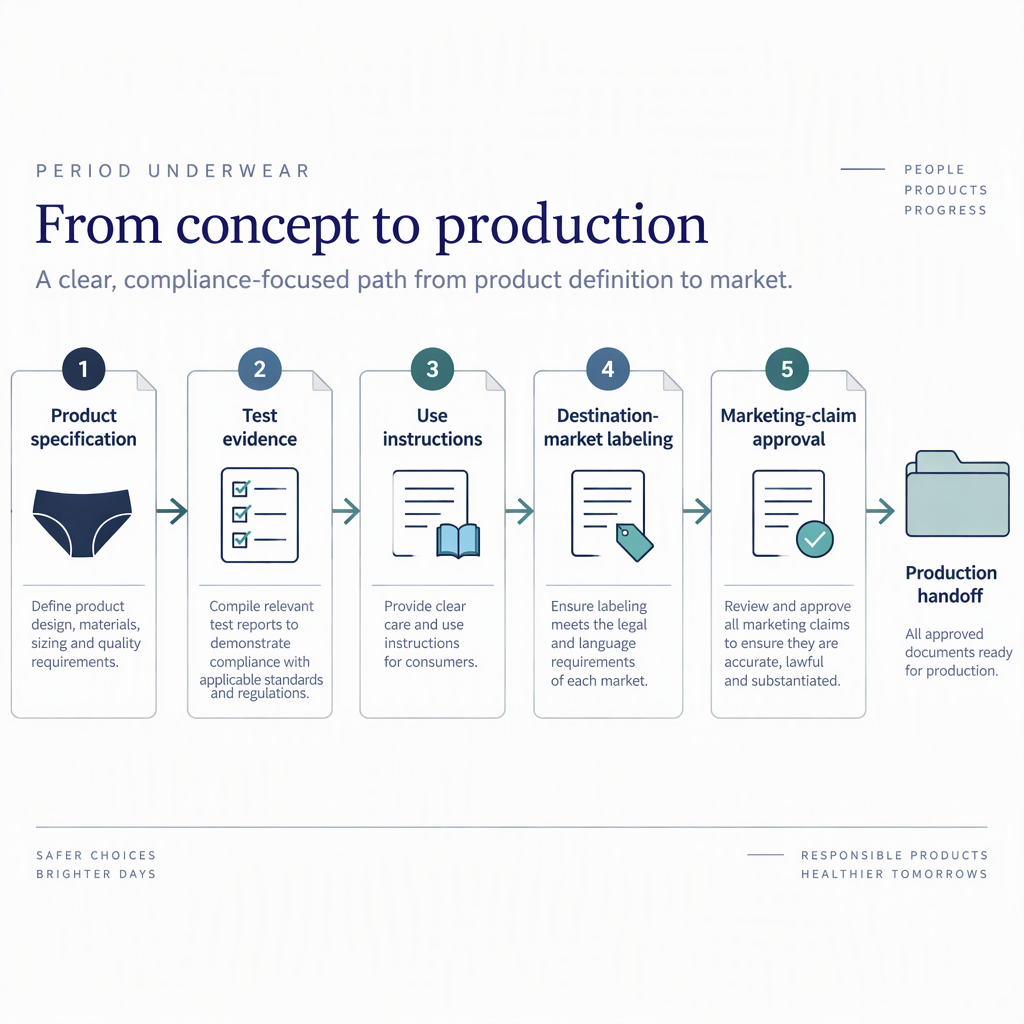
The safest production brief separates what the product is, what the brand wants to claim, which file supports the claim, and which use or care instruction must appear with the product.
| Claim or instruction type | Put in the brief | Approve only when |
|---|---|---|
| Absorbency or leakage language | Target use case, test request, sample size set, and claim wording to be reviewed later. | Testing supports the statement for the relevant reusable absorbent underwear construction. |
| Fit-related language | Measurement points, grading comments, wearer group, and fit review notes. | The fit evidence matches the approved pattern and size range. |
| Environmental language | Exact term, market, substantiation file, and any needed qualification. | The claim is not misleading, is substantiated, and is qualified where needed under the FTC Green Guides principles for U.S.-facing environmental marketing. |
| Use and care wording | Consumer instructions, wash guidance, absorbency-use notes, and limits of intended use. | The wording matches the tested product, the destination market, and the brand’s approved consumer communication. |
For U.S.-facing environmental terms such as recycled, biodegradable, renewable, or PFAS-free, the FTC Green Guides topic page emphasizes avoiding misleading claims and using substantiation and qualification where necessary.
Do not place certification names, PFAS-free statements, medical language, proprietary-technology wording, or quantified performance claims into packaging or ecommerce copy unless the brand has current documents that apply to the exact product and market.
Map destination-market labeling and claim rules early
If the product will be sold in the United States, plan textile labels around fiber content, country of origin, and the responsible manufacturer or business identity, and treat care labeling as a separate required planning item.
The FTC guidance page, Threading Your Way Through the Labeling Requirements Under the Textile and Wool Acts, says most covered textile and wool products must disclose fiber content, country of origin, and the identity of the manufacturer or another responsible business; it also notes that care labels for clothing are required by a separate FTC rule.
- For U.S. sales, reserve label space for fiber content, country of origin, responsible business identity, and care information before trims and packaging artwork are finalized.
- For other destinations, ask the compliance owner to confirm local textile labeling, product-safety, language, importer, and consumer-information requirements before production.
- For U.S.-facing environmental claims, keep substantiation and qualification files with the packaging artwork approval record.
Do not assume one global label is acceptable everywhere. Build the brief by destination market, sales channel, and claim language, then ask the brand’s compliance provider or local counsel to confirm the adopted rules before bulk packaging is printed.
Convert the approved sample into a production handoff file
Once the sample is approved, convert every customization decision into a controlled handoff file covering materials, construction, sizing, branding, packaging, test requests, and claim limits.
- Freeze the approved style, fabric direction, absorbency target, silhouette, size range, color, print, and branding placements.
- Attach the approved sample photos, measurement points, grading notes, artwork files, label drafts, and packaging layout.
- List open tests or inspections separately from approved specifications so the production team does not treat unfinished claims as final copy.
- Define who may approve changes to fabric, gusset construction, trim, label content, and packaging after the handoff.
| Handoff item | Owner question | Production risk if missing |
|---|---|---|
| Bill of materials | Which fabric, lining, trim, elastic, label, and packaging components are approved? | Substitution may change fit, comfort, appearance, and claim support. |
| Measurement file | Which points of measure, tolerances, and graded sizes are locked? | Bulk pieces may drift from the approved wearer fit. |
| Claim file | Which test or substantiation files are required before public copy is released? | Marketing may publish claims that the product file cannot support. |
Use a final production-readiness checklist
Approve production only when the product specification, sample record, testing plan, destination label file, artwork, care wording, and claim controls agree with each other.
- Product choices are locked for fabric, absorbency level, silhouette, size range, color or print, branding, and performance add-ons.
- Absorbency, leakage, and fit claims are tied to appropriate evidence requests or completed test files rather than assumptions from the sample.
- U.S. label planning covers fiber content, country of origin, responsible business identity, and care-label needs where the U.S. is a destination market.
- Environmental claims are substantiated and qualified before they appear on packaging, hangtags, ads, or ecommerce pages.
- Use instructions, wash guidance, and intended-use limits are consistent across label, insert, packaging, and product page copy.
- The production handoff identifies who can approve construction, artwork, label, or claim changes after sample signoff.
The buyer’s best control is a brief that treats claims as files to be proven, labels as destination-specific work, and the approved sample as the baseline for every production decision.
Conclusion
A strong private label period underwear brief does not start with MOQ alone; it starts with product decisions, evidence boundaries, destination-market labels, and a disciplined sample-to-production handoff.
For procurement, quality, and apparel-development teams, the goal is simple: make every sample comment traceable to a specification, every public claim traceable to a file, and every label decision traceable to the market where the product will be sold.
FAQs
These are the practical questions sourcing teams should settle before sampling and again before bulk approval.
What should a private label period underwear brief include first?
Start with fabric direction, absorbency target, silhouette, size range, color or print, branding touchpoints, and any performance add-ons because those choices shape the sample the supplier prepares.
Can the brief claim a specific absorbency level?
It can state an internal target and requested test approach, but a public absorbency or leakage claim should wait until evidence supports that exact product construction and intended use.
Should buyers use the word leakproof in the first sample brief?
Use leakage-control goals and test requirements first. Reserve absolute consumer-facing wording for claims that are supported by applicable test files.
How should fit be reviewed?
Fit is a relevant period-underwear review dimension, so buyers should record comments by size, body area, gusset placement, waistband stability, leg comfort, and wearer scenario.
What U.S. label items should be planned early?
For U.S. sales, plan for fiber content, country of origin, responsible business identity, and care-label needs before packaging and label artwork are finalized.
How should sustainability or PFAS-free claims be handled?
Treat environmental wording as a substantiation task: the claim should not mislead consumers, and the brand should keep support and qualifications for the exact wording and market.
What should be checked before approving bulk production?
Confirm that the approved sample, measurements, materials, artwork, labels, test files, use instructions, and claim approvals all match the same product version.