




For a period underwear range, do not rely on a badge list. Build a pack that separates harmful-substance certification, performance reports, care evidence, and destination-market rules before approving claims.

Which document types should a period underwear buyer request?
Request four evidence groups: a harmful-substance certificate for the textile article, performance test reports for period-underwear claims, care and use instructions, and destination-market compliance records.
| Document type | What it supports | What it does not prove by itself |
|---|---|---|
| Harmful-substance textile certification, such as OEKO-TEX STANDARD 100 | STANDARD 100 is described as a harmful-substance textile label covering yarn through finished products, with product classes based on use and skin contact. | It does not prove absorbency, leak resistance, garment fit, wash durability or medical performance. |
| Period-underwear performance report | A period-specific testing file can support absorbency, leakage-related and fit claims when it states the method, sample scope and criteria used. | It does not replace chemical, labeling or destination-market compliance checks. |
| Care and use instruction record | For U.S. selling, textile guidance includes care-label responsibilities and truthful material-claim framing. | A care label does not prove the product will keep a claimed absorbency level after any wash condition not tested. |
| EU fiber-composition file and U.S. labeling file | EU textile rules address textile fiber names and related labeling and marking of fiber composition. U.S. guidance covers fiber content, country of origin and responsible business identity for many textile products. | These records are market-entry and label-control documents, not marketing proof for absorbency or leak-proof claims. |
| General product-safety assessment and restricted-substance checks | EU product-safety assessment considers product aspects including physical, mechanical and chemical characteristics and presentation. REACH restrictions are enacted through Annex XVII and include consumer-article restrictions relevant to textiles. | Regulatory compliance is not the same as a voluntary certification logo or a period-underwear performance result. |
How are certifications different from absorbency and leak-proof testing?
A textile certification can support a defined certification scope, but it should not be treated as proof that period underwear absorbs, resists leakage, fits well or performs after washing.
| Question | Certification document | Performance test report |
|---|---|---|
| What is being checked? | For OEKO-TEX STANDARD 100, the stated focus is textiles tested for harmful substances, with product classes related to intended use and skin contact. | For a period-underwear label or performance file, the relevant scope is the stated test criteria, such as absorbency according to the method named by the testing provider. |
| What should the buyer match? | Certificate holder, article description, material scope, product class and validity period. | Garment style, absorbent area, size or fit scope, test method, sample condition and claimed use. |
| What claim risk remains? | Do not convert a harmful-substance certificate into a leak-proof, clinical or durability claim. | Do not use one report to support all fabrics, all sizes, all constructions or untested washing conditions. |
What should performance reports show for absorbency, leakage and fit?
Performance reports should link each absorbency, leakage or fit claim to a named method, defined sample, acceptance criteria and product scope.
- Ask whether the report identifies the period-underwear style, absorbent construction, sample size and test condition rather than only a fabric layer.
- For absorbency language, look for the named test basis. Hohenstein states that its label includes absorbency according to FEMTECHMAS-6513-1:2023; request the applicable report, not just a method name.
- For leakage or protection wording, check whether the report tests the finished garment or only a material component, and restrict claims to the tested configuration.
- For fit, confirm whether fit is included in the criteria, because the Hohenstein page says fit is strongly recommended when labeling the product.
- For wash-related claims, require before-and-after evidence if the claim implies performance after laundering; do not infer wash durability from an initial absorbency test.
Which destination-market rules should sourcing teams separate from certifications?
Treat destination-market rules separately because labeling, safety and restricted-substance duties depend on where the product is sold, not on a certification logo.
| Market or rule layer | Procurement check | Why it is separate from certification |
|---|---|---|
| United States textile labeling | Review the FTC clothing and textiles guidance for fiber content, country of origin and responsible-business identity obligations that apply to many textile and wool products. | These are labeling and truthful-claim controls; they are not period-underwear performance certifications. |
| European Union fiber composition | Check Regulation (EU) No 1007/2011 for textile fiber names and fiber-composition labeling in the Union. | Fiber-composition rules help buyers control label information, not absorbency, leakage or garment fit claims. |
| European Union general product safety | Review Regulation (EU) 2023/988 for product-safety assessment factors and supply-chain operator obligations. | Safety assessment is a consumer-product compliance layer, not a voluntary textile badge. |
| EU REACH restrictions | Check the European Commission page on REACH restrictions, including restrictions enacted through Annex XVII and consumer-article restrictions relevant to textiles. | Restricted-substance compliance is a chemical-control requirement; it should not be used as proof of absorbency or comfort. |
Why do care instructions and use limitations belong in the evidence pack?
Care instructions matter because washing, drying and use conditions affect claims, and regulators expect truthful label and care statements for the selling market.
- Check that the care label and packaging copy align with destination-market textile guidance, including the U.S. care-label and truthful-claim framework.
- If marketing says the garment remains absorbent, leak-resistant or suitable for a defined use after washing, ask for testing that reflects that claim rather than relying on an initial performance report.
- Record the use boundary: absorbent zone, tested construction, wash assumptions and conditions that should not become public promises.
- Keep label artwork, e-commerce text and packaging claims consistent so that material and care statements do not conflict across sales channels.
How should quality teams verify a supplier's document pack?
Use a claim-by-claim workflow: identify the claim, match the document type, check scope and date, then approve only supported wording.
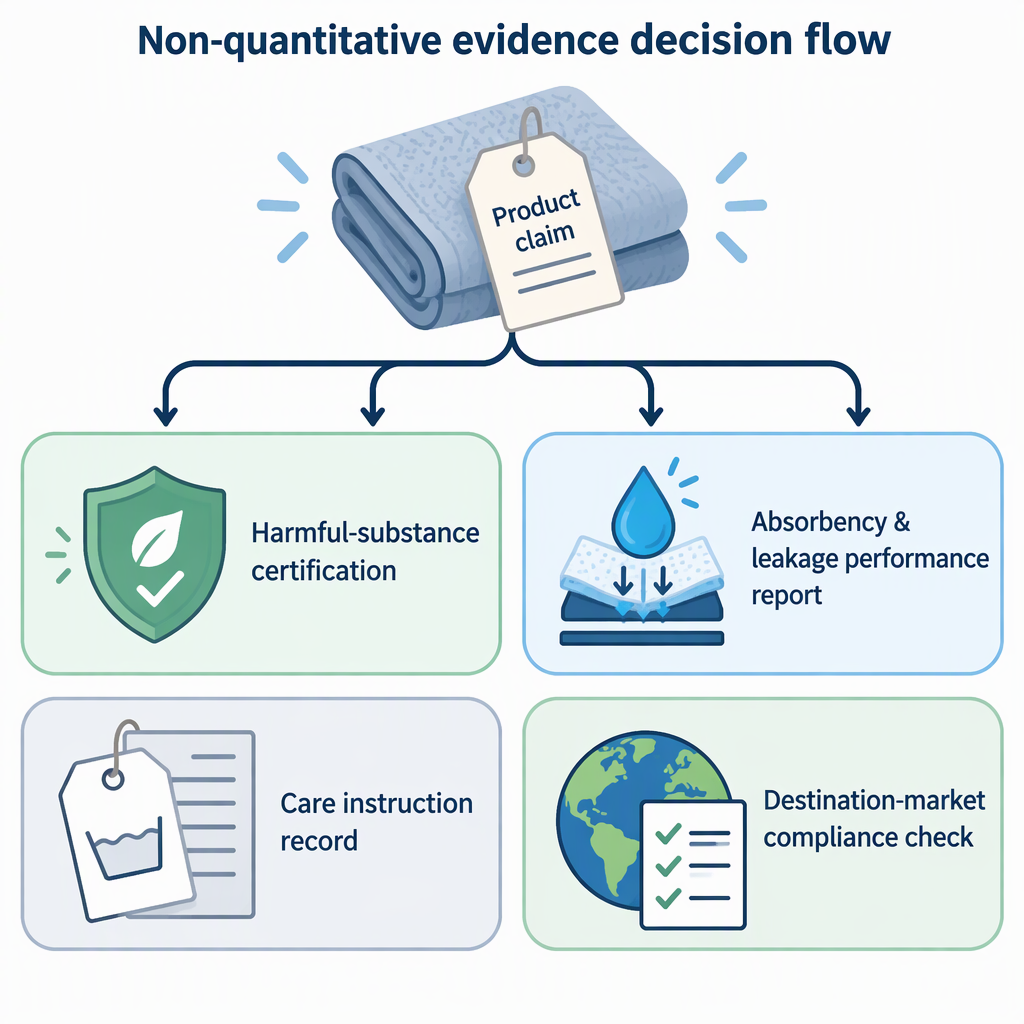
- Start with the claim. For harmful substances or skin-contact textile safety, review certificate scope, product class and validity.
- If the claim is about absorbency, leakage protection or fit, request a performance report for the finished garment or the exact tested construction and method.
- If the claim is about material content, origin, responsible business identity or care, match it to the destination-market labeling file.
- For EU sales, check that the fiber-composition information follows the EU textile fiber-name and composition-labeling framework.
- For EU consumer-product safety, keep a safety assessment file that considers relevant physical, mechanical, chemical and presentation aspects.
- For restricted substances, review the current REACH restriction list and test or supplier declarations for the actual article materials.
- Confirm the certificate holder, article description, product class and one-year certificate validity when reviewing OEKO-TEX STANDARD 100 files.
- Confirm that period-underwear performance reports state the test method and the product scope that the public claim will reference.
- Confirm that label artwork and online product copy do not exceed what the material, care and performance files support.
Where should period underwear claims stop?
Claims should stop where the document scope stops: do not say certified, compliant, organic, leak-proof, clinically safe or durable unless the exact product, market and claim wording are supported by current documents.
- Use harmful-substance certification for chemical and skin-contact certification questions, not for absorbency performance.
- Use performance reports for absorbency, leakage, fit and wash-related claims, with wording limited to the tested scope.
- Use market rules for fiber-composition and label-control questions in the sales destination.
- Use product-safety files for consumer-safety assessment and operator responsibilities.
- Use restricted-substance files for chemical restrictions in consumer articles.
Conclusion: approve documents before approving claims
The next sourcing step is to approve the evidence pack before approving the range claim sheet, packaging and e-commerce copy.
For period underwear material certification, use a structured file review: certificate scope, performance report, care record, label file and destination-market evidence. Keep each claim tied to a document naming the product, test or rule.
- Do not accept badge screenshots without certificate scope and date.
- Do not accept absorbency or leak-proof wording without a relevant performance report.
- Do not approve global packaging until the target-market label and safety files are checked.
FAQs about period underwear material certification
These questions help sourcing, quality and apparel-development teams turn period underwear material certification into practical document checks.
Is OEKO-TEX STANDARD 100 proof that period underwear is absorbent?
No. OEKO-TEX describes STANDARD 100 as a harmful-substance label for textiles, including product-class and skin-contact concepts. Absorbency needs a separate performance report for the tested garment or construction.
What if a supplier only provides a fabric certificate?
Treat it as evidence for the certified fabric scope only. Ask whether the finished garment, absorbent layers, trims and any skin-contact components are included in the certificate or covered by additional documents.
How should a buyer check a leak-proof claim?
Ask for a report that names the test method, sample, garment area, size or construction scope and acceptance criteria. Keep the public wording within that tested scope.
Are U.S. and EU textile labels the same?
No. U.S. textile guidance covers items such as fiber content, country of origin and responsible business identity for many products. EU Regulation 1007/2011 concerns textile fiber names and fiber-composition labeling in the Union.
Why include REACH in a certification review?
For EU sales, REACH restrictions are a regulatory chemical-control layer for articles, including textile-relevant restrictions. They should be checked separately from voluntary certification logos.
Do care instructions affect absorbency and durability claims?
Yes. Care instructions help define how consumers should maintain the garment, and truthful textile claims should not imply wash performance that has not been tested under the stated care conditions.
Can one document cover global sales?
Usually not. A certificate, performance report or safety assessment may support a specific scope, but destination-market rules and operator obligations still need to be checked for each selling market.