




Gusset coverage in period underwear is the planned zone where absorbent and leak-barrier materials, garment fit and performance testing meet; shape and placement should therefore be specified as coverage maps and claim-support requirements, not judged by visual width alone.
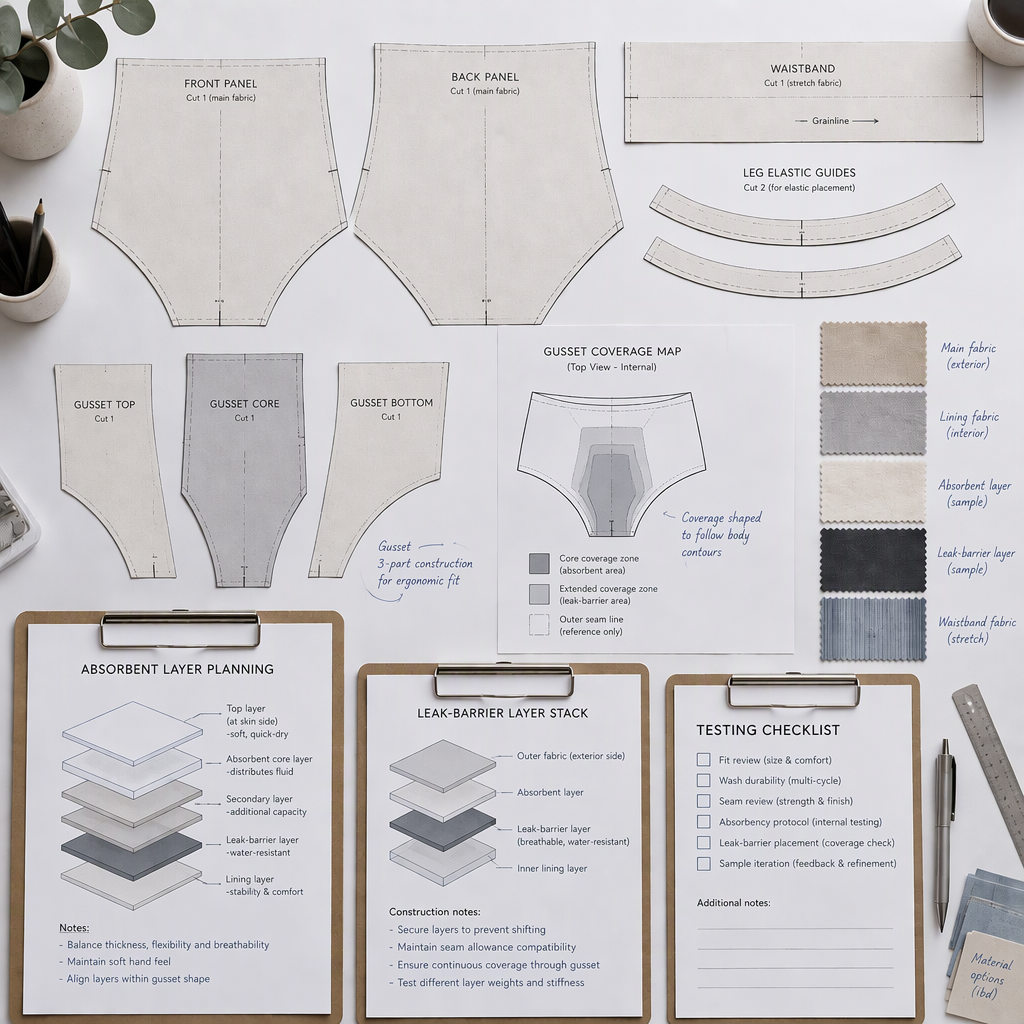
How gusset shape changes the protected zone
Gusset shape affects where absorbent and barrier layers sit against the body, but it does not prove absorbency or leak protection unless the finished construction is tested against the intended claim.
| Shape decision | What it changes in the brief | Buyer check before sampling |
|---|---|---|
| Central narrow coverage | Focuses the protected zone around the main absorbent area, making fit and placement especially important. | Ask how absorbency and moisture-management performance will be measured for the target claim. |
| Wider center coverage | Increases the planned protected area, but the garment still needs fit confirmation so the zone stays aligned in wear. | Confirm whether test data will support the exact marketing language, not only the material stack. |
| Contoured or wave-shaped coverage | Can describe a shaped gusset perimeter on a product page, such as a supplier-stated wave-bottom construction. | Request finished-product testing if the contour is linked to absorbency, leakage or comfort claims. |
A larger-looking gusset can still fail the buyer’s intent if the absorbent zone shifts away from the wearer’s flow path or if the finished garment fit is not checked.
How placement should match the use case
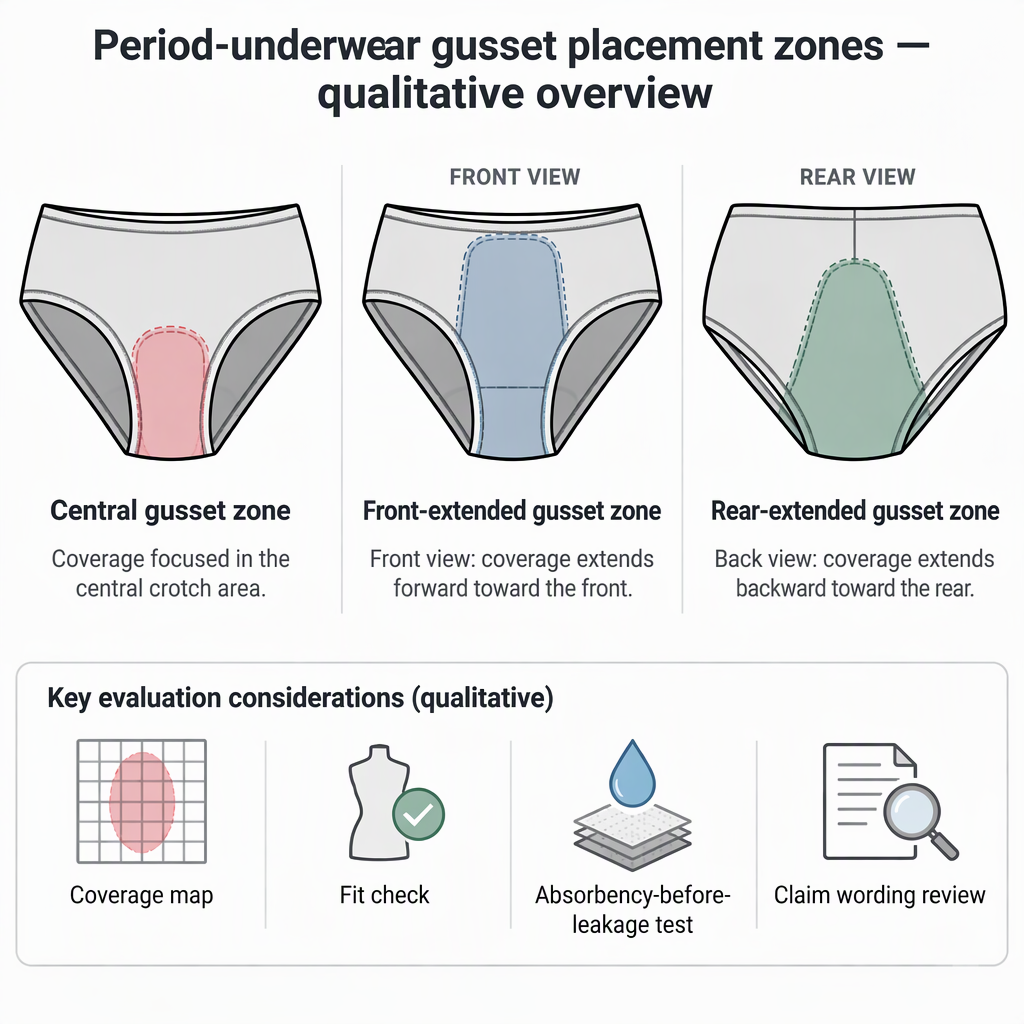
Front, central and rear gusset placement should be selected from the wearer scenario first, then validated through fit and absorbency-before-leakage evidence.
| Use case | Placement emphasis | Specification risk | Evidence to request |
|---|---|---|---|
| Everyday moderate flow | Balanced central coverage | Fit variation can move the protected zone away from the intended body area. | Finished-product absorbency and performance-claim substantiation. |
| Front-leaning coverage need | Forward extension | Extra length may not help if the garment pattern does not keep the extension in place. | Moisture-management and physical-performance data tied to the proposed claim. |
| Overnight or reclined use positioning | Rear extension | Rear coverage should be confirmed by fit trials rather than assumed from a flat pattern. | Leakproof-underwear testing data that supports the stated use case. |
What a wave-bottom gusset example can and cannot prove
A wave-bottom gusset example can define a shape concept and page-stated product positioning, but it cannot by itself prove superior leakage protection, wash durability or certification status.
One first-party CR-25016 product page states a wave-bottom gusset, 4-layer construction, a 3-layer gusset system, a TPU leak barrier and 18–24 ml moderate-flow absorbency.
The same page states OEM/ODM options such as logo, color, fabric, trim, packaging and tech-pack alignment.
For buyers, the useful action is to convert those page-stated options into sample requirements and test-report requests before using them in consumer-facing claim language.
Which tests should support coverage claims
Absorbency, leakproof, PFAS-related and physical/performance claims should be backed by relevant testing, with the test scope matching the exact claim the brand intends to publish.
Hohenstein’s period-underwear quality-label page describes testing for absorbent and leak-proof underwear and refers to maximum absorption capacity before leakage for reusable absorbent underwear.
Bureau Veritas CPS describes absorbency testing for period and leakproof underwear and states that performance claims should be verified and substantiated.
| Claim type | Why shape alone is not enough | Buyer request |
|---|---|---|
| Absorbency level | Absorbency-before-leakage is a performance question, not a visual design label. | Ask for the test method, sample condition and result basis. |
| Leakproof positioning | Leakproof-underwear performance should be substantiated for the finished product claim. | Ask whether results apply to the exact gusset placement and size range. |
| PFAS or chemical claim | Testing packages may address PFAS as a separate claim area. | Ask for the relevant chemical test report and claim wording review. |
How to validate gusset placement before production
Validate gusset placement by moving from a coverage map to prototypes, fit checks, performance testing and claim review before production approval.
- Define the coverage map: front edge, rear edge, width at key points and the intended wearer scenario.
- Translate the map into a construction brief, including layer stack, barrier position and any requested customization options.
- Run fit checks across the planned size range so the protected zone stays aligned during wear.
- Test the finished sample for the absorbency, leakage, moisture-management or physical-performance claims the brand intends to make.
- Review packaging and marketing language against the available reports before launch.
- Keep the pattern map and lab sample identification together.
- Separate intended use language from verified performance language.
- Retest if the gusset shape, material stack, size grading or finishing process changes.
What to confirm before an RFQ
Before an RFQ, buyers should define the intended coverage, target claim, testing expectations, size range and customization limits so suppliers quote the same product concept.
- Target use case and required coverage zone, including front and rear boundary expectations.
- Absorbency and leakproof claim language that will require substantiation.
- Construction preferences such as layer count, barrier material and trim or packaging customization, where offered by the supplier.
- Fit-trial plan for the size range and wearer scenarios.
- Required reports for absorbency, PFAS-related claims or physical/performance characteristics.
| If the priority is... | Ask the supplier for... | Do not rely only on... |
|---|---|---|
| Coverage confidence | Pattern map plus fit-trial plan | A flat image of a wide gusset. |
| Absorbency claim | Finished-product test data | Material descriptions without performance substantiation. |
| Custom appearance | Confirmed logo, color, fabric, trim and packaging options | Assuming every page-stated option fits every project. |
Coverage limits buyers should not overlook
Wider or longer coverage does not automatically guarantee no leaks; coverage must stay aligned in wear and the finished product must meet the tested claim.
A design team should avoid absolute no-leak wording unless the claim is supported by appropriate finished-product evidence and the use conditions are clearly defined.
Fit is a practical limit because even a well-designed absorbent zone can underperform if the garment shifts, gaps or compresses differently across sizes.
How to keep certification and claim language accurate
Following or referencing a test method is not the same as holding a third-party label or certification; buyers should request the applicable certificate or report before using certification language.
Hohenstein describes a quality-label route for tested period underwear, but that does not establish that any supplier product has the label unless the buyer receives product-specific proof.
For claim control, ask the supplier to match each proposed statement—absorbency, leakproof, PFAS-related or physical-performance—to the report that supports it.
Conclusion
The best gusset decision is not simply the widest shape; it is the shape, placement, fit plan and test evidence that match the brand’s intended claim.
- Specify gusset geometry as a coverage map, not a vague design preference.
- Match front, central or rear extension to the wearer scenario.
- Request finished-product evidence before using absorbency, leakproof, PFAS-related or certification language.
FAQs about period underwear gusset design
These answers help buyers turn period underwear gusset design questions into sampling, testing and RFQ decisions.
Does a wider gusset always improve leak protection?
No. Wider coverage can expand the intended protected zone, but fit and alignment still determine whether that zone sits where the wearer needs it.
Should overnight period underwear use a rear-extended gusset?
A rear extension may be relevant for reclined positioning, but the buyer should confirm the pattern map, fit trial and performance test evidence for that intended use.
Can a wave-bottom gusset be used in an RFQ?
Yes, if the RFQ defines what the wave-bottom shape means in the pattern and separates that design request from unverified performance claims.
What evidence should support an absorbency level?
Buyers should request absorbency testing for the finished product and confirm that the result supports the exact level and claim wording.
Confirm finished-product evidence before making TPU-barrier leakproof claims
No. A barrier material may be part of the construction, but leakproof performance should be supported by finished-product testing and claim substantiation.
What should quality teams check after changing gusset placement?
They should check whether the changed placement affects absorbency, leakage, moisture management, fit and any physical/performance claims already planned for the product.
Can a product be described as certified because a test method is mentioned?
No. Certification or label language should be used only when the buyer has product-specific proof from the applicable certification or labeling body.