


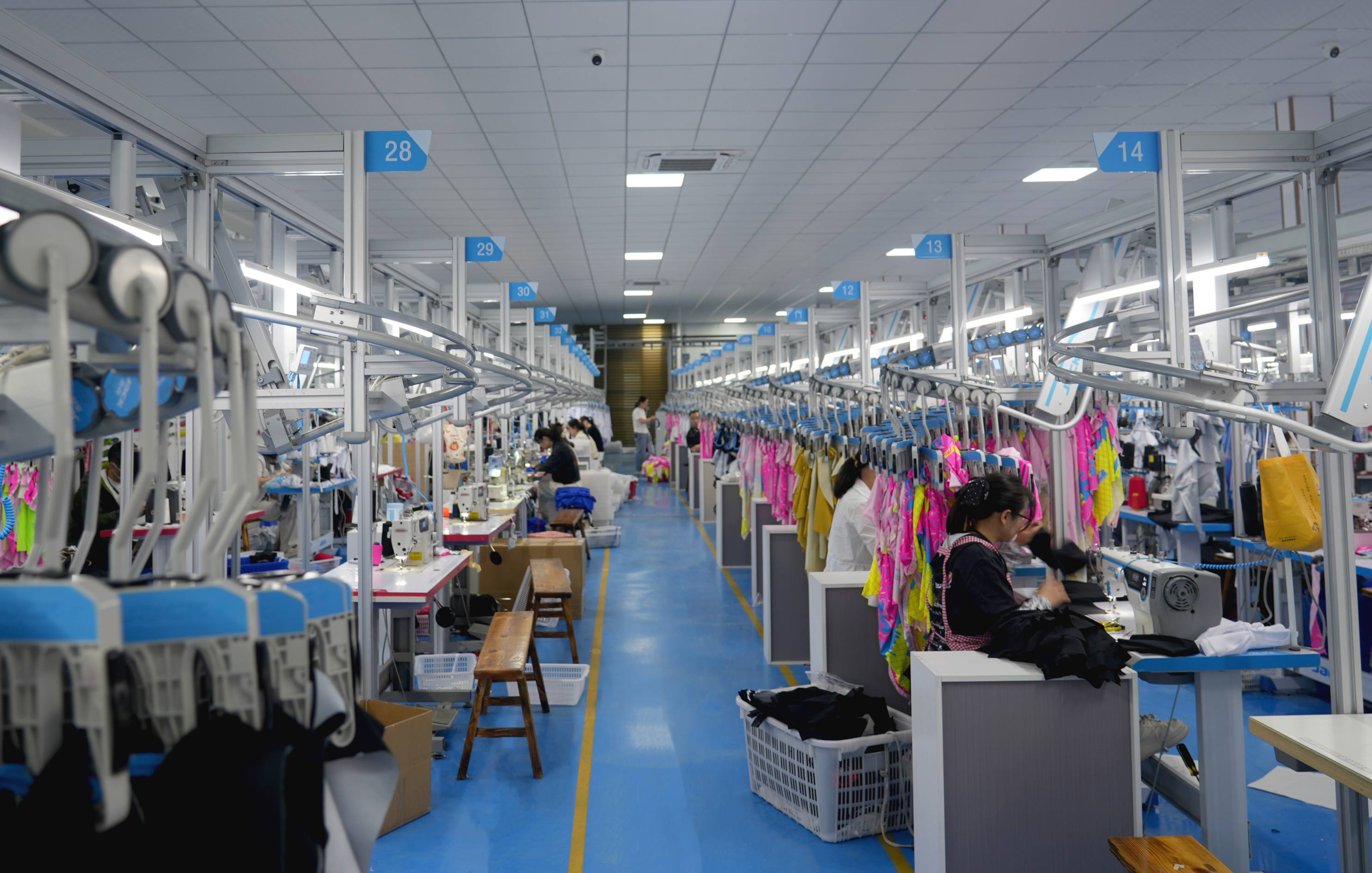

I get the same email at least once a month. A brand founder finds a swimwear factory, likes the fabric photos, sends over a period swimwear inquiry, and writes something like: "Can you just add a liner to your regular bikini?" That tells me right away they haven't sourced period swimwear before — and it's not a knock on them, because most swimwear factories genuinely can't answer it either. They've never had to build a core that holds fluid without swelling in pool water. The second common mistake is the opposite: a buyer asks all the right absorbency questions but assumes "leak-proof" means the same thing here as on dryland period underwear, when a wet garment is a different engineering problem entirely.
So let me say the thing plainly, up front: period swimwear manufacturing is a genuinely different technical problem from regular swimwear or from dryland period underwear, because the absorbent core has to work while fully submerged without swelling, bagging, or losing its seal — and if your manufacturer can't walk you through how they solve that, they're not really a period swimwear factory yet, they're a swimwear factory that added a pad.
I've spent eleven years running Shenzhen Ljvogues Sports Fashion Limited, and period swimwear is where I see the most costly buyer mistakes — not from carelessness, but because almost nobody explains what questions actually matter before you commit to a MOQ. Here are the five I'd ask if I were sitting on your side of the table.

Question 1: What's Actually in the Fabric Layers?
A period swimsuit that works is not one fabric with a pad sewn in — it's a four-layer system where each layer does one job, and if any layer is missing or substituted, the whole thing fails in the water, not on a lab bench.
On our line, that system looks like this:
Layer 1 — the wicking layer. A fine-fiber mesh against the skin that pulls fluid away rather than letting it sit on the surface.
Layer 2 — the antimicrobial fluid-path layer. Treated with either a silver-ion or a charcoal-infused finish for odor control. Not every antimicrobial treatment is silver-ion — some runs use charcoal-infused fabric instead, and your manufacturer should tell you which one is actually in your order, not just say "antimicrobial" and leave it vague.
Layer 3 — the high-density absorbent core. This is the layer that makes or breaks period swimwear. It's compressed microfiber, engineered specifically so it does not swell when it absorbs pool or lake water — the core engineering challenge unique to this category, which I'll come back to below.
Layer 4 — the DWR-coated TPU barrier. A Durable Water Repellent-treated, breathable TPU layer that blocks water from getting in while sealing fluid in. It only works if it's actually breathable — a fully sealed barrier with no airflow just turns the garment into a sauna.
If a factory can't describe these four layers separately, in this order, they're probably not running a real period swimwear line — they're modifying a swim liner and hoping it holds.
Question 2: What Absorbency Level Do I Actually Need, and How Is It Determined?
Absorbency in period swimwear is sold in tiers — light, medium, heavy — and the honest answer is that these tiers are the manufacturer's own stated capacity, not something with a universal lab standard behind it, so you need to ask what "15ml" actually means before you build a size run around it.
We market three tiers: Light (15ml), Medium (25ml), and Heavy (35ml), matched to typical flow needs across a swim session. Here's where I want to be straight with you rather than let a nice-sounding number do the selling: our page uses the phrase "verified absorbency," but there's no named lab, no ISO or ASTM test standard, and no visible certificate number attached to that figure. That means the 15/25/35ml numbers are our own stated tiers based on internal testing, not an independently certified rating. If absorbency capacity is critical to your product claims — and for period care, it usually is — ask for the actual test methodology behind the number, not just the number. Ask what "15ml" was measured against, under what conditions, and whether any third party has reviewed that data. If they can't answer, that tells you something too.
Question 3: Does the Silhouette I Want Actually Support My Absorbency Need?
Coverage area is a physical constraint on absorbent core size, not a style preference — you cannot put a 35ml core into a thong or a cheeky brief without it becoming bulky, visible, and uncomfortable, so the cut you choose is already deciding your absorbency ceiling whether you've thought about it that way or not.
I get requests every year for a heavy-flow thong, and I have to tell buyers the same thing: the fabric footprint on a thong or a minimal cheeky brief simply doesn't have room for a high-capacity core without turning into a diaper. More coverage means more room for the core without bulk; less coverage means the core has to stay thin, which caps how much it can absorb. Here's how it breaks down on our Fit & Size Matrix:
Silhouette Category | Recommended Absorbency | Typical MOQ Range |
Minimal coverage (cheeky brief, Brazilian brief, thong) | 15ml only | 500–800 pcs/style/color |
Mid coverage (classic bikini brief, hipster, racing brief, swim shorts/skirt with built-in liner) | 15–25ml | 200–300 pcs test order |
Full coverage (high-waist bikini, boyshort, short-leg training brief, one-piece with built-in liner) | 25–35ml | 500–600 pcs/style/color |
If a manufacturer takes an order for a heavy-flow thong without pushing back on this trade-off, treat that as a warning sign, not a selling point. A factory that actually understands the construction will tell you when your spec sheet asks for something the physics won't support well — not just quote whatever you send them.
Question 4: What's the MOQ and Lead Time for My Specific Silhouette?
There is no single MOQ number for "period swimwear" — it changes by silhouette, and any manufacturer who quotes you one flat figure across your whole line hasn't actually looked at what you're asking for.
On our end, a sample or prototype typically takes 7–14 days regardless of style. From there it splits by silhouette: test orders on a high-waist bikini or Brazilian brief run 200–300 pieces, standard MOQ on a cheeky brief runs 500–800 pieces per style/color, and a one-piece with a built-in liner sits around 500–600 pieces per style/color. Bulk lead time after PPS (pre-production sample) approval runs 30–45 days. It's useful to know going in, so you plan your first order and cash flow around your actual silhouette mix, not a rounded-off average.
Question 5: What Can Actually Be Verified vs. What's Manufacturer-Claimed?
This is the question that matters most, because a branded technology name or the word "verified" on a spec sheet is not the same thing as a third-party test report, and knowing the difference is what separates a buyer who gets burned from one who doesn't.
Let me walk through our own claims honestly, category by category, because I'd rather you hear the distinctions from me than find out after your product is on a shelf.
UPF 50+ sun protection and chlorine/saltwater colorfastness — the one area with formal third-party lab reports behind it. We state that we provide lab reports covering UPF 50+ sun defense and colorfastness against chlorine and saltwater, available on request. To be precise: I'm telling you the reports exist and are available to ask for, not asserting anyone's already seen the specific document — request and review the actual report before relying on the claim in your own marketing.
PFAS-free — a company-wide, production-level claim about how we run our facility, not a garment-specific certificate issued for the swimwear line itself. Meaningful, but a production standard, not a per-SKU certification.
ISO 9001, ISO 14001, REACH/SVHC compliance — company-level claims in our general compliance portfolio, not swimwear-line-specific certifications. If you need documentation tied to a specific swimwear SKU, that's a separate, more targeted ask.
GRS-certified recycled nylon — this one is swimwear-line-specific. You can request GRS-certified recycled nylon fabric for your order, a real, documentable material choice rather than a blanket company statement.
"Verified absorbency" (15/25/35ml) and "100% leak-proof" — self-reported figures, no named lab, no test standard, no certificate number visible. Ask for the methodology, not the marketing line.
Named technologies — terms like Hydro-Lock, Selective Absorption, Anti-Wave Finishing, or silver-ion antimicrobial describe real, legitimate construction choices, ours included — but a branded name is a marketing label, not proof of performance on its own. Ask what test method or data sits behind the name before repeating it in your own product copy.
4-needle 6-thread flatlock seaming — take this at face value. It's a concrete, verifiable stitch specification, not a claim needing a caveat.
If this reminds you of how a "100-wash durability test" gets described elsewhere in our own materials — as an internal factory test, not a third-party certification — that's intentional. I'd rather under-claim and tell you what to verify than let a good-sounding term do the convincing for me.

A Quick Word on Why This Isn't Dryland Period Underwear
The reason period swimwear needs its own engineering conversation, separate from period underwear, comes down to one thing: water. A core built for regular period underwear is designed to absorb and hold — it's fine if it swells a little, since it's not sitting in a pool. Submerge that same core and it swells further, gets heavy, and turns bulky fast. Period swimwear cores have to be compressed and engineered specifically to resist swelling in water while still absorbing underneath. For the full flatlock-seaming and TPU-barrier breakdown as it applies to dryland period underwear, I've covered that elsewhere.
The Checklist, Recapped
Before you send a period swimwear inquiry to any factory, ask:
What's in the fabric layers? — You want a clear answer covering the wicking layer, antimicrobial fluid-path layer, non-swelling absorbent core, and DWR-coated TPU barrier, in that order.
What absorbency level do I need, and how was it determined? — Get the tier (15/25/35ml) and ask what testing sits behind it.
Does my silhouette actually support that absorbency? — Minimal coverage caps out around 15ml; full coverage can carry 25–35ml. A factory that doesn't flag a mismatch is a red flag.
What's the MOQ and lead time for this specific silhouette? — Not a flat number across your whole line; it moves with coverage and construction.
What's actually verified vs. manufacturer-claimed? — UPF and colorfastness claims here have stated third-party lab backing on request; PFAS-free and ISO/REACH are company-level; GRS recycled nylon is swimwear-specific and requestable; absorbency figures and "100% leak-proof" are self-reported until you ask for and see the methodology.
Question 5 is the one to never skip, even in a hurry to place a PO. A manufacturer who's straightforward about what's tested by a third party, what's an internal claim, and what's a branded name for a real construction choice is one you can build a long-term supply chain with.
If you're working on a period swimwear line and want to talk through your specific silhouette and absorbency requirements, reach out — we're happy to walk through a quote and get a sample into your hands. WhatsApp us at +86-199-2880-2613 or email info@ljvogues.com.
— Ocean Yang, CEO, Shenzhen Ljvogues Sports Fashion Limited