



Ljvogues has received Global Organic Textile Standard (GOTS) certification, License Number GOTS-BVCN9928, issued by Bureau Veritas Consumer Products Services on September 4, 2026. In plain terms: we now have an independently audited, verifiable credential covering organic cotton apparel produced under our brand, trading, and manufacturing processes — not a claim we're making about ourselves, but a certification a third party checked and signed off on.
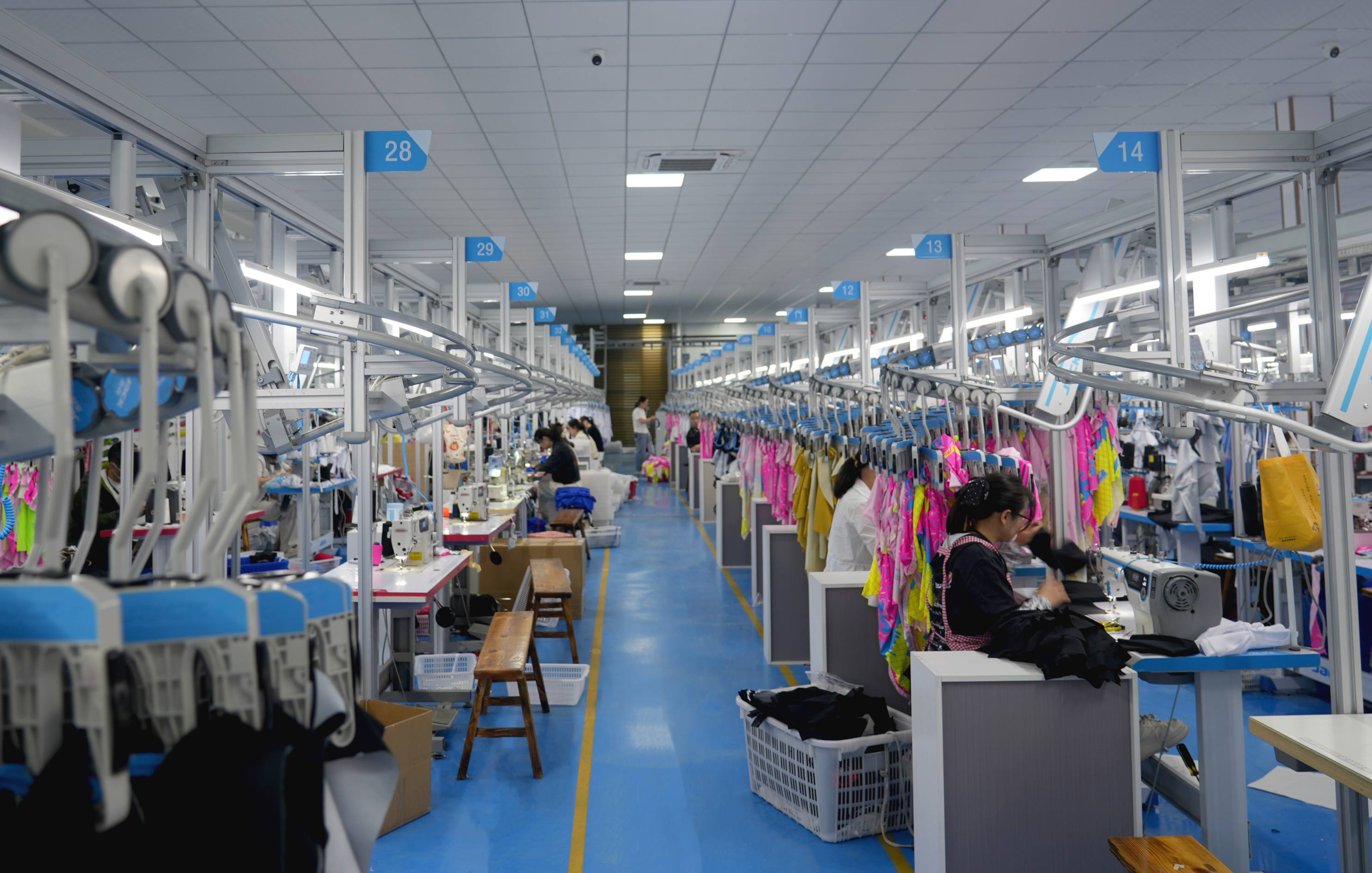
I've been running this factory for eleven years. In that time I've watched "organic" and "sustainable" get used on packaging with basically nothing behind them. GOTS is one of the few labels in this industry where that's not possible — you don't get the certificate by writing a nice paragraph about your values. Someone from an accredited body has to come in, look at your actual paperwork, your actual materials, your actual process categories, and sign a document that says yes, this checks out. That's the certificate we just got, and I want to walk through why we went after it and what it does and doesn't cover.
Why We Went for GOTS Certification
The short version: more buyers are asking for organic cotton options, and we didn't want to keep saying "let us check" every time.
Over the past year or so, the question started showing up more often in buyer conversations — not as a one-off request, but as a recurring theme. Brands wanted to know if we could do organic cotton versions of intimate apparel, not just the synthetic blends we've built most of our production around. Some of it is coming from consumer demand for sustainable fabrics, some of it is brands trying to differentiate on materials, some of it is just where the intimate apparel category is heading in the US and European markets generally. I'm not going to pretend I have a precise breakdown of why — I don't run consumer research, I run a factory — but the pattern was clear enough that ignoring it would have been the wrong call.
Here's the thing about organic cotton sourcing: you can't fake your way into it. Unlike a marketing claim, GOTS requires the organic status of the raw material to be verifiable all the way back, and it requires the processing steps after that to meet defined environmental and chemical standards. If a buyer asks "can you do organic cotton" and you say yes without any certification behind it, you're asking them to take your word for a claim that's specifically designed to require proof. I didn't want to be in that position. So instead of promising something we couldn't back up, we went through the audit and got the paperwork that lets us actually answer that question with a certificate number instead of a sentence.
This wasn't a fast or simple process. GOTS certification isn't something you apply for and receive — it requires your organic material sourcing, your process categories, and your facility to all be reviewed and found in conformity by an accredited certification body. That takes real documentation and real verification, not a form.
What GOTS Actually Requires
GOTS certification audits four things together — organic fiber content, environmental processing standards, chemical restrictions, and social compliance — not just one of them in isolation.
If you've dealt with textile certifications before, you know most of them focus on a single narrow question. GOTS doesn't work that way. To get certified, an organization has to demonstrate:
Organic fiber origin and traceability. The raw material — in our case, organic cotton — has to be verifiably organic from the field forward, tracked through every stage it passes through.
Environmental criteria in processing. Wet processing, dyeing, and finishing steps are held to defined environmental standards, including restrictions on the chemical inputs used.
Restricted substance lists. GOTS maintains its own criteria for which chemicals and inputs are prohibited or restricted at each processing stage, separate from and in addition to general textile chemical regulations.
Social compliance. GOTS includes criteria for labor practices at certified facilities, tied to internationally recognized labor standards.
That combination is what makes GOTS different from most of the certifications floating around this industry. It's not testing a finished product for residues after the fact — it's certifying that the organization's processes, from raw material sourcing through to the labeled product, meet the standard at every step in between.
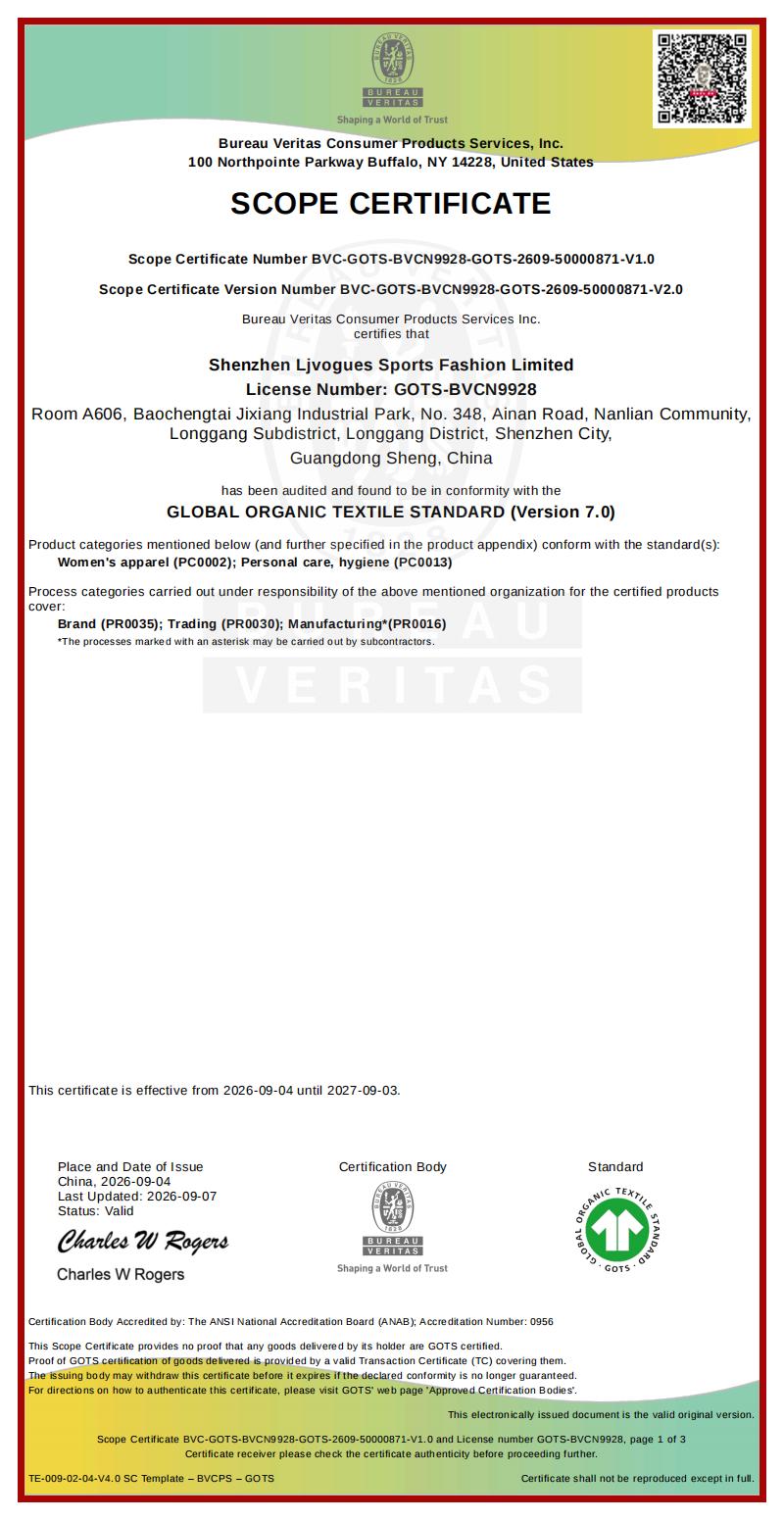
Our certificate is specific about what was reviewed. Bureau Veritas Consumer Products Services, Inc. audited Shenzhen Ljvogues Sports Fashion Limited and found us in conformity with the Global Organic Textile Standard, Version 7.0. The certification covers our organization's Brand, Trading, and Manufacturing process categories, and it was issued in China on September 4, 2026, effective through September 3, 2027. Bureau Veritas is accredited by the ANSI National Accreditation Board (ANAB) under Accreditation Number 0956 — meaning the body that audited us is itself subject to independent oversight, which is part of what makes a GOTS scope certificate worth something rather than being a paid stamp.
Key Facts on This Certification
Detail | Information |
Certificate holder | Shenzhen Ljvogues Sports Fashion Limited |
Standard | Global Organic Textile Standard (GOTS), Version 7.0 |
License Number | GOTS-BVCN9928 |
Scope Certificate Number | BVC-GOTS-BVCN9928-GOTS-2609-50000871-V1.0 |
Certification body | Bureau Veritas Consumer Products Services, Inc. |
Accreditation | ANSI National Accreditation Board (ANAB), Accreditation No. 0956 |
Place and date of issue | China, September 4, 2026 |
Valid | September 4, 2026 – September 3, 2027 |
Label Grade | GOTS (Organic) |
Anyone can and should verify certification claims like this directly rather than taking a supplier's word for it — GOTS publishes guidance on its site for authenticating a certification body's scope certificates, and I'd encourage any buyer to use it before treating a supplier's GOTS claim as settled.
What This Certification Covers — And What It Doesn't
This certification applies to organic-cotton-based products within our women's apparel and personal care categories, most directly our reusable period underwear development — it is not a blanket claim that every product we manufacture is GOTS certified.
I want to be straightforward about scope here, because vague certification language is exactly the kind of thing that erodes trust in this space. Our GOTS certificate covers product categories built on 100% organic cotton, under the GOTS (Organic) label grade. This is the direction we're developing for reusable period underwear made from organic cotton — a category where buyer interest in organic materials has been the most consistent.
It does not mean every style, every fabric blend, or every product line coming out of our factory is GOTS certified. A lot of what we manufacture, including some of our established period underwear constructions, uses performance fabric blends that were never intended to carry an organic cotton certification in the first place — different materials serve different purposes, and blended technical fabrics and organic cotton certification are simply not the same conversation. If a buyer wants a specific style certified under our GOTS scope, that's a conversation to have directly, style by style, rather than an assumption to make from a general announcement like this one.
I'd rather tell you the honest boundaries of what we have than let you assume more than the certificate actually says.
How GOTS Is Different From OEKO-TEX (And Why We Hold Both)
GOTS and OEKO-TEX Standard 100 test different things and answer different questions — one is not a replacement for the other.
We announced our OEKO-TEX Standard 100 Product Class I certification earlier this year, covering our period underwear fabrics under Certificate No. 26.HCN.12213, issued by Hohenstein Laboratories in Germany and valid through July 31, 2027. People sometimes ask whether that certification and this new GOTS certification cover the same ground. They don't, and it's worth being clear on the distinction:
OEKO-TEX Standard 100 tests the finished product and its components for harmful substances against defined limits — it's a residue and safety test performed by an accredited lab on what comes off the line.
GOTS certifies the organic status of the raw fiber, the environmental standards of the processing steps, chemical restrictions throughout manufacturing, and social compliance at the facility — it's a standard applied to the material's origin and the whole production chain, not just a test of the end product.
A product can meet OEKO-TEX Standard 100 without any organic fiber content at all — a polyester or nylon-blend garment can pass an OEKO-TEX substance test just fine. GOTS, by contrast, has nothing to say about heavy metal or formaldehyde residue limits on a synthetic garment; its entire premise starts with organic fiber. These aren't competing certifications, and one doesn't make the other redundant. A supplier holding only one of the two is answering only half of a serious sourcing question. Holding both, on the categories where each applies, means we can speak to material safety and organic sourcing without asking a buyer to just trust us on the parts we don't have paperwork for.
What This Means If You're Evaluating Us as a Supplier
A GOTS certificate is a documented signal that a factory can manage organic cotton sourcing and processing to an audited standard — it's one data point for supplier evaluation, not a guarantee that covers a supplier's entire catalog.
If you're a brand looking at organic cotton or broader sustainable-materials development for intimate apparel, here's what I'd actually tell you to take from this, without oversell:
It's evidence of capability, not a blank check. This certificate tells you Ljvogues has been through the organic material traceability and processing audit GOTS requires, and passed. That's a real, checkable fact you can weigh when comparing suppliers who claim organic capability without anything behind it. It is not a claim that any product we make, regardless of material, is automatically GOTS compliant.
Ask for the scope, not just the logo. Same advice I'd give about any certification: don't take "we're GOTS certified" at face value. Ask which product categories and process categories are actually in scope, and check the certificate number yourself. We're not precious about this — it's a two-minute conversation, and it's the same standard I hold when I'm evaluating fabric suppliers on our own end.
This is a starting point for organic-cotton development conversations, not a finished catalog. If organic cotton reusable period underwear is a direction you're exploring for your brand, this certification means that conversation with us starts from an audited base rather than from zero. Where the specific product ends up — fabric weight, construction, styling — is still a development conversation, not something this certificate answers on its own.
FAQ
What's the difference between GOTS and OEKO-TEX certification?
OEKO-TEX Standard 100 tests a finished product and its components in a lab for harmful substance residues, regardless of whether the fiber is organic. GOTS certifies the organic origin of the raw fiber plus environmental, chemical, and social compliance standards through the whole production process. They answer different questions and aren't interchangeable.
Which products does this GOTS certification cover?
The certificate covers organic-cotton-based categories in women's apparel and personal care under the GOTS (Organic) label grade, most directly our organic cotton reusable period underwear development. It does not extend to our non-organic fabric constructions. We're open to discussing scope expansion to other product lines as buyer demand for organic materials develops — that's a conversation, not a current guarantee.
Who issued the certificate and how can I verify it?
Bureau Veritas Consumer Products Services, Inc. issued the certificate, and Bureau Veritas is accredited by the ANSI National Accreditation Board (ANAB), Accreditation Number 0956. The Scope Certificate Number is BVC-GOTS-BVCN9928-GOTS-2609-50000871-V1.0 and the License Number is GOTS-BVCN9928. GOTS publishes guidance for authenticating certification bodies and their scope certificates directly on its website — I'd recommend any buyer use it rather than relying on our word alone.
Does GOTS certification mean my whole order will be organic cotton?
No — GOTS certification applies to specific product and process categories defined in the scope certificate, tied to organic cotton material composition. If your order isn't built on the certified organic cotton categories, GOTS status doesn't automatically apply to it. Talk to us directly about what you're sourcing and we'll tell you plainly whether it falls inside or outside current scope.
How long is this certification valid?
The certificate is effective from September 4, 2026 through September 3, 2027. Like most serious textile certifications, it isn't permanent — it reflects a specific audited period, not a one-time achievement to reference indefinitely.
If you're developing an organic cotton product line, or just want to see the certificate and ask questions about scope before you take our word for anything, reach out directly.
— Ocean Yang
Founder & CEO, Shenzhen Ljvogues Sports Fashion Limited
Email: info@ljvogues.com
WhatsApp: +86-199-2880-2613
Website: ljvogues.com