




Compare period underwear absorbency levels only after fixing the same test basis: sample size, preconditioning, liquid application, endpoint, wash state, and reporting unit. A milliliter number is useful, but it is not the whole decision; leakage endpoint, moisture handling, fit, and claim substantiation determine whether a sample is ready for sourcing, QA approval, or retail claim review.
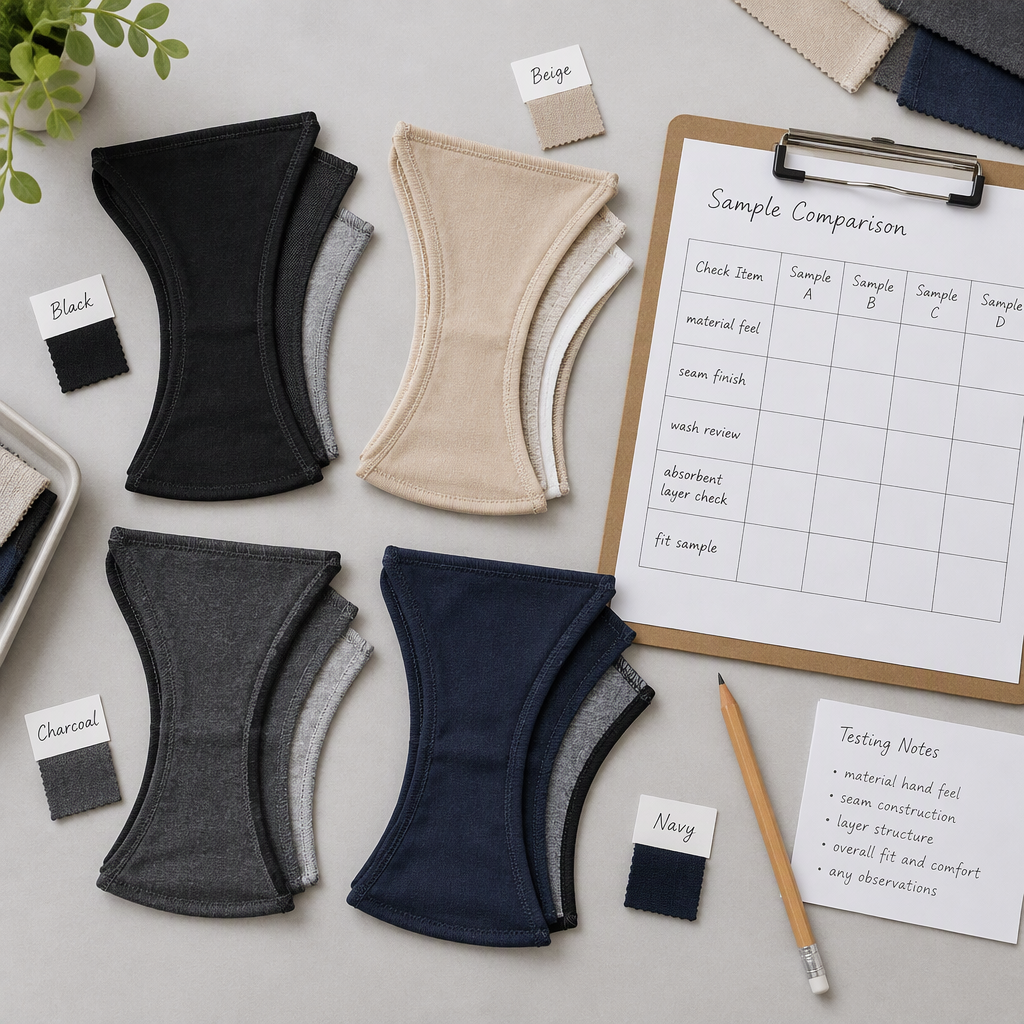
What absorbency levels really mean in period underwear
For sourcing and product development, an absorbency level should mean the measured absorption capacity of a defined sample under a stated method and endpoint, not a loose marketing tier such as light, regular, or heavy.
Hohenstein’s period-underwear quality-label page states that its label criteria include absorbency according to FEMTECHMAS-6513-1:2023 and frames the method around maximum absorption capacity before leakage for reusable absorbent underwear suitable for menstruation and urinary incontinence.
Bureau Veritas describes absorbency testing for period and leakproof underwear as a way to verify and substantiate product performance claims, including absorbency and related physical or performance characteristics.
That means buyers should treat “period underwear absorbency levels” as documented performance ranges tied to a protocol, sample condition, and claim boundary. If two samples use different endpoints or different pre-wash conditions, their numbers should not be ranked as if they were directly comparable.
How to compare absorbency across product samples
Compare samples by running the same documented procedure on equivalent sizes and states, then record capacity, leakage endpoint, visible wetness, fit condition, and wash history in one comparison sheet.
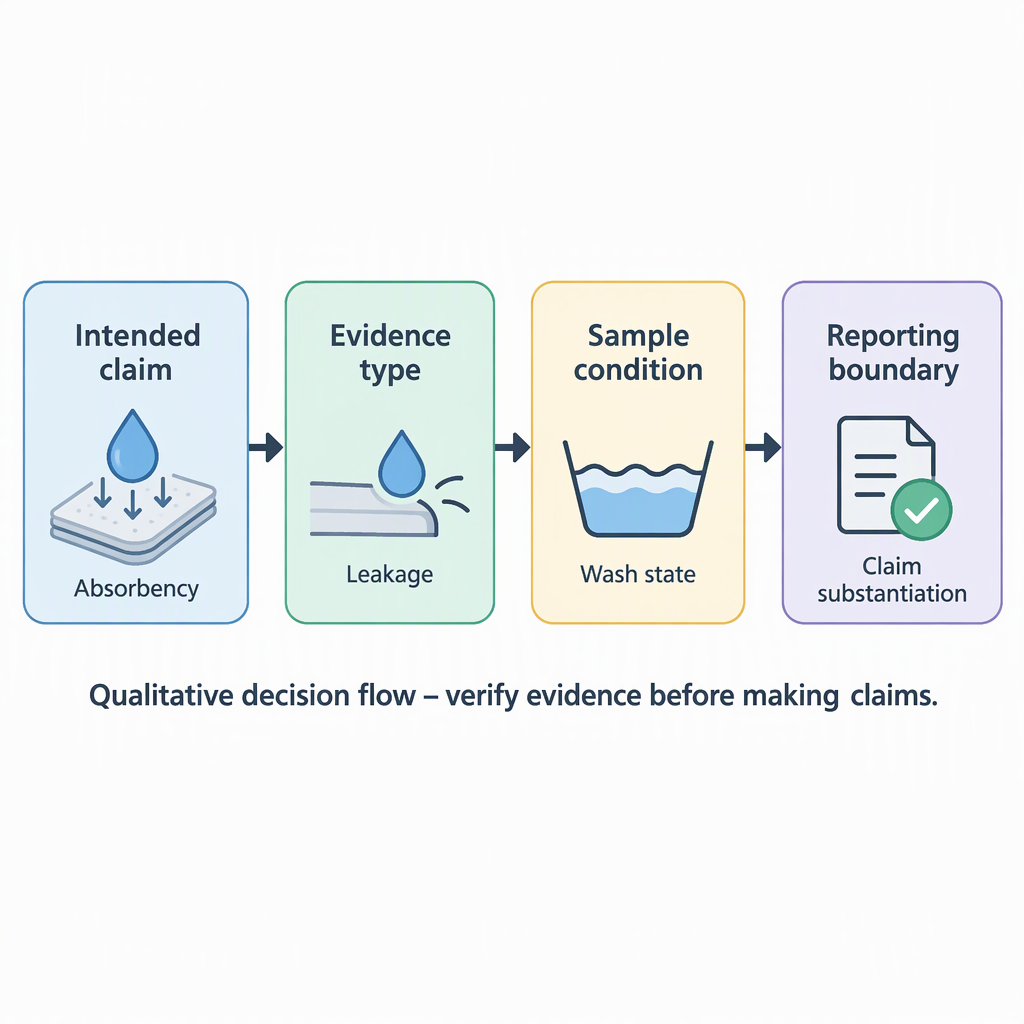
- Define the intended claim first. Decide whether the sample is being compared for absorbency, leakproof positioning, quick-dry comfort, breathability, PFAS-related requirements, or a combined retail claim.
- Fix the endpoint. Record whether the comparison stops at first leakage, maximum absorption before leakage, or another documented endpoint. Do not mix endpoints in the same ranking.
- Use equivalent sample conditions. Compare the same garment size or size grade, the same preconditioning, and the same wash state. A new sample and a washed sample may support different development decisions.
- Report observations beyond the number. Note pooling, run-off, wet-back feel, edge leakage, gusset coverage, and fit-related movement where the chosen protocol or inspection plan records them.
- Separate development notes from consumer claims. Internal sample rankings can be exploratory, but objective outward-facing claims need a reasonable substantiation basis before use in advertising or retail materials.
Choose the test basis before you compare numbers
Before accepting an absorbency number, ask what method produced it, what claim it is meant to support, and whether the report covers the exact sample state you are buying.
| Buyer question | What to request | Why it matters |
|---|---|---|
| Is the comparison about maximum absorption before leakage? | A stated method, endpoint, sample size, and capacity result. | A leakage endpoint helps prevent direct comparison between samples measured under different stopping rules. |
| Is the claim about absorbency, leakproofness, quick-dry, or breathability? | Testing aligned with the exact claim type, not a single generic absorbency figure. | Bureau Veritas identifies absorbency, physical/performance characteristics, and moisture-management testing as relevant to different performance claims. |
| Will the number appear in advertising or retail submissions? | Documentation that supports the express or implied claim before the claim is used. | The FTC advertising substantiation policy states that objective product claims should have a reasonable basis before dissemination. |
For a testing-scope example, review the Hohenstein period-underwear quality-label page; it shows how one label program frames absorbency testing. Do not treat that page as proof that any supplier or sample has that label.
For broader performance-claim context, Bureau Veritas CPS describes absorbency testing for period and leakproof underwear as part of substantiating claims.
Compare more than milliliters: leakage, comfort, fit, and wash state
Milliliter capacity helps screen samples, but it does not by itself prove that a garment is suitable for a wear scenario, body fit, movement pattern, or post-wash claim.
| Comparison factor | What it can tell you | What it cannot prove alone |
|---|---|---|
| Measured absorbency capacity | How much liquid the sample absorbed before the defined endpoint. | Whether another sample tested under a different endpoint is better. |
| Leakage endpoint | When liquid first escapes or when the selected method stops the test. | Full consumer comfort, movement performance, or breathable feel. |
| Moisture-management evidence | Support for quick-dry or breathability-related positioning where the test scope covers those claims. | Absorbency capacity unless the report also measures it. |
| Physical and performance characteristics | Information that may affect product performance claims for leakproof underwear. | Permission to make advertising claims without adequate substantiation. |
| Wash state | Whether the data reflects new, prewashed, or post-wash samples. | Long-term performance unless the wash protocol and acceptance criteria are defined. |
For buyer decisions, keep separate columns for laboratory capacity, leakage observation, fit note, fabric hand-feel note, and wash condition. This keeps the sample review useful without turning one test result into an unsupported all-purpose performance claim.
Set claim boundaries before marketing or retail submission
Quality, sourcing, and marketing teams should agree on claim wording only after the evidence matches the exact claim, product sample, and market-use context.
If the claim says “high absorbency,” the file should show absorbency evidence. If the claim says “leakproof,” the file should address leakage performance. If the claim says “quick-dry” or “breathable,” the file should include evidence relevant to moisture-management positioning.
The FTC policy statement on advertising substantiation says advertisers should have a reasonable basis before disseminating objective claims and that express or implied claims may require the amount and type of substantiation communicated to consumers.
Use that as advertising-compliance context, not as global legal advice. For market launch, align testing files, retailer requirements, and local advertising rules before approving final wording.
For U.S. advertising context, review the FTC Policy Statement Regarding Advertising Substantiation before turning sample-comparison data into objective product claims.
What to request before RFQ or sample approval
Before RFQ, request the data that lets your team compare like with like: method, endpoint, sample state, size, wash condition, claim wording, and reporting format.
- Absorbency result with the stated unit and endpoint, especially if the number is tied to maximum absorption before leakage.
- The test purpose: absorbency, leakproof performance, physical/performance characteristics, PFAS-related requirement, quick-dry, breathability, or another defined claim.
- Sample description, size, gusset coverage, fabric construction notes, and whether samples are new, prewashed, or post-wash.
- Number of samples tested and whether all compared products used the same conditioning and procedure.
- Leakage criteria or stopping rule, so that capacity figures are not ranked across incompatible endpoints.
- Claim language proposed for packaging, marketplace listings, advertising, and retailer submissions, with supporting documents matched to each objective claim.
- Any limitation that prevents direct comparison, such as different size grades, different wash histories, or different performance tests.
A clean comparison sheet is often more useful than a long sample description. It lets buyers see which samples are comparable, which need retesting, and which claims should wait until evidence is stronger.
Conclusion
The practical selection rule is simple: rank period underwear samples only when the test basis, leakage endpoint, sample condition, and claim purpose are the same.
Use milliliter capacity as one comparison field, not the whole decision. For absorbency, leakage, wash state, comfort positioning, and retail claims, ask for evidence that matches the exact product sample and intended wording before moving to approval.
FAQs about period underwear absorbency levels
These questions help brands, garment developers, QA teams, and sourcing buyers turn absorbency data into comparable sample decisions.
What does an absorbency level mean in period underwear?
It should mean measured absorbency under a stated method, endpoint, and sample condition. A label such as light or heavy is not enough for sample approval unless it is backed by comparable data.
Is a higher milliliter number always the better sample?
Not always. A higher number may indicate more absorbed liquid under a specific endpoint, but the buyer still needs leakage observation, fit context, and wash condition before choosing the sample.
Can absorbency data support a leakproof claim?
Only when the evidence addresses the leakproof claim itself. Absorbency testing can be part of the file, but the claim should match the tested performance characteristic and stated endpoint.
Should samples be tested before or after washing?
The comparison sheet should state the wash condition. New, prewashed, and post-wash samples should not be ranked together unless the protocol intentionally covers those states.
Do quick-dry or breathable claims use the same evidence as absorbency claims?
No. Bureau Veritas describes moisture-management testing as relevant to quick-dry and breathability claims, so those claims need evidence beyond a simple absorbency-capacity number.
What is the most important RFQ field for comparing absorbency samples?
The most important field is the stated test basis: method, endpoint, sample size, and condition. Without that, the absorbency number cannot be fairly compared across samples.
When can marketing use absorbency results in product copy?
Marketing should use objective absorbency or leakproof claims only when the team has a reasonable substantiation basis for the exact express or implied claim being made.