



The period underwear market has experienced rapid growth, driven largely by the success of major brands like Thinx and Modibodi. If you're developing your own brand, the challenge lies in finding a Period Underwear manufacturer that can deliver consistent quality at scale—without compromising your values. This article offers two distinct perspectives to guide your search. First, we break down the key attributes that define the best period underwear for today’s consumers. Second, we apply a rigorous business-to-business framework—covering factory audits, minimum order quantities, and certifications—to evaluate trusted manufacturers across Europe and the United States. By the end, you’ll have a clear, data-driven shortlist that helps you avoid common pitfalls such as trademark conflicts or opaque supply chains. For private-label buyers, gaining this full perspective is essential to making an informed, strategic decision.
Key Takeaways
Focus on safety certifications like OEKO-TEX Class I and independent PFAS tests to gain customers' trust.
Use a business-to-business checklist to check manufacturers. Look at factory audits, minimum order sizes, and growth ability to avoid supply chain problems.
Begin with small minimum order quantities and 72-hour sample turnaround to test the market before you commit to large-scale production.
Use AQL 2.5 checks and ISO 6330 wash tests to make sure the product is good quality and lasts long.
Pick a maker that fits where your brand is now, whether you need small order sizes or big production power.
Benchmarking the Best Period Underwear: Consumer Criteria
To sell well, your private label product must match or beat the top brands. Aisle, TomboyX, and Cora set the quality level that shoppers already know. Your period underwear must feel familiar and comfy, yet show it is safer and works better. The best period underwear earns customer trust through proven facts, not just ad talk.
Material Safety and PFAS-Free Verification
Safety starts with what touches your skin. Shoppers now want proof that products have no PFAS chemicals. These substances stay in the environment and may harm health. You need a maker who can show safety through outside tests.
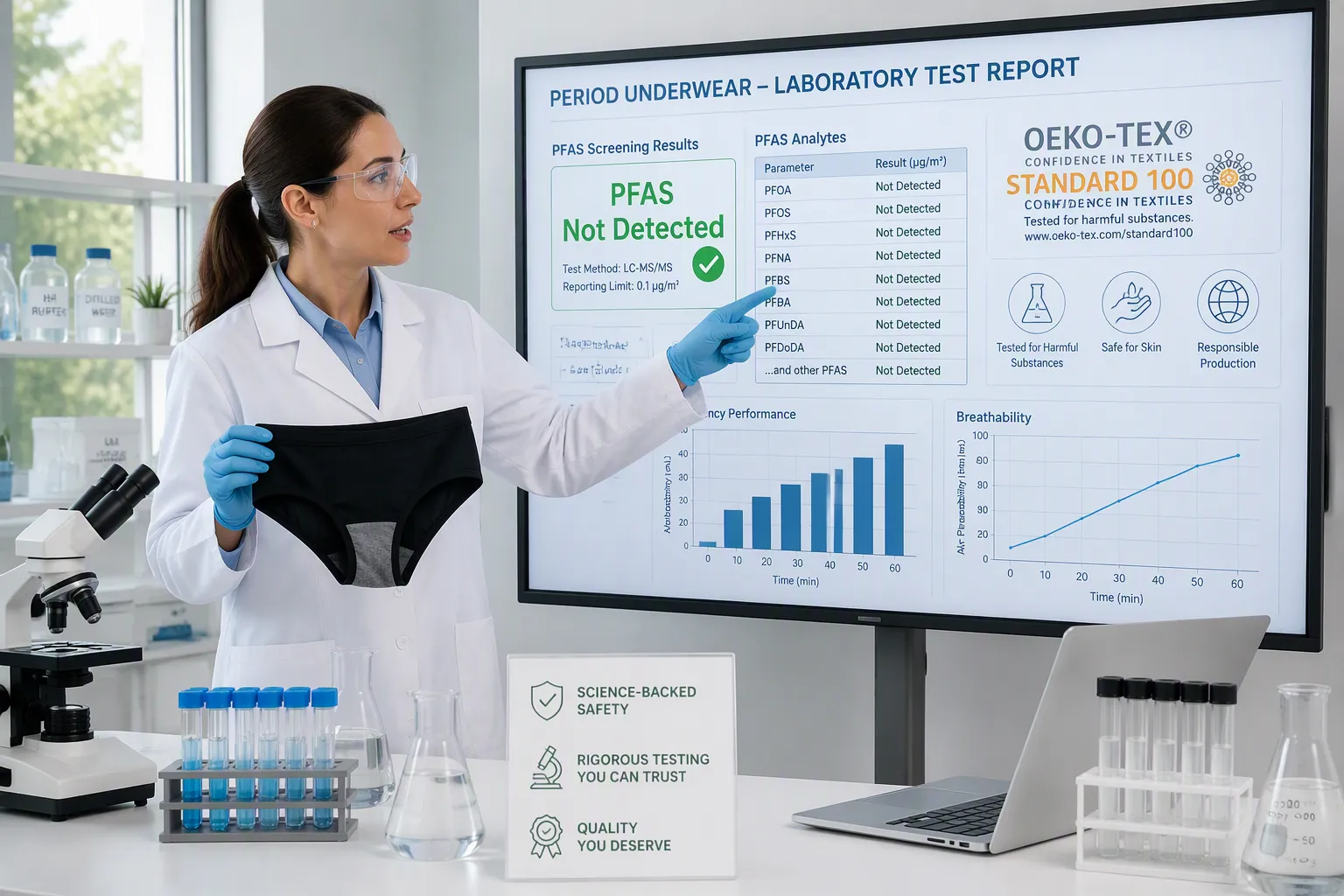
Look for textile labels that confirm material safety. The OEKO-TEX® STANDARD 100 mark, Class I, is the top safety level for items that touch sensitive skin. This label comes from Hohenstein in Germany and stays good until 2027. It proves that every part meets strict limits for harmful stuff.
PFAS checks need special tests beyond normal textile ones. A trusted maker tests the waterproof layer on its own. For example, one lab report from Eurofins looked for 45+ PFAS compounds using advanced methods. The report said "Not Detected" for all compounds, with an overall PASS result. This deep testing gives you the proof to make safety claims in your ads.
Certification or Test | What It Verifies | Key Details |
|---|---|---|
OEKO-TEX® STANDARD 100 | Textile safety, Class I | Issued by Hohenstein, valid through 2027 |
Eurofins PFAS Report | Absence of 45+ PFAS compounds | "Not Detected" for all, overall PASS |
ISO 9001:2015 | Production quality consistency | Ensures repeatable safety standards |
Comprehensive Safety Report | 12+ parameters (formaldehyde, phthalates, pH) | Overall PASS result |
Quality control systems also count. ISO 9001:2015 shows the factory keeps steady quality in every run. This repeatability means your safety rules hold for each batch, not just the first sample.
Absorbency, Comfort, and Fit Standards
Shoppers pick the best period underwear by clear absorbency levels. You must offer choices marked light, moderate, and heavy. Each level fits different flow needs and product build. Your labels and product pages should state these levels clearly.
Comfort comes from fabric feel, airflow, and seam placement. Test samples against top brands to compare softness and bend. The waterproof layer should not feel stiff or make noise when you move. Fit needs a wide range of sizes for all body types. Offer bigger sizes to grab the full market chance.
Think about how absorbency works with daily wear. A heavy-flow option needs more layers in the gusset area. A light-flow style can focus on thinness and being hidden under clothes. Your maker should help you balance these choices through fabric picks and build methods.
The wider safety report covering 12+ parameters adds more trust. This includes checks for formaldehyde, phthalates, colorfastness, and pH levels. Along with PFAS tests, these results back up your brand's safety story. You can share these facts with stores and buyers who ask hard questions.
Vetting a Period Underwear Manufacturer: The B2B Rubric
A great product means nothing if the factory that makes it can't pass checks or grow with you. Your brand's good name depends on every batch they send. So you must check the partner as carefully as you check the fabric. This section gives you a useful way to do that.
Factory Audits, Transparency, and Ethical Compliance
You need proof that your period underwear maker works in a fair and steady way. Certifications give you that proof. Look for ISO 9001 to show a strong quality management system. OEKO-TEX® checks that materials have no harmful substances. BSCI shows fair working conditions in the factory. GRS confirms recycled content claims if you sell eco-friendly products. Some makers even have ISO 13485 and CE marking. These show medical-grade quality standards. These credentials give you peace of mind about rules before you sign anything.
Transparency is more than just papers on a wall. You must check it by asking direct questions. Use this list when you talk to possible partners:
Transparency Category | Key Verification Questions |
|---|---|
Facility Access | Are they willing to allow facility visits? |
Subcontractor Disclosure | Do they disclose all production locations? |
Worker Access | Will they provide access to workers for interviews? |
Communication | How do they communicate production challenges? |
Ask for audit reports from outside groups like BSCI or SEDEX/SMETA. Ask if you can visit without notice. Talk to workers away from managers. Check payroll records and time logs. A factory that waits on any of these points shows risk. For private-label buyers, this careful check protects your brand from supply chain problems.
MOQs, Lead Times, and Scalability for Growth
Your growth stage decides which MOQ setup works best for you. Most Asian makers ask for high minimums that tie up your money. But some partners offer flexibility. Ljvogues, for example, starts at just 50 pieces per design with 72-hour sampling. That low start lets you test the market before buying a lot of inventory.
Compare how MOQs affect your timeline:
Parameter | Low-Volume Orders | Bulk Production |
|---|---|---|
MOQ Range | 500 units (standard designs with branding) | 2,000-3,000 units (fully custom designs) |
Material Sourcing | 3-4 weeks (stock materials) | 3-4 weeks (may extend to 6-8 weeks for custom) |
Production Time | 4-6 weeks (standard designs) | 4-6 weeks (may extend for complex designs) |
Total Lead Time | 12-20 weeks | 12-20 weeks (longer if custom materials required) |
Start with a small test run at lower MOQs to check if your product fits the market. When sales show demand, increase to bulk production with confidence. Pick a partner whose minimums match your cash flow now, not just your dream for next year.
Sourcing and Sampling: Your First Steps to Partnership
You have your brand idea ready. Now you need to find the right period underwear maker to make it real. Before you reach out to anyone, build a supplier scorecard. This tool helps you compare partners fairly on fabric quality, absorbency, and certifications. Add checks for fabric type, weight, stretch, and colorfastness. Include build tests for seam strength and elastic attachment. Performance checks matter too, such as how fabric changes after washing and pilling risk. A full scorecard turns vague promises into clear facts.
Navigating MOQs and Price Negotiation
Minimum order quantities often feel like the biggest hurdle for new brands. Many factories want thousands of pieces before they will talk to you. You can get better terms by focusing on the whole value package, not just unit price. Think about levers like defect rate, lead-time reliability, compliance readiness, and FBA prep. Frame your negotiation around a simple offer: "Give me 100 pieces per color, 72-hour sampling, bound compliance, and FBA prep at a fair unit, and I will commit to a reorder schedule." This approach shows you understand the full cost picture, not just the sticker price.
A trial order serves as your relationship test. Order a small batch, perhaps 200 pieces, and watch how the supplier handles samples, communication, and defects. This small investment reveals their true working style. You also can team up with other buyers to combine orders and meet higher MOQs together. Some suppliers offer mixed orders or tiered pricing to help you manage costs while you grow.
The 72-Hour Sampling Process: What to Evaluate
Once you agree on terms, request samples that match your target design closely. A fast 72-hour sampling turnaround, as offered by some manufacturers, lets you iterate quickly. Use this time wisely by checking three key areas.
First, look at the stitching. Check for even, secure seams without gaps. Test seam stress by pulling gently at the fabric. Check edges for clean finishes and loose threads. Secure elastic attachment prevents early failure.
Second, inspect the waterproof layer. Ask which barrier material the factory uses, such as PUL or TPU. Verify the barrier extends past the absorbent core, rises higher in the back, and follows the leg openings. Test leak resistance by simulating movement and pressure points. This layer decides whether your product truly stops leaks.
Third, assess the overall feel. Softness against skin matters for daily comfort. Check flexibility during movement and breathability for airflow. Consider the bulk factor under clothing. Edge comfort prevents digging or irritation during long wear.
Ask for verification documents during this phase. Confirm certification scope covers the finished garment, not just fabric rolls. Request PFAS verification that states which parts were tested, especially the barrier layer. Review report numbers and issuer validity. This transparency builds confidence before you commit to larger production runs.
Scaling Your Line: From Pilot to Full Production
Your pilot run is a great chance to fix issues before customers see them. Treat this small batch as a way to learn, not as the final item. Compare your samples with the features that top consumer lists highlight. This review shows you what to improve before you start bulk production.
Scoring Your Product Against Top Consumer Lists
Health blogs and magazines put out yearly rankings of the best period underwear. These lists share common points that you can turn into a scorecard. Material safety comes first. Reviewers look for certified, skin-safe fabrics with outside checks like OEKO-TEX Class I. Your product needs the same proof.
Prioritized Feature | Concrete Standard for Your Pilot Run |
|---|---|
Material safety | Certified, skin-safe, third-party verified (e.g., OEKO-TEX Class I) |
Absorbency clarity | Clear tiers (light/moderate/heavy) with measurable capacity (e.g., 20–45 ml, 50–100 ml) |
Transparency | Disclosure of manufacturing location, factory identity, and working conditions |
Comfort and fit | Size inclusivity (e.g., 2XS–6XL), soft fabric, flat seams to avoid visible panty lines |
Trust signals | Return policy, customer service responsiveness, verifiable proof of performance claims |
Rate each sample with honesty against these rows. Does your absorbency label match how it really works? Can you back up your capacity claims with lab data? Do your sizes cover the full range reviewers expect? A low score on any row means you need a fix before launch. You want your product on those lists someday, not missing their marks.
The PR Angle: Earning Media Mentions Through Quality
Quality certifications become your press release gold. Journalists who cover period underwear look for claims they can prove to protect their readers. Your PFAS-free check from an independent lab gives them a solid fact to quote. Your OEKO-TEX Class I certification adds another reliable detail.
Build a media kit around these credentials. Add your test reports, your factory audit summaries, and your sustainability promises. Explain what makes your manufacturing process different. Editors get hundreds of pitches every day. A brand with documented safety proof stands out from vague marketing talk.
Send samples to reviewers who focus on feminine care products. Add a one-page fact sheet that lists your certifications and test results. Offer to connect them with your factory for interviews. This openness builds trust with editors. When your product earns a spot on a top list, that link brings traffic and proves your brand. One strong review can beat months of paid ads.
Quality Assurance: Protecting Your Brand Reputation
Quality control is a must for your brand. You need to guard your reputation starting with the very first order. The standard for period underwear is AQL 2.5. This means the overall defect rate must stay below 1.5%. A dependable partner will share this data with you. They will show they meet this standard every time.
Implementing Independent Inspections with AQL 2.5
You must review your factory's quality control process. The industry benchmark is AQL 2.5. This standard sets the limit for major defects during final checks. It also requires an overall defect rate below 1.5%.
When you evaluate a period underwear manufacturer, the industry-standard quality control benchmark is AQL 2.5 plus an overall defect rate below 1.5%. This means the manufacturer must prove that no more than 2.5% of sampled major defects appear during final inspection, and the total defect rate across all categories must stay under 1.5% to be seen as a reliable partner.
Independent inspectors use this standard with a clear defect classification. The table below shows the categories and their strict limits.
Defect Category | Tolerance Level | Implication for Period Underwear |
|---|---|---|
Critical defects | 0% | Any leakage risk means rejection |
Major defects | ≤2.5% | Going over this fails the AQL 2.5 inspection |
Minor defects | ≤4.0% | Lower priority but still watched |
For period underwear, the Major category covers functional failures like seam leakage or reduced absorbency. These are the main usability concerns. You must demand zero tolerance for Critical defects. Any single Critical defect in the sample rejects the whole lot.
Ensuring Durability: The 200+ Wash Test Proof via ISO 6330
Your product must handle 200+ washes. This durability is tested using ISO 6330, the home-laundry simulation standard. The test makes sure your period underwear keeps its absorbency and shape over time. Without this proof, your brand risks bad reviews tied to product failure.
The table below shows the specific pass criteria for each part after 200+ washes.
Property Tested | Test Method | Pass Criteria for 200+ Washes |
|---|---|---|
Leak-proof barrier (TPU film) | ISO 6330 repeated wash-dry cycles | Must keep hydrostatic pressure after repeated flex and heat |
Absorbent core | ISO 6330 repeated wash-dry cycles | Must keep capacity and rebound after hundreds of wet-dry cycles |
Elastic (waistband and leg openings) | ISO 6330 repeated wash-dry cycles | Must keep recovery (no sag, no wedgie) |
Odor-control finish (optional) | ISO 6330 | Must survive 50+ washes if claimed |
The care instructions you give are part of protecting this 200+ wash rating. You should suggest cold-to-warm washes. You should advise against fabric softeners and bleach. You should recommend air drying. These simple steps help your product last. They shield your brand from early failure complaints.
Navigating Market Challenges and Building Loyalty
Handling Negative Reviews and Product Recalls
Bad reviews often come from real product problems. Mamavation ran independent tests and found that some top period underwear brands have high levels of fluorine. Fluorine is a sign that PFAS chemicals may be present. This discovery upset customers and forced brands to do expensive recalls.
Brand | Fluorine Level (ppm) | Category |
|---|---|---|
Thinx Bayshort | 619 | Not Our Favorite |
Knix High Rise | 373 | Not Our Favorite |
Saalt Period Underwear | Non-detect | Best |
Aisle | Non-detect | Best |
Modibodi | Non-detect | Best |
Brands that showed no PFAS in testing stayed out of trouble. Your strong QA process, like the AQL 2.5 standard from earlier, stops these risks. When you check material safety before making products, you remove the chance of a recall before it starts.
Other common complaints include sizes that differ between brands, leaks on heavy days, and the trouble of special washing steps. Each issue can cause bad reviews that hurt your brand. A strong QA process fixes these problems before customers see them. You test absorbency claims in real situations. You make sizes consistent across the range. You confirm that care instructions match how long the product truly lasts.
Market-wide issues also slow adoption. Period underwear costs more at first, which scares off new buyers. Many people do not know enough about it and doubt it works. Cultural shame around periods limits open talk in some places. A strong QA process helps you beat these barriers by making a product that works every time, builds trust, and earns good word-of-mouth.
Lifecycle Management: From First Purchase to Repeat Customer
Steady quality drives customer loyalty. A product that lasts through 200+ washes means fewer replacements, fewer complaints, and more repeat orders. These benefits grow over time, creating a customer base that believes in your brand.
A cheaper factory might save you 10 cents on production, but cost you a $30 customer forever. Don't let poor craftsmanship ruin your brand reputation.
Being open about how you make products builds this trust. When customers know your factory follows strict rules, they feel safe buying again. The same verified base that earns first-time attention drives reorders and repeat buys. Your brand becomes known for dependability, not just ads.
Quality is part of every production step, not just the final check. Standard sewing steps and quality checks ensure steady manufacturing in every batch. Building this care into every stitch helps your brand deliver products customers trust. That trust leads to repeat purchases. A happy customer who buys a second pair costs less to win than a new customer from ads. Their recommendation to friends matters more than any paid ad.
The 2026 Shortlist: Top EU and US Manufacturers
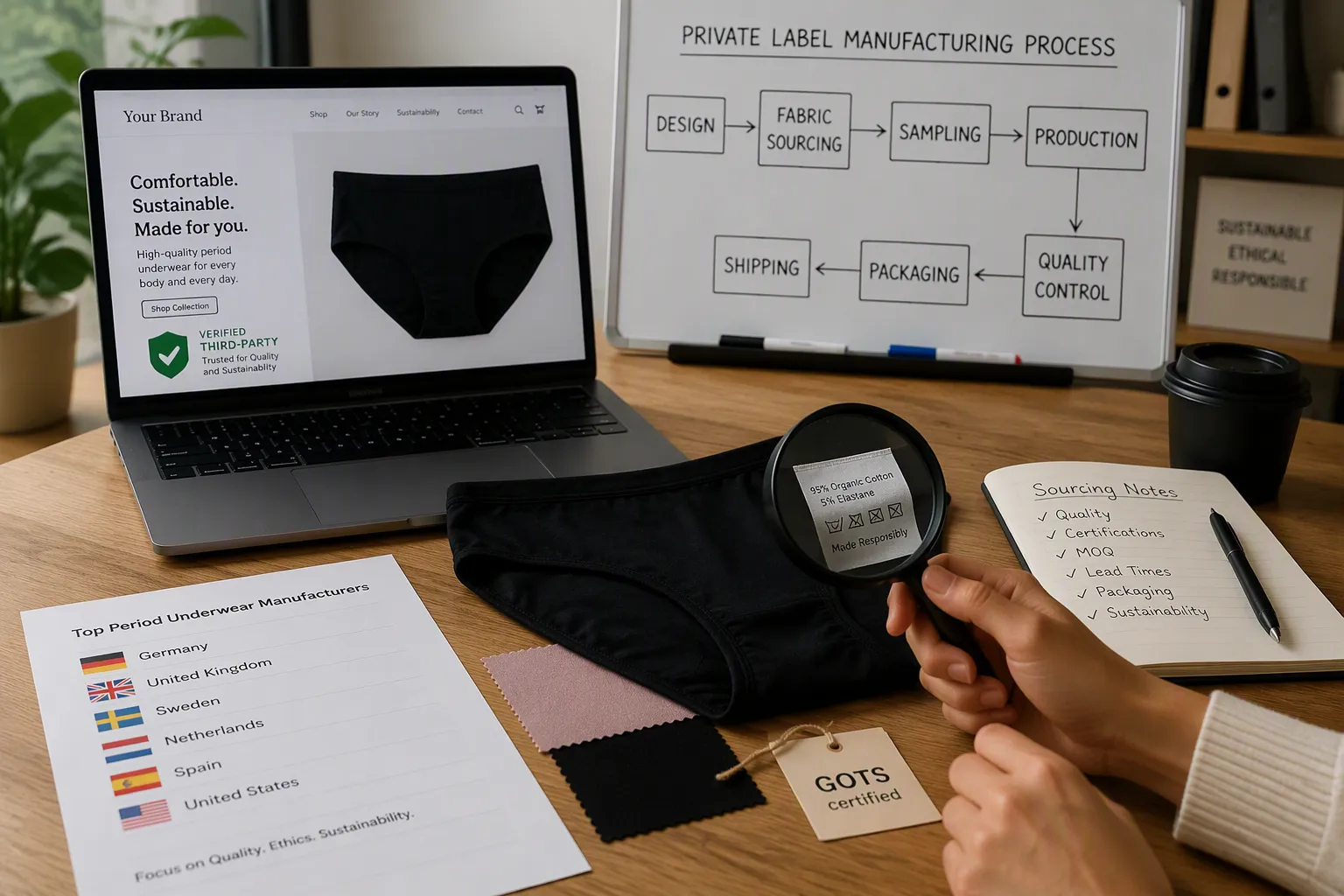
You now have a clear way to check possible partners. The next step is finding out who deserves your time. The list below shows ten manufacturers in Europe and the United States. Each one has passed third-party checks through sites like Wonnda, which verifies business credentials and production abilities. Use this list as a starting point, not your final choice. Always ask for samples and audit reports before you make a commitment.
Leading European Manufacturers for Private Label
European factories excel at sustainable materials and strict compliance standards. Their production costs run higher, but their certifications often open doors to eco-conscious retailers.
1. Femme Connection (Germany) – This manufacturer specializes in organic cotton period underwear with GOTS certification. They offer full private label services, including custom patterning and packaging design. Their MOQ starts at 300 pieces per design, with lead times around 8-10 weeks from sample approval.
2. Wuka (United Kingdom) – Wuka focuses on heavy-flow protection with high-absorbency gussets. They produce in Portugal and offer flexible MOQs starting at 200 units. Their typical lead time runs 6-8 weeks, making them a solid choice for mid-sized brands.
3. Kora (Sweden) – This factory specializes in seamless period underwear using recycled nylon. They hold GRS certification and offer MOQs from 500 pieces. Expect lead times of 10-12 weeks due to their detailed quality checks.
4. MiaBelle (Netherlands) – MiaBelle focuses on inclusive sizing, producing sizes from XS to 4XL. Their MOQ starts at 250 pieces per colorway. They offer 6-week production cycles and provide FBA-ready packaging for Amazon sellers.
5. LunaTextiles (Spain) – This manufacturer produces bamboo-blend period underwear with natural antimicrobial properties. Their MOQ begins at 400 units, and they offer 7-9 week lead times. They excel at custom dye work and sustainable packaging options.
Leading American Manufacturers for Private Label
US-based manufacturers offer faster shipping and easier communication. You avoid overseas logistics and gain simpler quality control oversight.
1. Proof (United States) – Proof operates a dedicated private label division. They specialize in cotton-modal blends with silver-infused odor control. Their MOQ starts at 500 pieces, with lead times around 6-8 weeks.
2. Knix (United States) – Knix offers private label production through their Toronto facility. They focus on leakproof technology with multi-layer gussets. Their MOQ begins at 1,000 units, making them better suited for established brands.
3. Thinx (United States) – Thinx opened their manufacturing network to private label partners in 2025. They specialize in high-absorbency designs with recycled materials. Their MOQ starts at 2,000 pieces, and they require 12-week lead times.
4. Dear Kate (United States) – This manufacturer focuses on lightweight, everyday period underwear. They offer MOQs from 300 units and 5-7 week production cycles. Their specialty lies in seamless designs that work under activewear.
5. Period. (United States) – Period. produces organic cotton period underwear with a focus on breathability. Their MOQ starts at 400 pieces, and they offer 6-week lead times. They provide strong support for startups navigating first-time production.
A Note on Global Alternatives
For brands seeking a global partner with startup-friendly terms, Ljvogues (Shenzhen) offers a viable alternative. They hold the same certifications as EU and US factories, including ISO 9001 and OEKO-TEX Standard 100. Their MOQ starts at just 50 pieces, and they deliver samples within 72 hours. This flexibility suits brands testing new markets without large inventory commitments. Their transparency about factory audits and material sourcing matches Western standards, giving you confidence in their production quality.
When you compare these options, weigh your brand's stage against each factory's requirements. A startup might prioritize low MOQs and rapid sampling. An established brand might value larger capacity and faster shipping. The best period underwear manufacturer for you depends on your specific growth plan and target market.
Choosing a period underwear manufacturer shapes your brand's future. You must weigh product safety and comfort alongside operational strengths like compliance and scalability. No single partner fits every brand. A startup benefits from low minimums, such as Ljvogues' 50-piece start. An established company might need a factory's larger capacity instead.
Use this rubric and shortlist as your due diligence starting point. Visit facilities, request audits, and test samples thoroughly. Demand transparency about materials and processes. The right partner helps you compete with market leaders. Your careful evaluation today builds customer trust tomorrow.
FAQ
What is the lowest MOQ I can expect from a period underwear manufacturer?
Most factories ask for 500 to 2,000 pieces per design. Ljvogues is different, with a 50-piece minimum. This low start lets you test your product idea without spending too much money. You can check demand first, then grow with confidence.
How do I verify a manufacturer's PFAS-free claims?
Ask for independent lab reports that test the waterproof barrier layer. A trusted report from a lab like Eurofins should list 45+ PFAS compounds with "Not Detected" results. Check the report number and who issued it. Never accept verbal promises without written proof.
What should I evaluate during the sampling phase?
Look at three areas closely. Check stitching for even, secure seams without gaps. Test the waterproof layer's coverage and flexibility. Assess overall softness and comfort against your skin. Request samples that match your target design closely so your evaluation reflects the final product.
Should I choose a European, American, or Asian manufacturer?
Your brand's stage determines the best fit. European and American factories offer faster shipping and easier communication but require higher MOQs. Asian manufacturers like Ljvogues provide lower minimums and rapid sampling. Consider your budget, timeline, and growth plans before making this decision.