
Views: 0 Author: Ocean Yang Publish Time: 2025-12-30 Origin: Ljvogues


Table of Contents
When founders like Gregory from South Africa write to me asking about OEM/ODM leak-proof underwear, my answer is always the same: with the right manufacturing partner, you can turn a clear product idea into a reliable, scalable private label brand faster than you think. In this article, I want to share, from my own experience as CEO of Ljvogues, how we understand these pain points and how our team helps brands build menstrual and incontinence underwear that truly works in the real world.

When I read Gregory’s email, I immediately recognized the same challenges I have seen from many new brands across Europe, North America, Africa, and the Middle East. Most founders are not just “buying underwear”; they are trying to solve a sensitive problem for their customers and protect their new brand reputation at the same time.
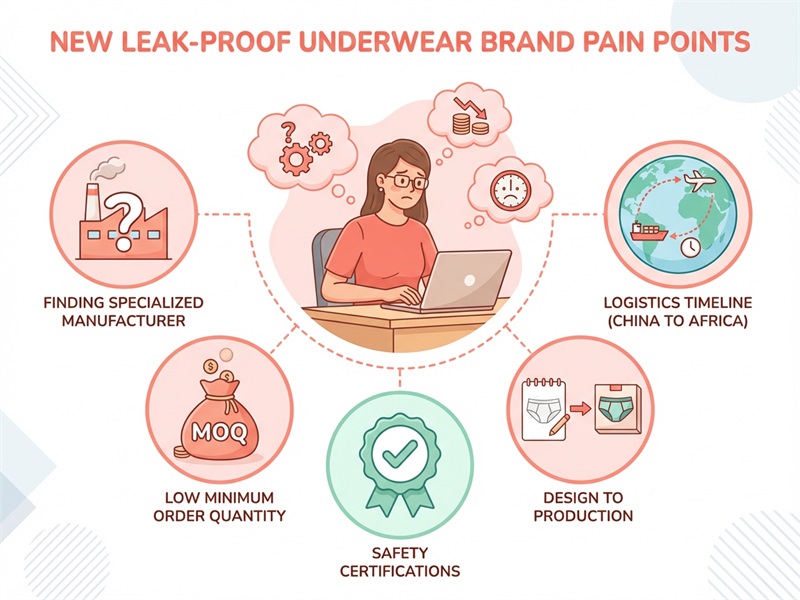
From my conversations with clients, the common pain points usually include:
Finding a specialized manufacturer that understands period and incontinence technology, not only basic lingerie.
Starting with low MOQs to test the market, yet still getting competitive pricing and professional service.
Ensuring safe, certified fabrics and leak-proof performance that can stand up to online reviews and returns.
Turning simple ideas like “cotton top layer + absorbent core + TPU” into real patterns, sizes, and production-ready tech packs
Managing timelines and shipping from China to destinations like South Africa while keeping cash flow healthy.
When I design solutions with my team at Ljvogues, I always start from these pain points, not from what is easiest for the factory.
Gregory’s requirements are very typical of serious new brands: women’s leak-proof underwear for menstruation and light incontinence; men’s underwear with a front absorbent panel; different absorbency levels; and clear preferences for cotton or bamboo, microfiber, and TPU. Over the last decade, my team and I have repeatedly turned exactly this type of brief into successful OEM and ODM product lines.
Here is how we usually break it down inside the factory:
Absorbency levels (light, medium, heavy): We adjust the number of layers and the thickness and pattern of the absorbent core, using our existing 4-layer and multi-layer structures that can reach 15–50 ml+ capacity.
Materials:
Top layer: We select OEKO-TEX® certified organic cotton, bamboo viscose, or MicroModal according to the target market’s preference for handfeel and sustainability.
Core: We engineer the microfiber absorbent area to cover the real leak zones, not just a flat rectangle.
Barrier: We use breathable TPU to lock in liquid while keeping the garment flexible and comfortable.
Size ranges: My pattern-making team works every day on extended sizes, so covering women’s XS–XXXL and men’s S–XXL is a routine task for us.
Men’s front absorbent panel: We adapt our incontinence and functional pouch structures to create targeted protection for light bladder leakage in men.
Because we already have a mature library of leak-proof and incontinence underwear designs, each new project builds on proven engineering instead of starting from zero.
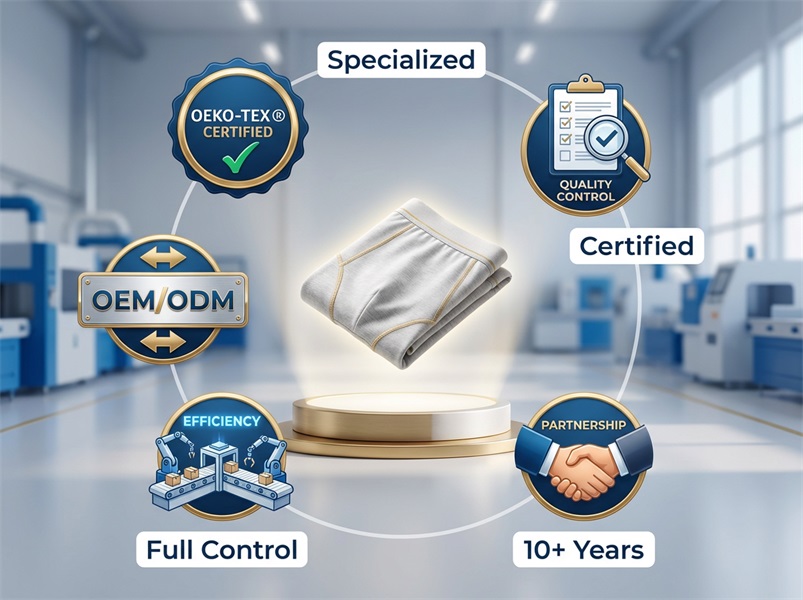
When I founded Ljvogues, I did not want to be “just another underwear factory”. I wanted us to be a specialist partner that understands menstrual, incontinence, and functional underwear as deeply as sports brands understand performance sneakers.
From my perspective, these are the key advantages we offer OEM and ODM clients:
Deep specialization: We focus on period underwear, incontinence underwear, maternity and nursing underwear, and related functional categories, not every possible garment.
OEM/ODM flexibility:
OEM: When a client sends tech packs, patterns, or reference samples, we follow them strictly and optimize for manufacturing stability.
ODM: When a client only has ideas and reference photos, we let them choose from our 100+ base leak-proof styles and customize fabrics, colors, absorbency, and branding.
Certifications and compliance: I insist on using OEKO-TEX® certified fabrics and offering GOTS, PFAS-free, and other compliance options because I know end customers care about safety and trust.
End-to-end support: From fabric sourcing to pattern making, grading, sampling, bulk production, and packaging, my team manages the entire chain under one roof.
This full-control approach has helped us support both big retail chains and fast-growing online brands with consistent quality and repeat orders.
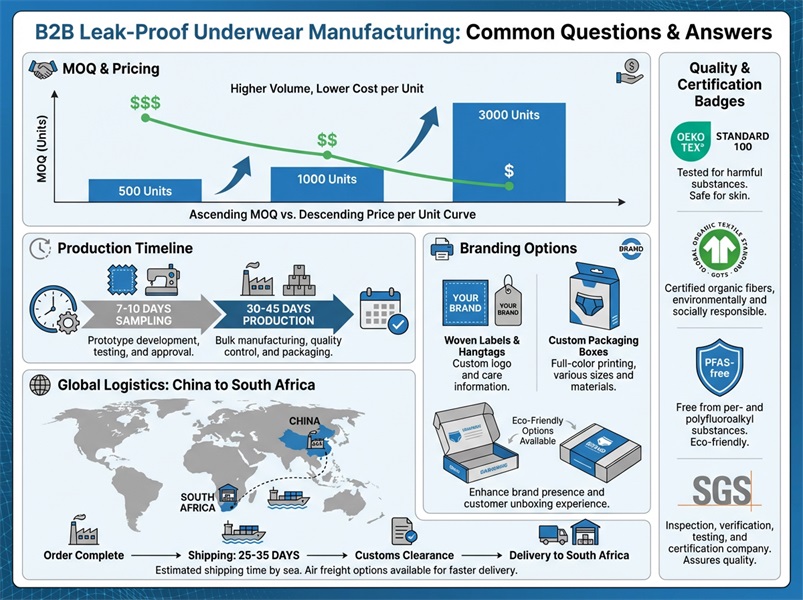
In almost every email, founders ask me the same questions that Gregory listed: MOQ per design, price for 500/1,000/3,000 units, samples, branding, certifications, and shipping. Over time, I have developed a clear way to explain these points so that new brands can make informed decisions.
In general, here is how we handle them at Ljvogues:
MOQ per design:
For ready-made, in-stock ODM designs, we can often support very low MOQs, which is ideal for market testing.
For fully custom OEM designs, our usual starting point is from a few hundred to around 1,000 pieces per style/color, shared across a full size run.
Pricing for 500 / 1,000 / 3,000 units:
Leak-proof period and incontinence underwear typically sit in the low-to-mid single-digit USD range in B2B.
I always provide a price ladder so clients can see how unit cost drops as they scale from 500 to 3,000 pieces and beyond.
Sample cost & lead time:
Once we finalize design details, my pattern team usually needs about 7–10 days to produce first samples.
Sample fees mainly cover fabric and labor, and for many projects they can be deducted or refunded after bulk orders reach an agreed quantity.
Branding (logo, labels, packaging):
We customize woven labels, heat-transfer labels, care labels, branded waistbands, hangtags, and barcodes.
For packaging, we provide options from simple polybags to eco-friendly boxes or pouches with full logo printing.
Certifications:
I make sure our core fabrics have OEKO-TEX® certification, and we can support GOTS and PFAS-free claims on specific lines.
We also offer third-party tests such as SGS for physical performance where needed.
Production & shipping timelines to South Africa:
After sample approval and deposit, standard production for custom leak-proof underwear usually takes about 30–45 days, depending on complexity and quantity.
For shipping to South Africa, our clients typically choose sea freight for bulk orders and air or express for urgent replenishments, and we work either with their forwarder or our recommended partners.
Explaining these details clearly at the beginning helps my clients plan retail pricing, cash flow, and launch timelines with confidence.
After working in manufacturing and export for many years, I have seen that the best results come from long-term partnerships, not one-time orders. When I look at Gregory’s inquiry, I do not only see an order; I see a chance to help build a new brand that can grow with us for many years.
These are the reasons I believe Ljvogues is a strong long-term partner for leak-proof underwear brands:
Focus: We specialize in menstrual, incontinence, and functional underwear, and we continuously invest in absorbency structures, pattern optimization, and size inclusivity.
Stability: With a professional team and integrated production, we can maintain consistent quality, even as order volumes increase.
Flexibility: From low-MOQ ODM programs for market testing to large OEM programs for retail chains, we adapt as our clients grow.
Transparency and communication: I personally value clear, honest communication about costs, timelines, and technical limits, because this is how trust is built in B2B manufacturing.
If you are planning to launch or scale a leak-proof underwear brand and want to discuss your own requirements for women’s and men’s products, you are welcome to contact me and my team at Ljvogues. Together, we can “construct success” step by step—from your first email to your first container.


2026-06-15 16
LJVOGUES-June-2026-New-Arrivals.pdf
2026-06-05 11
LJVOGUES-May-2026-New-Arrivals.pdf
2026-04-01 192
Plus Size Bra Collection.pdf
2026-02-04 117
Professional Period Underwear OEMODM Manufacturer Catalog 2026.pdf
2026-02-04 117
Ljvogues Period-Panties-Catalog-In-stocks-2026-1.pdf


